This site is supported by our readers. We may earn a commission, at no cost to you, if you purchase through links.

Corn snakes rank among the most forgiving reptiles for beginners, yet poor husbandry accounts for the majority of health problems these snakes experience in captivity. You’ll find countless care sheets online, but many contradict each other or recycle outdated practices that can compromise your snake’s wellbeing.
The difference between a thriving corn snake and one that barely survives often comes down to understanding a few fundamental principles: precise temperature gradients, appropriate prey sizing, and recognizing early warning signs of stress or illness.
Getting these basics right from day one sets the foundation for a snake that feeds reliably, sheds cleanly, and lives well into its second decade—while missteps create cascading problems that become progressively harder to correct.
Table Of Contents
- Key Takeaways
- Choosing The Right Corn Snake
- Corn Snake Lifespan and Size
- Setting Up a Corn Snake Enclosure
- Top 4 Essential Corn Snake Products
- Feeding and Nutrition for Corn Snakes
- Health and Hygiene for Corn Snakes
- Handling and Behavior Tips
- Monitoring Corn Snake Wellness
- Frequently Asked Questions (FAQs)
- Conclusion
Key Takeaways
- Precise temperature gradients (warm side 84–86°F, cool side 75–80°F, basking spot 90–92°F) and humidity levels between 40–60% form the non-negotiable foundation for preventing respiratory issues, metabolic stress, and shedding problems that account for most captive corn snake health failures.
- Proper prey sizing—matching 1 to 1.5 times the snake’s mid-body width—combined with age-appropriate feeding schedules (hatchlings every 5–7 days, adults every 10–14 days) prevents regurgitation and supports healthy growth into the 15–20 year lifespan these snakes can achieve under optimal care.
- Multiple hides positioned across thermal zones and vertical climbing structures reduce defensive behavior by up to 83% while increasing natural activity by 28%, transforming basic housing into an environment that actively supports psychological wellbeing and reduces handling stress by 60%.
- Early detection of warning signs—persistent feeding refusal, respiratory symptoms like wheezing, incomplete sheds, or behavioral changes—requires weekly monitoring and immediate veterinary consultation, as most health crises stem from subtle husbandry errors that compound over time if left unaddressed.
Choosing The Right Corn Snake
Picking out your first corn snake is an important first step in the adventure of reptile keeping. There are a few things to think about, from where you buy to the kind of snake that might suit you best.
Let’s walk through your main options so you can choose wisely.
Where to Buy a Corn Snake
For your first corn snake, you have several buying options, each with its own benefits. Consider these reputable sources for pet snake ownership and effective reptile care:
- Reptile breeders
- Pet stores
- Rescue organizations
- Online marketplaces
- Local classifieds
Always prioritize health records and secure housing to set the stage for successful snake care and maintenance. When researching care guides, look for resources that offer study guide support to help with understanding complex topics.
Corn Snake Morphs and Colors
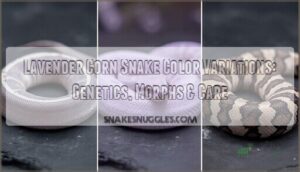
Corn snakes display striking Color Morphs shaped by Color Genetics and Morph Breeding. You’ll find Amelanistic, Snow, and Coral specimens showcasing Pattern Variations that affect Snake Camouflage and Snake Behavior.
Albino morphs lack melanin, producing yellow-orange bodies with red eyes. Snow morphs exhibit reduced black pigment, creating pale peach backgrounds. These variations reflect Genetic Diversity in captive populations and influence your Reptile Care approach and enclosure display decisions.
Understanding web server issues can also impact online research for snake care.
Price: How Much Do Corn Snakes Cost?
Once you’ve chosen your preferred morph, you’ll need to budget accordingly. Hatchling corn snakes generally run $50 to $150, though common pet-grade specimens cost $100 to $200. Premium morphs can exceed $300—albinos and patternless varieties command 20–60% premiums based on genetics and breeder reputation.
Market trends show steady demand with seasonal price spikes. Consider these ownership costs:
- Initial setup expenses range $150 to $300 for complete enclosures
- Annual food and substrate average $60 to $120
- Routine veterinary care adds $100 to $300 yearly
Corn Snakes as Pets: Are They Good Pets?
Beyond the upfront investment, ask yourself whether this reptile suits your lifestyle. Corn snakes make excellent pet snakes for beginners—they tolerate handling well, require minimal socialization, and adapt easily to captive conditions. Their calm temperament and straightforward care demands mean fewer surprises. Pet owner responsibilities include weekly feeding and monthly enclosure maintenance, making ownership manageable for most households. Reptile ownership delivers low-maintenance companionship and the unique benefit of observing natural predatory behavior up close.
| Trait | Beginner Suitability | Care Demand |
|---|---|---|
| Temperament | Docile, rarely defensive | Low stress |
| Feeding | Weekly rodents | Minimal effort |
| Handling | Tolerates routine contact | Moderate frequency |
Corn Snake Lifespan and Size
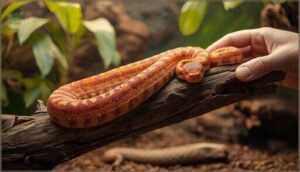
Before you commit to a corn snake, it’s worth knowing what you’re signing up for regarding time and space. These snakes are long-lived companions that grow to a manageable but substantial size.
Here’s what to expect as your snake matures.
Lifespan: How Long Do Corn Snakes Live?
You’re looking at 6–8 years on average for captive corn snakes, though many reach their teens with attentive care. Genetic factors, environmental impact, nutrition effects, and health monitoring all shape longevity—some individuals approach 20 years under exemplary conditions. Wild populations face shorter lifespans due to predation.
Your consistent attention to temperature gradients, humidity, and prompt veterinary care directly influences your reptile’s lifespan, making this care sheet your longevity roadmap.
Size & Weight: How Big Do Corn Snakes Get?
Growth rates in your corn snake depend on consistent heat, prey availability, and enclosure space. Most reach 4–5 feet in length within 2–3 years, with females often exceeding males in weight. Size limits stabilize around adulthood, though outstanding care produces occasional 6-foot individuals.
- Hatchlings measure 12–18 inches by six months
- Adults weigh 150–300 grams at maturity
- Length variations reflect morph and lineage differences
Scaling patterns and health directly influence final dimensions.
Setting Up a Corn Snake Enclosure
Setting up a proper enclosure is the foundation of responsible corn snake care. You’ll need to think about several key components, from the tank itself to the environmental conditions your snake requires to thrive.
Let’s walk through the essential elements that create a safe, comfortable habitat for your corn snake.
Tank Size and Secure Lids
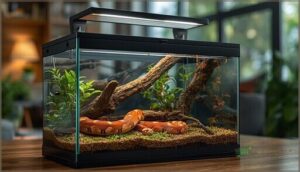
Your corn snake’s enclosure acts as its lifelong home—get the tank requirements wrong, and you’ll be chasing an escaped snake at midnight. Juveniles need 20-40 gallons, while adults thrive in 75-125 gallons. Secure lid security prevents escapes; use locking mechanisms or clips since hatchlings slip through gaps and adults push lids open. Glass terrariums with screened ventilation systems maintain proper airflow while supporting escape prevention and enclosure safety.
| Snake Age | Recommended Tank Setup |
|---|---|
| Hatchling | 10-20 gallons with secure clips |
| Juvenile | 20-40 gallons, expanding as needed |
| Subadult | 40-55 gallons with locking lid |
| Adult | 75-125 gallons, sealed edges |
Temperature and Humidity Requirements
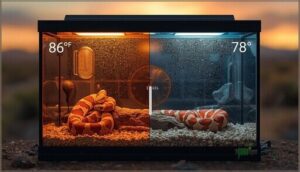
Think of your enclosure as a miniature climate system—temperature control and humidity levels determine whether your corn snake thrives or merely survives.
Maintain these thermal gradients for ideal reptile health:
- Warm side: 84–86°F (29–30°C) for active digestion
- Cool side: 75–80°F (24–27°C) for thermal regulation
- Basking spot: 90–92°F (32–33°C) using regulated heat sources
- Nighttime drop: 70–75°F facilitates natural cycles
- Humidity range: 40–60% with ventilation systems preventing respiratory issues
Monitor with dual thermometers and a hygrometer—accuracy prevents metabolic stress.
Substrate and Environmental Enrichment

Your snake’s foundation influences every aspect of its well-being. Substrate choice, enclosure design, and environmental enrichment shape behavior and health outcomes. Aspen shavings reduce respiratory issues by 40%, while ReptiChip coconut substrate retains humidity 12–18% more effectively than alternatives, supporting consistent shedding. Maintain 2–4 inches depth for burrowing enrichment.
| Substrate Type | Primary Benefit |
|---|---|
| Aspen shavings | Low dust, easy cleaning |
| ReptiChip coconut | Enhanced humidity retention |
| Cypress mulch | Balanced moisture control |
| Cork rounds | Vertical climbing structures |
| Artificial plants | Stress reduction, visual barriers |
Add climbing branches and multiple hides—vertical structures increase activity by 28% while reducing defensive strikes during handling by 83%.
Adding climbing branches and multiple hides reduces defensive strikes by 83% while boosting activity by 28%
Essential Hides and Climbing Features

Your snake needs at least three hiding places—one on each thermal gradient zone—to support proper thermoregulation and stress reduction. Enclosure design matters: studies show snakes with multiple hides spend 21% more time in preferred temperature zones.
Add climbing structures at varied heights to reduce defensive behavior by 28%. This housing approach transforms a basic snake habitat into an environment that promotes natural exploration and security.
Top 4 Essential Corn Snake Products
Once you’ve mapped out your corn snake’s housing needs, it’s time to stock your cart with the right gear. The products you choose directly affect temperature regulation, humidity control, and your snake’s overall comfort.
Below are four items that form the backbone of a well-functioning corn snake setup.
1. Reptile Glass Terrarium Tank Enclosure
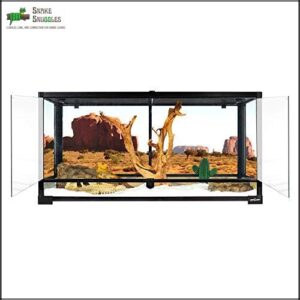
A well-designed glass enclosure forms the foundation of your corn snake’s environment. You’ll want a 40- to 50-gallon terrarium with double-hinged front-opening doors—this design reduces escape risk by more than 90% compared to top-access housing.
Look for screen ventilation systems that enable 5 to 10 air changes per hour, supporting humidity control at the ideal 40–60% range without excessive thermal loss.
Secure clasps and a raised bottom frame improve tank maintenance while accommodating under-tank heating elements essential for proper thermoregulation.
Best For: Corn snake owners who want a spacious, secure setup with front-access doors that make feeding and cleaning easier while keeping escape risk low.
- Double-hinged front doors cut escape risk by over 90% and let you reach in without removing the whole lid
- Screen ventilation keeps airflow steady at 5–10 changes per hour, so humidity stays in the 40–60% sweet spot without losing heat
- Raised bottom frame fits under-tank heaters perfectly and makes it simple to set up the 28–30°C warm side your snake needs
- Side screen panels can make it tricky to hold higher humidity if your room is dry
- Top frame isn’t super sturdy, so heavy lighting fixtures or constant opening might loosen it over time
- Glass panels sometimes arrive with small gaps or uneven edges that need extra sealing to prevent drafts
2. ReptiChip Coconut Reptile Substrate Bedding Block
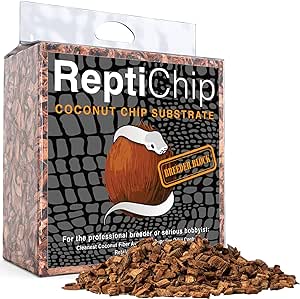
Once you have a secure enclosure, substrate selection determines how well your housing maintains respiratory health and humidity control. ReptiChip coconut bedding offers a bioactive substrate that reduces dust-related irritation by up to 60% compared to pine alternatives.
The compressed brick expands to approximately 10 pounds when hydrated, maintaining 40–60% relative humidity without excessive drift. Controlled studies show this reptile bedding lowers mold growth risk by 25–40%, and its reusable nature cuts annual costs by roughly 20% while providing your snake appropriate burrowing friction.
Best For: Reptile keepers looking for a low-dust, humidity-retaining substrate that supports natural burrowing behavior and reduces mold risk in tropical or semi-tropical setups.
- Reduces respiratory irritation by up to 60% compared to pine substrates thanks to lower dust levels
- Maintains stable 40–60% humidity for healthy shedding while cutting mold growth risk by 25–40%
- Reusable when dried properly, lowering annual substrate costs by around 20%
- Can be dusty during initial expansion, requiring ventilation or a mask
- Higher upfront cost at $34.95 compared to some bulk substrate options
- Requires regular monitoring and maintenance to prevent mold or odor issues if substrate stays too wet
3. Warm Hydroponic Seedling Heat Mat

For better humidity levels and stable temperature control, a warm hydroponic seedling heat mat sits neatly beneath your enclosure, distributing warmth evenly across the substrate. This method mimics the gentle diurnal cycling found in natural habitats and fosters predictable seedling growth in hydroponic systems—or, in your case, healthy snake behavior.
Heat mat safety depends on routine mat maintenance and proper placement, reducing moisture buildup and minimizing electrical concerns. With uniform heat, you can confidently balance your snake’s comfort, health, and environmental needs.
Best For: Indoor gardeners, hydroponic growers, and home hobbyists looking to boost seed germination and maintain stable warmth for delicate starts.
- Precise digital thermostat offers stable temperature control for healthier seedlings.
- Speeds up germination and plant growth compared to ambient conditions.
- Waterproof, durable design adapts well to various uses in humid or wet environments.
- Some users find the heat level lower than expected, staying just slightly warm to the touch.
- Temperature sensor accuracy can vary, especially if not placed correctly.
- Limited to devices under the maximum wattage and amps; not for high-powered appliances.
4. Digital Heat Mat Thermostat Controller

Once you’ve achieved consistent ambient warmth with a heat mat, it’s time to focus on precise Temperature Control using a digital heat mat thermostat controller. This device toggles your mat on and off as needed, guarding against spikes and drops so your snake habitat remains steadfast.
Careful Controller Calibration means you avoid overheating and maintain ideal Humidity Levels. Energy Efficiency improves, too, as the thermostat powers equipment only when necessary.
Reliable Thermostat Settings directly safeguard Reptile Health and make your Heat Mat Safety easy.
Best For: Snake owners, reptile enthusiasts, and hobbyists who want reliable, hands-off temperature control for heat mats in small enclosures.
- Consistently keeps temperatures in a safe range for reptiles, reducing spikes and drops.
- Saves energy by turning heating equipment on only when necessary, helping cut electricity costs.
- Works with most heat mats and lets you easily choose between Celsius and Fahrenheit readings.
- Not a proportional thermostat—temperature can swing above and below the set point before turning on or off.
- Not suited for applications needing tight, ultra-precise temperature control.
- Shouldn’t get wet and can give error warnings if the sensor isn’t placed correctly or fails.
Feeding and Nutrition for Corn Snakes
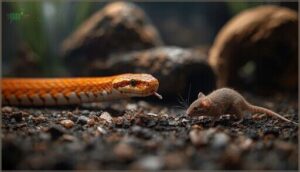
Feeding your corn snake isn’t just about dropping a mouse in its enclosure and calling it a day. There’s a little more to getting their nutrition right, especially as they grow and change.
Here’s what you need to know to set them up with a healthy, balanced diet.
What is The Corn Snake Diet?
If you picture a corn snake’s diet in the wild, imagine it quietly hunting rodents, small birds, or even the occasional frog. In captivity, Feeding Corn Snakes centers around offering frozen-thawed mice.
This approach aligns with ideal Feeding Habits and Prey Selection, meets core Nutrient Requirements, and lessens injury risk—making it fundamental to responsible Snake Feeding and Nutrition.
How to Feed Your Corn Snake Based on Age
Understanding Feeding Schedules is essential—each life stage demands its own approach for ideal Snake Nutrition. Age Based Diets play a significant role in Feeding Corn Snakes successfully.
- Hatchlings: eat frequently, usually every 5–7 days.
- Juveniles: shift to weekly Feeding Techniques.
- Adults: shift to a Corn Snake Diet of prey offered every 7–14 days.
Tailor prey and routine as your snake grows.
Prey Size and Frequency Guidelines
Properly sizing prey to your corn snake’s girth is one of the most effective Feeding Techniques you’ll master. Prey Size Limits recommend items measuring 1–1.5 times mid-body width for safe Meal Portioning.
Feeding Frequency shifts with age: hatchlings need meals every 5–7 days, juveniles every 7–10 days, and adults every 10–14 days.
Growth Monitoring helps you adjust portions and maintain ideal Reptile Nutrition.
How to Thaw Frozen Prey
Safe Thawing Methods keep your corn snake healthy by reducing bacterial risk and regurgitation. Never microwave frozen prey—it creates hot spots that harm reptile nutrition and prey safety.
Always verify prey reaches near room temperature before feeding your corn snake.
- Water-bath thawing: submerge prey in 40–41°C water for 15–45 minutes to guarantee uniform temperature control.
- Refrigerator method: thaw over 12–24 hours for gradual, safe defrosting.
- Warm-water rinse: accelerate thawing without overheating.
Calcium and Vitamin Supplements
Did you know too much of a good thing—like vitamins—can harm your snake as much as too little? In corn snake care, obsessing over calcium isn’t the answer, but neither is skipping it altogether. Get your Supplement Timing, Dosage Control, and Nutrient Balance right to avoid Calcium Deficiency or Vitamin Toxicity and build Reptile Health that lasts.
| Supplement | Frequency |
|---|---|
| Calcium (Juvenile) | Daily |
| Calcium (Adult) | 2–3 times per week |
| Vitamin D3 | Only if no UVB exposure |
| Multivitamin | Rare, vet guidance |
| Record Dosage | Always note schedule |
Health and Hygiene for Corn Snakes
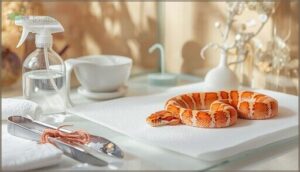
Keeping your corn snake healthy starts with good hygiene and attention to everyday care. There are a few key routines you’ll want to follow to prevent common problems.
Here’s what you should focus on for a safe and clean environment.
Common Health Issues and Prevention
Think of your corn snake’s health as a balancing act—ventilation and hygiene tip the scale in your favor. Respiratory issues, scale rot, and inflammatory diseases often stem from dirty enclosures or poor conditions.
Regular cleaning and careful monitoring prevent most health concerns. Don’t let mild symptoms slide; prompt veterinary care ensures peak reptile health and wellness throughout your pet’s life.
Shedding Problems and Dysecdysis
If you spot patches of old skin stuck to your corn snake, you’re facing classic Shedding Issues—and humidity control is often at fault. Molting Difficulties like dysecdysis trigger skin problems and anxiety for both you and the snake. To stay ahead of these challenges:
- Maintain humidity at 50–70%
- Offer a moist hide
- Check for retained eyecaps
- Clean substrate regularly
Signs of Illness and When to Call a Vet
When persistent shedding problems crop up, it’s time to focus on broader Health Monitoring. Watch closely for Respiratory Issues—like wheezing or nasal discharge—or Dysecdysis Symptoms that just won’t clear.
Refusal to eat, sudden lethargy, visible swelling, or lasting mouth crust signal Emergency Signs. Don’t hesitate to seek Veterinary Care for Reptile Health and Hygiene if concerns linger.
Cleaning and Disinfecting The Enclosure
After spotting signs of illness, bring your attention to enclosure hygiene. Reliable cleaning schedules and the right Sanitizing Methods keep bacterial threats at bay. Use reptile-safe Disinfectant Types and mind your routine.
- Wash hides and décor with soap and water, and air-dry.
- Replace soil-based substrate monthly.
- Wipe corners with a soft brush.
- Let everything dry fully before reassembling.
Handling and Behavior Tips
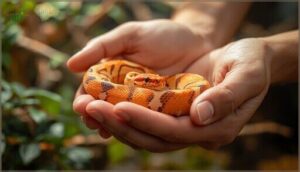
Handling your corn snake should feel calm and predictable, not stressful for either of you. Every interaction shapes their behavior and comfort around people.
Here’s what you need to know for safe and confident handling.
Safe and Stress-Free Handling Techniques
You can reduce handling stress by at least 60% with a secure, calm approach. Support both the snake’s head and body during contact—never restrain forcefully. Keep sessions brief, around one to two minutes initially.
Wash your hands before and after to minimize residue transfer. A gentle approach in calm environments trains your corn snake to tolerate animal handling confidently over time.
General Behavior and Temperament
Corn snakes display calm temperament types with minimal aggression when properly socialized. Behavioral patterns shift from exploratory in juveniles to more sedentary in adults. Stress signals include elevated breathing, persistent escape attempts, and defensive coiling—indicators requiring enclosure adjustments.
Regular handling techniques from youth build cooperative corn snake behavior and psychology, while predictable routines reduce fear responses. Understanding animal behavior and psychology transforms routine care into successful long-term snake handling and behavior management.
Handling During Shedding and After Feeding
During the shedding process, you’ll notice reduced appetite and cloudy eye scales—signs your snake needs minimal handling until molting completes.
Post feeding, wait at least 24 hours before snake handling to prevent regurgitation and unnecessary snake stress.
Your feeding schedule should align with these handling tips: healthy snakes resume normal activity within 48 hours after feeding, signaling readiness for interaction.
Prioritizing shedding and feeding windows protects snake health.
Reducing Stress and Preventing Bites
Consistency in your approach transforms interactions with your corn snake. Regular, gentle handling sessions reduce defensive bites by up to 60% within eight weeks, while scheduled feeding times and enrichment activities lower stress-related aggression by 28–35%.
Effective calming methods include:
- Approaching from the side to minimize perceived threats
- Maintaining stable temperatures and humidity for reduced cortisol levels
- Providing climbing branches and multiple hides for security
- Monitoring health concerns like dysecdysis that trigger pain-driven bites
Bite prevention relies on predictable routines and environmental enrichment.
Monitoring Corn Snake Wellness
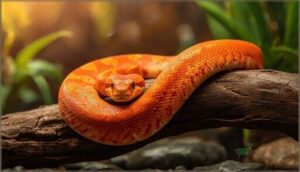
Keeping your corn snake healthy means knowing what normal looks like and catching problems early. A well-cared-for snake will show clear signs of wellness, from its appearance to its eating habits.
Let’s walk through the key indicators you should monitor regularly and when professional care becomes necessary.
Recognizing Healthy Appearance
A healthy corn snake shows clear, bright eyes, smooth skin with intact scales, and consistent coloration across its body. Approximately 85% of snakes in routine health checks display these characteristics.
Monitor these key indicators weekly:
| Health Indicator | What to Look For |
|---|---|
| Skin Condition | Smooth, free of lesions or flaking |
| Eye Brightness | Clear, rounded pupils when alert |
| Scale Health | Intact, uniform appearance |
| Shedding Cycles | Complete shed in one piece |
Regular observation helps you catch potential health concerns early.
Eating Problems and Solutions
Even with the best care sheet and feeding guidelines in place, about 28% of captive corn snakes show intermittent feeding refusal. This appetite disruption can stem from temperature issues, prey selection mismatches, or underlying health concerns like digestive issues and nutrient deficiencies.
Address feeding problems with these proven strategies:
- Verify temperatures – Basking zones below 28–C increase refusal rates by up to 12%.
- Adjust prey selection – Confirm frozen-thawed prey matches 20–30% of your snake’s girth to reduce regurgitation risk.
- Monitor shedding cycles – Approximately 15% of individuals naturally pause diet intake before shedding; appetite stimulation attempts during this period often fail.
Document feeding behavior weekly to catch health trends early.
Annual Veterinary Checkups
Annual veterinary checkups form the cornerstone of preventative measures for your corn snake’s long-term health. Schedule at least one exam yearly—more frequently during the first three years of growth.
Your veterinarian will conduct diagnostic tests, including fecal parasitology and body condition scoring, building a medical history that catches internal parasites affecting up to 40% of captive snakes before symptoms emerge.
Frequently Asked Questions (FAQs)
Can corn snakes live together in one tank?
While it’s technically possible, housing corn snakes together isn’t recommended. Multi-snake enclosures often trigger stress, territorial disputes, and feeding competition.
For ideal reptile welfare, single-snake housing prevents co-housing complications and ensures better tank mate compatibility.
Do corn snakes need UVB lighting?
While corn snakes don’t strictly require UVB lighting, providing it aids calcium metabolism and overall health—especially for juveniles. UVB benefits include improved skeletal development, though dietary calcium supplements and proper housing can serve as UVB alternatives.
How often should I change the water?
Fresh water daily keeps your corn snake hydrated and healthy. Replace it at least once every 24 hours, or immediately if contaminated, to maintain ideal water quality and support proper humidity control in the enclosure.
What sounds or noises do corn snakes make?
You’ll mainly hear defensive hissing when your corn snake feels threatened, reaching frequencies around 5–0 kHz. Tail vibrations mimic rattlesnakes but produce minimal auditory cues—vocal communication isn’t their primary behavior.
Can corn snakes swim or enjoy water?
Yes, corn snakes can swim—though they’re not aquatic by nature. They’ll occasionally soak in shallow water for hydration or during shedding cycles.
Proper water quality and enclosure humidity prevent stress-related swimming behavior and maintain snake health.
Conclusion
Corn snakes demand minimal effort yet reward careful scrutiny—that’s the paradox defining successful long-term care. Your corn snake basic care guide ultimately hinges on consistency: maintaining stable temperatures, sizing prey correctly, and recognizing subtle behavioral shifts before they escalate into health crises.
These fundamentals aren’t negotiable shortcuts but rather the framework separating decades of thriving companionship from preventable suffering. Get the essentials right initially, and everything else falls into place naturally.
- https://reptile-database.reptarium.cz/species?genus=Pantherophis&species=guttatus
- https://www.virginiaherpetologicalsociety.com/reptiles/snakes/corn-snake/
- https://journals.biologists.com/jeb/article/218/14/2279/14389/Snake-constriction-rapidly-induces-circulatory
- https://image.petmd.com/files/2024-12/1730300-24-10-PMD-CornSnakeCareSheet.pdf?VersionId=C85M2VWn84MucQ1nerMeMYFQ3gfu0JZS?utm_source=petmd.com&utm_campaign=caresheet&utm_medium=PDF
- https://www.ncbi.nlm.nih.gov/books/NBK481583/