This site is supported by our readers. We may earn a commission, at no cost to you, if you purchase through links.
Most corn snake keepers obsess over feeding schedules and handling routines, but lighting quietly drives everything from digestion to shedding cycles.
Wild corn snakes in the southeastern U.S. experience 10–14 hours of natural sunlight daily, including UV exposure that captive setups rarely replicate.
Get the lighting wrong, and your snake may eat fine for months before stress and metabolic strain show up—by then, damage is already done.
A well-designed corn snake lighting setup guide cuts through the guesswork with exact measurements, proven equipment, and a configuration sequence that mirrors what these snakes actually need to thrive.
Table Of Contents
- Key Takeaways
- Choosing The Right Lighting Equipment
- Establishing a Proper Lighting Schedule
- Setting Up Lighting in The Enclosure
- Monitoring Temperature and Humidity Levels
- Preventing Health Issues With Proper Lighting
- Frequently Asked Questions (FAQs)
- Can corn snakes see and react to colored lights?
- How does lighting affect corn snake breeding cycles?
- What lighting adjustments are needed for juvenile snakes?
- Does lighting impact shedding frequency in corn snakes?
- Can corn snakes see colors in their enclosure?
- How does lighting change after a corn snake sheds?
- Conclusion
Key Takeaways
- Lighting drives digestion, shedding, and hormone cycles in corn snakes, so getting it wrong causes internal damage long before visible symptoms appear.
- A T5 HO UVB tube (Zoo Med Reptisun 5.0 or Arcadia Forest 6%) mounted 12–16 inches above the basking site, paired with a 50–75W halogen flood at 85–90°F, gives your snake the UV and heat overlap it actually needs.
- Lock your photoperiod to a consistent 12-on/12-off cycle using a digital timer, and shift it one hour seasonally—13 hours in summer, 11 in winter—to keep feeding, shedding, and breeding cues on track.
- Lethargy lasting 12+ hours two or more skipped meals, and 18+ hours spent hiding are your clearest early signals that the lighting setup is failing your snake.
Choosing The Right Lighting Equipment
Getting your corn snake’s lighting right starts with choosing reliable equipment. There are a few key options to evaluate for UVB, basking, and heat. Let’s look at what works best for safe and healthy enclosures.
Understanding how your snake reacts to different light conditions also helps, so brushing up on corn snake body language signs can tell you a lot about whether your setup is working.
Best UVB Bulbs for Corn Snakes
When you’re serious about Corn Snake care, the right UVB lighting isn’t optional—it’s foundational.
For consistent UVB intensity and cost efficiency, stick with T5 HO tubes: Zoo Med Reptisun 5.0 or Arcadia Forest 6%. These brands outperform off‑label options in both bulb lifespan and safety.
Mounting distance matters: place your bulb 12–16 inches above the basking site for ideal UVB exposure.
Here’s what you need to track:
- Brand comparison and UVB intensity
- Bulb lifespan
- Mounting distance
Crested Geckos fall into Ferguson Zone 1, which highlights low‑level UVB needs for nocturnal reptiles.
Basking and Ambient Light Options
UVB bulbs handle the ultraviolet side, but your lighting setup still needs two more layers working together.
For the basking surface, a white basking bulb in a reflective dome fixture focuses heat downward and holds that 85–90°F sweet spot efficiently. Halogen flood bulbs at 50–75W mounted 8–12 inches above the platform work well here. Colored bulbs distort day‑night cues — don’t use them.
For ambient lighting, LED ambient strips with a daylight color temperature around 6000–7000K fill the enclosure with natural‑looking light without adding unwanted heat, supporting both your snake’s behavioral rhythms and any live plants.
Safe Heat Sources for Enclosures
Heat lamps and basking surface warmth only get you so far.
Under Tank Heaters covered by 2 inches of aspen substrate deliver steady belly heat without hot spots.
Ceramic Heat Emitters and Radiant Panels work overhead for overnight ambient warmth.
A Deep Projector suits larger enclosures well.
Whatever you choose, always pair it with a Proportional Thermostat — your complete Heating Guide starts with stable, controlled temperatures, not guesswork.
Establishing a Proper Lighting Schedule
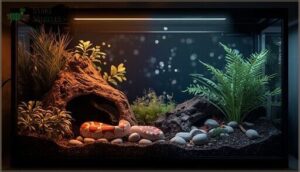
Getting the lighting schedule right is just as important as picking the right bulbs.
Pairing your schedule with the right tools—like humidity gauges designed for reptile incubators—ensures every environmental variable stays dialed in around the clock.
Corn snakes are crepuscular, so their bodies are wired to follow a consistent light-dark rhythm — and disrupting that rhythm throws off everything from appetite to shedding.
Here’s what a solid schedule actually looks like.
Recommended Day/night Cycles
A stable lighting cycle is the backbone of a healthy corn snake setup. Aim for exactly 12 hours on and 12 hours off — photoperiod consistency matters more than most keepers realize. Set your timer for a window like 8 AM to 8 PM, and let it run the same way every day.
- Circadian rhythms stabilize feeding and shedding patterns
- Light duration effects influence activity levels at dawn‑dusk transitions
- A fixed day/night cycle reduces stress and hiding behavior
- Timer automation keeps the photoperiod steady even when you’re away
Seasonal Lighting Adjustments
Nature doesn’t run on a fixed 12-hour clock year‑round — and neither should your corn snake’s enclosure.
Extend the light cycle to 13 hours in summer and drop to 11 hours in winter.
These photoperiod shifts trigger hormonal rhythm changes that regulate behavioral changes, appetite, and shedding.
Gradually adjust UVB seasonal levels and heat lamp wattage alongside each photoperiod change to maintain a healthy temperature gradient and support natural circadian rhythms.
A proper enclosure should meet the minimum enclosure size guidelines to guarantee comfort.
Using Timers for Consistency
Manual switching is where photoperiods fall apart — one missed flip and your corn snake’s circadian rhythms take the hit.
Digital timer programming solves this cleanly: set a 7 AM to 7 PM day/night cycle, plug your UVB light and basking lamp into separate outlets, and let the timer run it. Choose a moisture-safe placement outside the enclosure, check battery backup reliability annually, and follow a simple timer maintenance schedule every three to five years.
Setting Up Lighting in The Enclosure
Getting the physical setup right is where all your planning finally becomes real.
How you position your lights and arrange your heat sources have a direct impact on your snake’s daily comfort and long‑term health. Here’s what you need to get right before you flip the switch.
Positioning UVB and Basking Lights
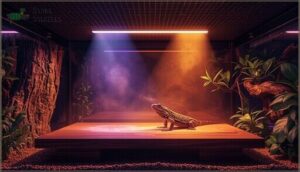
Think of your lighting setup as building a sun patch your corn snake can actually navigate. The goal is getting UVB and heat to overlap at the same warm end, not scatter randomly across the enclosure.
For a standard 4 × 2 × 2 corn snake habitat setup, mount your T5 HO UVB tube so the basking surface sits 12–16 inches below it — that’s your target UVB distance for a safe UVI of 2.0–3.0. Set your basking light at roughly 6–8 inches above the platform.
Key positioning rules for reptile lighting and heating:
- Align both fixtures over the warm end so heat and UVB overlap
- Account for screen transmission — mesh blocks 30–40% of UVB output
- Keep climbing branches 15 cm from any bulb
- Verify basking height using a Solarmeter 6.5
- Create multiple light zones by running UVB across half the enclosure length
Never guess distances. Measure them.
Ensuring Light and Heat Gradients
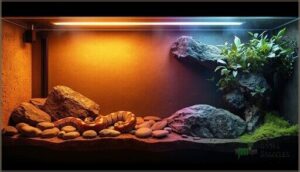
A solid temperature gradient isn’t optional — it’s how your corn snake decides where to digest, rest, and move throughout the day. For reptile lighting and heating to work correctly, all heat sources and UVB light must concentrate at one end, with cool shading on the opposite side.
Your target numbers: basking placement surface at 88–90°F, warm-side ambient temperature around 78–82°F, and a cool zone holding steady at 75–80°F. That 15°F difference across the floor gives your snake real thermoregulation control.
For UVB mapping, target a UVI of 2.0–3.0 at basking height — lower for albinos. Verify heat distance with a digital probe thermometer and your Solarmeter 6.5 for the vertical gradient.
Avoiding Common Installation Mistakes
Even small misstep in your lighting setup can quietly work against everything else you’ve built. Keep UVB lighting at least 11–13 inches above mesh — closer risks skin burns.
Never mount bulbs over glass; it blocks nearly all UVB output. Route wiring outside the enclosure using lid clips. Check reflector alignment monthly, and always run heat lamps and ceramic heat emitters through a thermostat.
Monitoring Temperature and Humidity Levels
Getting the temperature and humidity right is just as important as the lighting itself. Even a perfectly placed UVB bulb won’t do much good if the thermal gradient is off or the air is too dry.
Here are the key numbers and tools you need to keep everything in check.
Ideal Basking and Cool Zone Temperatures
Your enclosure’s temperature gradient range does the heavy lifting for your snake’s health. Set your basking spot placement to hit 88°F–92°F using halogen basking light or ceramic heat emitters — never guesswork. Cool zone substrate should rest at 75°F–82°F.
- Basking spot: 88°F–92°F for digestion
- Warm ambient: 80°F–85°F
- Cool zone: 75°F–82°F
- Nighttime drop effects: 65°F–72°F helps adult circadian rhythm
- Juvenile temperature needs: keep minimums above 75°F overnight
Humidity Range for Healthy Corn Snakes
Ideal humidity for corn snakes sits between 40% and 60% — that moderate band is your daily target for solid reptile husbandry.
Drop below 35% and you’ll see incomplete sheds and flaky skin.
Push above 70% for more than a few days and high‑humidity risks climb fast: scale rot, bacterial growth, respiratory infections.
During shedding, nudge shedding humidity to 60–70% using a humid hide packed with damp sphagnum moss, giving your snake a microclimate zone to retreat into without soaking the whole enclosure.
Tools for Accurate Measurement
Keeping those humidity levels dialed in means nothing without the right tools to verify them. Here’s what actually works:
- Infrared Thermometer — Point the Etekcity 774 at basking surfaces for instant, contact‑free temperature control checks.
- Infrared Probe Thermometer — Zoo Med’s digital probe manages precise probe placement in both warm and cool zones.
- Thermostat — Herpstat 1 with proportional control prevents overheating at the warm end.
- Hygrometer Accuracy — NEOREP’s digital unit logs max‑min humidity levels with ±2% reliability.
- UVB Calibration — Solarmeter 6.5R confirms your UVI stays between 2.0–3.0 at basking height.
Pair these for full temperature and humidity control, and recalibrate every six months.
Preventing Health Issues With Proper Lighting
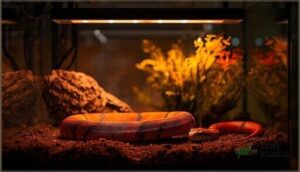
Good lighting does more than brighten an enclosure — it directly shapes your corn snake’s health from the inside out.
Get it wrong, and you’ll start seeing subtle warning signs that are easy to miss until real damage is done.
Here are the key health areas where proper lighting makes all the difference.
Reducing Stress and Supporting Natural Behavior
Matching corn snake’s light cycles to its crepuscular nature cuts stress fast. Dawn and dusk dimming with low-intensity 6000–7000K LEDs signals safe foraging time. Red light avoidance matters — corn snakes see red wavelengths fully, causing chronic stress.
| Strategy | Benefit |
|---|---|
| UVI Gradient Design (0–3.0) | Provides cryptic UVB basking choice |
| Hide Placement Strategy (both sides) | Reduces open-space anxiety |
| Crepuscular Simulation schedule | Regulates circadian rhythms naturally |
Preventing Metabolic Bone Disease
Good UVB dosage does more than regulate behavior — it’s your corn snake’s front-line defense against metabolic bone disease. Without reptile lighting that drives vitamin D3 supplementation, calcium absorption stalls regardless of dietary balance. A T5 HO 5.0 UVB tube spanning half the enclosure delivers reliable snake health benefits without overdosing.
Without proper UVB lighting, even a perfect diet cannot prevent metabolic bone disease in corn snakes
- Maintain UVI 2.0–3.0 at the basking light zone
- Dust feeders with calcium supplementation powder 2–3 times weekly
- Practice gut loading with dandelion greens 24–48 hours before feeding
- Replace UVB lighting tubes every 6–12 months
Signs of Improper Lighting in Corn Snakes
Your corn snake’s behavior is the most honest report card you’ll ever get on your lighting setup.
Lethargy symptoms, appetite decline, and excessive hiding all signal something’s off. Watch for these warning signs:
| Sign | Behavior | Likely Cause |
|---|---|---|
| Lethargy Symptoms | Motionless 12+ hours daily | Disrupted day-night cycle |
| Appetite Decline | Refusing 2+ consecutive meals | Circadian rhythm disruption |
| Excessive Hiding | 18+ hours in hides | Light intensity or spectrum mismatch |
| Nocturnal Disruption | Active past midnight | Colored or red night bulbs |
| Vision Problems | Eye rubbing, hesitant strikes | UVB overexposure or spectrum imbalance |
Catching these signs of improper lighting early protects your corn snake’s long-term reptile health.
Frequently Asked Questions (FAQs)
Can corn snakes see and react to colored lights?
Yes, corn snakes can see and react to colored lights.
Their UV sensitivity spans into the ultraviolet range, and exposure to blue or red light triggers clear behavioral cues like hiding and reduced activity.
How does lighting affect corn snake breeding cycles?
Ever wonder why corn snake seems restless in spring? Photoperiod hormones drive that.
Light cycles regulate circadian rhythm, gonadal development, and UVB seasonal influence — making reptile lighting central to successful photoperiod synchronization and light-induced brumation.
What lighting adjustments are needed for juvenile snakes?
Juveniles need UVB intensity targeting UVI 2–3, with lamp distance around 10–14 inches using a T5 HO Keep basking spot at 88–92°F and nighttime lighting off, never below 75°F.
Does lighting impact shedding frequency in corn snakes?
lighting directly impacts shedding frequency. Photoperiod effects regulate your corn snake’s circadian rhythm, influencing how often and how cleanly it sheds.
UVB intensity and seasonal light shifts keep cycles predictable and stress‑induced shedding problems minimal.
Can corn snakes see colors in their enclosure?
Corn snakes have dichromatic color perception, detecting UV spectrum visibility around 361 nm and longer wavelengths near 550 nm.
Substrate hues, visual enrichment, and proper UVB lighting all support natural cone sensitivity and animal behavior.
How does lighting change after a corn snake sheds?
After a shed, no lighting changes are needed — your setup’s already doing its job.
Post‑shed eye clarity returns, scale color vibrancy peaks, and behavioral activity boost kicks in under your existing UVB lighting and photoperiod.
Conclusion
Most keepers assume their corn snake is thriving simply because it’s eating—but a full belly doesn’t mean a healthy nervous system or properly cycling hormones.
Following this corn snake lighting setup guide challenges that assumption directly.
Light isn’t just visibility; it’s the biological clock your snake runs on.
Dial in the UVB output, lock your timer to a consistent cycle, and the results show up where it matters: clean sheds, active behavior, and genuine long‑term health.
- https://reptifiles.com/corn-snake-care-guide/corn-snake-temperatures-humidity/
- https://exoticdirect.co.uk/news/corn-snake-set-up-advice/
- https://www.thebiodude.com/blogs/snake-caresheets/care-guidelines-for-corn-snakes
- https://www.zenhabitats.com/blogs/reptile-care-sheets-resources/corn-snake-complete-lighting-and-heating-guide
- https://www.cttlight.com/post/do-snakes-need-uvb-evidence-guide