This site is supported by our readers. We may earn a commission, at no cost to you, if you purchase through links.
Your corn snake never speaks, but it talks to you every time you open the enclosure. A tail tremor, a tightened coil, a slow tongue flick: each one carries a message.
Corn snake body language tells you whether your pet feels safe, stressed, or sick. Miss the signals and you risk bites, refused meals, and a snake that dreads your hands. Read them well and handling gets easier, health problems surface early, and your setup improves.
You’ll learn to spot a relaxed snake, catch stress before it escalates, and fix the habitat problems behind it.
Table Of Contents
- Key Takeaways
- Corn Snake Body Language: Relaxed Posture, Movement, and Tongue Flicking
- Corn Snake Stress Signals: Tight Coils, Hissing, and Tail Shaking
- How to Respond to Your Corn Snake’s Body Language During Handling
- When Changes in Corn Snake Behavior May Signal Illness or a Habitat Problem
- Top 6 Corn Snake Habitat Products for Natural Behavior
- Frequently Asked Questions (FAQs)
- How do you know if a corn snake is happy?
- Can corn snakes bond with humans?
- How to tell if a corn snake is angry?
- How to tell if a corn snake trusts you?
- How to tell if your corn snake likes you?
- How to tell if a corn snake is stressed?
- What does it mean when a corn snake stares at you?
- How to tell if a corn snake is ill?
- How do I know if my corn snake is happy?
- How to tell if a snake is comfortable with you?
- Conclusion
Key Takeaways
- A relaxed corn snake lies low in loose curves with its head level, glides slowly, and flicks its tongue at a steady pace, so you can use that calm baseline to spot when something’s off.
- Tight coils, hissing, and tail shaking mean your snake wants less pressure, so support its whole body, back off, and keep handling to two or three short sessions a week.
- If odd behavior continues after you handle it more gently, check your enclosure’s temperature gradient, humidity, and hides first, since poor heat control is a common hidden cause of hiding and listlessness.
- Open-mouth breathing, mucus, weeks of refusing food, or constant lethargy point to illness, so book a reptile vet visit quickly rather than waiting.
Corn Snake Body Language: Relaxed Posture, Movement, and Tongue Flicking
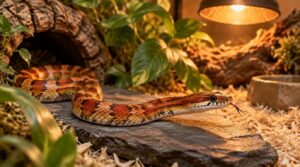
When you understand corn snake body language, you stop guessing and start reading your pet accurately. A calm snake shows it through relaxed posture. Its body lies low and straight, or in loose, even curves. The head stays level and slightly raised, and the scales look smooth.
Since corn snakes are most active at dawn and dusk, these corn snake behavior patterns can help you tell normal evening roaming from stress.
Watch its movement next. A comfortable corn snake glides slowly across the enclosure, pausing near warm spots without tension. Its body undulates evenly, with no tight squeezing or frantic thrashing.
Tongue flicking tells you the most. Steady, measured flicks mean your snake is sampling scents in its familiar space. They’re paired with calm eyes and easy breathing, never jerky snaps. Learn these behavioral cues, and you’ll know when your snake feels safe.
Corn Snake Stress Signals: Tight Coils, Hissing, and Tail Shaking
Calm posture is only half of body language interpretation. Corn snake stress signals show up when that easy glide turns rigid, and spotting them early keeps both of you safe.
Tight coils come first. A stressed snake wraps itself snugly to feel secure, then stays put. You may see small shimmies between the loops. Heat makes this worse, so check that your enclosure isn’t running past its preferred range. A digital thermometer and hygrometer lets you track warm-side temperatures and humidity at a glance, so overheating never goes unnoticed.
Hissing comes next. It gets longer and louder as handling pressure rises, and it often starts when your grip tightens around midbody.
Tail shaking is a rapid tremor. You’ll see it when your snake feels restrained or expects to be picked up. Low hides and cramped space can trigger it too.
If the shaking continues after you put your snake down, this guide to corn snake handling and body language can help you tell nervousness from simple curiosity.
How to Respond to Your Corn Snake’s Body Language During Handling
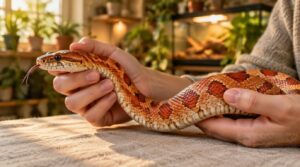
Once you spot those stress indicators, your next move matters. Tight coils, hissing, and a trembling tail all mean the same thing: your snake wants less pressure.
When your snake coils tightly, hisses, or trembles its tail, it’s asking you for less pressure, so listen and ease off
Start with handling safety and use a two-point hold, with one hand at the neck and one at midbody:
- Lower your hands toward a surface if your snake arches away.
- Switch to a cupped grip around the torso to cut squeeze.
- Support the whole body so no section dangles or pinches.
- Pause for 10 to 15 seconds after every adjustment.
If defensive behavior continues, return your snake to its enclosure and try again tomorrow. Keep sessions short, and don’t push handling frequency past two or three times weekly. Trust building takes real patience. A corn snake enclosure with hides gives your snake a secure retreat after handling, which helps it recover and feel calmer next time.
Since every snake has its own temperament, it helps to understand young ball python personality and behavior so you can tell shyness from genuine stress.
When Changes in Corn Snake Behavior May Signal Illness or a Habitat Problem
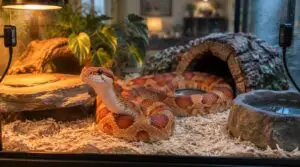
Stress indicators fade when you back off. Health warning signs don’t. If your corn snake keeps acting off after gentler handling, look at the bigger picture.
Persistent behavioral changes usually point to either illness or habitat problems. Check these first: A reliable reptile habitat thermostat keeps your heat lamp from drifting, which is often the quiet culprit behind a hiding, listless corn snake.
| Sign | Likely cause | Your move |
|---|---|---|
| Mouth breathing, mucus | Respiratory issues | See a vet |
| Hiding, no exploring | Wrong temperatures | Check the gradient |
| Refusing food, lethargy | Illness | Book a vet visit |
Warm one end of the enclosure and keep the other cooler. A snake that avoids heat or basks nonstop is telling you the temperatures are wrong. Damp, soiled substrate and open, hideless setups add stress and irritate skin too.
Labored breathing, twisting, or repeated stumbling needs a reptile vet right now.
Top 6 Corn Snake Habitat Products for Natural Behavior
Your corn snake’s habitat shapes how it moves, hides, and explores. The right heat and substrate setup lets your snake act on its natural instincts. Here are six products that help you build that setup, from lamps and bulbs to burrowing-friendly bedding.
1. Zoo Med Deep Dome Lamp Large
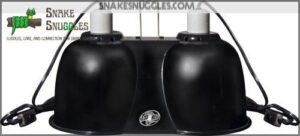
Can’t read your corn snake clearly in a dim tank? Good lighting fixes that.
The Zoo Med Deep Dome Lamp Large gives your habitat setup a focused basking area. It fits standard reptile bulbs up to roughly 75 to 100 watts, depending on the reflector. Use a reflector bulb, since non-reflective bulbs heat unevenly.
Start the lamp 12 inches up, then adjust until the basking spot hits 90 to 95°F. Keep the opposite side cooler for a temperature gradient. Add a UVB lighting tube and thermostat.
| Key Ingredients | N/A |
|---|---|
| Burrowing Support | N/A |
| Bioactive Use | N/A |
| Moisture Handling | N/A |
| Substrate Depth | N/A |
| Debris Risk | N/A |
2. Zoo Med Reptisoil Blend
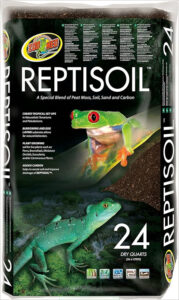
A good substrate gives your corn snake something to burrow into, and Zoo Med Reptisoil Mix does that well. It mixes peat moss, soil, sand, and a coconut carbon mix that helps beneficial bacteria thrive and helps cut persistent odors. Add water to dampen it, then pack it deep enough for tunneling.
If you’re unsure how often to refresh the bedding, this guide to replacing snake cage substrate explains when and why a full change matters.
Watch closely how your snake moves through it. Steady, unhurried digging is a good sign. Before you pour, pick out any sharp wood or stone fragments, and always rinse your hands afterward.
| Best For | Keepers of tropical lizards, amphibians, box turtles, hermit crabs, or tarantulas who want a burrowing-friendly substrate that also works in bioactive setups. |
|---|---|
| Key Ingredients | Peat moss, soil, sand, coconut carbon |
| Burrowing Support | Yes, packed deep for tunneling |
| Bioactive Use | Works in bioactive terrariums and paludariums |
| Moisture Handling | Dampen with water before use |
| Substrate Depth | Deep enough for tunneling |
| Debris Risk | Sharp wood or stone fragments |
| Additional Features |
|
- Coconut carbon helps beneficial bacteria colonize and reduces persistent odors.
- Peat moss, soil, sand, and carbon blend supports burrowing and egg-laying and also helps plants grow in bioactive terrariums and paludariums.
- Works for a wide range of animals, including reptiles and invertebrates.
- May contain sharp wood or stone fragments that need to be picked out.
- Some users report having to remove large chunks before use.
- Leaves residue, so hands need to be rinsed after handling.
3. Zilla Pet Reptile Terrarium Substrate
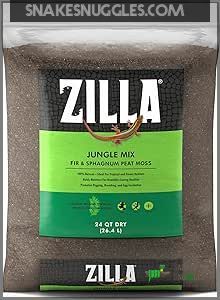
Picture a forest floor after rain: dark, springy, faintly sweet with bark. That’s the feel Zilla Pet Reptile Terrarium Substrate brings to your corn snake’s enclosure.
It blends aged Douglas fir bark with sphagnum peat moss, so it holds humidity and lets your snake dig and burrow. Spread it 1 to 2 inches deep. Spot-clean waste daily, and replace the whole bed monthly or whenever it gets soiled or soggy.
Watch for tiny splinters. They can irritate your skin during handling, and some keepers report scale damage. Check your snake’s belly after each shed. A calm, burrowing snake usually means the bedding works.
| Best For | Keepers of tropical and forest-dwelling reptiles and amphibians, such as frogs, rainforest geckos, toads, and humidity-loving snakes, who want a natural, burrow-friendly substrate for their enclosures. |
|---|---|
| Key Ingredients | Douglas fir bark, sphagnum peat moss |
| Burrowing Support | Yes, encourages digging and burrowing |
| Bioactive Use | Supports live plants and microfauna |
| Moisture Handling | Holds humidity well |
| Substrate Depth | 1 to 2 inches |
| Debris Risk | Tiny splinters, possible scale damage |
| Additional Features |
|
- Made from 100% organic aged Douglas fir bark and sphagnum peat moss, it holds humidity well for both animals and plants.
- Encourages natural behaviors like digging, nesting, breeding, and egg incubation.
- Supports live plants and beneficial microfauna, making it a good fit for bioactive setups.
- Can produce tiny splinters that may irritate your skin when handling it.
- Some keepers report it may damage snake scales.
- Needs to be replaced monthly, or sooner if it gets soiled or too wet.
4. Philips 90W Halogen Flood Light Bulb
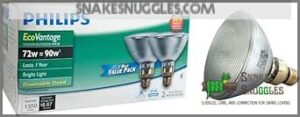
Say your corn snake keeps pressing against the cool-side glass, tongue flicking, never settling near the lamp. That’s often a basking problem, and a halogen flood can fix it.
This PAR38 bulb throws a 25-degree beam that creates a defined basking spot over the warm side. Because it’s dimmable, you can pair it with a thermostat and fine-tune the heat. Rated for 1100 hours, it comes as a 2-pack.
Halogen delivers heat and bright light but almost no UVB, so add a proper UVB source. Mount it high, behind a protective guard, and check temperatures with two calibrated probes.
| Best For | Reptile keepers, such as corn snake owners, who want a dimmable basking light to create a defined warm spot and don’t mind adding a separate UVB source. |
|---|
- Dimmable, so you can pair it with a thermostat and fine-tune the heat.
- The 25-degree flood beam creates a defined basking spot over the warm side.
- Gives instant full brightness with no warm-up time.
- Produces almost no UVB, so you need a separate UVB source. Since a heat lamp won’t cover UVB, pairing it with a proportional thermostat, as outlined in these reptile heat lamp setups for small apartments, keeps energy costs down.
- Halogen is less efficient than LED, with an estimated energy cost of $8.67 a year at 3 hours a day.
- Rated for only 1100 hours and sold only as a 2-pack.
5. Flukers Ceramic Heat Emitter
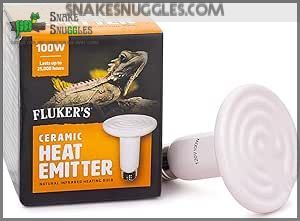
Your corn snake doesn’t stop needing warmth when the lights go out. The Flukers Ceramic Heat Emitter radiates heat without any light, so nighttime thermal regulation never interrupts sleep.
Mount it 6 to 12 inches above the basking area and aim for 85 to 95°F. Plug it into a thermostat, and add a digital probe for temperature monitoring. Then, your temperature gradient stays steady and your heat source never overshoots 100°F.
6. Flukers Heavy Duty Clamp Lamp
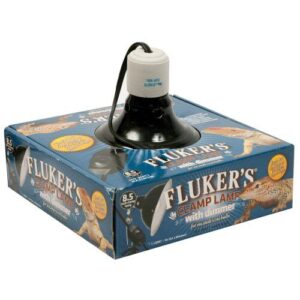
A wobbly lamp is a stressed snake waiting to happen. The Flukers Heavy Duty Clamp Lamp, with its 8.5-inch painted aluminum clamp and ceramic socket, holds your heat source steady. It’s UL/CUL approved, too.
Steady heat helps you read Corn Snake Body Language accurately. A snake that’s too hot may show a defensive posture, an Sshaped posture, or tail vibration.
- Clamp locks firmly onto your enclosure frame
- Ceramic socket controls high-wattage bulbs
- Dimmer switch controls heat output precisely
- Choose a bulb with the right lighting spectrum
Frequently Asked Questions (FAQs)
How do you know if a corn snake is happy?
A happy snake moves like a quiet river.
Look for relaxed body posture, slow tongue flicking, and steady basking. These healthy snake signs show up when you’ve dialed in your basking area and environmental enrichment.
Can corn snakes bond with humans?
Does a corn snake feel affection? Not like a dog does. But reptile bonding with owners is real in a practical sense. Your snake learns your scent, tolerates your hands, and relaxes. Watch Corn Snake Body Language for proof.
How to tell if a corn snake is angry?
Anger is defensive behavior. Watch for audible hissing and tight coils pressed against surfaces. These warning signals, plus rapid tail shaking, are stress indicators in snakes.
Back off. Defensive posturing means your snake feels threatened.
How to tell if a corn snake trusts you?
Trust development starts with a loose, open s-shape and slow tongue flicks toward your hand.
Steady routine familiarity, handling technique, and scent recognition drive the bonding process. A snake staying relaxed near you trusts you.
How to tell if your corn snake likes you?
A calm corn snake moves slowly across your hands, flicking its tongue often. That’s scent recognition, and it shows growing trust. Watch for head rubbing and cuddling for warmth. A loose, relaxed body means it’s comfortable with you.
How to tell if a corn snake is stressed?
Watch for these stress signals: tight coils, hissing, and tail shaking. That’s defensive behavior, so back off.
Cut your handling frequency if you see refused meals or hiding. Behavioral changes may be health warning signs.
What does it mean when a corn snake stares at you?
You think it’s admiring you. It’s sizing you up. This stare is Corn Snake Body Language for alert, not affectionate.
Head retracted and body in an S position, plus rapid tongue flicking, signals environmental stress.
How to tell if a corn snake is ill?
Healthy adults usually eat every one to two weeks, so weeks of refusal are unhealthy snake signs.
Check for openmouth breathing, respiratory issues, cloudy eyes, scale rot, regurgitation, and constant hiding.
Respiratory infections are often triggered by cold or damp enclosures and usually need antibiotics from a vet, with costs usually running £100-£
Call a vet quickly.
How do I know if my corn snake is happy?
Snakes don’t feel happiness the way you do, but you can read their comfort. Relaxed body language shows up as loose coils, a broad head, and slow tongue flicking. Add regular eating, clean sheds, and normal basking area use.
How to tell if a snake is comfortable with you?
No, a snake that doesn’t flee isn’t automatically comfortable.
Look for relaxed posture, slow tongue flicking, and no stress signals. Keep handling frequency modest and use gentle handling to build steady trust over several weeks.
Conclusion
A loose, unhurried coil on a branch. A tongue flicking slowly through the air. That’s your snake saying everything is fine.
Learning corn snake body language turns guesswork into a conversation. You’ll catch tight coils and tail shaking before a bite happens, and you’ll notice when a missed meal points to illness or a bad setup. Keep reading your snake and adjust the habitat when it asks. Trust grows quietly, one session at a time.