This site is supported by our readers. We may earn a commission, at no cost to you, if you purchase through links.
Most keepers obsess over temperature and humidity, then pile in two inches of substrate and call it done.
Substrate depth isn’t a decorative choice—it’s a functional variable that directly controls thermoregulation, cortisol levels, and whether a fossorial species can express natural behavior at all.
A sand boa forced to live on a shallow, compacted layer isn’t just uncomfortable; it’s physiologically stressed, every single day.
Getting the depth right means matching what the substrate does in the wild: insulating, grading heat, retaining moisture, and giving your snake somewhere to disappear into.
Species, size, enclosure dimensions, and material all factor into how deep that layer needs to be.
Table Of Contents
- Key Takeaways
- How Deep Should Snake Substrate Be?
- Factors Affecting Ideal Substrate Depth
- Species-Specific Substrate Depth Needs
- Benefits of Proper Substrate Depth
- Choosing The Right Substrate Material
- Maintenance and Depth Adjustments Over Time
- Frequently Asked Questions (FAQs)
- What is a good substrate for hognose snakes?
- What is a good substrate for a corn snake?
- Do corn snakes need terrarium substrate?
- Can a corn snake eat a substrate?
- Is 1 inch of substrate enough?
- Do ball pythons need deep substrate?
- Can snakes share enclosures with different substrate needs?
- How does substrate depth affect egg-laying and incubation?
- Does substrate depth change during brumation or hibernation?
- What substrate works best for snakes with respiratory infections?
- Conclusion
Key Takeaways
- Substrate depth is a physiological necessity, not decoration — fossorial species like sand boas need 5–6 inches to thermoregulate, manage cortisol, and express natural burrowing behavior.
- Depth requirements scale with species, age, and enclosure size: hatchlings need at least 2–3 inches, adults of burrowing species need up to 6 inches, and a 20‑gallon tank caps out at 3 inches to avoid heat trapping.
- The substrate material must match the depth and species — cypress mulch suits fossorial setups at 4–5 inches, while aspen shavings keep humidity low for dry‑climate snakes at 2–4 inches.
- Your snake tells you when depth is wrong: surface scratching signals too little, burrow collapse signals too much, and uneven shedding points to humidity failure beneath the surface.
How Deep Should Snake Substrate Be?
Substrate depth isn’t one-size-fits-all — it shifts depending on the species, its natural behaviors, and what it actually needs to stay healthy.
A burrowing species like a hognose, for instance, needs several inches to dig comfortably — and choosing the right substrate depth for your snake’s species makes all the difference in keeping that moisture balance just right.
A fossorial sand boa and an arboreal green tree python live in completely different worlds, and their enclosures should reflect that. Here’s how depth recommendations break down across snake types, from minimum baselines to species-specific targets.
General Depth Guidelines by Snake Type
Substrate depth isn’t one-size-fits-all — it follows your snake’s natural history.
Desert-dwelling species need 4–6 inches to support thermal gradient depth and burrowing stress mitigation, while terrestrial snakes generally do well with 2–4 inches.
Arboreal humidity depth requirements drop to just 1–2 inches, since vertical space matters more than floor coverage.
Juvenile depth needs to start shallower, then scale upward with growth.
Ensuring the proper minimum enclosure length guidelines is essential for the snake’s health and activity levels.
Minimum and Maximum Depth Recommendations
Think of depth as a range, not a fixed number. For most snakes, never go below the snake’s tail length — that’s your Tail Length Minimum and a reliable baseline. Cap terrestrial species at 6 inches to avoid Thermal Stratification Risks in deeper layers.
Keep these benchmarks in mind for substrate depth:
- Hatchlings: minimum 3 inches
- Small adults: 4‑inch baseline
- Burrowing Species Limits: up to 12 inches with adequate Enclosure Height Constraints
- Mixed substrates: cap loose layers at 6 inches
- Humidity‑Depth Balance: maintain 2 inches above any heat source
Why Depth Varies Between Species
Depth varies because every species carries millions of years of evolutionary burrowing needs written into its biology. A sand boa’s fossorial instincts demand 5–6 inches to satisfy species-specific stress responses shaped by arid habitat pressure gradients, while a corn snake’s size-related thermoregulation requires far less.
Every species carries millions of years of burrowing instinct — and substrate depth must answer to that history
Humidity adaptation strategies differ just as sharply—your snake’s health depends on matching substrate depth to those species-specific needs precisely.
Factors Affecting Ideal Substrate Depth
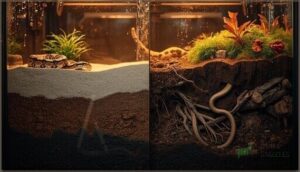
Substrate depth isn’t a one-size-fits-all measurement—several variables push that number up or down depending on your specific setup.
Getting it right means understanding what’s actually driving the requirement in the first place. Three factors consistently determine how deep your substrate needs to be.
Species and Natural Habitat
A snake’s natural habitat is the single biggest variable driving substrate depth requirements.
A desert species needs shallower, drier substrate than a burrowing forest snake—check out these signs your snake is stressed by its environment to fine-tune your setup.
Fossorial species from Desert Climate zones, like sand boas, need 4–6 inches to thermoregulate underground, while Forest Understory and Wetland Moisture environments shape humidity control demands for ball pythons. Rocky Outcrops and Grassland Cover species rely on shallower substrate but still depend on species-specific needs and burrowing behavior for stress regulation.
Snake Age and Size
Age and size reshape substrate depth requirements at every growth stage. 12-inch hatchling corn snake doesn’t need the same 4–6 inches an adult demands for thermoregulation—but scaling up ahead of maturity indicators matters. Lifespan trends and size-species correlation both signal when enclosure size and substrate depth adjustments are overdue:
- Hatchlings: 2–3 inches minimum
- Juveniles (first-year growth): 3–4 inches
- Sub‑adults approaching sexual maturity: 4–5 inches
- Adults of fossorial species: 5–6 inches
- Large adult females (especially hognose): maximum burrowing depth
Enclosure Dimensions and Heating
Enclosure volume shapes substrate depth as much as species does. A compact 20-gallon won’t support 6‑inch burrowing layers without crushing your gradient span or trapping heat unevenly. Match your heater capacity to enclosure size, maintaining clearance standards of at least 2 inches from walls.
| Enclosure Size | Recommended Substrate Depth |
|---|---|
| 20-gallon | 2–3 inches |
| 40-gallon | 3–4 inches |
| 60-gallon | 4–5 inches |
| 75+ gallon | 5–6 inches |
Your heat zone layout should anchor to one side, letting the gradient span carry thermal variation across the full substrate depth for effective humidity control and burrowing access.
Species-Specific Substrate Depth Needs
Every snake has its own rulebook regarding substrate depth, and getting it wrong isn’t just inconvenient — it can genuinely affect their health.
The right depth comes down to species, natural behavior, and how your snake interacts with its environment.
Here’s what the numbers look like for the most commonly kept snakes.
Ball Pythons
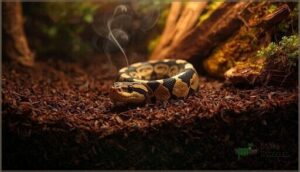
Ball pythons don’t dig aggressively, but don’t let that fool you—they still need 3–4 inches of coconut fiber to help proper burrow design and heat gradient interaction. That depth gives your snake room to partially submerge, which stabilizes humidity control between 60–70% and directly helps shedding support.
Shallower setups compromise thermoregulation and stress the animal more than most keepers realize.
deep substrate encourages burrowing in fossorial species, with some like Hysterocrates digging burrows up to 22 feet.
Corn Snakes
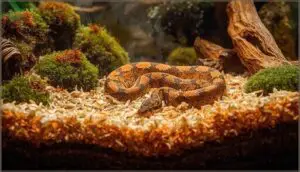
Corn snakes are forgiving, but that doesn’t mean substrate depth is negotiable. Juvenile growth stages and shedding success both depend on maintaining 2–3 inches of aspen shavings, scaling to 4–6 inches at maturity.
Enclosure size shapes how effectively humidity control stabilizes.
Support burrowing behavior with loose reptile substrate selection, and your corn snake’s humidity needs stay consistently met without intervention.
Hognose and Sand Boas
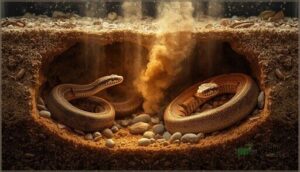
Both committed burrowers—substrate depth isn’t optional for them; it’s physiological. Hognose snakes require 4–6 inches of loose material to express natural burrowing behavior and maintain humidity control; sand boas need 5–6 inches to move fully underground.
Insufficient depth triggers clear stress indicators like restless surfacing. Make growth adjustments annually, and always verify substrate safety to prevent compaction-related impaction.
Arboreal and Terrestrial Snakes
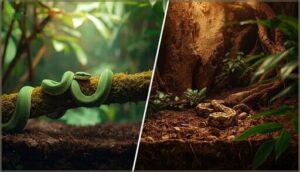
Not every snake lives close to the ground—and substrate depth should reflect that reality.
- Arboreal species need only 1–2 inches, just enough for humidity retention without waterlogging branch perching zones.
- Terrestrial species require 3–5 inches to support temperature gradients and natural movement.
- Skin shedding improves noticeably when substrate moisture stays consistent.
- Enclosure décor placement affects how depth distributes across your snake enclosure setup—factor it into reptile substrate selection.
Benefits of Proper Substrate Depth
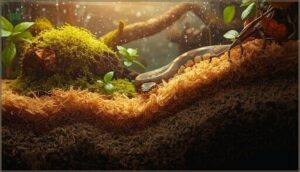
Getting substrate depth right isn’t just about aesthetics—it directly shapes how your snake eats, sheds, and manages stress.
The right depth works quietly in the background, regulating temperature gradients, locking in humidity, and giving your snake room to behave like a snake. Here’s a closer look at what proper depth actually delivers.
Thermoregulation and Humidity Control
Substrate depth does more than fill space—it actively creates Thermal Gradient Zones that smooth out the temperature swings your heating element would otherwise spike.
Moisture Retention Layers within a properly built substrate maintain Humidity Buffer Capacity, slowing evaporation between mistings.
That Temp‑Humidity Feedback loop, driven by Heat Source Distribution through adequate depth, is the backbone of effective thermoregulation and humidity control for species-specific care.
Encouraging Natural Burrowing Behaviors
Beyond temperature, substrate depth unlocks fossorial expression—your snake’s hardwired drive to burrow, retreat, and explore.
Enrichment Tunnel Design and Substrate Texture Variation give species-specific care real teeth.
Monitoring Digging Frequency tells you whether depth is sufficient; collapsed tunnels signal it isn’t.
Incorporate Seasonal Burrow Rotation and Burrow Humidity Management into your Reptile Habitat Design, and substrate depth stops being guesswork.
Reducing Stress and Promoting Health
Adequate substrate depth does more than satisfy fossorial instinct—it anchors the entire stress-reduction framework.
Correct substrate depth and substrate choice eliminate that baseline cortisol load before you intervene with anything else.
Consistent Temperature gradients, Stable Humidity, Appropriate Hides, and Scheduled Feeding only work when your snake feels secure enough to use them.
Minimal Handling matters less if the enclosure itself reads as unsafe.
Choosing The Right Substrate Material
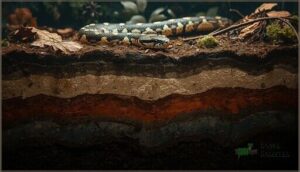
Depth gets you halfway there — the material filling that space matters just as much.
The wrong substrate can undermine thermoregulation, spike impaction risk, or leave your snake stress‑shedding through every cycle.
Here’s what you need to know about matching the right material to the right setup.
Best Substrates for Different Depths
The substrate you choose has to match both the depth you’re maintaining and the species living in it. At 3 to 5 inches, cypress mulch burrowing support is excellent for ball pythons, while aspen bedding humidity stays low enough for corn snakes and king snakes. Match your substrate choice to your snake species and target depth:
- Coconut coir moisture retention suits tropical setups at 3–4 inches
- Cypress mulch burrowing support works best at 4–5 inches for fossorial species
- Aspen bedding humidity stays low, ideal for dry-climate snakes at 2–4 inches
- Bioactive compost benefits improve substrate depth stability in naturalistic enclosures
- Paper towel hygiene is best for hatchlings regardless of depth needs
Substrate Safety and Impaction Risks
Even the right depth becomes a liability if your substrate choice introduces impaction risk. Fine particles cling to prey during feeding, and moisture clumping turns loose material into dense, gut‑blocking masses.
Younger snakes carry considerably less digestive tolerance, making age‑specific tolerance a non‑negotiable factor in substrate choice.
| Risk Factor | What to Watch |
|---|---|
| Particle Size | Fine grains increase ingestion risk |
| Moisture Clumping | Wet substrate forms blockage‑prone masses |
| Feeding Surface Hygiene | Contaminated surfaces raise cumulative exposure |
| Burrowing Behavior Monitoring | Frequent digging increases mouth contact |
Bioactive Vs. Traditional Substrates
Bioactive setups do more than hold your snake—they work.
A living substrate layer, seeded with springtails, isopods, and microbial diversity, actively breaks down waste and stabilizes humidity through natural moisture buffering.
Your cleanup crew takes care of what manual spot‑cleaning misses.
Traditional substrates keep things predictable and sterile, but maintenance frequency climbs fast.
For species‑specific care and housing that prioritizes environmental enrichment for reptiles, bioactive systems reward the investment.
Maintenance and Depth Adjustments Over Time
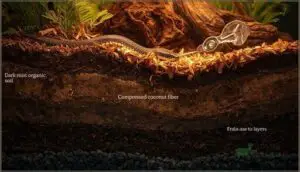
Getting the depth right is only half the job — keeping it right is where most keepers fall short.
Substrate breaks down, compacts, and accumulates waste over time, which means regular maintenance isn’t optional.
Here’s what you need to stay on top of.
Cleaning and Replacing Substrate
Regular cleaning isn’t optional — it’s the foundation of a functional enclosure. Stick to this rotation schedule:
- Spot-clean waste daily using vacuum techniques with a siphon gravel vacuum
- Rotate and aerate substrate weekly to maintain humidity control and reduce compaction
- dechlorinated rinsing protocols before adding fresh material monthly
- Sanitize decorations and tools after each session — tool sanitization prevents bacterial transfer
- full replacement every three to six months
Monitoring and Adjusting Depth as Needed
Think of depth monitoring as your snake’s silent feedback loop. Weekly depth checks using a depth ruler at both the warm and cool ends catch uneven settling before it disrupts thermal gradients.
Pair this with moisture meter use and temperature correlation tracking to detect humidity shifts tied to compaction. Log adjustments in a depth adjustment log — even minor changes reveal patterns in burrowing behavior indicators that guide species-specific care and housing decisions.
Signs Your Snake Needs More or Less Substrate
Your snake communicates substrate depth problems through behavior — you just need to know how to read it. Watch for these red flags:
- Surface scratching or repeated probing signals inadequate depth for burrowing
- Uneven shedding points to failed humidity control beneath the surface
- Odor buildup without feeding changes means waste is trapped below
- Heat avoidance suggests shallow substrate warming too aggressively
- Burrow collapse indicates loose bedding that’s too deep to stay stable
Frequently Asked Questions (FAQs)
What is a good substrate for hognose snakes?
Aspen bedding and a topsoil-sand mix are top choices for hognose snakes, offering burrow stability, moisture retention, and impaction-safe materials that support natural burrowing, humidity control, and temperature gradient benefits throughout the enclosure.
What is a good substrate for a corn snake?
For a corn snake, aspen shavings or coconut fiber work best, balancing burrowing support with humidity control. Target 3–4 inches for impaction safety, natural behavior, and cost-effective substrate depth maintenance.
Do corn snakes need terrarium substrate?
Yes, corn snakes absolutely need terrarium substrate—it provides burrowing, humidity balance, and snake health.
Without it, stress builds fast.
A 2–4 inch depth minimizes impaction risk while enabling natural burrowing behavior.
Can a corn snake eat a substrate?
Technically, yes—a corn snake can accidentally ingest substrate while striking prey.
Feeding on a clean surface eliminates impaction risk, promotes snake health, and makes low-risk bedding choices far less critical during mealtime.
Is 1 inch of substrate enough?
One inch of substrate depth falls short for most species.
It dries out quickly, undermines moisture retention, disrupts heat transfer, and triggers stress indicators.
Burrowing snakes especially suffer—species‑specific care demands more.
Do ball pythons need deep substrate?
Ball pythons need 3 to 4 inches of substrate depth. This provides burrowing comfort, humidity balance around 60 to 70 percent, even heat distribution, and reduces impaction risk while keeping cleaning frequency manageable.
Can snakes share enclosures with different substrate needs?
Sharing an enclosure with mixed substrate needs is possible, but only with deliberate zoning strategies—burrow isolation, microclimate barriers, and humidity gradient monitoring keep each species’ environment stable without compromise.
How does substrate depth affect egg-laying and incubation?
Substrate depth directly shapes egg temperature stability and humidity buffering around the clutch.
Deeper nests support embryo development and incubation success rates by enabling proper gas exchange while shielding eggs from destabilizing diurnal swings.
Does substrate depth change during brumation or hibernation?
Yes — but not in the way most keepers expect.
During brumation, depth needs to increase, not decrease. Aim for four to six inches to support thermal buffering effects, moisture retention dynamics, and species-specific burrowing patterns throughout hibernation.
What substrate works best for snakes with respiratory infections?
When respiratory infections strike, go dust-free immediately.
Paper-towel hygiene simplifies cleaning, while aspen shavings choice and moisture-balancing fiber help stabilize humidity control without harboring bacteria.
Avoid cedar—it’s toxic to compromised airways.
Conclusion
Depth isn’t just a number—it’s the difference between a snake that thrives and one that merely survives. Knowing how deep the snake substrate should be for your specific species lets you replicate the one thing captivity often strips away: the ability to self-regulate, disappear, and decompress.
Get the depth right, and your enclosure stops being a box and starts being a habitat. That shift, measured in inches, matters more than any other variable you’ll adjust.