This site is supported by our readers. We may earn a commission, at no cost to you, if you purchase through links.

A flash of movement ripples through the canopy—but by the time a predator registers the disturbance, the green tree python has vanished into the foliage. These emerald serpents don’t rely on venom to survive their rainforest home; instead, they’ve perfected a complex arsenal of defensive strategies that begin long before a threat gets close.
From their striking ability to disappear against sun-dappled leaves to their intimidating physical displays when cornered, green tree pythons demonstrate how evolutionary pressure sculpts survival into an art form. Understanding how these arboreal specialists protect themselves reveals not just snake behavior, but the intricate dance between predator and prey that unfolds silently in the trees above.
Table Of Contents
- Key Takeaways
- How Do Green Tree Pythons Protect Themselves?
- Camouflage and Coloration as Defense
- Arboreal Lifestyle and Hiding Tactics
- Physical and Behavioral Defense Mechanisms
- Predator Avoidance and Environmental Adaptations
- Frequently Asked Questions (FAQs)
- How does a green tree snake protect itself?
- How do pythons protect themselves?
- Do green tree pythons have predators?
- What are the green tree pythons adaptations?
- How do green tree pythons survive?
- What are the green tree pythons predators?
- What role does the prehensile tail play in defense?
- How do green tree pythons use their coloration?
- Are green tree pythons aggressive towards threats?
- What deters predators from attacking green tree pythons?
- Conclusion
Key Takeaways
- Green tree pythons rely on a multi-layered defense system that combines vibrant green camouflage, heat-sensing pits for early threat detection, and behavioral tactics like coiling, hissing, and musk secretion to avoid predators before physical confrontation becomes necessary.
- Their arboreal lifestyle serves as both hunting strategy and defense mechanism, with prehensile tails providing secure anchoring on branches while their coiled posture and strategic positioning in dense vegetation make detection nearly impossible for ground-based and aerial predators.
- Physical defenses escalate from visual intimidation through body inflation and mock strikes with sharp recurved teeth to powerful constriction that immobilizes threats, though these snakes prefer avoidance over aggression.
- Nocturnal activity patterns and solitary behavior minimize predator encounters, while their ability to remain motionless for extended periods and execute rapid canopy maneuvers when threatened demonstrates how evolutionary adaptations transform vulnerability into survival advantage.
How Do Green Tree Pythons Protect Themselves?
You’ll discover that green tree pythons rely on a layered approach to defense, combining camouflage, physical weaponry, and behavioral tactics to survive. Their survival strategies begin with threat detection through specialized heat-sensing pits along their jaws, allowing you to understand how they identify warm-blooded predators before visual contact occurs.
When keeping these snakes in captivity, replicating their natural defense mechanisms becomes easier if you maintain proper arboreal care conditions that reduce stress-related defensive behaviors.
When detected, these snakes employ defensive posturing—coiling tightly with their head positioned centrally while releasing musk to discourage closer inspection. Snake defense mechanisms escalate from hissing warnings to mock strikes with sharp, backward-curving teeth. If necessary, their muscular body delivers powerful constriction, applying multiple loops that immobilize threats attempting to dislodge them from branches.
Defensive postures capitalize on their arboreal habitat, where ambush tactics used for hunting also serve protection. Remarkably, their survival often depends on, which helps them remain virtually invisible among dense forest leaves. This multi-tiered system ensures you recognize how camouflage, sensory awareness, and immediate physical response work together to keep these exceptional reptiles safe in dense rainforest canopies.
Green tree pythons survive through a multi-layered defense system combining camouflage, sensory awareness, and immediate physical responses in rainforest canopies
Camouflage and Coloration as Defense
In the realm of rainforest canopy survival, green tree pythons have mastered the art of disappearing in plain sight. Their coloration isn’t just beautiful—it’s a survival tool that’s been fine-tuned over millions of years.
Let’s look at the specific ways their colors and patterns keep them hidden from both predators and prey.
Bright Green Blending With Foliage
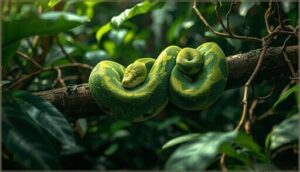
The green tree python’s survival depends on remarkable visual camouflage created by its vibrant foliage coloration. You’ll notice how this adaptive camouflage mirrors the canopy structure perfectly, making detection nearly impossible for predators. Their defensive behavior relies on matching green texture and leaf pattern effortlessly.
Key aspects of their animal camouflage include:
- Mid to light greens that replicate sunlit leaves for effortless branch transitions
- Subtle hue shifts from lime to emerald creating natural depth among dense canopy textures
- Color harmony with yellow-green tones imitating new tree growth
- Enhanced blending through proper lighting in continuous foliage fields
- Fine visual integration matching natural green weave patterns
White or Yellow Undersides for Concealment

While bright dorsal greens capture attention, the snake’s white or yellow ventral coloration plays an equally essential role in concealment strategies. This underside camouflage creates countershading effects that minimize the python’s silhouette when viewed from below, blending pale surfaces with sunlit canopy gaps in dappled lighting.
Such ventral coloration represents intricate animal camouflage, supporting defensive behavior in snakes through multi-angle reptilian defense and extensive animal defense mechanisms.
The Amazon tree boa exemplifies this adaptation with dorsal patterns that blend seamlessly into bark and foliage while its lighter belly remains hidden from aerial predators.
Juvenile Color Changes for Safety

As juveniles mature, you’ll notice striking color shift timing that enhances green tree python biology through adaptive coloration. Young snakes display lighter yellow-green hues, mirroring fresh foliage in pattern development that strengthens camouflage strategies.
These camouflage and predator avoidance tactics involve green hue variance aligned with environmental changes, supporting defensive behavior in snakes. This reptile behavior and ecology ensures juveniles remain concealed as they grow, reducing predator encounters through effortless canopy blending.
Distinctive Patterns Breaking Up Outline
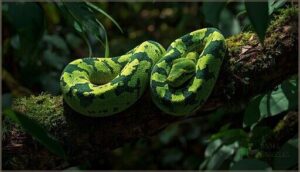
Irregular markings along the python’s body create pattern disruption that confuses predators by interrupting recognizable length signatures. These visual illusions employ adaptive coloration through outline breaks designed for prime camouflage tactics:
- Dark cross bands fragment the body contour against branch textures
- Flecked scales produce a mosaic effect that mimics dappled sunlight
- Contrasting scale edges break up shadow lines in dense foliage
- Color transitions from bright to shadowed greens simulate canopy depth
- Irregular markings align with leaf edges and bark patterns for concealment
This defensive posture element strengthens animal camouflage and predator avoidance throughout green tree python biology, supporting effective defense mechanisms in arboreal habitats.
Arboreal Lifestyle and Hiding Tactics
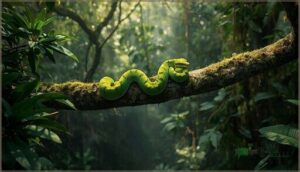
Green tree pythons don’t just use camouflage to stay safe—they’ve mastered the art of living above ground where many predators can’t reach them.
Their entire lifestyle revolves around the canopy, relying on height, stillness, and strategic positioning to avoid detection.
You’ll find their arboreal adaptations are just as essential to survival as their vibrant green scales.
Exclusive Tree-Dwelling Habits
You’ll find these outstanding snakes spending their entire lives high above the forest floor, perfectly adapted to an arboreal habitat.
Green tree pythons master branch navigation through their prehensile tails and muscular bodies, allowing them to traverse the tree canopy with superb control.
Their forest acclimation includes leaf mimicry and trunk concealment, essential skills for predator avoidance. This exclusive commitment to arboreal living makes them one of nature’s most specialized defensive strategists.
Coiled Posture on Branches
You’ll notice their signature coiled posture creates both branch support and defensive advantage. This coil formation wraps tightly around limbs, distributing weight across multiple contact points while maintaining superior balance control.
The circular outline enhances camouflage by disrupting their silhouette, and their spatial awareness keeps the head positioned for ambush tactics.
These defensive postures combine constriction capability with snake behavior that makes detection nearly impossible, supporting their wait-and-strike hunting strategy.
Utilizing Dense Vegetation and Tree Hollows
Dense vegetation and tree hollows serve as your python’s fortress in the canopy. Thick foliage masks movement during ambush hunts, while hollow limbs offer secure retreats that stabilize temperature and humidity around their coiled bodies.
- Layered leaves create shadows that break up their outline, perfecting vegetation concealment
- Hollow trunks limit predator access while allowing rapid escape through multiple exits
- Microclimate control inside hollows maintains healthy shedding cycles and skin hydration
- Branch networks provide canopy navigation routes between defensive postures and hunting perches
Prehensile Tail for Secure Anchoring
Your python’s prehensile tail functions like a living anchor, wrapping around branches with friction pads and specialized scales that grip bark contours. This tail morphology lets them secure perching spots while the body extends for prey strikes or defensive maneuvers.
Dermal ridges increase friction without extra effort, and tactile receptors adjust grip strength instantly as branch diameter shifts. Tail grip mechanics are essential to their arboreal defense mechanisms and wildlife survival strategies.
Physical and Behavioral Defense Mechanisms
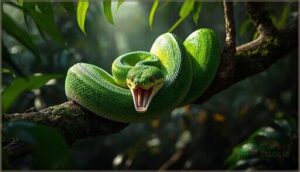
When camouflage isn’t enough, green tree pythons rely on a toolkit of physical and behavioral defenses to protect themselves from threats. These mechanisms range from impressive muscular power to surprising psychological tactics that can startle even experienced predators.
Understanding these defense strategies reveals just how well-adapted these arboreal serpents are for survival in their rainforest environment.
Muscular Body for Constriction
When you encounter a green tree python, you’re facing a formidable predator built for constriction. The muscular body relies on powerful muscle contraction and coordinated body coiling to generate impressive constriction force. Through sustained physical strength and outstanding muscular endurance, these snakes immobilize prey efficiently.
While camouflage, hissing, and body inflation serve as initial deterrents, their muscular architecture delivers the definitive defensive capability.
Sharp Teeth and Mock Strikes
When a threat approaches, you’ll see those small, recurved teeth in action. Mock strikes simulate a bite without full contact, creating space for escape—Tooth Replacement ensures sharpness through shedding cycles.
Defensive Biting relies on backward-angled Tooth Structure for grip, while Mock Strikes disrupt predator paths. Combined with Constriction, these defense mechanisms make Biting a secondary deterrent, though Bite Force remains formidable when actual contact occurs.
Body Inflation and Hissing
When visual camouflage doesn’t convince a predator to back off, you’ll witness a dramatic shift: body inflation and hissing sounds. The snake widens its ribs, inflating its body diameter to create a bulky, intimidating silhouette while exhaling sharply through the glottis to produce a loud, warning hiss.
These threat displays combine defensive postures with acoustic warning signals, transforming a slender arboreal hunter into a formidable defensive presence.
Secretion of Musk to Deter Predators
Beyond inflating and hissing, you’ll encounter another formidable defense mechanism: musk secretion. When threatened, green tree pythons release a pungent substance from cloacal glands, creating a persistent odor that functions as a chemical deterrent.
This musk composition contains fatty acids and proteins, effectively discouraging predators through chemical signaling. The strong aroma can cause temporary disorientation in wildlife, making it a highly effective predator avoidance strategy.
Predator Avoidance and Environmental Adaptations

Green tree pythons don’t just rely on physical defenses—they’ve also mastered the art of staying out of harm’s way. Their survival depends on a combination of behavioral adaptations and environmental awareness that help them avoid predators altogether.
From timing their activity to moving with precision through the canopy, these strategies work together to keep them safe in their rainforest home.
Nocturnal Activity to Reduce Encounters
Green tree pythons embrace the cover of darkness to sharpen their predator avoidance strategy, becoming most active from dusk through early night when diurnal threats rest. This nocturnal activity grants them reduced visibility and encounter minimization with ground-based hunters.
By timing their movements with prey patterns, these snakes employ nighttime stealth and animal camouflage within dense foliage, effectively avoiding confrontation while utilizing their defense mechanisms in the shadowy canopy.
Remaining Motionless to Avoid Detection
You’ll notice the python’s stillness techniques are among its most effective defense mechanisms. Remaining motionless on a branch, it uses branch alignment and silent posture to merge seamlessly with foliage, perfecting animal camouflage strategies that help in avoiding confrontation.
This frozen stance prevents detection by predators, allowing the snake to rely on camouflage rather than constriction or active escape when threats pass nearby. Research on the shows that background matching and disruptive patterns play a key role in helping creatures remain undetected in their natural habitats.
Rapid Movement Through Canopy
When danger looms, you’ll see these reptiles execute swift arboreal maneuvers through the canopy, using branch navigation skills that surpass most ambush predators.
Their tree climbing abilities include:
- Using strong forelimbs and prehensile tails for limb propulsion between branches
- Choosing compact routes through dense foliage for efficient canopy travel
- Executing quick head pivots to scan for threats while maintaining grip
- Twisting flexible bodies around branches without losing traction
These rapid escapes complement their camouflage and snake defense strategies.
Solitary Nature Minimizing Exposure
By nature, these reptiles embrace solitary behavior that dramatically cuts exposure to predators and human threats. You won’t find them competing for territory or basking in groups—habitat selection favors isolated perches where camouflage techniques and reduced activity keep them invisible.
Their stealth movements, combined with constriction readiness and snake defense instincts, mean fewer encounters and safer survival in the canopy’s hidden corners.
Frequently Asked Questions (FAQs)
How does a green tree snake protect itself?
When danger looms, tree-dwelling pythons rely on camouflage tactics and defensive behavior like hissing, constriction, and predator mimicry.
Their stealth hunting skills translate into snake evasion strategies that keep them safely hidden.
How do pythons protect themselves?
Pythons protect themselves through camouflage tactics that match their habitat, defensive posturing with hissing and mock strikes, powerful constriction when threatened, and sharp biting.
Adaptive behaviors like hiding in burrows effectively support predator evasion.
Do green tree pythons have predators?
Even skilled climbers aren’t immune to becoming someone else’s meal.
Green tree pythons face wild enemies like large birds of prey, monitor lizards, and occasionally opportunistic mammals that exploit arboreal risks throughout their rainforest habitat.
What are the green tree pythons adaptations?
You’ll notice their prehensile tail, heat-sensing pits, and emerald camouflage represent key evolutionary adaptations.
These features allow tree climbing, thermal detection of prey, and defensive behavior that keeps them hidden in dense tropical canopies.
How do green tree pythons survive?
Like a living emerald vanishing into jade foliage, green tree pythons survive through camouflage, thermal regulation via habitat selection, predator recognition, adaptive physiology, and defensive behavior.
These evolutionary adaptations form wildlife survival strategies perfected over millennia.
What are the green tree pythons predators?
In their rainforest habitat, green tree pythons face threats from large birds of prey, crocodiles in waterside areas, and warthog predators.
Human poaching for illegal pet trading also disrupts predator-prey dynamics and ecological balance.
What role does the prehensile tail play in defense?
You might think the prehensile tail is just for climbing, but it’s actually a formidable defensive tool.
Green tree pythons use tail grasping and tail anchoring to execute rapid evasive maneuvers, maintain balance control during escapes, and create a predator deterrent through strategic positioning.
How do green tree pythons use their coloration?
Their vibrant green skin acts as outstanding camouflage among leafy branches, while white undersides provide concealment from below.
Juveniles display yellow or red tones that shift to protective emerald as they mature.
Are green tree pythons aggressive towards threats?
Green tree pythons aren’t naturally aggressive, but they’ll defend themselves when cornered.
You’ll see defensive behavior like hissing, body inflation, and mock strikes—responses driven by stress and fear rather than true aggression.
What deters predators from attacking green tree pythons?
You’ll notice several survival strategies working in concert: camouflage tactics blend these snakes into foliage, while defensive posturing—hissing, body inflation, and musk secretion—combines with their arboreal lifestyle to minimize predator-prey relationships and guarantee threat detection succeeds.
Conclusion
Picture a green tree python draped motionless across a branch, its emerald scales dissolving into leafy shadows as an eagle passes overhead. This single moment captures how green tree pythons protect themselves—not through aggression, but through layered adaptations refined over millennia.
Their camouflage, arboreal expertise, and behavioral defenses work in concert, transforming vulnerability into survival. Understanding these mechanisms reveals nature’s elegant solution: sometimes the best defense isn’t fighting back, but becoming invisible altogether.