This site is supported by our readers. We may earn a commission, at no cost to you, if you purchase through links.

Your ball python’s bones aren’t supposed to bend like rubber. Yet metabolic bone disease—a preventable condition caused by inadequate UVB exposure—remains one of the most common health crises in captive snakes.
The culprit? Most keepers either skip UVB lighting entirely or install it incorrectly, unknowingly starving their snakes of the ultraviolet wavelengths needed for vitamin D3 synthesis. Without this critical nutrient, calcium regulation fails, leading to skeletal deformities, lethargy, and potentially fatal complications.
Setting up UVB lighting correctly isn’t just about mimicking nature—it’s about preventing tragedy. The right bulb, proper placement, and consistent maintenance create the difference between a thriving snake and one silently deteriorating in what appears to be a perfect enclosure.
Table Of Contents
- Key Takeaways
- Why Snakes Need UVB Lighting
- Choosing The Right UVB Bulb for Snakes
- Determining The Ideal UVB Strength
- Deciding on UVB Fixture Placement
- Setting Up The UVB Fixture Safely
- Establishing a Proper Light Cycle
- Maintaining UVB Equipment
- Integrating UVB With Other Enclosure Lighting
- Troubleshooting Common UVB Setup Issues
- Frequently Asked Questions (FAQs)
- How do you set up UVB for ball pythons?
- Is too much UVB bad for snakes?
- Should UVB cover the whole enclosure?
- Can snakes get too much UVB exposure?
- Do baby snakes need different UVB levels?
- How does screen mesh affect UVB strength?
- Should I provide UVB during winter brumation?
- What UVI reading should I target exactly?
- Conclusion
Key Takeaways
- UVB lighting between 290-320 nanometers is essential for vitamin D3 synthesis in snakes, directly preventing metabolic bone disease through proper calcium regulation and skeletal health.
- Position fluorescent tube fixtures 12-18 inches above the basking area to achieve a UVI reading of 2.0-4.0 for diurnal species, using a solarmeter to verify actual output rather than guessing distance.
- Replace fluorescent UVB bulbs every 6-9 months and mercury vapor bulbs every 12 months regardless of visible light output, since UV effectiveness decays before the bulb appears dim.
- Maintain a consistent 10-12 hour daily photoperiod using automated timers to support circadian rhythms, combining UVB with separate heat sources positioned to create proper temperature gradients without overlap.
Why Snakes Need UVB Lighting
UVB lighting isn’t just a nice-to-have for your snake—it’s a fundamental component of their physiological health. Without it, critical internal processes break down, leaving your snake vulnerable to serious health complications.
For a complete breakdown of how to balance UVB with temperature and humidity, check out this ball python lighting and environmental setup guide.
Let’s examine the three essential roles UVB plays in keeping your snake healthy and thriving.
Role of UVB in Vitamin D3 Synthesis
UVB lighting drives vitamin D3 synthesis through a precise biochemical pathway. When UVB wavelengths between 290 and 320 nanometers hit your snake’s skin, they convert 7-dehydrocholesterol into previtamin D3. This transforms into vitamin D3, which your snake’s liver and kidneys metabolize into active forms that regulate calcium metabolism.
Skin exposure triggers circulating vitamin D3 levels that peak around 12 hours post-exposure—essential for reptile lighting success. It’s vital to grasp the to verify your snake receives adequate light for proper vitamin D3 production.
Preventing Metabolic Bone Disease
Without consistent UVB lighting, your snake’s vitamin D3 role in bone health management collapses. Calcium absorption plummets, triggering secondary parathyroidism.
Bones soften, fractures emerge, and metabolic bone disease sets in—often irreversibly. That’s why metabolic disease prevention demands proper reptile lighting from day one.
UVB lighting safety paired with strategic calcium supplementation protects your snake’s skeleton. Think of snake enclosure lighting as preventive medicine, not optional equipment.
To learn more, it’s important to understand metabolic bone disease prevention.
Supporting Healthy Circadian Rhythms
Your snake’s biological rhythms depend on predictable photoperiod cues. A consistent 10-12 hour daylight exposure pattern reinforces circadian entrainment, stabilizing sleep patterns and thermoregulation. Proper reptile lighting acts like light therapy for captive animals.
Here’s how UVB lighting maintains circadian rhythms:
- Morning activation – Bright light signals daytime, triggering alert behaviors and metabolic function.
- Evening wind-down – Darkness cues rest, supporting melatonin release and recovery.
- Seasonal alignment – Consistent photoperiod prevents phase shifts and metabolic disruption.
Choosing The Right UVB Bulb for Snakes
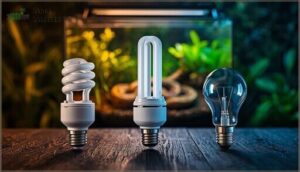
Not all UVB bulbs are created equal, and choosing the wrong one can leave your snake without the light spectrum it needs. You’ll find three main types on the market, each with distinct advantages depending on your enclosure size and species requirements.
Let’s break down your options so you can make the right call for your setup.
Tube Vs. Compact Bulbs
Choosing between tube fixtures and compact options comes down to enclosure size and lighting efficiency. Tube bulbs deliver consistent UVB across larger spaces, making them ideal for reptile lighting setups over 36 inches.
Compact bulbs concentrate output in smaller zones—perfect for tight quarters. Both offer LED benefits like reduced heat and bulb durability, but tubes provide enhanced UVB lighting for reptiles with demanding lighting requirements.
Mercury Vapor Bulbs
These all-in-one powerhouses deliver both heat and UVB lighting in a single package. Mercury vapor lamps contain a quartz arc tube filled with mercury content, surrounded by a specialized ballast design to regulate vapor emission.
You’ll achieve outstanding UVB bulbs output for deep enclosures, but proper reptile lighting setup demands careful bulb anatomy understanding—the high-intensity arc requires secure fixtures and ventilation to prevent overheating.
Recommended Brands and Reptile-Specific Options
You’ll find trusted UVB lighting brands designed specifically for reptile enclosures. Arcadia Products and Zoo Med Options offer T5 and compact UVB bulbs with proven UV output. Exo Terra Solutions and Zilla Lighting provide reliable fixtures with integrated guards. Reptile Systems delivers specialty options for bioactive setups.
When setting up your apartment-friendly snake enclosure, choose fixtures with built-in thermal protection to prevent heat-related warping of plastic guards and latches.
Always choose reptile-specific UVB light—aquarium bulbs won’t deliver the wavelengths your snake needs for proper calcium metabolism.
Determining The Ideal UVB Strength
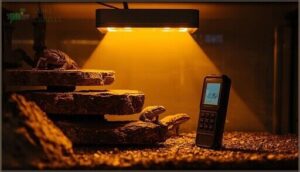
The difference between a thriving snake and one struggling with metabolic bone disease often comes down to a single number: the UVI reading at your basking spot. Most diurnal snake species need a UV Index between 2.0 and 4.0, while crepuscular types do well with 1.0 to 2.0. Nocturnal snakes? They’ll thrive with minimal exposure, around 0.5 to 1.0.
The difference between a thriving snake and one with metabolic bone disease often comes down to a single number: the UVI reading at your basking spot
Your enclosure size directly affects UVB intensity—larger tanks require stronger bulbs to maintain proper readings. Don’t guess. Use a solarmeter to measure UVI at basking height, then adjust your fixture distance accordingly.
Here’s what matters: UVB strength isn’t one-size-fits-all. A ball python’s needs differ dramatically from a garter snake’s. Match your UVB bulbs to your species’ natural habitat and activity pattern, then verify with regular UVI monitoring. That’s how you prevent deficiencies before they start.
Deciding on UVB Fixture Placement
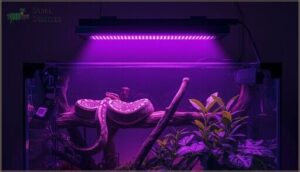
Getting the placement right matters just as much as choosing the correct bulb. You need to account for distance, mounting strategy, and physical barriers between your snake and the UVB source.
Let’s break down the three critical factors that determine where your fixture should go.
Distance From Basking Area
Proper UVB placement hinges on hitting a basking UVI of 2 to 3—your snake’s sweet spot for self-regulation. Here’s how you’ll dial in safe distance:
- Position most fluorescent tubes 12 to 18 inches above the basking area for moderate UVI levels
- High-output lamps need greater spacing—sometimes 30 to 45 centimeters—to prevent overexposure
- Use a Solarmeter at basking height to confirm actual UVI, not just estimate
- Adjust perch or platform height in small increments until behavior and readings align
Mounting Inside Vs. Outside The Enclosure
Your mounting choice—inside or outside the enclosure—directly shapes heat management, fixture safety, and lighting efficiency. Internal UVB setups deliver more even dispersion across the basking zone but add thermal load, demanding careful integration with your reptile lighting and enclosure design.
External placement simplifies bulb swaps and reduces humidity exposure, yet requires sturdy reflectors to penetrate screen tops without compromising UVB output or snake behavior patterns.
Importance of Mesh and Guards
Guards and mesh act as your first line of defense against burns, electrical hazards, and fixture damage. Protective covers maintain enclosure ventilation while blocking direct contact with hot UVB bulbs—critical when snakes climb or strike at light sources.
Replace damaged guards before the next lighting cycle.
- Welded mesh resists deformation from climbing weight and accidental strikes.
- Stainless steel guard materials endure humid environments without corroding.
- Openings sized correctly prevent tongue flicks from reaching live components.
- Barrier design allows airflow to prevent dangerous heat buildup near fixtures.
- Clear visibility through mesh lets you spot cracks or discoloration immediately.
Setting Up The UVB Fixture Safely
Installing your UVB fixture correctly keeps your snake safe and ensures the equipment lasts. A poorly secured setup can fall into the enclosure, overheat surfaces, or expose your snake to burns.
Focus on three critical areas: anchoring the fixture firmly, adding protective barriers, and managing heat risks.
Securing Fixtures to Prevent Falls
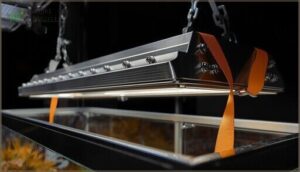
When you mount UVB lighting inside your snake enclosure, fixture anchoring becomes your first line of defense against catastrophic falls. Secure mounting demands stainless steel or zinc-plated screws at least 1¼ inches long, driven firmly into the enclosure frame. Don’t rely on a single fastener—install two independent retention straps per fixture for true fall prevention.
| Mounting Method | Safety Rating |
|---|---|
| Single-point suspension | High-risk failure |
| Two-point cross-brace | Maximum stability |
| Adhesive-only attachment | Unsafe for reptile lighting |
Weekly safety inspections catch loosening hardware before your snake gets hurt.
Using Protective Covers
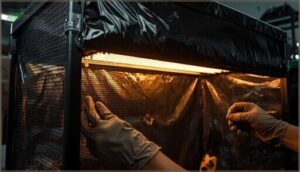
Once your fixtures are locked down, protective covers add a second barrier between hot bulbs and your snake. Choose nylon or vinyl cover material options for their durability and easy cleaning—both withstand moisture and resist tearing.
Install mesh guards with mounting systems that clip securely to rack frames or hinge open for bulb changes. Inspect seams monthly and replace covers showing UV degradation to maintain safety features.
Avoiding Overheating and Burns
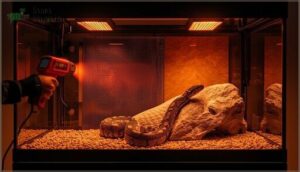
Beyond guards, burn prevention demands careful thermal monitoring and strategic heat source placement. Keep UVB lighting and heat lamps at least six inches from plastic walls to prevent warping.
Use an infrared thermometer daily to verify basking surfaces stay below 120°F.
Install protective screens over ceramic heat emitters, and guarantee proper enclosure ventilation prevents heat buildup that disrupts your snake’s temperature gradient and thermoregulation.
Establishing a Proper Light Cycle
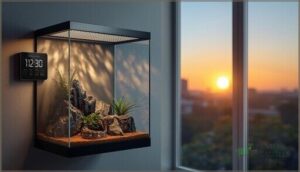
Your snake’s body runs on an internal clock that aligns with consistent light patterns. Without a predictable schedule, stress levels rise and immune function drops—metabolic chaos you can easily prevent.
Set your UVB on a timer to mimic the natural rhythm your snake evolved to follow.
10. 12 Hour On/Off Schedule
Your snake’s circadian rhythm depends on consistent photoperiod management—run UVB lighting for exactly 10 to 12 hours daily. This lighting cycle mirrors natural day-night shift patterns that regulate hormone production, appetite, and immune function.
Precise cycle management prevents metabolic disruption that compromises calcium absorption. Reptile lighting requirements demand unwavering consistency; even one irregular photoperiod can destabilize your snake’s internal clock and compromise vitamin D3 synthesis.
Using Timers for Consistency
Automated systems eliminate the guesswork—invest in a digital timer to enforce photoperiod stability without daily intervention. Timer settings lock in consistent lighting schedules, protecting circadian rhythms and thermoregulation from human error.
Cycle management becomes seamless: program your UVB lighting requirements once, then rely on the timer to deliver consistency benefits that support metabolic health. You’ll never miss a switch again.
Aligning With Natural Day-Night Patterns
Your snake’s health depends on matching its light-dark patterns to the wild. Photoperiod control means more than flipping a switch—align your UVB lighting with natural day-night cycles to reinforce circadian rhythms.
Pair reptile lighting with temperature gradients that rise during the day and drop at night. This photoperiod synchrony drives appetite, digestion, and metabolic balance without confusing your snake’s internal clock.
Maintaining UVB Equipment
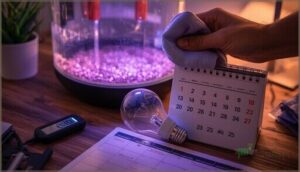
UVB bulbs don’t last forever, and their invisible output drops long before the light dims. You’ll need to replace them on schedule, keep fixtures clean, and watch for damage that could put your snake at risk.
Here’s how to stay on top of maintenance so your lighting stays effective and safe.
Regular Bulb Replacement Timelines
Your UVB bulbs won’t warn you when they stop working. Fluorescent tubes lose effectiveness in 6 to 9 months; mercury vapor bulbs last about 12 months. UVB decay happens even when visible light stays bright, so mark installation dates on each bulb.
Monthly UV meter checks confirm output at basking level. Replace promptly when readings drop below your snake’s species-specific minimum—compromised UVB lighting threatens calcium metabolism and long-term snake health.
Cleaning and Inspecting Fixtures
Dust buildup can slash your UVB output by 30 percent or more. Wipe fixture housings weekly with a damp microfiber cloth, and use mild cleaners on ceramic sockets to prevent surface damage.
Power off and unplug before every cleaning session—electrical checks and burn prevention start with safe handling.
Inspect lenses monthly for fogging or cracks, and replace damaged components immediately to maintain peak UVB safety.
Spotting and Addressing Damage
Cracks or blackened housing aren’t just cosmetic—they signal immediate safety risks and failing UVB output that can trigger Metabolic Bone Disease by disrupting Vitamin D3 synthesis.
Conduct weekly safety checks for loose mounts, corrosion, or peeling sleeves; cracked UVB Light demands replacement within 24 hours, while corroded parts need attention within a week.
These damage signs guide your equipment maintenance timeline and protect your snake’s long-term health.
Integrating UVB With Other Enclosure Lighting
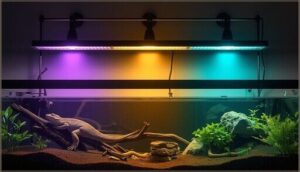
Your snake’s enclosure needs more than just UVB—it needs a balanced lighting system that works together without creating hot spots or confusing shadows.
Getting UVB to play nicely with heat lamps and day-night bulbs takes some planning, but it’s not complicated once you understand the basics.
Here’s how to layer your lighting so everything aids your snake’s health instead of working against it.
Combining UVB and Heat Sources
Your UVB lighting and heat lamps must work together without creating dangerous hotspots. Place separate heat sources on the opposite end from UVB to build a clear temperature gradient. This thermoregulation strategy lets your snake choose between warm basking zones and cooler rest areas.
Here’s your integration checklist:
- Mount UVB fixtures 6–12 inches from surfaces to prevent burns
- Position heat lamps away from UVB to avoid fixture damage
- Maintain basking temperatures between 88–92°F using dimmer thermostats
- Use ceramic heat emitters for nighttime heat options without disrupting photoperiod
- Install mesh guards for UVB fixture safety and reptile lighting protection
Avoiding Light Overlap and Glare
Multiple bright fixtures create harsh glare that stresses your snake and disrupts visual comfort. Position your UVB lighting at a 15–30 degree downward angle for proper beam angling, keeping at least 1.5 times the bulb width between fixtures.
Fixture shielding with matte covers blocks direct light spill onto viewing glass. Light diffusion through frosted guards softens hotspots while maintaining your reptile lighting setup’s photoperiod effectiveness and glare reduction.
Enhancing Snake Well-Being
Balanced snake enclosure lighting facilitates natural animal behavior by creating thermal gradients for thermoregulation and temperature control alongside UVB exposure. Your habitat design should integrate environmental enrichment through varied light zones that encourage exploration and proper health monitoring of activity patterns.
When UVB light complements heat sources, you’re facilitating snake nutrition through improved calcium metabolism while maintaining visual comfort that reduces stress and promotes long-term well-being.
Troubleshooting Common UVB Setup Issues
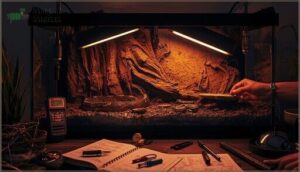
Even with careful planning, UVB setups don’t always work perfectly the first time. You might face weak UV readings, equipment that doesn’t fit right, or a snake that won’t use the area you’ve lit.
Here’s how to identify and fix the most common problems you’ll encounter.
Low UVI Readings
Low UVI readings don’t guarantee safety—cumulative exposure still matters. If your UVI reader registers below target, check bulb age and fixture distance first.
Even moderate UV index levels can pose erythemal risk with prolonged exposure, so don’t dismiss borderline measurements.
Ocular safety differs from skin protection; your snake’s eyes face direct UVB lighting for hours daily, making consistent monitoring essential for preventing long-term damage.
Fixture Compatibility Problems
Your UVB lighting setup can fail before the bulb burns out. Fixture sizing mismatches—tube bulbs in compact-only hoods or mercury vapor lamps without proper ballasts—prevent ignition entirely.
Electrical safety demands correct wattage; overloaded circuits trip breakers or overheat snake enclosure lighting.
Material durability suffers when plastic hoods warp from heat, altering distance to your basking zone.
Check mounting options and bulb replacement compatibility before purchasing any reptile lighting fixture.
Snake Avoiding UVB Area
When your snake consistently avoids the basking area, you’re witnessing UVB stress. Check for light gradients—snakes need retreat zones where photoperiod and thermoregulation happen separately.
Reposition your reptile lighting to create distinct basking behavior zones while preserving dark hides. If snake hiding persists, reduce UVB intensity or shorten exposure periods.
Proper snake enclosure lighting balances visibility with comfort-driven choices.
Frequently Asked Questions (FAQs)
How do you set up UVB for ball pythons?
Ironically, a species famous for thriving in dark burrows still benefits from UVB lighting.
Mount a low-intensity 0 tube 10–14 inches above your ball python’s basking spot for ideal reptile health and vitamin D3 synthesis.
Is too much UVB bad for snakes?
Yes. Excessive UVB causes skin burns, dehydration, and stress in snakes. Overexposure risks include disrupted shedding, eye irritation, and metabolic imbalances.
Proper UVB dosage prevents health consequences while supporting vitamin D3 synthesis safely.
Should UVB cover the whole enclosure?
No. Targeted UVB lighting over the basking zone lets your snake regulate exposure naturally.
Full enclosure coverage risks overstimulation and prevents proper thermoregulation through lighting gradients essential for snake behavior in reptile enclosures.
Can snakes get too much UVB exposure?
Like a sunbather without shade, snakes can suffer UVB overdose. Excessive UVB exposure causes skin burns, vitamin D3 toxicity, and dehydration.
Proper reptile lighting distance and timed cycles prevent UVB-related reptile safety issues.
Do baby snakes need different UVB levels?
Baby snakes usually need lower UVB intensity than adults—species-dependent requirements guide proper juvenile lighting.
Provide basking zones with gentler UVB exposure, allowing young snakes to regulate vitamin D3 synthesis naturally while supporting healthy snake development within their reptile habitat.
How does screen mesh affect UVB strength?
Screen mesh creates a barrier that blocks 30–50% of UVB transmission depending on weave density. Metal screens with larger openings allow more light through than tight fabric weaves, markedly reducing your snake’s UVB exposure.
Should I provide UVB during winter brumation?
You don’t need UVB during winter brumation. Most species tolerate a complete shutdown when inactive and not feeding.
If you prefer a gradual reduction, dim the UVB intensity instead—then restore normal photoperiod as brumation ends.
What UVI reading should I target exactly?
Most snakes thrive when you maintain a UVI of 3 to 6 at the basking spot—tropical species prefer 4 to 5, while desert dwellers tolerate slightly higher readings without stress.
Conclusion
Your snake’s skeletal integrity doesn’t rely on ancient alchemy—it depends on modern precision. How to set up UVB for a snake enclosure correctly means choosing appropriate bulbs, positioning fixtures at safe distances, maintaining consistent photoperiods, and replacing equipment before effectiveness declines.
Each parameter protects against metabolic collapse. Measure twice, mount once, and commit to the maintenance schedule. Your vigilance transforms invisible wavelengths into structural strength. That’s not just good husbandry—it’s the difference between thriving and fracturing.
- https://arcadiareptile.com/lighting/guide/
- https://www.reptiles.swelluk.com/help-guides/how-to-select-the-right-lighting-for-your-reptile/
- http://www.uvguide.co.uk/fluorescenttubemeshtests.htm
- https://reptilenetworks.co.uk/2019/08/12/uvb-on-top-of-screen-mesh/
- https://www.aussiepythons.com/threads/correct-distance-from-uvb-light-and-basking-light-for-a-beardie.148632/