This site is supported by our readers. We may earn a commission, at no cost to you, if you purchase through links.
A ball python rarely has a bad shed out of nowhere. Most of the time, the problem started days earlier, when dry air tightened old skin and the eye caps lost moisture.
Owners often chase whole-enclosure humidity, but many snakes improve faster when they get one damp, secure place to rest.
That’s where the humid hide benefits for ball python shedding become hard to ignore. A well-set hide creates a small pocket of moisture right where your snake needs it most, during the dull phase, the blue phase, and the final push to peel cleanly instead of patch by patch.
Table Of Contents
- Key Takeaways
- Why Humid Hides Matter for Ball Python Shedding
- Recognizing The Ball Python Shedding Cycle
- Ideal Humidity Levels During Each Shed Stage
- How to Set Up a Ball Python Humid Hide
- Preventing Stuck Shed and Retained Eye Caps
- Cleaning and Maintaining Your Humid Hide
- Common Humid Hide Setup Mistakes to Avoid
- Frequently Asked Questions (FAQs)
- How do you keep a ball python from shedding?
- How do you maintain humidity in a ball python?
- Can a ball python cage keep humidity high?
- How to keep a ball python healthy?
- Are humid hides good for ball pythons?
- What will help my ball python shed?
- Does humidity help reptiles shed?
- What signs show a humid hide is too wet?
- How often should humid hide substrate be replaced?
- Are humid hides useful for ball python breeding?
- Conclusion
Key Takeaways
- Bad sheds usually start with low humidity before shedding begins, and a humid hide works better than chasing whole-tank humidity because it gives your ball python a moist, secure spot where it actually rests.
- Humid hides matter most during the dull, blue, and clear phases because steady localized moisture keeps the skin flexible, helps old skin release cleanly, and lowers the risk of stuck shed and retained eye caps.
- Good setup makes the difference: keep overall enclosure humidity around 60–80%, raise the humid hide to about 80–90% in the blue phase, place it on the warm side, and use damp sphagnum moss, coco coir, or a mix that stays moist without becoming wet.
- To keep the hide safe and effective, clean it weekly, replace compacted or smelly substrate, avoid placing it too close to heat or sealing it without airflow, and see a vet for eye caps that last over seven days, tail darkening, infection signs, wheezing, lethargy, or weight loss.
Why Humid Hides Matter for Ball Python Shedding
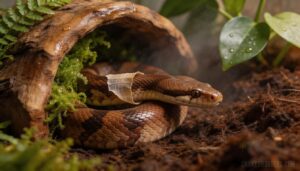
A humid hide does one thing really well — it gives your ball python a reliable spot to absorb moisture right when its body needs it most. Whole-tank humidity helps, but a dedicated hide creates a targeted microclimate that makes a real difference during shedding.
For tips on choosing moss and arranging hides to keep humidity steady, check out this guide to ball python hides for small tanks.
Here’s what you need to know about why that matters.
How Humid Hides Support Clean, Complete Sheds
A humid hide does one job really well — it gives your ball python a reliable moisture zone exactly when the ball python shedding process demands it. That microclimate consistency enhances skin elasticity, so old skin separates cleanly instead of clinging.
Heat evaporation inside the hide keeps conditions steady. Stress reduction follows naturally, and proper humidity management for reptile shedding means a stuck shed becomes far less likely.
A localized high humidity microclimate helps maintain skin pliability during pre‑shed.
The Connection Between Localized Moisture and Skin Release
Localized moisture works differently than ambient air humidity. A humid hide builds a microclimate vapor gradient right where your snake rests, slowing trans-epidermal water loss at the skin surface.
Skin barrier lipids stay intact longer, supporting hydration-driven desquamation — meaning old layers separate cleanly.
Phase-specific moisture during the blue phase is what turns a potential stuck shed into a smooth, complete ball python shedding process.
Why Whole-tank Humidity Alone is Not Always Enough
Even with whole-tank relative humidity in range, thermal gradient effects mean your warm side often runs drier than your sensor shows. Airflow drying through screen tops pulls moisture out fast. Substrate surface dryness develops between mistings.
Sensor placement issues skew readings too — your hygrometer isn’t measuring where your snake actually rests. Microclimate variability is real, and a humid hide solves it directly.
Recognizing The Ball Python Shedding Cycle
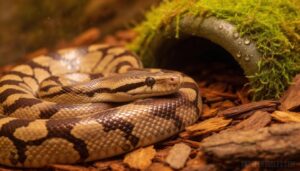
Knowing your ball python’s shedding cycle takes the guesswork out of humid hide management.
There are three key stages you’ll want to recognize before you start adjusting humidity or reaching for the misting bottle. Here’s what each stage looks like and what it means for your snake’s care.
Juvenile Vs. Adult Shedding Frequency
Juvenile shedding happens faster — roughly every 3 to 6 weeks — because rapid growth rate and higher metabolic demands keep skin renewal in overdrive. Adults slow down to every 6 to 10 weeks as age-related hormones shift and growth stabilizes.
Matching your humid hide setup and feeding frequency to your snake’s life stage helps prevent stuck shed before it starts.
Pre-shed Signs: Dull Coloration and The Blue Phase
Your ball python will tell you a shed is coming — you just need to know what to watch for. These five pre-shed signs appear in sequence:
- Dull Skin Warning — Colors fade and look washed out
- Belly Pink Shift — Abdomen brightens slightly
- Fluid Separation — Layers split beneath the surface
- Spectacle Clouding — Eyes turn milky blue
- Pre-shed Timeline — Full sequence spans about 14 days
The Clear Phase and What to Expect Before The Shed
After the blue phase, your snake’s eyes clear again — but the shed hasn’t happened yet. This is the clear phase, and it’s the stage most keepers misread.
If you notice issues like difficulty shedding or unusual breathing during this phase, understanding common snake health concerns can help you spot problems early.
| Clear Phase Sign | What It Means |
|---|---|
| Eye Reclear Timing | Eyes clear 1–3 days before shedding |
| Fluid Reabsorption | Internal Skin Loosening continues beneath the surface |
| Behavioral Calmness | Snake settles; still avoid handling |
| Appetite Decrease | May persist from earlier preshed signs |
Keep your humid hide ready — stuck shed risk is highest now.
Ideal Humidity Levels During Each Shed Stage
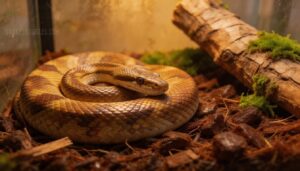
Humidity isn’t a "set it and forget it" number — it shifts with your snake’s shedding cycle, and so should your approach. Getting the levels right at each stage makes a real difference between a clean shed and a frustrating one.
Here’s what you need to know at every point in the process.
Baseline Enclosure Humidity Targets (60–80%)
Think of your enclosure as a two-zone system. Humidity Gradient Balance means the warm side runs slightly wetter, while Cool Side Stabilization keeps the far end drier — preventing stagnant dampness. Aim for 60–80% relative humidity overall. Substrate Moisture Management and Condensation Control keep swings in check.
- Place your digital hygrometer at mid-height
- Spot-check substrate moisture at multiple locations
- Schedule regular Hygrometer Calibration to guarantee accurate readings
Raising Humidity to 80–90% During The Blue Phase
Once your snake enters the blue phase, bump the humidity hide up to 80–90%. This Microclimate Timing window is critical — the fluid loosening old skin needs sustained moisture to release cleanly.
Your Humidity Buffer Substrate, whether sphagnum moss or coco coir, stabilizes that range without soaking the hide.
Mind Condensation Management and Airflow Regulation: damp air, not standing water.
Temperature-Humidity Interaction matters too — warm-side placement keeps conditions consistent and prevents stuck shed.
Using Digital Hygrometers to Monitor Levels Accurately
A good digital hygrometer is your eyes inside the enclosure.
Follow Placement Best Practices: mount it near the humid side, away from vents and heat sources.
Stick to a Sensor Calibration Protocol every one to three months to keep readings within 1–2% RH accuracy.
Use Data Logging Frequency of 5–15 minute intervals, and enable Wireless Alert Setup for threshold breaches.
Don’t forget Battery Health Monitoring — low power skews readings and costs you a clean shed.
How to Set Up a Ball Python Humid Hide
Setting up a humid hide doesn’t require expensive equipment or a complicated process. The key is getting three things right: the container, the substrate, and where you put it.
Here’s what to focus on for each part.
Choosing The Right Container Size and Material
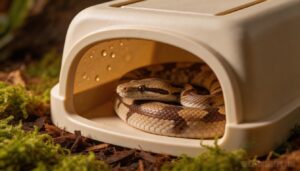
Size matters more than most keepers realize. Your humid hide should measure about 1.5 times your ball python’s girth — snug enough to feel secure, but not a squeeze.
For materials, stick to food-grade polypropylene or ABS plastic; material toxicity is a real concern with unknown plastics. Adequate wall thickness helps retain moisture longer, while small lid venting gaps — around 2–4 mm — prevent stale, mold-prone air buildup.
Best Substrates for Moisture Retention: Sphagnum Moss Vs. Coco Coir
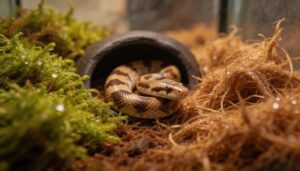
Once you’ve picked your container, what goes inside makes or breaks the humidity hide.
Sphagnum moss holds up to 20 times its weight in water — that’s serious moisture holding capacity for stuck shed prevention.
Coco fiber holds around 8–9 times its weight but wins on airflow balance and substrate longevity.
Mold risk management is where coco fiber pulls ahead; sphagnum compacts and stays wet longer.
Mixing both balances humidity and drainage cleanly.
Placement on The Warm Side of The Enclosure
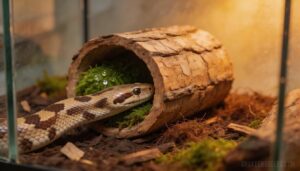
Where you set the hide matters as much as what’s inside it. Place it on the warm side of the tank — that warm side microclimate helps gradient-driven thermoregulation, keeping moisture active rather than stagnant.
hide entrance orientation angled away from the direct heat spot. Airflow modulation and a solid draft buffer zone prevent the humidity from evaporating too quickly.
DIY Humid Hide Construction With a Tupperware Container
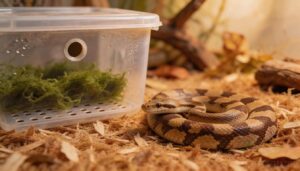
A plastic tub with a loose-sealing lid is your simplest DIY win. Cut a 1 cm vent hole near the top for airflow — that small opening keeps air moving without draining your moisture. Add a perforated tray inside to distribute dampness evenly, then layer damp sphagnum moss on top.
Label the container with your last cleaning date to stay on schedule.
Preventing Stuck Shed and Retained Eye Caps
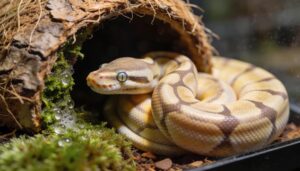
Stuck shed doesn’t happen by accident — dry conditions set the stage long before your snake starts rubbing its snout. Knowing what causes dysecdysis and how to stop it before it starts makes a real difference in your snake’s comfort and health.
Stuck shed starts long before the shed itself—dry conditions quietly create the problem before your ball python shows any signs
Here’s what you need to understand about preventing stuck shed and retained eye caps.
How Dry Conditions Lead to Dysecdysis
Dry air is basically a silent trap. When relative humidity drops too low, vapor pressure increase pulls moisture straight off your snake’s skin — faster than the body can replace it.
Blue phase dryness makes this worse: the separating layers dry out before they fully release. That skin adhesion causes stuck shed, and if dehydration effects compound low humidity stress, dysecdysis becomes almost inevitable.
Role of The Humid Hide in Preventing Retained Eye Caps
Retained eye caps are where a proper ball python humidity hide setup really earns its place.
Eye Cap Hydration depends on Microclimate Contact — your snake pressing its face directly against a moist Face-Contact Surface inside the hide. That Targeted Moisture helps Cap Loosening Mechanics by keeping the thin tissue flexible until it releases naturally.
Without a humid hide, stuck shed around the eye caps becomes a real risk.
Lukewarm Soaking Protocol for Stuck Shed Relief
When your humid hide isn’t enough to clear a stuck shed, a simple soaking protocol can finish the job.
- Water Temperature Control: Fill your soak container with lukewarm water at 80–85°F.
- Soak Container Design: Use a locking tub with air holes so your ball python stays secure.
- Duration Guidelines: Leave the snake undisturbed for 15–20 minutes.
- Post-Soak Monitoring: Check whether the shed releases naturally — never force it.
When to Seek Veterinary Evaluation
Some shedding problems go beyond what a humid hide or lukewarm soak can fix.
Seek veterinary care if you notice persistent eye caps lasting more than seven days, tail constriction with darkening tissue, or skin infection signs like redness, blistering, or foul odor.
Systemic illness indicators — significant weight loss, lethargy, or wheezing — also demand a health assessment.
Don’t wait on these.
Cleaning and Maintaining Your Humid Hide
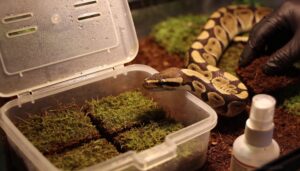
humid hide does a lot of work, but only if you keep it clean and functional.
Neglect it for even a week or two, and you’re looking at mold, bacteria, and a snake that avoids the very thing meant to help it shed.
Here’s what you need to stay on top of it.
Weekly Cleaning Routine With Reptile-safe Disinfectant
Clean hides keep your snake safe — and the routine is simpler than you think.
- Remove waste first, then rinse before applying disinfectant.
- Follow proper Disinfectant Dilution — full strength irritates skin.
- Contact Time Management matters: let it sit, then rinse.
- Use Glove Use Protocol, then air-dry completely for Drying Odor Control.
Store clean hides separately using a Storage Separation System.
Replacing Compacted or Discolored Substrate
Old substrate doesn’t just lose moisture — it loses structure. Compacted sphagnum moss or coco coir blocks even humidity distribution, creating dry patches that increase dysecdysis risk.
Follow this Substrate Refresh Schedule to maintain Moisture Uniformity and avoid Material Performance Degradation:
| Visual Substrate Indicators | What It Means | Action |
|---|---|---|
| Dark, muddy streaks | Uneven saturation | Replace immediately |
| Crusty or crunchy texture | Dried hard spots | Full substrate swap |
| Compressed, unfluffable clumps | Structure collapsed | Replace, don’t stir |
| Sour smell present | Hygiene Odor Reset needed | Remove and sanitize |
| Uniform light-brown color | Good moisture retention | Monitor weekly |
Fresh substrate selection for moisture retention restores capillary movement, ensuring your humid hide maintenance stays effective throughout every shed cycle.
Preventing Mold, Mildew, and Bacterial Growth
Think of mold like a weed—give it a foothold, and it spreads fast.
You prevent mold and bacterial growth in reptile tanks by dialing in Airflow Optimization, choosing Mold-Resistant Materials, and maintaining Moisture Balance. Pair this with steady Temperature Regulation and Hygrometer Accuracy.
That’s your foundation for preventing mold and mildew in humid hides and keeping your ball python humidity hide setup safe.
Seasonal Adjustments to Misting Frequency
Winter dry air pulls moisture from your humid hide fast, while summer humidity spikes let you mist less. Thermostat influence and ventilation both shift how quickly water evaporates.
Instead of sticking to a fixed misting schedule for hides, use hygrometer triggering for seasonal humidity adjustments for ball pythons:
- Check hide humidity daily
- Adjust misting after ventilation changes
- Monitor thermostat settings
- Respond to stuck shed
- Mist more during winter
Common Humid Hide Setup Mistakes to Avoid
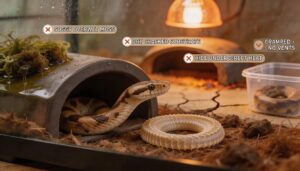
Setting up a humid hide sounds simple, but a few common mistakes can make shedding much harder for your snake. Paying attention to the right details can save you trouble down the line.
Here’s what you’ll want to watch out for as you plan your enclosure.
Placing The Hide Too Close to Heating Elements
When you place your humidity hide right next to a heat source, you risk Heat Burn, Hot Spot Spikes, and rapid Evaporation Acceleration. That’s why careful placement strategies for humid hides matter.
Too much heat throws off the temperature gradient, causes Condensation Imbalance, and leads to Snake Avoidance Behavior—meaning your python won’t use the hide when it needs moisture most.
Using Materials That Trap Excess Moisture Without Airflow
Moisture retention materials can backfire if you skip Airflow Control Mechanisms. For example, a Material Moisture Barrier without ventilation turns your humid hide into a soggy trap.
Microclimate Isolation Design matters—humidity pocket engineering needs Seal Integrity Testing, not a sealed tomb.
To prevent mold and bacterial growth, check substrate selection for moisture retention and tweak ventilation adjustments for glass tanks:
- Test airflow regularly
- Avoid airtight containers
- Replace damp substrate weekly
Skipping The Hygrometer Inside The Hide
Skipping a hygrometer inside your humid hide creates a microclimate blind spot. You might trust a stable enclosure reading, but hide humidity lag is common.
That undetected dry pocket can sabotage ball python shedding humidity management, leading to inconsistent shed outcomes.
For best results, include humidity monitoring in your DIY humidity hide construction guide—don’t let misleading enclosure readings fool you.
Offering Only One Hide in The Enclosure
Relying on a Single Hide Strategy limits your ball python’s choices.
Microclimate Focus matters, but Behavioral Preference means snakes need options.
For healthy ball python shedding and humidity management, offer at least two hides:
- Warm and cool retreat zones
- Ventilation Balance
- Temperature Integration
- Reduce stress
- Use of humid hide in enclosure for identifying and treating stuck shed
Frequently Asked Questions (FAQs)
How do you keep a ball python from shedding?
You can’t prevent ball python shedding—it’s a natural process.
Focus on Vitamin A levels, consistent hydration, temperature gradient, stress management, humidity management, and regular vet exams to support healthy sheds and avoid dysecdysis or retained eye caps.
How do you maintain humidity in a ball python?
You maintain humidity in a ball python’s enclosure by combining Water Bowl Evaporation, Misting Schedule Timing, Ventilation Slot Adjustment, Heat Source Positioning, regular Hygrometer Calibration Frequency, and digital hygrometer checks.
—plus automated misting systems for steady humidity regulation techniques.
Can a ball python cage keep humidity high?
Yes, a ball python cage can keep humidity high if you use deep substrate, place the water bowl for evaporation, adjust seasonally, monitor with humidity sensors, and improve enclosure ventilation.
Humid hides help maintain ideal RH for shedding.
How to keep a ball python healthy?
Funny how a ball python’s health hinges on simple routines: Balanced Nutrition, Proper Hydration, a stable temperature gradient, Enrichment Activities, Regular Veterinary Checks, and the ideal RH for ball pythons.
Don’t overlook ball python shedding humidity management or identifying and fixing stuck shed.
Are humid hides good for ball pythons?
Humid hides are genuinely worth it.
They create a moisture microclimate your ball python can choose when it needs it most — making cleaner sheds, better skin release, and fewer stuck-shed headaches far more likely.
What will help my ball python shed?
Dry skin and stuck sheds aren’t just a nuisance—they signal deeper issues.
Your ball python needs Nutritional Support, Vitamin A Intake, Hydration Access, Temperature Gradient, Stress Reduction, and steady humidity control to prevent shedding problems and retained eye caps.
Does humidity help reptiles shed?
Moisture Impact is critical for reptiles. Proper humidity control boosts Skin Elasticity, Hydration Behavior, and Respiratory Health.
Without ideal RH for ball pythons, shedding problems like stuck sheds occur. Ball python shedding humidity management prevents these issues.
What signs show a humid hide is too wet?
Picture lifting the hide and finding puddles inside, condensation droplets, or a sour odor—these signal mold growth and mildew risk.
Sticky skin, scale rot, or persistent humidity levels near saturation invite mold and bacteria, plus respiratory issues.
How often should humid hide substrate be replaced?
Aim for a replacement frequency of once a week, or sooner if you notice substrate degradation, musty odor indicators, or compromised moisture balance.
Cleaning and disinfecting reptile hides at each change prevents mold and bacterial growth in humidity hides.
Are humid hides useful for ball python breeding?
Humid hides are essential during ball python breeding. They help regulate pre‑lay moisture, boost mating season humidity, and support clutch hydration.
stable microclimate improves breeding success and prevents retained eye caps, especially during egg incubation humidity changes.
Conclusion
As the shedding cycle comes full circle, a well-crafted humid hide stands as a beacon of relief for your ball python. Like a gentle rain shower on parched earth, humid hide benefits for ball python shedding bring much-needed moisture to tight skin.
By integrating this simple yet effective tool, you’ll witness a transformation from stuck sheds to smooth, complete peels. Your snake’s health and your peace of mind will thank you for this small but essential investment.
- https://petcarelab.co/blog/ball-python-humidity-setup-to-prevent-stuck-shed
- https://www.furrycritter.com/pages/articles/reptiles/humid_hide.htm
- https://ballpythonbreeder.co.uk/ball-python-care-sheet/ball-python-humidity-water-shedding/ball-python-shedding-and-humidity/
- https://ludwig.guru/s/shed+clarity
- https://tegutalk.com/threads/stuck-shed-need-help.485/