This site is supported by our readers. We may earn a commission, at no cost to you, if you purchase through links.
A snake’s comfort depends not on luck but on precision. A few degrees too warm can dehydrate it; a few too cool can slow digestion and leave it vulnerable to illness. The same goes for humidity—too low, and shedding turns painful; too high, and scales invite infection.
Each species, from ball pythons to corn snakes, thrives within narrow environmental margins shaped by evolution. Understanding the ideal temperature and humidity for a snake terrarium isn’t about numbers on a gauge—it’s about recreating the invisible balance their wild habitats perfected.
That balance begins with controlling heat and moisture correctly from the start.
Table Of Contents
- Key Takeaways
- Ideal Temperature Ranges for Snake Terrariums
- Importance of Temperature Gradients
- Proper Humidity Levels for Snakes
- Species-Specific Temperature and Humidity Needs
- Equipment for Heating Snake Terrariums
- Humidity Control Methods in Terrariums
- Monitoring Temperature and Humidity Accurately
- Adjusting Terrarium Conditions Seasonally
- Health Effects of Improper Temperature or Humidity
- Top 9 Products for Temperature and Humidity Control
- 1. Zoo Med ReptiSun UVB Lamp
- 2. Solarmeter Reptile UV Index Meter
- 3. Vinaco Par30 Halogen Bulb
- 4. Repti Zoo Heat Lamp Bulb
- PAR30 Short Neck Dimmable Halogen Bulbs
- 5. Lutron Plug In Dimmer Switch
- 6. Herpstat Temperature Controller
- 7. Inkbird Digital Temperature Controller Thermostat
- 8. F10 All Purpose Disinfectant Spray
- Frequently Asked Questions (FAQs)
- How humid should my snake enclosure be?
- Is 40 degrees too cold for snakes?
- What temperature should a snake terrarium be?
- What are signs of too much humidity for pythons?
- What is the ideal temperature range for a ball python’s habitat?
- How should I create a temperature gradient in my ball python’s enclosure?
- How important is maintaining proper humidity for ball pythons?
- Should I use UVB lighting in my ball python’s enclosure?
- How can I ensure safe temperatures for my ball python’s enclosure?
- What temp and humidity should a snake tank be?
- Conclusion
Key Takeaways
- Snakes need a clear temperature gradient, with a warm side, cool side, and basking hotspot, so they can regulate their body temperature and digest properly.
- Humidity must stay in a species-appropriate range, generally around 40–70 percent, with brief increases during shedding and careful control to avoid dry sheds or respiratory stress.
- Ball pythons and corn snakes each have specific temperature and humidity ranges within those general bands, so you have to match your setup to the exact species you keep.
- Safe husbandry depends on using proper heating and humidity equipment with thermostats, thermometers, hygrometers, and regular monitoring to prevent burns, scale rot, dehydration, and other health problems.
Ideal Temperature Ranges for Snake Terrariums
Getting your snake’s temperature range right is the foundation of a healthy enclosure. It keeps their digestion, shedding, and energy levels exactly where they need to be.
If you’re still fine-tuning your setup, this guide on how long a snake can go without heat will help you understand how crucial steady warmth really is.
Here’s how to set your warm zone, cool zone, and basking area for stable, safe conditions.
Warm Zone Temperatures
Think of the warm zone as your snake’s engine room: it drives metabolism, digestion rates, and comfort. You’re aiming for a controlled temperature gradient with basking areas and a warm hideout held around 30–32°C for most species, slightly higher for ball pythons, using safe heat sources like heat mats plus firm temperature control to prevent instability and thermal burns.
Cool Zone Temperatures
While the warm zone fuels digestion, your cool zone keeps Snake Thermoregulation balanced within a stable temperature gradient. Design this area around 75–80°F for most species to support proper thermal regulation and rest.
Cool Zone Design matters—place hides away from direct heat to maintain Environmental Stability and consistent Humidity Control with minimal fluctuations.
Basking Spot (hotspot) Requirements
Once your cool zone is set, you still need a defined basking spot to complete the temperature gradient and support reliable Snake Thermoregulation. Aim for a Hotspot Temperature around 88–95°F on the actual surface, using heat lamps or carefully controlled heat mats as Heat Source Options. Prioritize Basking Spot Safety and Burn Prevention Methods so no surface your snake touches exceeds your species’ safe range within the thermal gradient.
- A low stone ledge directly under a focused basking spot beam, rim glowing softly in the enclosure.
- Your snake stretched out, belly pressed to a warm slate while cooler shadows wait a body-length away.
- Overhead heat lamps secured with guards, every hotspot checked by an infrared gun before your snake explores.
Importance of Temperature Gradients
Snakes need more than one temperature in their enclosure to stay healthy. A proper gradient lets them warm up, cool down, and control their body temperature naturally.
Here’s how to set up those critical zones to keep their environment balanced and safe.
Role in Snake Thermoregulation
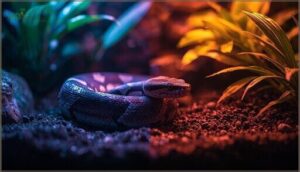
Temperature gradients are the backbone of Thermal Regulation and real thermoregulation in your snake’s body. In a proper thermal gradient, your snake uses Environmental Cues, Heat Sensing pit organs, and blood-flow based Thermogenic Control to fine-tune temperature control, shifting between mild Cold Adaptation on the cool side and deeper warming over heat mats or other heat sources as needed.
Creating Effective Gradients

Blueprints for Gradient Design let you turn any enclosure into focused temperature and humidity control, with a clear temperature gradient and defined Humidity Zones.
- Place heat mats at one end, thermostats managing gradual Temperature Ramping.
- Stagger hides and branches, enabling Microclimate Creation across the thermal gradient.
- Add stone beneath hotspots for Thermal Mass.
- Keep water bowl slightly warm-side, shaping humidity.
Risks of Uniform Temperatures

Without a stable temperature gradient, your snake faces overlapping health consequences. Uniform temperatures create digestion risks, respiratory stress, and immune suppression as natural thermoregulation fails. Constant warmth or chill triggers behavioral issues like refusal to feed.
Only careful climate control—using thermostats and heat mats—prevents temperature extremes that undermine your snake’s comfort and biological stability.
Proper Humidity Levels for Snakes
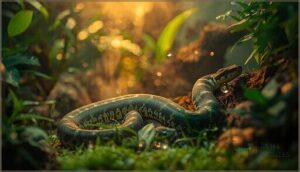
Keeping the right humidity in a snake terrarium is just as essential as maintaining proper heat. It shapes how your snake sheds, breathes, and stays hydrated.
Here’s what you need to know before setting the ideal levels for your enclosure.
General Humidity Guidelines
Think of humidity as the invisible pulse of your terrarium. Stable humidity levels protect Air Quality, guarantee proper Moisture Control, and support overall Snake Health. For reliable humidity management, use accurate humidity gauges and misting systems.
Humidity is the invisible pulse of your terrarium, quietly protecting your snake’s air quality, moisture balance, and overall health
Maintain Environmental Balance with these essentials:
- Steady readings
- Proper ventilation
- Controlled misting
- Balanced substrates
- Adaptive humidity control
Preventing Shedding Issues
Smooth shedding depends on precise humidity control and consistent temperature gradients.
Effective Shed Cycle Management starts with timed Humidity Spike Timing during the ecdysis phase, supported by Ecdysis Environment Optimization through moist hides and textured surfaces.
Combine Hydration Techniques and Skin Retention Solutions to reduce shedding difficulties, ensuring balanced temperature and humidity management for snakes throughout their cycles.
Avoiding Excess Moisture and Health Risks
Excess moisture is more dangerous than you think, because a constantly humid environment quickly turns into a health trap. You need tight humidity monitoring, pairing moisture control with strong airflow management and careful substrate selection to protect scale health and lungs. Aim for species-appropriate humidity levels and watch for:
- Early signs of scale rot or blistering
- Wheezing or mucus indicating respiratory problems
- Persistent mold growth demanding strict mold prevention strategies.
Species-Specific Temperature and Humidity Needs
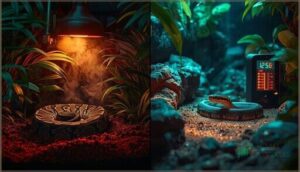
Every snake species has its own comfort zone regarding heat and moisture. Getting those details right is essential for proper digestion, shedding, and overall health.
Here’s what different species usually need to stay comfortable and thrive in your care.
Ball Python Requirements
A healthy ball python depends on a stable temperature gradient and tightly controlled humidity levels in your snake enclosures. Aim for a warm side around 88–92°F with a hotspot up to about 95°F, and a cool side near 75–80°F to support digestion, Ball Python Diet, and safe Ball Python Handling within sound reptile care.
Maintain 40–60% baseline humidity, raising it toward 70% during shed, and use Python Substrate Options and careful Snake Habitat Design to hold moisture without creating constantly damp conditions that risk skin or respiratory disease.
Build routine Python Health Checks into your schedule so you notice early if your ball python hugs one end of the tank, shows stuck shed, or avoids certain areas, which often signals that humidity levels or temperatures need correction in the habitat.
Corn Snake Requirements
Your corn snake depends on a steady temperature gradient and moderate humidity to thrive. Keep the warm side near 85–88°F and the cool end around 75–82°F. Stable reptile lighting and ventilation are crucial for proper snake behavior patterns.
Follow these guidelines for balanced reptile care:
- Regular terrarium maintenance tips
- Thoughtful snake habitat design
- Corn snake diet monitoring
Variation Among Other Common Species
When you step back and look at Snake Species Comparison as a whole, you see how strongly reptile environmental needs vary.
Garter Snake Care often means a slightly cooler temperature gradient with species-specific humidity requirements around the mid-range. Meanwhile, a Milk Snake Habitat or Kingsnake Behavior setup leans warmer and moderately dry.
Rosy Boa Diet demands still drier air, so you keep humidity levels low and rely on species-specific care to fine-tune every enclosure.
Equipment for Heating Snake Terrariums
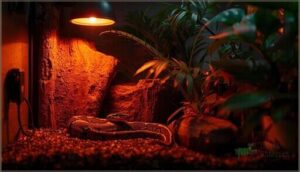
Keeping the right temperature inside your snake’s terrarium starts with choosing the right heating tools. Each type of heater works differently and maintains specific temperature zones.
Here’s a look at the main options you’ll use to keep conditions consistent and safe.
Heat Mats and Heat Lamps
Heat sources like heat mats and heat lamps each serve distinct roles in reptile heating. Proper mat placement under one third of the enclosure and careful lamp safety checks sustain a stable temperature gradient.
Pairing each heater with the right thermostat type prevents burns, improves regulation, and keeps heating costs efficient year-round.
Ceramic Heaters and Heat Projectors
Beyond mats and lamps, ceramic heat emitters and deep projectors provide steady, light-free warmth ideal for night use. Their broad infrared heat wavelengths penetrate deeply, balancing warmth across surfaces through efficient heat distribution and high thermal efficiency. Choose placement carefully—each heat source type produces unique surface effects:
- Ceramic emitters radiate IR‑C.
- Deep projectors mix IR‑A and IR‑B.
- Both maintain stable reptile heating.
- Uniform warmth prevents cold zones.
- Extended lifespan enables long-term setups.
Thermostat Regulation and Safety
One critical layer of control is reliable thermostat regulation, not just powerful heat lamps or another heat source. Thermostat calibration keeps your temperature gradient accurate, while modern thermostats add temperature alarms, overheat protection, and other safety features for true temperature control.
Pair the thermostat probe with your basking area, and let the system quietly guard your snake day and night.
Humidity Control Methods in Terrariums
Keeping humidity steady takes more than just adding a water bowl. You’ll need to use the right tools and setup to keep the air properly balanced.
Here are a few reliable ways to manage moisture in your terrarium.
Misting Systems and Spray Bottles
Manual spray bottles offer precise humidity control methods for your snake’s terrarium, with adjustable nozzles for fine mists that target dry spots without over-wetting substrate moisture management. Automatic Misting systems maintain steady humidity levels via timers, but require vigilant Water Quality and Nozzle Maintenance—check humidity gauges daily to fine-tune.
Spray Bottle Tips include using distilled water to prevent clogs and pump-action models for easier Mist Frequency.
Water Bowl Placement and Size
In your snake enclosure, Bowl Placement is one of the quiet levers that controls humidity levels, Evaporation Rates, and Snake Hydration through basic physics of warm air meeting exposed water bowls and Water Depth in a closed enclosure design focused on Humidity Control and temperature balance.
- Warm side placement: higher evaporation, higher humidity.
- Cool side placement: lower evaporation, drier air.
- Larger, wider bowls: stronger humidity influence, faster evaporation.
- Heavy, shallow dishes: safer soaking, less tipping, easier daily checks.
Substrate Choices for Moisture Retention
Strong humidity substrates work like a slow-release water battery for your enclosure, storing moisture and feeding a stable humid environment. Coconut Fiber and Cypress mulch hold moisture well for Moisture Control, while Sphagnum Moss works best in targeted humid hides rather than as the main substrate.
Bioactive Layers combine drainage and soil mixes, keeping surface humidity levels safe when your humidity gauges stay within range.
Monitoring Temperature and Humidity Accurately
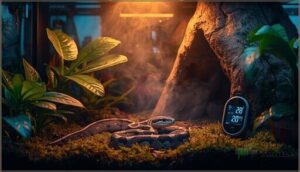
Keeping a close eye on temperature and humidity is the only way to keep your snake healthy. Even small changes in either can affect how well your setup works.
Here’s how to monitor both with accuracy and confidence.
Thermometer Types and Placement
Accurate temperature monitoring starts with choosing the right tools and putting them in the right places. Digital Thermometers give you precise readings at snake level, while Infrared Sensors quickly check basking surfaces. Analog Devices work as backups if you trust their Calibration Methods. Prioritize Probe Placement near hides, thermostats, and hotspot zones, then cross‑check with a hygrometer to relate temperature to humidity levels.
- Place one probe on or just above the warm hide floor.
- Set a second probe on the cool end to confirm the gradient.
- Use an infrared unit to spot‑check hotspot surface temperature.
- Keep analog dials away from direct lamps or heating elements.
Hygrometer Accuracy and Setup
Think of your hygrometer as your terrarium’s weatherman—only as good as its setup. Start with Hygrometer Calibration using a salt test to confirm Accuracy Testing, then place Digital Hygrometers or humidity gauges at snake height where airflow is steady.
Proper Sensor Placement of Humidity Probes keeps humidity levels precise across humid environments and within a healthy range. For best results, review to verify readings truly reflect your snake’s environment.
Regular Monitoring Schedules
Once your hygrometer and humidity gauges are set, the next step is building Regular Monitoring Schedules that keep temperature and humidity levels stable through real-life changes. As you adjust your setup, learn how different influence both temperature gradients and humidity stability. Use structured Daily Checks, Weekly Reviews, Monthly Audits, and Seasonal Adjustments, and support everything with simple Logging Readings so humidity monitoring becomes routine rather than guesswork.
- Daily Checks: confirm warm side, cool side, and ambient temperature plus humidity levels twice a day with your hygrometer or digital humidity gauges.
- Weekly Reviews: compare different devices, spot drifts, and adjust heating or misting if readings slide from target ranges.
- Monthly Audits: inspect for drafts, blocked vents, uneven heating, and recalibrate or replace inaccurate monitors before they cause health issues.
- Seasonal Adjustments: increase checks during weather swings, watching for nighttime temperature drops or persistently high humidity that might promote mold or scale problems.
- Logging Readings: jot key data alongside feeding, shedding, and cleaning dates so you can see patterns and correct small deviations early.
Adjusting Terrarium Conditions Seasonally
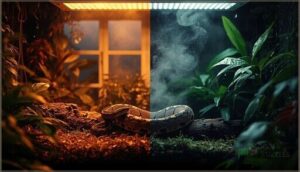
As the seasons shift, the conditions in your home shift with them, and your snake’s enclosure feels those changes first. Winter heating, summer heat waves, and changing indoor humidity can all push temperatures and moisture outside your snake’s safe range if you aren’t watching closely.
In this next section, you’ll see clear, practical ways to adjust your setup so it stays stable and safe all year.
Managing Temperature Fluctuations
One reliable way to tame temperature swings is to treat your setup like a layered system: stable Ambient Heating, precise Thermostat Setup, and controlled Gradient Control.
Use dimming thermostats on your main heat source types, especially overhead heat lamps, to smooth sudden spikes and dips.
Then verify temperature gradients with multiple thermometers so warm, cool, and basking zones stay within your target temperature band.
Humidity Adjustments in Different Climates
After you’ve stabilized temperatures, you need Climate Humidity strategies that match where you live.
In dry regions, use Dry Air Fixes like deeper substrate, misting systems, and even a room humidifier, watching humidity gauges so levels don’t crash.
In naturally damp homes, focus on Humid Microclimates, extra ventilation, and smaller water bowls as your key Seasonal Tweaks for safe humidity control and sensible Regional Adjustments.
Recognizing and Responding to Seasonal Changes
Seasonal Shifts bring Temperature Fluctuations, Humidity Swings, and subtle Snake Behavior changes that call for fine-tuned Environmental Adaptation. Use your humidity gauges and climate control tools to balance responses:
- Watch feeding slowdowns linked to cooler nights.
- Adjust heaters as room temps drop.
- Increase airflow and Environmental Enrichment when humidity levels rise indoors.
Health Effects of Improper Temperature or Humidity
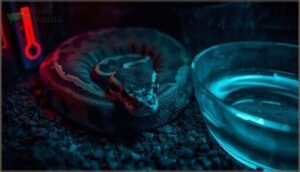
When temperature or humidity levels stay off for too long, snakes start to show clear signs of stress. Their bodies rely entirely on the environment to stay balanced, so small mistakes can lead to big health issues.
Here are the main problems you’ll notice when those conditions aren’t right.
Shedding Problems and Dehydration
Trouble with clean shedding cycles usually starts with water balance and humidity control, not bad luck. When humidity levels stay too low, skin health suffers, sheds break into patches, and dehydration signs like wrinkled skin or sunken eyes follow. Use humidity gauges, misting systems, and larger water bowls to stabilize moisture, then apply gentle rehydration methods such as short lukewarm soaks to support safe shedding and recovery.
| Problem | What you’ll see | What to adjust |
|---|---|---|
| Dry, patchy shedding | Retained eye caps, tail tip skin | Raise humidity, add a humid hide |
| Dehydration signs | Wrinkled skin, sunken eyes | Offer fresh water, soak, review heat |
| Repeated bad sheds | Flaky, dull body scales | Recheck humidity control and gradients |
Scale Rot and Respiratory Infections
Moisture imbalance can quickly undermine your snake’s health. Poor Humidity Management and cool, damp substrates invite scale rot, while stagnant air harms Respiratory Health.
Practice consistent Snake Hygiene, use humidity gauges, and regulate temperature for Infection Control.
Effective Scale Rot Prevention relies on balanced humidity levels, sanitation, and responsive reptile care to stop respiratory infections early.
Mold, Mildew, and Environmental Hazards
Neglect in Terrarium Maintenance quietly turns your enclosure into a reservoir of environmental hazards, undermining Air Quality and your snake’s respiratory health. When humidity levels stay chronically high with poor airflow inside enclosures, mold and mildew spread, spores rise, and bacterial growth accelerates.
- Practice Mold Prevention through routine mold prevention checks and thorough drying.
- Improve Spore Control.
- Biofilm Removal weekly.
Top 9 Products for Temperature and Humidity Control
Now that you understand what your snake needs, the next step is choosing reliable tools to control those conditions.
The products below are commonly used by keepers to manage temperature, humidity, and lighting with much better precision and safety.
Look through this list and match each option to your enclosure style, your budget, and your snake’s specific requirements.
1. Zoo Med ReptiSun UVB Lamp
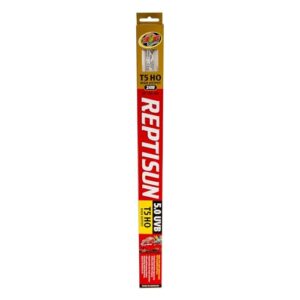
Think of the Zoo Med ReptiSun UVB lamp as the backbone of your snake’s lighting plan, even though snakes don’t bask like bearded dragons. This T5 HO FS5‑24 tube is 22 inches long, 24 watts, and produces stronger UVB and brighter visible light than standard ReptiSun 5.0 bulbs, so it suits larger or taller enclosures where light needs to reach the animal reliably.
Use it in an appropriate terrarium hood, position it above the primary activity area, and remember it supplies UVB, not heat, so you still need separate heating elements for proper gradients.
| Best For | Reptile owners who need strong, reliable UVB lighting for larger enclosures or species that benefit from moderate sun exposure. |
|---|---|
| Brand | Zoo Med |
| Weight | 3.2 oz |
| Material | Plastic |
| Indoor Use | Yes |
| Reptile Suitable | Yes |
| Safety Features | None listed |
| Additional Features |
|
- High-output T5 design delivers strong UVB for healthy bone development.
- Bright, full-spectrum light improves visibility and natural behavior.
- Fits comfortably in standard 22-inch fixtures for broad coverage.
- Some units may burn out sooner than expected.
- Requires a separate hood or fixture for setup.
- Reports of shipping damage or inconsistent packaging.
2. Solarmeter Reptile UV Index Meter
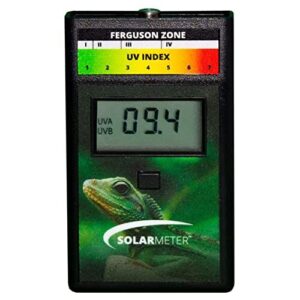
A reliable UV meter can make or break your lighting setup, and the Solarmeter 6.5R is the standard tool for accuracy. It measures the 280–400 nm range, showing precise UV Index readings from 0 to 199.9.
You can map basking zones, track bulb aging, and fine‑tune lamp height without guesswork. Compact, NIST‑traceable, and simple to use, this handheld meter ensures your snakes receive safe, consistent exposure—critical for preventing vitamin D deficiency and maintaining overall reptile health.
| Best For | Serious reptile keepers who want precise UVB monitoring to keep their pets healthy and lighting setups perfectly tuned. |
|---|---|
| Brand | Solarmeter |
| Weight | 4.5 oz |
| Material | Unspecified |
| Indoor Use | Yes |
| Reptile Suitable | Yes |
| Safety Features | NIST Traceable |
| Additional Features |
|
- Highly accurate readings across the 280–400 nm spectrum.
- Easy one-button operation with a clear LCD display.
- Compact and durable design backed by NIST-traceable calibration.
- Pricey compared to basic UV meters.
- Requires careful sensor positioning for accurate basking spot readings.
- Doesn’t replace regular reptile health checks.
3. Vinaco Par30 Halogen Bulb
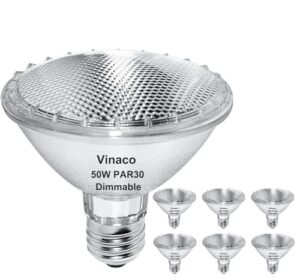
A single bulb can define your terrarium’s balance, and the Vinaco PAR30 halogen does it expertly. Producing about 500 to 1100 lumens with a focused flood beam, it creates strong, natural basking zones without uneven hot spots.
The warm white 3000K light mimics afternoon sun, showing true colors while providing steady infrared warmth. Fully dimmable from 10–100%, it lets you fine‑tune thermal gradients safely.
Durable, mercury‑free, and designed for standard E26 fixtures, it’s a dependable choice for daily reptile use.
| Best For | Reptile owners who want a warm, natural‑looking light source that safely balances heat and brightness in terrariums. |
|---|---|
| Brand | Unbranded |
| Weight | 2.64 oz |
| Material | Glass |
| Indoor Use | Yes |
| Reptile Suitable | No |
| Safety Features | No hazardous emissions |
| Additional Features |
|
- Produces a cozy 3000K glow that mimics natural sunlight.
- Fully dimmable for precise temperature and lighting control.
- Mercury‑free, sturdy glass build fits standard E26 fixtures.
- Shorter 3000‑hour lifespan compared to LED options.
- Runs hotter and uses more energy than modern bulbs.
- Some users report early burnouts or inconsistent performance.
4. Repti Zoo Heat Lamp Bulb
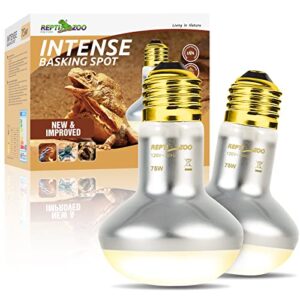
After a precise halogen like the Vinaco, you may want a more specialized reptile brand. Repti Zoo heat lamp bulbs offer intense basking spots, infrared night bulbs, and full‑spectrum “sun lamps” that combine heat, UVA, and UVB in one 100W self‑ballasted bulb. Most use standard E26 or E27 bases and are rated for roughly 2,000–3,000 hours.
In practice, you should monitor closely; users report some 75W models failing early or losing output, especially in larger enclosures during long daily use.
| Best For | Reptile owners who want a reliable, easy-to-use bulb that mimics natural sunlight for small to medium enclosures. |
|---|---|
| Brand | Unbranded |
| Weight | 3.84 oz |
| Material | Aluminum |
| Indoor Use | Yes |
| Reptile Suitable | Yes |
| Safety Features | No flicker/buzz |
| Additional Features |
|
- Simulates sunrise and sunset for gentle, even heating.
- Promotes healthy growth, appetite, and natural behavior in reptiles.
- Fits standard E26 sockets and runs quietly without flicker.
- Some bulbs may fail early or lose heat output over time.
- Glue holding the glass can weaken with heat exposure.
- Not powerful enough for very large or tall enclosures.
PAR30 Short Neck Dimmable Halogen Bulbs
If Repti Zoo bulbs are your branded workhorses, PAR30 short neck dimmable halogen bulbs are your precision tools. These compact heat lamps focus strong Heat Projection and visible light into a clear basking zone using reflector Lighting Designs and efficient infrared heat wavelengths, while staying shallow enough for standard domes and screens.
Pair them with Dimming Thermostats or proportional thermostats for Halogen Bulb Safety, smoother temperature and humidity control, and better Bulb Longevity than hard on off reptile heating methods.
5. Lutron Plug In Dimmer Switch
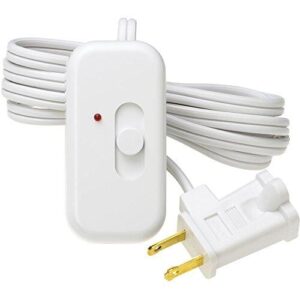
Where your PAR30 halogens give you focused heat, the Lutron plug-in dimmer switch lets you fine tune that output without swapping bulbs. You plug the dimmer into a standard 120 volt outlet, then plug your incandescent or halogen heat lamp (up to 300 watts total) into the dimmer’s built-in outlet, so you can slide temperatures up or down from outside the terrarium.
Because this isn’t a thermostat, you still need thermometers in the warm zone and regular checks to keep basking and ambient temperatures within target ranges.
| Best For | People who want simple, adjustable control over incandescent or halogen lamps, like for terrariums, nurseries, or cozy reading areas. |
|---|---|
| Brand | Unbranded |
| Weight | Unspecified |
| Material | Unspecified |
| Indoor Use | Yes |
| Reptile Suitable | No |
| Safety Features | RoHS/CE certified |
| Additional Features |
|
- Easy plug-in setup—no wiring or installation needed.
- Smooth slide dimming to fine-tune brightness or heat output.
- Soft LED locator light makes it easy to find in the dark.
- Not compatible with LED or fluorescent bulbs.
- Some bulbs may buzz or flicker at lower settings.
- May wear out over time with heavy use.
6. Herpstat Temperature Controller
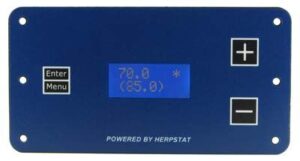
Where the Lutron dimmer gives manual control, the Herpstat Temperature Controller automates precision. It uses proportional heating—constantly adjusting power instead of switching full on or off—to hold stable gradients between 40°F and 150°F.
Each output can manage heat, light, or humidity independently, making it ideal for multi-zone terrariums.
Safety features like a built‑in relay, sensor fault protection, and soft startup protect both animals and equipment while maintaining fine temperature resolution within about one degree of the target.
| Best For | Reptile and amphibian keepers who want precise, automated temperature control for cages, racks, and incubators. |
|---|---|
| Brand | Lutron |
| Weight | 5.6 oz |
| Material | Metal |
| Indoor Use | Yes |
| Reptile Suitable | No |
| Safety Features | Soft-glow locator |
| Additional Features |
|
- Proportional heating maintains steady temperatures instead of cycling on and off.
- Built‑in safety relay and fault detection protect your pets and gear.
- Customizable startup, alerts, and temperature ramping for fine‑tuned control.
- No returns—repairs only through the manufacturer.
- Requires calibration for the most accurate readings.
- Limited temperature range may not suit all species.
7. Inkbird Digital Temperature Controller Thermostat
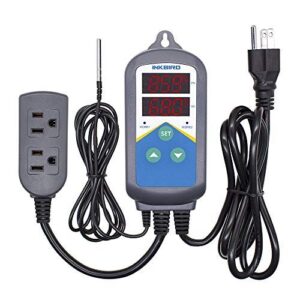
The Inkbird Digital Temperature Controller Thermostat offers steady, hands‑off temperature regulation for any reptile setup. Its plug‑and‑play design makes installation easy—just connect your heating device and set your target range. Dual displays show both current and set temperatures for quick checks.
With a 10‑amp load capacity and accuracy within one degree, it’s well suited for heat mats or ceramic emitters.
The WiFi variant adds remote monitoring, letting you confirm stable conditions from anywhere, which helps prevent overheating or cold stress.
| Best For | Reptile keepers, gardeners, or DIYers who need reliable, hands‑off temperature control for heat‑only setups. |
|---|---|
| Brand | Unbranded |
| Weight | Unspecified |
| Material | Unspecified |
| Indoor Use | Yes |
| Reptile Suitable | Yes |
| Safety Features | Built-in safety relay |
| Additional Features |
|
- Plug‑and‑play design makes setup quick and simple.
- Dual displays let you instantly check current and target temperatures.
- Day/night cycle helps maintain stable conditions for sensitive species or plants.
- Heating only—no cooling function included.
- Alarm limits can’t be adjusted.
- Some users report display or durability issues over time.
8. F10 All Purpose Disinfectant Spray
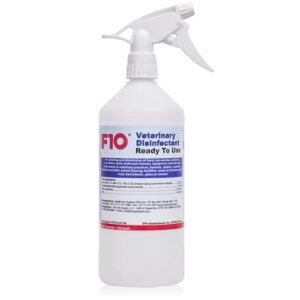
Biosecurity is your quiet insurance policy when you’re working this hard to keep temperatures and humidity dialed in. F10 All Purpose Disinfectant Spray gives you hospital‑grade control over bacteria, fungi, and viruses on glass, plastic, and sealed wood, without harsh fumes or corrosion.
You can remove your snake and loose substrate, clean visible waste, then spray F10, let it stay wet for the full contact time, and allow it to air dry. Used this way, it maintains a stable, low‑pathogen environment that keeps respiratory and skin issues from undoing your careful climate control.
| Best For | Pet owners, breeders, and veterinary professionals who need a strong, ready-to-use disinfectant for keeping animal enclosures, cages, and work areas hygienic and pathogen-free. |
|---|---|
| Brand | Inkbird |
| Weight | 1.76 lbs |
| Material | Plastic |
| Indoor Use | Yes |
| Reptile Suitable | Yes |
| Safety Features | Over/under alarm |
| Additional Features |
|
- Hospital-grade disinfection that kills bacteria, fungi, and viruses effectively.
- Safe for use around animals when applied correctly.
- Convenient and versatile—no mixing required and works on multiple surfaces.
- More expensive than everyday cleaning products.
- Ready-to-use formula offers less flexibility than concentrated versions.
- May face shipping restrictions in some regions.
Frequently Asked Questions (FAQs)
How humid should my snake enclosure be?
Most snake enclosures should maintain humidity between 40 and 70 percent, depending on species. Corn snakes prefer around 40–50 percent, while tropical snakes like ball pythons need closer to 55–70 percent for healthy skin and lungs.
Is 40 degrees too cold for snakes?
Forty degrees Fahrenheit is dangerously cold for almost all pet snakes, not just “a bit chilly.” At that temperature, your snake’s metabolism, heart rate, and breathing slow toward hypothermia, and prolonged exposure can be life threatening.
What temperature should a snake terrarium be?
Comfort for most pet snakes means a warm side around 85–90°F, a cooler side near 75–80°F, and a basking spot roughly 88–95°F, so your terrarium isn’t one single temperature but a usable gradient.
What are signs of too much humidity for pythons?
You’re looking at a problem when the belly scales stay damp or soggy, the substrate feels wet instead of just slightly moist, and you see discolored, soft, or blistered scales that can even smell foul. Thick, persistent condensation on the glass, fuzzy mold on decor, a musty “swampy” odor, or decorations that feel slimy all point to chronic excess moisture rather than a brief humidity spike.
Behavior often shifts too: a python may climb to stay off the substrate, pace restlessly instead of settling in hides, or hang near vents seeking drier air, and in more serious cases you can also hear wheezing or see bubbly saliva as respiratory issues develop.
What is the ideal temperature range for a ball python’s habitat?
Ball pythons aren’t particularly demanding — they just need a warm side around 85–88°F, a cool side near 78–80°F, and a hotspot hitting 88–92°F for proper thermoregulation and digestion.
How should I create a temperature gradient in my ball python’s enclosure?
Place the main heat source under about one third of the floor at one end, with a warm hide over a hotspot around 88–92°F. Leave the opposite end unheated so the cool side settles near 75–80°F.
How important is maintaining proper humidity for ball pythons?
Keeping humidity between 55 and 65 percent keeps your ball python’s skin supple, promotes clean, one-piece sheds, and protects its lungs.
Consistent moisture near this range also strengthens immunity and prevents dehydration or respiratory infections.
Should I use UVB lighting in my ball python’s enclosure?
You don’t have to use UVB for a healthy ball python if your temperatures, humidity, and diet are correct, but low‑level UVB is a useful upgrade. Aim for a gentle 2–3 UVI basking zone with shaded retreats.
How can I ensure safe temperatures for my ball python’s enclosure?
Warm-blooded rules don’t apply to your python—it depends on you.
Maintain a warm side near 30–32°C, a cool side around 25–26°C, and a hotspot near 31–33°C, monitored by thermostats and infrared probes daily.
What temp and humidity should a snake tank be?
Most snake enclosures work well with a warm side around 80–85°F, a cooler side near 75–80°F, and a hotspot close to 88–92°F.
Aim for roughly 40–60% humidity for many common species, adjusting to your snake’s specific needs.
Conclusion
Treat your terrarium less like a decorated box and more like a life-support system under glass. When you control gradients, humidity cycles, and equipment with intent, you remove guesswork and protect your snake’s physiology.
The ideal temperature and humidity for snake terrarium setups aren’t abstract targets; they’re daily parameters you confirm, not assume. If you keep measuring, adjusting, and watching behavior, your snake won’t just survive those margins; it will thrive within them for years.
- https://terrariumhaven.com/gear-guides/best-hygrometer-for-reptiles/
- https://fischer-barometer.de/en/blog/tips-tricks/calibrate-hygrometer
- https://www.thebiodude.com/blogs/reptile-and-amphibian-lighting-faqs-and-help/how-to-place-thermometer-and-hygrometer-probes
- https://www.backyardchickens.com/threads/issues-with-calibrating-the-hygrometer.637911/
- https://enviroliteracy.org/animals/what-happens-if-a-snake-enclosure-is-too-humid/