This site is supported by our readers. We may earn a commission, at no cost to you, if you purchase through links.
A ball python at 78°F won’t eat. At 95°F across the whole tank, it cooks. Your snake lives or struggles inside a few degrees, and the walls around it decide which way it goes.
That’s why custom snake habitat plans beat store-bought kits. You pick the size, the heat gradient, the humidity, and the locks. A 20-liter tub works for a hatchling. A 6x2x2 ft PVC build suits a boa. Stack four modules and you’ve got a rack that fits your wall.
Ready to match a build to your budget, your species, and your space? Here are the plans, from under $300 to full naturalistic setups.
Table Of Contents
- Key Takeaways
- Budget-Friendly DIY Snake Habitat Plan
- Stackable and Modular Snake Habitat Plan
- Naturalistic Snake Habitat Plan
- Species-Specific Snake Habitat Plans
- Compare Plans by Size, Climate Control, Safety, and Cost
- Frequently Asked Questions (FAQs)
- How do I make a snake habitat?
- Did custom reptile habitats go out of business?
- What is the best habitat for a snake?
- Where can I find custom-built snake enclosures?
- Should you build a custom snake enclosure?
- How much does it cost to build a snake enclosure?
- How many gallons does a custom snake enclosure need?
- How do you choose a snake enclosure size?
- What is a DIY snake cage enclosure?
- Are DIY snake enclosures safe?
- Conclusion
Key Takeaways
- You’ll keep your snake healthy by building a temperature gradient, with a warm side around 88–92°F, a cooler side near 78–85°F, and a thermostat so neither end drifts into dangerous territory. Since heat and light often work together in an enclosure, this guide to snake lighting needs helps you choose bulbs that support your thermal gradient without overheating.
- You should size your enclosure to your species and your snake’s length, from a 20–40 gallon setup for hatchlings to a 6x2x2 ft PVC build for a boa.
- You can pick the plan that fits your budget and space, whether that’s a DIY build under $300, stackable modules at $100–$400 each, or a naturalistic setup at $200–$800.
- You need to lock down safety whatever you spend, with a secure lid, tight latches, sealed gaps, and an overheat cutoff to stop escapes and overheating.
Budget-Friendly DIY Snake Habitat Plan
Building your first setup doesn’t mean emptying your wallet! Custom snake habitat plans start with a simple glass aquarium or tub. Match your enclosure size to your snake: 20–40 L for hatchlings, 60–120 L for adults.
Once the enclosure is set, add a snug hide, a water bowl, and the right substrate, all covered in this healthy snake habitat creation guide.
Next, tackle heat. Cut recycled Styrofoam panels to fit and stack them under the tank. Then add low-wattage heating elements, like an under-tank heater or ceramic heat emitter, and wire in a digital thermostat. Aim for 28–32°C on the warm side and 20–24°C on the cool side.
Pick a substrate like aspen, or go with paper towels for easy cleaning. Add a cork hide and some fake foliage.
Finish with a secure mesh lid, silicone on any gaps, and smart ventilation and humidity control.
Stackable and Modular Snake Habitat Plan
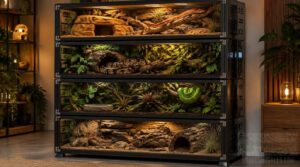
Once your first tub or tank is humming, why not think vertical? Stackable designs let you grow without eating up floor space, and modular options mean you add a level only when your collection calls for it. Even DIY reptile cages can go modular!
Pick your enclosure size per module, using 12 to 24 inch grid steps. Here’s what makes a stack work:
Once you’ve measured your snake, this snake cage size and layout guide shows how body length translates into the right floor space, height, and hide placement.
- Interlocking corner brackets that handle 15 to 20 kg per module
- Quick-seal gaskets, so you stack without tools
- Non-slip feet and fail-safe latches for safety
- Shared ventilation channels and one controller with sensors in every unit
Keep stacks to four to six modules, and add cross-bracing past three. Add naturalistic backgrounds per level for a wild look!
Naturalistic Snake Habitat Plan
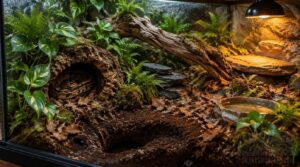
Remember those naturalistic backgrounds we added to each level? Now let’s make the whole enclosure match! Start with substrate selection. Pick coco coir, layered over a non-toxic liner, and keep it deep enough for burrowing. It holds moisture, so humidity stays steady without constant watering.
Next, shape your temperature gradients. Aim for a 26 to 32°C warm zone, a 22 to 26°C cool zone, and a 32 to 34°C basking spot. Place hides at both ends, plus a humid hide misted to 70 to 90% during shedding.
Choosing the right placement for each shelter matters, so this guide to warm side vs. cool side hides for snakes shows how to help your snake regulate its body temperature.
Add habitat enrichment: driftwood, rock piles, and live or artificial plants. Anchor everything so nothing collapses. Run a 12:12 to 14:10 light cycle with full-spectrum LEDs, and refresh the shallow water dish daily.
Species-Specific Snake Habitat Plans
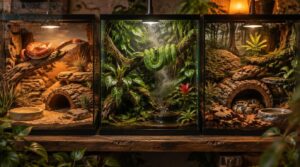
Every snake has its own quirks, so your habitat should, too! Below, you’ll find three species-specific plans built around what each snake needs to feel safe and thrive. Ready to match your setup to your scaly roommate?
Ball Python Habitat Plan
Think ball pythons are too fussy for beginners? Nope! They just like it steady. Set a temperature gradient of 88–92°F on the warm end and 80–85°F on the cool side, and let a thermostat do the work.
Aim for 50–60% humidity control using a water dish and humid hide. Habitat builder software can map your layout. Keep enclosure safety tight.
Corn Snake Habitat Plan
Thermostat setup makes or breaks your corn snake’s comfort! Pick a 20 to 40 gallon enclosure, the species specific size that suits most adults. Build a temperature gradient: 26–28°C ambient, with a 30–32°C basking hotspot.
Aim humidity control at 40–60%, and add a dry hide plus a moist hide for smooth sheds. Smart enclosure ventilation design keeps air fresh, never drafty.
Boa Constrictor Habitat Plan
Boas need room, and your plan should deliver! Among custom snake habitat plans, this one’s the heavyweight. Build a 6x2x2 ft enclosure from PVC panels, add secure locks, and stack cork shelving for climbing.
Dial in thermostat regulation: an 88–92°F basking spot, cooler 78–85°F zones. Add burrowable hideouts, a soaking dish, and cypress mulch for humidity control at 60–70%. Easy!
Compare Plans by Size, Climate Control, Safety, and Cost
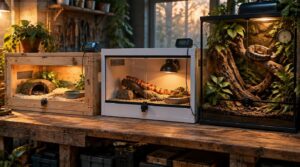
Cheap doesn’t mean careless, and fancy doesn’t mean safe! That’s the big lesson when you stack your custom snake habitat plans side by side.
Cheap doesn’t mean careless and fancy doesn’t mean safe, so compare every snake habitat plan before you build
Start with size. DIY builds and modular options both handle 20–60 gallons, while naturalistic setups need extra room for driftwood and plants.
Climate control is where temperature gradients earn their keep. Every plan needs 78–88°F ambient, a 90–95°F basking spot, and a thermostat.
Safety? Choose an escapeproof enclosure with secure latches and an overheat cutoff, whatever your budget.
Cost swings widely. DIY stays under $300 for one or two enclosures, modules run $100–$400 each, and naturalistic builds hit $200–$800. Which habitat design fits your wallet and your goals? Pick one and build with total confidence, champ!
Frequently Asked Questions (FAQs)
How do I make a snake habitat?
Picture a tiny desert canyon, warm on one end, cool on the other!
Start with species-specific size, then build a temperature gradient. Add hides, climbing branches, and proper ventilation. Control humidity, and you’re all set!
Did custom reptile habitats go out of business?
Nope, custom reptile habitats aren’t gone! Some custom vivarium fabrication shops closed, others opened, and many now offer modular options. Buyers still want species-specific care requirements and smart enclosure design, so your custom builders survive.
What is the best habitat for a snake?
The best habitat fits your snake’s species and size. Nail the temperature gradient, keep humidity control steady, pick safe substrate like aspen or coconut fiber, and add hides. You’ll get a healthy, confident snake!
Where can I find custom-built snake enclosures?
Want custom snake habitats? Try local reptile expo builders, Etsy makers, and breeder forums. Each offers a custombuilt solution with habitat customization. Share your enclosure design, species, and size, ask about ventilation, heat, locking doors!
Should you build a custom snake enclosure?
Yes, you should! Custom snake habitats fit your snake’s size and habits, and DIY keeps costs down.
Habitat customization turns a custom reptile environment into a custombuilt solution. Add a reliable thermostat and secure lid.
How much does it cost to build a snake enclosure?
Your wallet’s about to become a snake, slithering away fast! Expect $100 to $300: wood, glass, reptilesafe sealants, vents, and substrate selection.
Plan a temperature gradient, humidity control, and durability, and you’ll beat pricey cages.
How many gallons does a custom snake enclosure need?
Your enclosure size depends on species and snake length measurements. Hatchlings thrive in 20 to 40 gallons, but adults need 40 to 125-plus. Smart reptile enclosure design and vivarium setup keep you ahead of growth!
How do you choose a snake enclosure size?
Ball pythons need a 40-gallon minimum, roughly 3x their length. Use an enclosure planning tool, then make smart species picks, add proper ventilation, and build a thermal gradient so your snake thrives from day one!
What is a DIY snake cage enclosure?
A DIY snake cage enclosure is a custom-built home made to fit your snake’s size and habits. Build it from PVC, glass, or sealed wood, then add secure latches, solid ventilation rate, a temperature gradient setup, and hideouts.
Are DIY snake enclosures safe?
Tiny gaps cause escapes!
Yes, DIY snake enclosures can be safe. Choose sturdy reptile enclosure materials like glass or PVC, add proper ventilation, and lock every latch. Enclosure safety also needs a steady thermal gradient.
Conclusion
Ball pythons want a 90°F hot spot and a 78°F cool side. That twelve-degree spread is the whole game! Your enclosure either delivers it or it doesn’t.
Whether you build a tub, a rack, or a bioactive display, custom snake habitat plans put that control in your hands. Test the gradient with a probe, then lock it down. Build it right, and your snake will thank you by living long, eating well, and shedding clean.