This site is supported by our readers. We may earn a commission, at no cost to you, if you purchase through links.

A snake in a cage that’s too small doesn’t complain. It stops eating, rubs its nose raw against the glass, or sits motionless for weeks while its muscles waste away. Most keepers never connect those symptoms to floor space, because the pet store sold them a "starter kit" that was undersized before they got home.
Here’s the part that surprises people: an enclosure that worked last month can fail this month. Snakes grow fast, and a juvenile setup becomes a prison before you notice.
Getting snake cage size and layout right comes down to a few measurable rules. Measure the animal, apply the full-length rule, and build a thermal gradient the snake can actually use. Let’s start with the measuring tape.
Table Of Contents
- Key Takeaways
- How to Choose The Right Snake Cage Size
- Snake Enclosure Dimensions by Species
- How to Plan a Snake Cage Layout
- Set Up Temperature, Humidity, and Ventilation
- Build, Secure, and Maintain The Enclosure
- Frequently Asked Questions (FAQs)
- How big should my snake cage be?
- Can a ball python live in a 36x18x18?
- Is a 75 gallon tank too big for a ball python?
- Do snakes like big enclosures?
- How to choose a snake cage size in metric measurements?
- How big should a snake enclosure be?
- How long should a snake cage be?
- What should a snake cage include?
- How do I choose a snake enclosure?
- How do you house a snake in a cage?
- Conclusion
Key Takeaways
- Size the enclosure by your snake’s measured body length (snout to tail tip), with combined length plus width equaling or exceeding that total—so a 4-foot corn snake needs at minimum a 4x2x2 foot setup.
- floor space beats height for nearly all species, since snakes are ground-level movers; prioritize horizontal room, clear movement lanes, and low-profile hides over vertical climbing features.
- a working thermal gradient—an 8–12°C differential between warm and cool ends with hides at both sides—is essential for digestion, shedding, and stress control, and must be verified with calibrated thermometers rather than guessed.
- undersized or poorly designed cages show up as feeding refusals, chronic circling, failed sheds, and nose-rubbing, so re-measure your snake after each shed and upgrade the enclosure as it grows rather than trusting a "starter kit" size.
How to Choose The Right Snake Cage Size
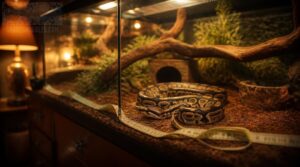
Getting your snake’s cage size right starts with one simple measurement: your snake’s actual length. From there, a few key rules determine how much floor space, height, and layout structure you need. Here’s how to size the enclosure correctly, step by step.
The basic rule of thumb: floor space should equal your snake’s length times half its length, so a 6-foot carpet python needs at least a 6 ft × 3 ft enclosure — see this carpet python enclosure size guide for a full breakdown.
Measure Your Snake Correctly
A flexible tape or string-plus-ruler setup gives you the most reliable read on body length. Lay your snake flat and measure snout to tail tip, not snout to vent, unless your cage standard specifies otherwise.
Measure at midday when muscle tone is relaxed. Always re-measure after shedding; keratin changes can shift apparent length enough to throw off your space calculations.
Apply The Full-Length Rule
Once you have that number, the math is simple. The full-length rule requires the combined length and width of your snake enclosure to equal or exceed the snake’s total body length.
For a 4-foot corn snake, a 4x2x2 feet setup is the minimum enclosure size. Drop below that and stress hormones rise measurably. Muscle tone and feeding response both suffer.
Prioritize Floor Versus Height
Floor space matters more than height. Snakes are ground-level movers, not climbers.
- Floor area target: 1.5 to 2x the snake’s curled girth length
- Limit vertical clearance to movement only, not repeated climbing
- Low-profile hides free up floor without raising cage height
- Measure enclosure quality by horizontal path length, not peak height
Height is secondary. More floor means a healthier snake.
Size Hatchling Enclosures Safely
Hatchlings don’t need a large setup right away, but the cage size for a snake at this stage matters more than most keepers expect.
Start with an enclosure that provides full body length plus 50% in total volume, solid walls for heat retention, and two hides placed at opposite ends.
Schedule size upgrades as they grow.
Avoid Undersized Cage Risks
When a cage is too small, your snake shows it. Chronic circling, failed sheds, and digestive slowdown all trace back to inadequate floor space. Minimum enclosure size isn’t a guideline. It’s a survival baseline.
Species-appropriate habitat helps with thermoregulation and stress reduction in reptiles. Without a proper gradient, your snake can’t digest or shed normally. Escapeproof design prevents drafts and escapes.
Snake Enclosure Dimensions by Species

No two species share the same space requirements, so cookie-cutter sizing gets snakes hurt. Whether you’re housing a compact ball python or a giant constrictor, the numbers below give you the exact dimensions to work with. Match your species to its entry and build from there.
Ball Python Cage Size
Ball pythons are stockier than they look. Juveniles do well in a 20–24 inch enclosure, but most adults need at least 36 inches of floor space. Larger adults push that to 48 inches.
Whatever enclosure size you settle on, this ball python starter kit checklist walks you through the thermostats and heating gear you’ll need to keep that 88-92°F warm side dialed in.
Getting the minimum enclosure size wrong causes chronic stress and feeding refusals. Always match your ball python cage size to actual body length, not the animal’s age.
Corn Snake Cage Size
A corn snake thrives with proper space. The minimum enclosure size for adults is 36×18 inches; a 4x2x2 feet setup suits most active adults best.
What every corn snake enclosure needs:
- Secure hides on the warm and cool ends
- A reliable temperature gradient across the floor
- Escape-proof latches; they’re escape artists
- A 12–18 inch enclosure for hatchlings
- Smooth, safe substrate
Boa Constrictor Cage Size
Boas demand serious real estate. A species-appropriate habitat starts at 6×3×3 feet for adults, roughly 1.5 to 2 times their full length.
Integrate temperature gradient controls and secure hides on both ends. Correct boa constrictor cage size includes 2 to 3 feet of vertical height for climbing. Too cramped, and your boa stresses, stops eating, and tests every latch.
Giant Constrictor Space Requirements
Giant constrictors don’t fit cages. They fit rooms. Reticulated pythons hit 18 feet; green anacondas exceed 15. Floor space beats height every time for these species.
Minimum enclosure size standards:
- 8×4 feet for medium giants
- 12×6 feet for large retics
- Full body length plus 30% escape margin
- Reinforced walls, not glass
- Locking doors rated for 200+ pounds
Undersize it, and you’ll regret it.
Room-Sized Enclosure Planning
Converting a spare room? Measure first. Aim for 1.5 to 2 times your snake’s body length in one unbroken straight line. That’s your minimum floor span.
Professional builders follow the Swiss Reptile Housing Formula for room conversions. It works. Use it.
Prioritize floor area. Add vertical space and climbing structures only after roaming room is secured. Your snake needs walls it won’t constantly touch.
How to Plan a Snake Cage Layout
Size is only half the battle. A properly sized cage still fails your snake if the layout works against its instincts. Here’s how to arrange warm zones, hides, water, and climbing space so your enclosure functions the way your snake actually uses it.
Create Warm and Cool Zones
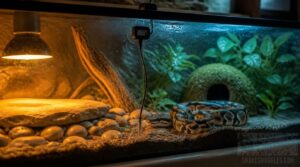
Build the gradient before you add anything else. A thermostat-controlled heat source on one end creates your basking zones; the far end stays unheated. Aim for an 8–12°C differential between warm and cool zones. Measure with two calibrated thermometers, plus one ambient reading. Temperature gradients aren’t optional; they drive digestion and immune function.
Without proper heat gradient:
- Impacted digestion, regurgitation risk
- Respiratory infections from chronic chilling
- Stress that suppresses feeding
Thermal gradient safety means verifying numbers, not guessing.
Place Hides at Both Ends
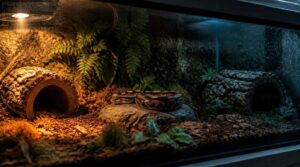
Once your gradient is set, put a hide at each end. This creates two microhabitats and stops center crowding. A snake that must choose between warmth and security will skip meals. Match hide types and interior volume at both ends—identical hollow logs, caves, or tubes—so neither side wins. Vary entrance orientation slightly. Keep the corridor between hides clear. Hide placement is thermoregulation support.
Place identical hides at both warm and cool ends, because a snake forced to choose between warmth and security will skip meals
Position The Water Bowl
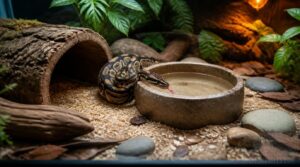
Water bowl placement works with your hide placement, not against it. Put the bowl mid-wall, near a hide, so your snake drinks without crossing open ground.
Keep it away from heat sources. Rapid evaporation skews humidity and destabilizes temperature gradients.
Center it along the enclosure length to encourage straight drinking routes. Skip corners.
A shallow dish, sized for coiling around, helps with substrate safety and hygiene.
Add Branches and Climbing Features

Branches add vertical space, but only for the right species. Ball pythons stay grounded. Corn snakes and boas climb eagerly. Match climbing features to behavior.
Use 2–4 vertical paths with varied branch diameter. Thicker low, thinner high. Rough bark improves grip. No sharp snags.
Anchor every branch at two points minimum. Wobbling discourages use and causes injury. Leave 60% of floor space open. Overcrowding kills movement.
Preserve Clear Movement Routes

Always map your enclosure from the snake’s perspective. Movement routes determine whether your animal stretches fully or crams into corners. Clear floor lanes support natural behaviors like exploration and thermoregulation.
Protect those lanes:
- Keep a 12-inch minimum corridor between hides
- Route paths past, never through, décor clusters
- Match lane width to your snake’s body length
- Position the water bowl off main crossing points
- Inspect weekly for shifted substrate blocking travel
Cluttered cages cause stress. Open lanes let natural behaviors flourish.
Set Up Temperature, Humidity, and Ventilation
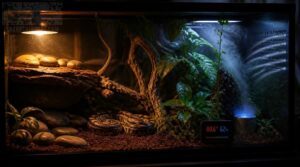
Size and layout mean nothing without the right climate inside the cage. A snake that can’t thermoregulate properly will stress, refuse meals, and develop respiratory illness fast. Here’s how to dial in heat, humidity, ventilation, and lighting so your setup works as one system.
Install Thermostatted Heat Sources
Heat without control is a burn waiting to happen. Every thermostat-controlled heat source needs a high-fidelity thermostat with an external probe, positioned to read ambient temps without contacting the mat itself.
Size thermostatted mats to match your floor area for even warmth. Program a fallback power-off setpoint.
Calibrate with a surface probe at snake contact points. Verify before your snake pays the price.
Maintain The Thermal Gradient
Because a thermostat only controls one point, your job is to build the full gradient. Aim for a 10–15°C warm-zone offset above the cool end. Without it, thermal regulation fails.
Verify your setup:
- Basking surface: 31–33°C
- Cool zone: 24–26°C
- Midbody midpoint reading
- Two thermometers minimum
- 24-hour stability check
Cold spots kill appetite. Uneven heat gradient causes stress. Track temperature monitoring logs weekly. Your snake depends on that contrast.
Set Species-Appropriate Humidity
Humidity isn’t one number. It’s a species-appropriate habitat with daily rhythm.
Ball pythons need 50–60% day, 60–80% night. Corn snakes hold 40–60%. Boas want 60–70% during molts. Rapid swings wreck shedding.
Place a calibrated hygrometer mid-cage and near basking zones. Log readings over 24–72 hours. Build gradients with substrate moisture, not misting floods. Precision here prevents dysecdysis.
Balance Ventilation and Moisture
Airflow is a double-edged sword. Too little, and stagnant moisture breeds mold. Too much, and your humidity control collapses overnight.
Balance it deliberately:
- Vent high and low for cross-flow
- Keep water bowls away from vents
- Use digital sensors at multiple heights
- Log readings to catch stratification
- Adjust airflow before misting more
Good ventilation systems protect temperature gradients. Reptile ventilation needs aren’t optional. Get this wrong, everything else fails.
Establish a Lighting Cycle
Light is your snake’s clock. Get the lighting cycle wrong, and feeding, shedding, and activity all drift.
Run a 12-hour day/night baseline on a programmable timer. Add a 15–30 minute dawn and dusk ramp. Give UVB its own timer, 1–2 hours daily, never at night. Shift seasons gradually: 12–14 hours in summer, 10–12 in winter.
Watch behavior. Adjust. Your snake will tell you.
Build, Secure, and Maintain The Enclosure
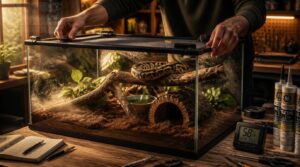
A great layout means nothing if the cage itself fails you. Materials, security, and maintenance decide whether your snake stays healthy or escapes. Here’s how to build it right and keep it that way, one decision at a time.
Choose Snake-Safe Cage Materials
Start with the frame, not the snake. Glass aquariums resist chewing, hold heat poorly, and sanitize fast. A PVC enclosure offers better insulation and humidity control. Skip low-density plastics; they warp within 18 months and trap odors in scratched surfaces. Choose corrosion-resistant metals with smooth welds. Reptile enclosure materials determine reptile escape prevention success and long-term hygiene.
Secure Doors, Vents, and Gaps
Good materials mean nothing without enclosure security. A snake the width of a pencil slips through a 6 mm gap.
Use tamper-resistant latches with hidden hinge pins. Seal door perimeters with weather-stripping that doesn’t block airflow. Test every hatch with a probe.
Remember: water bowls and branches become snake ladders. Check vents monthly on your reptile cleaning schedule.
Escape prevention is a habit, not a one-time fix.
Select Proper Substrate Depth
Substrate depth matters as much as cage security. Wrong depth invites buried heat sources, collapsed tunnels, and trapped moisture.
Match depth to species and size:
- Ball pythons: 5–8 cm of soil mix for shallow burrows
- Corn snakes: 5–10 cm, loose and moisture-retentive
- Boas and giants: 10–15 cm of structured burrowing substrate
Deep enough for belly contact during thermoregulation. Not so deep that humidity pockets form or cleaning becomes guesswork. Verify depth tolerances at annual health checks. Proper depth also helps with natural shedding assistance.
Clean and Replace Substrate
Deep substrate means nothing without substrate maintenance. Spot-clean waste daily. Ammonia builds fast in a naturalistic enclosure and damages your snake’s eyes and skin within days, not weeks.
Replace soiled sections immediately when waste leaks beneath the surface. Work section by section. This preserves beneficial microflora while cutting disruption.
For full changes, wash with enzyme-based reptile-safe cleaners, dry completely, and confirm enclosure ventilation before refilling. Damp substrate grows mold. Fast.
Monitor Health and Behavior
Watch your snake more than you watch your thermometer. Reptile behavior observation catches problems equipment misses. Basking outside normal hours? Check your temperature gradients. Glass-surfing and weaving signal stress or tight quarters. Rubbing the head repeatedly means mites or enclosure discomfort.
Log sheds, meals, and waste weekly. Consistent reptile health monitoring prevents emergencies. Pair records with reptile stress reduction: stable routines, proper humidity levels, minimal handling changes.
Frequently Asked Questions (FAQs)
How big should my snake cage be?
You’ve heard bigger is always better? Not exactly. Snake enclosure size should match body length: at least 5 times total length in floor space. Measure snout to tail tip, calmly extended. Undersized cages cause stress.
Can a ball python live in a 36x18x18?
Yes, but with limits. A 36x18x18 works for juveniles and smaller adult ball pythons short-term. Most adults reach 4–5 feet, so prioritize larger floor space for long-term housing.
Is a 75 gallon tank too big for a ball python?
A 75 gallon tank isn’t too big. It exceeds minimums, giving your ball python room for proper temperature gradients and hides. Just manage heat, humidity, and floor space carefully.
Do snakes like big enclosures?
Yes, most snakes thrive in larger enclosures, but only when the space works for them. A big cage without proper thermal gradients becomes a stressor, not a benefit. Bigger isn’t automatically better.
How to choose a snake cage size in metric measurements?
Choosing a cage size for a snake starts with body length. Measure snout to tail tip in centimeters, then convert from millimeters. Multiply by 5 for enclosure length. Floor area: 5 times length squared.
How big should a snake enclosure be?
Here’s the truth: bigger isn’t always better, but too small is always worse. Your snake enclosure size should match your snake’s full body length, not a rough guess. For most species, make the enclosure’s length plus width equal or exceed that total. This lets your snake stretch fully and move naturally, which reduces stress and helps healthy muscle tone.
If you’re wondering how much space a garter snake will eventually need, understanding how big garter snakes get and how fast they grow helps you plan an enclosure that fits them long-term, not just right now.
For floor space, aim for 5 to 2 times the snake’s girth-length at minimum, and more for active or semi-arboreal species. A hatchling in an oversized cage can feel exposed and refuse food, so size up gradually as your snake grows. Species-specific care matters here: a corn snake wants length and climbing height, while a ball python prioritizes secure floor space with multiple hides.
Get the cage size for a snake right from the start, and you prevent escape risks, feeding problems, and costly upgrades later.
How long should a snake cage be?
Your snake cage should match your snake’s full body length, minimum. Complete stretching prevents muscle atrophy and helps healthy thermoregulation. Going longer reduces stress behaviors and delays costly enclosure upgrades later.
What should a snake cage include?
Every cage needs two secure hides, a stable water bowl, thermostatted heating, correct substrate depth, and escape-proof latches. These basics drive thermoregulation, humidity control, and reptile welfare. Skip them, and you’re building stress, not habitat.
How do I choose a snake enclosure?
Match enclosure size to your snake’s adult length first—at least 5 times body length. Arboreal species need vertical space; terrestrial snakes need floor area.
Since a rosy boa stays compact and thrives in dry, warm setups, it’s worth browsing these colorful snake breeds for vivariums to see which species suit your enclosure.
Material choice matters too—off-gassing and oversized mesh vents create hidden dangers, so reviewing safe and secure snake cage ideas helps you avoid setups that look fine but quietly harm your snake.
For burrowing species especially, replicating natural substrate conditions is just as critical as floor space—this desert snake habitat setup guide walks through how depth and particle size work together to support natural behavior.
Prioritize materials supporting temperature gradients, humidity control, and long-term reptile welfare.
How do you house a snake in a cage?
Housing a snake starts with security: tight-fitting lids, locked doors, and sealed gaps. Snakes escape through openings under half an inch. Ventilation matters too—cross-flow airflow prevents stagnant humidity and respiratory infections.
Conclusion
Your snake won’t send a memo when the cage fails. It stops eating. It hides more.
Mastering snake cage size and layout means reading those signals before they become vet bills.
Measure the animal, not the myth.
Build the gradient, place the hides, and check the locks like a medieval jailer guarding treasure.
Do that, and your setup won’t just hold a snake.
It will let one genuinely thrive.