This site is supported by our readers. We may earn a commission, at no cost to you, if you purchase through links.

Most carpet pythons don’t fail because of bad feeding schedules or incorrect temperatures—they fail because their enclosure was built around guesswork.
A snake that can’t stretch, thermoregulate properly, or express natural climbing behavior is a snake under constant physiological stress, even if it’s eating fine.
The fix isn’t complicated, but it requires knowing the actual numbers. Get the dimensions right, and everything else in your setup clicks into place. Carpet python enclosure size isn’t one-size-fits-all; a 5-foot Inland behaves differently than a 9-foot Coastal, and their space requirements reflect that.
Table Of Contents
- Key Takeaways
- Carpet Python Enclosure Size
- Subspecies Size Differences
- Space Planning Essentials
- Top 5 Enclosure Setup Items
- Frequently Asked Questions (FAQs)
- How big do carpet pythons get?
- How big should a carpet python enclosure be?
- How big should a Python enclosure be?
- How big should a carpet python vivarium be?
- What size enclosure do carpet pythons need?
- How big should a carpet python tank be?
- Do carpet pythons need a front entry enclosure?
- What size tank do you need for a carpet python?
- Is a carpet python a good beginner snake?
- Can carpet pythons be kept together?
- Conclusion
Key Takeaways
- Floor space equals the snake’s length multiplied by half of that length, with vertical clearance of at least 24–30 inches for adults.
- Subspecies size differences matter — a Coastal carpet python can hit 9–10 feet and needs significantly more space than the Inland, which typically tops out around 4–5 feet.
- Vertical space isn’t optional; carpet pythons are semi-arboreal, so sturdy branches placed 60–95 cm high are essential for natural climbing behavior and stress reduction.
- How you use the space matters as much as the size — deliberate placement of hides, water bowls, substrate depth, and ventilation directly affects your snake’s health and thermoregulation.
Carpet Python Enclosure Size
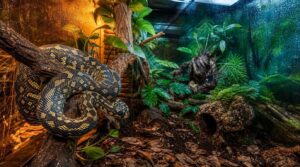
Getting the enclosure size right is one of the most important decisions you’ll make for your carpet python. Too small, and your snake can’t thermoregulate properly or express natural climbing behavior.
For a full breakdown of dimensions at every life stage, carpet python enclosure size and setup guidelines walks you through exactly what your snake needs from hatchling to full-grown adult.
Here’s what you need to know about sizing it correctly.
Minimum Size Formula
Getting enclosure size right starts with one core formula: floor space equals the snake’s total length multiplied by half that length. For a 6-foot carpet python, that’s 6 ft × 3 ft minimum.
Here’s what drives that calculation:
- Length‑Width Ratio — 2:1 along the horizontal axis
- Tail Length Factor — included in total measurement, not ignored
- Girth Consideration — wider snakes need turning room
- Growth Scaling — size up before the snake maxes out space
- Volume Calculation — vertical axis matters; minimum 4 feet of floor space enables climbing
Adult Enclosure Dimensions
Once you know the formula, applying its straightforward. Most adult carpet pythons need a minimum 4 feet of linear travel path—6 ft × 2 ft × 3 ft is a solid baseline, roughly 120 × 70 × 80 cm. A large enclosure with vertical clearance height of at least 3 feet, escape-proof lids, sidewall reinforcement, and a secure lock mechanism keeps your adult-size snake safe.
Providing a deep substrate depth of at least one-third of the enclosure height benefits burrowing species like carpet pythons.
Floor Space Guidelines
Enclosure setup begins with floor space. Your snake requires at least 2.5 times its girth in unobstructed clearance — that’s your girth ratio calculation baseline. Zone distribution planning divides the 120x70x80 cm space into warm and cool sides, enabling purposeful movement for your python.
Run floor area audits monthly. If it’s coiled in one spot constantly, that’s a red flag.
Height Requirements
Carpet pythons are semi-arboreal, meaning vertical space directly facilitates their natural behavior. Adults require 24–30 inches of vertical clearance, while juveniles need at least 12–18 inches of vertical clearance. Always maintain a lid safety gap of 2 inches minimum to ensure security.
Height zoning is critical for their habitat. Position sturdy perches 6–12 inches below the top to enable safe climbing opportunities and optimal perch placement. This arrangement supports both exploration and rest, aligning with their arboreal instincts.
Juvenile Versus Adult Setups
Juvenile and adult setups aren’t interchangeable — your hatchling needs a tighter, safer space, while your adult demands a large enclosure with real room to move. Here’s what each stage actually requires:
- Hatchlings thrive in snug 120x70x80 cm setups with simple thermal gradient control
- Juveniles need gradual enrichment complexity increases as they grow toward adult size
- Adults require a minimum length of 1500mm for proper thermoregulation
- Escape prevention means heavy-duty lids at every stage
- Handling guidelines and feeding frequency both shift as your snake matures
Subspecies Size Differences
Not all carpet pythons are built the same, and that gap in size matters more than most keepers expect.
A coastal carpet python, for instance, needs noticeably more vertical space than an Irian Jaya, and understanding those differences starts with knowing how carpet python colors, patterns, and subspecies vary.
The subspecies you own will determine exactly how much floor space, height, and climbing room your setup needs. Here’s how each one stacks up.
Jungle Carpet Pythons
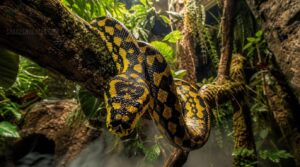
Jungle Carpet Pythons are the compact athletes of the carpet python world — reaching lengths of 5 to 7 feet, with some females approaching 8 feet. Their Rainforest habitat origins demand vertical space, making upward expansion essential, not just horizontal.
Jungle Carpet Pythons may be compact, but their rainforest roots demand vertical space above all else
| Jungle Carpet Python Trait | Typical Range |
|---|---|
| Adult Length | 5–7 ft |
| Reproductive Maturity | 3–4 years |
| Humidity Preference | 60–70% |
Their temperament is curious and manageable, though shedding triggers like improper humidity can increase defensiveness. A large enclosure with sturdy perches and ample height ensures regular feeding schedules and minimizes stress.
Coastal Carpet Pythons
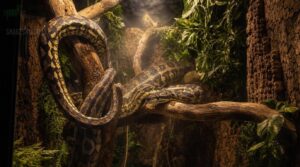
Coastal Carpet Pythons are the heavyweights here — commonly reaching 7 to 9 feet, with some females pushing past 10. Their habitat preferences and activity cycle demand serious vertical space, so enclosure height of 120–70–80 cm minimum isn’t optional.
- Color Variation ranges from tan to olive-brown with bold dark blotches
- Feeding Schedule: every 2–4 weeks for adults
- Lifespan Range: 15–25 years in captivity
- Sturdy perches at multiple heights are essential
- Vertical space rivals floor space in importance
Darwin Carpet Pythons
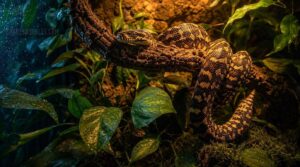
Darwin Carpet Pythons sit in the middle of the size spectrum — typically 5 to 7 feet, occasionally reaching 8. Their nocturnal activity peaks at dusk, requiring a thermal gradient of 88–92°F on the warm side and 78–82°F on the cool end. Humidity control must be maintained at 50–60%.
| Feature | Spec | Notes |
|---|---|---|
| Enclosure Height | 120 70 80 cm min | Facilitates climbing |
| Humidity Requirements | 50–60% | Aids shedding |
| Feeding Frequency | Every 2–4 weeks | Adults only |
| Lifespan Management | 20–25 years | Consistent husbandry |
Color morphs, such as albino and hypo, do not alter care requirements.
Inland Carpet Pythons
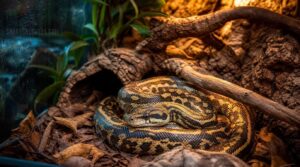
The Inland Carpet Python is the compact option of the group — adults usually reach 4 to 5 feet, making a 120×70×80 cm PVC enclosure workable for most setups. Their slower growth rate means enclosure design doesn’t need to be scaled up quickly.
Maintain a thermal gradient of 82–90°F warm side, keep relative humidity at 40–60%, and feed adults every 2–4 weeks.
Diamond Carpet Pythons
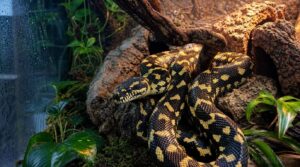
The Diamond Carpet Python stands out with its striking black-and-yellow patterning and a temperament that rewards consistent handling.
Adults reach 6 to 8 feet, so a habitat setup of at least 120×70×80 cm works for most, though bigger is better.
Maintain a temperature gradient of 85–90°F warm, 75–80°F cool, with humidity requirements around 50–60%.
Keeping these conditions stable is especially important during breeding season — you can find detailed guidance on setting up the ideal environment for breeding ball pythons to support healthy egg development across each 4–10 egg clutch.
Adjust your feeding schedule and obesity prevention strategy as they mature.
Space Planning Essentials
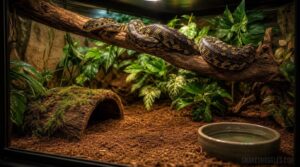
Getting the enclosure size right is only half the battle — how you use that space matters just as much.
Every element inside the tank, from branches to hides to the water bowl, needs a deliberate spot.
Here’s what to think through before you start setting things up.
From wood selection to anchoring technique, this beginner’s guide to snake climbing branches walks you through every decision so nothing gets overlooked.
Climbing Branch Placement
Branches aren’t just décor — they’re the foundation of healthy climbing behavior. Vertical pathways and branch height zoning let your carpet python move naturally through the enclosure, from floor to ceiling.
- Place upper branches 60–95 cm high for arboreal housing needs
- Use angled perch arrangement to encourage balance and turning
- Prioritize texture variety: knobby, forked, bark-covered wood for grip
- Confirm branch loadbearing capacity bears 10× your snake’s weight
Solid branch installation and proper branch mounting techniques keep everything secure.
Warm and Cool Hides
Once your branches are set, securing hides completes the setup. Place a warm hide directly above your heat source — interior temperatures should hold at 88–92°F. Position the cool hide opposite, maintaining 75–85°F. For adults, aim for a diameter of 8–12 inches for each. Plastic tubs are the best material choice.
Clean both hides monthly with a reptile-safe disinfectant.
Water Bowl Clearance
With your hides secured, the water bowl comes next. Maintain a Bowl Edge Buffer of at least 2 inches between the bowl and enclosure walls to ensure easy cleaning. Position the heat source at a Heat Source Distance of 4–6 inches to regulate evaporation and humidity control.
Ensure Vertical Clearance of 2.5 inches above the rim and practice Corner Avoidance to prevent trapping the water source in confined spaces.
Restrict the bowl to a Floor Area Ratio of 10% to allow ample room for movement.
Substrate Depth Needs
Carpet pythons require 3–5 inches of substrate for proper burrowing layers and moisture retention.
A particle size mix—like Exo Terra Plantation Soil blended with coconut fiber substrate or cypress mulch—balances drainage and substrate moisture retention perfectly.
Depth adjustment matters by subspecies: coastal and Darwin carpets need the deeper end for stable humidity management.
Ventilation and Access
Good ventilation does more than just move air — it keeps your snake healthy and your setup stable. Mesh ventilation panels create clear airflow zones from cool to warm sides, achieving 6–10 air changes per hour.
Adjustable vents allow fine-tuning of humidity during sheds, while front doors with one-handed access simplify routine checks.
Wire guards over heat sources ensure escape prevention remains secure, maintaining safety without compromising airflow.
Top 5 Enclosure Setup Items
Getting the enclosure right is only half the battle — what you put inside it matters just as much. These five items cover the essentials without overcomplicating your setup.
Here’s what you’ll want to have on hand before your carpet python moves in.
1. GE Heavy Duty Grounded 6 Outlet Power Strip
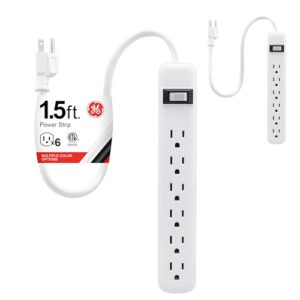
Running a carpet python setup means juggling heat mats, thermostats, lighting, and misters — all needing power at once. The GE Heavy Duty Grounded 6-Outlet Power Strip manages that load cleanly.
Each strip provides six grounded outlets, a built-in circuit breaker with a reset switch, keyhole slots for wall-mounting, and a 1.5 ft cord to maintain tidiness.
Just note: it doesn’t include surge protection, so pair it with a quality thermostat to safeguard heat sources.
| Best For | Reptile keepers and hobbyists who need to power multiple enclosure devices like heat mats, thermostats, and misters from a single, safely mounted location. |
|---|---|
| Primary Use | Power distribution |
| Indoor Suitable | Yes |
| Safety Feature | Circuit breaker |
| Material | PVC housing |
| Animal/Pet Safe | Indirect (powers equipment) |
| Reptile Relevant | Powers heating/lighting |
| Additional Features |
|
- Six grounded outlets give you room for all your gear without daisy-chaining strips together.
- The built-in circuit breaker adds a real safety net if something draws too much power or overheats.
- Keyhole slots make wall-mounting easy, which keeps cords off the floor and out of the way.
- No surge protection, so sensitive electronics like thermostats aren’t fully covered if there’s a voltage spike.
- The short 1.5 ft cord limits where you can position the strip relative to your wall outlet.
- There’s no indicator light on the switch, so it’s hard to tell at a glance whether the strip is on or off.
2. Etekcity Infrared Laser Temperature Gun
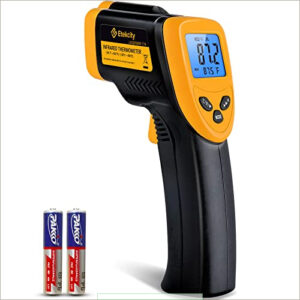
Knowing your basking spot hits 95–100 °F matters—and guessing won’t cut it. The Etekcity Infrared Laser Temperature Gun delivers a verified reading in under half a second without contact.
Point it at the surface from about 14 inches away, and the backlit LCD displays your exact temperature. Its adjustable emissivity (0.1–1.0) accommodates diverse materials, from cork bark to glass.
Accurate, fast, and dead simple to use, this tool ensures precision for any task.
| Best For | Anyone who needs quick, accurate surface temperature readings—whether you’re keeping a reptile enclosure dialed in, cooking on a cast iron, or troubleshooting HVAC equipment. |
|---|---|
| Primary Use | Temperature measurement |
| Indoor Suitable | Yes |
| Safety Feature | ±2% accuracy limit |
| Material | Plastic housing |
| Animal/Pet Safe | Yes, habitat monitoring |
| Reptile Relevant | Monitors basking temps |
| Additional Features |
|
- Reads in under half a second with a laser aim point, so you hit exactly the spot you’re targeting
- Wide range (−50°C to 450°C) covers everything from your freezer to a hot grill or workshop equipment
- Simple single-button operation with a backlit display—no learning curve, no fuss
- Surface-only measurement means it can’t tell you the internal temp of food or liquids
- Accuracy can drift by up to ±5°F if you’re not at the right distance or emissivity setting
- Highly reflective surfaces may need a few tries before the reading stabilizes
3. PetraTools HD201 Garden Sprayer
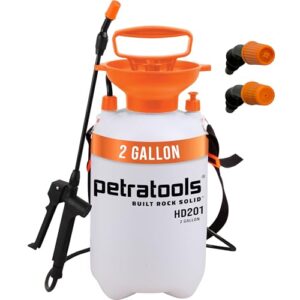
Humidity management is hands-on work, and the PetraTools HD201 makes it straightforward. Its 2-gallon translucent tank allows you to monitor water levels mid-session, while the wide-mouth opening ensures quick, hassle-free refills.
The 52-inch wand eliminates awkward repositioning by reaching every corner of large enclosures. This design prioritizes efficiency during maintenance tasks.
Switching to the fine mist nozzle delivers an even coating across substrates and branches—ideal for jungle and coastal subspecies requiring precise humidity during shed cycles.
| Best For | Homeowners and DIY gardeners who need a versatile, easy-to-use sprayer for lawn care, pest control, or garden maintenance on properties up to an acre. |
|---|---|
| Primary Use | Liquid spraying |
| Indoor Suitable | Yes |
| Safety Feature | Built-in relief valve |
| Material | Molded plastic |
| Animal/Pet Safe | Yes, garden/enclosure use |
| Reptile Relevant | Misting enclosures |
| Additional Features |
|
- The translucent 2-gallon tank makes it easy to see exactly how much liquid you have left, so no guessing mid-job.
- Two interchangeable nozzles give you real flexibility—switch from a gentle mist to a strong jet stream depending on what you’re spraying.
- The 52-inch wand lets you reach rooftops or high branches (up to about 28 feet on stream mode) without dragging out a ladder.
- It’s built for light residential use, so don’t expect it to hold up under heavy, commercial-grade spraying.
- Some users have reported a leaky shut-off valve, which means you might need to contact customer support for a replacement part.
- The wand needs to be fully inserted and twisted to lock properly—skip that step and you’ll likely deal with leaks or weak performance right out of the box.
4. Zoo Med ReptoSoil Bioactive Terrarium Soil
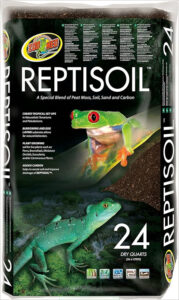
Zoo Med ReptiSoil does more than just fill the bottom of your enclosure. Its blend of peat moss, humus, sand, and coconut carbon holds moisture without turning soggy — exactly what carpet pythons need for proper thermoregulation at ground level.
The carbon layer actively hosts beneficial bacteria, which breaks down waste and keeps persistent odors manageable.
At 2–4 inches deep, it accommodates natural burrowing behavior and pairs well with live plants in bioactive builds.
One 24-quart bag covers most standard setups cleanly.
| Best For | Reptile, amphibian, and invertebrate keepers who want a natural, bioactive substrate that holds humidity and encourages digging behavior. |
|---|---|
| Primary Use | Reptile substrate |
| Indoor Suitable | Yes |
| Safety Feature | Coconut carbon filtration |
| Material | Plastic bag/organic mix |
| Animal/Pet Safe | Yes, reptile substrate |
| Reptile Relevant | Burrowing substrate |
| Additional Features |
|
- Coconut carbon actively hosts beneficial bacteria, which cuts down on odors over time without much effort on your end.
- Holds moisture really well, so animals that need humid conditions — like amphibians and burrowing reptiles — stay comfortable longer.
- Works great in bioactive setups, supporting live plants and healthy micro-fauna for a more self-sustaining enclosure.
- Gets messy and sticky on enclosure walls and décor when it’s damp, which makes cleaning a bit of a chore.
- Occasionally contains larger wood chips or stone fragments that could pose a risk to smaller or more delicate animals.
- One 24-quart bag won’t cut it for bigger tanks (30 gallons) or deep-burrowing species — you’ll likely need to grab more than one.
5. Rescue One Step Disinfectant Cleaner
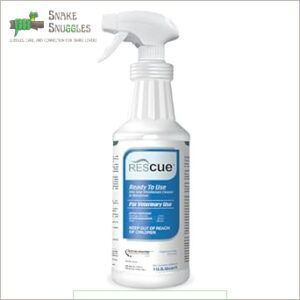
Cleaning your carpet python’s enclosure isn’t glamorous, but it’s non-negotiable. Rescue One Step Disinfectant Cleaner makes it straightforward. The ready-to-use formula relies on Accelerated Hydrogen Peroxide technology — broad-spectrum, fast-acting, and low-odor. It kills pathogens like Canine Parvovirus in under 60 seconds on hard, non-porous surfaces.
No mixing, no harsh fumes, no residue on your hides or branches. Just spray, let it dwell, and wipe. Weekly water bowl disinfection becomes a two-minute task instead of a production.
| Best For | Reptile and exotic pet owners who want a fast, fume-free disinfectant that’s tough on pathogens but safe around animals. |
|---|---|
| Primary Use | Surface disinfection |
| Indoor Suitable | Yes |
| Safety Feature | EPA lowest toxicity rating |
| Material | Liquid solution |
| Animal/Pet Safe | Yes, OSHA-compliant |
| Reptile Relevant | Enclosure disinfection |
| Additional Features |
|
- Kills nasty pathogens like Canine Parvovirus in under 60 seconds — no dilution needed for everyday use.
- Low-odor, fast-evaporating formula means no harsh fumes lingering around your enclosure.
- EPA’s lowest toxicity rating, so it’s safe for use around animals and people without a hazmat situation.
- No spray nozzle included, and the factory sprayer can be uneven — you may need to grab your own.
- Leaves a visible film on glass surfaces, so expect a follow-up wipe with glass cleaner on tank panels.
- Doesn’t reliably disinfect porous materials like fabric or wood, which limits its use on certain enclosure decor.
Frequently Asked Questions (FAQs)
How big do carpet pythons get?
Carpet pythons range from about 4 feet to over 10 feet, depending on the subspecies. Coastal carpets are the largest, while inland and Darwin types stay noticeably smaller.
How big should a carpet python enclosure be?
Most adults need at least a 6 by 3 foot enclosure — enough room to stretch, thermoregulate, and move without constant coiling. Bigger is always better, especially for coastal subspecies.
How big should a Python enclosure be?
Most adult carpet pythons need at least a 4×2×2 ft enclosure, but bigger is always better. A 6×2×3 ft setup gives your snake room to climb, thermoregulate, and actually thrive.
How big should a carpet python vivarium be?
The bigger the snake, the bigger the space it needs. For most adults, a 6 ft × 2 ft × 3 ft enclosure hits the sweet spot — room to roam, climb, and thermoregulate properly.
What size enclosure do carpet pythons need?
Most adult carpet pythons need at least a 6 ft × 2 ft × 2 ft enclosure. Larger subspecies, like coastals, do better in a 6 ft × 2 ft × 3 ft setup.
How big should a carpet python tank be?
Most adults need at least a 4×2×2 ft enclosure, but a 6×2×3 ft setup is better. Larger subspecies like coastals may need 6×3×3 ft or more.
Do carpet pythons need a front entry enclosure?
Front entry enclosures aren’t required, but they make life easier. Carpet pythons are curious and fast, so a secure front-opening design reduces stress for both you and the snake during feeding and maintenance.
What size tank do you need for a carpet python?
Most carpet pythons need an enclosure at least 4 feet long, 2 feet wide, and 2 feet tall. Larger subspecies like coastals do better in a 6 × 2 × 3 ft setup.
Is a carpet python a good beginner snake?
Carpet pythons are not ideal for beginners. They are semi-arboreal, require precise temperature gradients, and can be defensive when young.
With research and commitment, though, many keepers successfully make them their first snake.
Can carpet pythons be kept together?
No — carpet pythons are solitary by nature. Housing two together raises the risk of stress, territorial aggression, and feeding competition. One snake, one enclosure is always the safer rule.
Conclusion
Old keepers used to say, ‘measure twice, cut once’—and that wisdom holds just as true for reptile housing as it does for carpentry. Nail the carpet python’s enclosure size from the start, and you eliminate half the problems before they appear.
Your snake doesn’t need luxury—it needs geometry. The right floor space, the right height, the right thermal gradient. Get those numbers locked in, and you’ll have a calmer, healthier animal that actually thrives.