This site is supported by our readers. We may earn a commission, at no cost to you, if you purchase through links.

A single carpet python can wear a dozen different faces. Jungle carpets glow yellow-green with jet black blotching. Diamond pythons carry geometric gold-and-black rosettes down the spine like scales cut from a pattern. Coastal carpets just get big, sometimes pushing past 12 feet in captivity.
That variety pulls people in, but it also raises the stakes. Carpet python morphs and care aren’t one-size-fits-all. Jaguar morphs carry a known neurological risk. Albino and axanthic lines need the same rigor without the guesswork.
Get the fundamentals right, from enclosure setup to feeding intervals, and you’ll handle any morph with confidence.
Table Of Contents
- Key Takeaways
- Best Carpet Python Morphs and Subspecies to Know
- Carpet Python Enclosure Setup and Habitat Care
- Top 5 Supplies for Carpet Python Owners
- Carpet Python Feeding, Handling, and Health Care
- Frequently Asked Questions (FAQs)
- What are the different carpet python morphs?
- Are carpet pythons easy to take care of?
- Are carpet pythons easy to breed?
- How long does it take for a carpet python to fully grow?
- Are carpet pythons hard to care for?
- What do pythons do at night?
- Do carpet pythons have morphs?
- What not to use for snake bedding?
- How to care for carpet python?
- What is the best substrate for carpet pythons?
- Conclusion
Key Takeaways
- Jaguar morph carpet pythons carry a known neurological risk, and breeding two Jaguars together risks producing "Super Jaguars" with near-100% mortality from lung defects.
- Adult enclosures need a floor area around 60 by 30 inches with a basking zone of 88–92°F and a cool side of 75–82°F to keep your python thermoregulating properly.
- Feed neonates every 5–7 days and adults every 10–14 days, always matching prey size to body girth to prevent regurgitation and obesity.
- Keeping humidity between 40–60% (60–70% during shedding) and using secure, tamper-resistant hide latches are both essential for preventing health issues and escapes.
Best Carpet Python Morphs and Subspecies to Know
Six subspecies make up Morelia spilota, and each one brings its own size, pattern, and temperament to the table. Morphs add another layer, from bold Jaguar patterns to ghostly Axanthic coloring. Here’s what sets the most popular varieties apart.
Breeders regularly mix these genes into striking combos like albino jaguar, so checking current carpet python morph availability helps you spot rare pairings before they’re gone.
Jungle Carpet Python Traits

Rarely do you find a python this striking and this manageable.
Jungle carpet pythons live a semi-arboreal lifestyle, climbing by night to hunt, then dropping down to prowl the forest floor. Their yellow-to-olive bodies wear bold black blotching, a camouflage pattern that shifts wildly between individuals. Wild adults run 4-6 feet, females outsizing males, thanks to natural sexual dimorphism seen across most carpet python morphs.
These snakes use an exceptional sense of smell to detect warm-blooded prey.
Coastal Carpet Python Size
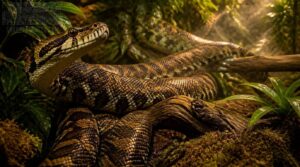
Where jungle pythons stay compact, coastal carpet pythons pack on serious length. Adult coastal size range runs 9–10 feet, with captive specimens topping 12–13 feet on record. Females outsize males here too.
Growth spurts hit hardest in the first 2–3 years, slowing as they approach maturity between 4–6. Wild populations average 6–9 feet — habitat and prey availability shape the difference.
Diamond Python Markings
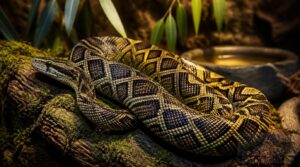
Coastal size impresses, but diamond pythons win on looks alone. Bold black-and-gold diamonds run along the spine in Geometric Pattern Contrast, sharpest right after shedding. Juveniles show denser, smaller diamonds that expand with growth.
Watch for Melanism Color Shifts muting contrast, and feed quality prey—Pigment Nutrition Impact keeps diamonds crisp instead of faded across this carpet python morph’s lifespan.
Albino and Axanthic Morphs
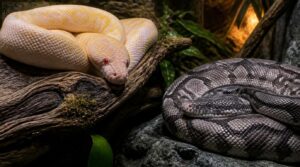
Diamonds dazzle, but pigment-deficient morphs offer a different mastery lesson: genetic traits stripped down to essentials. Albino carpet pythons run pale yellow to pink, red pupils flashing under light—manage light sensitivity with dimmer setups. Axanthic morphs deliver striking grayscale pattern contrast, no yellow pigment involved.
Both trace back to recessive gene breeding. Watch ocular health monitoring closely; pigment mutation health issues often surface there first.
Jaguar Morph Health Risks
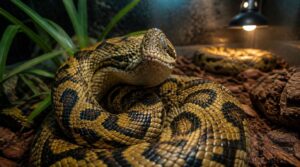
Beauty comes with a price tag here. Jaguar morphs carry neurological coordination issues tied to embryonic development, worsening under stress into wobbling or corkscrewing.
Breeding two Jaguars risks the "Super Jaguar," a leucistic phenotype with near-100% leucistic mortality risk from lung development defects. Know your genetic lineage before pairing—this isn’t a morph to breed blind.
Carpet Python Enclosure Setup and Habitat Care
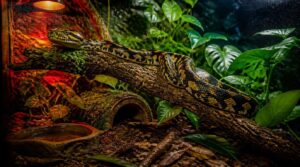
Your carpet python’s enclosure isn’t just a box, it’s the foundation of its entire health. Get the size, climbing structure, and thermal setup wrong, and you’ll spend years fighting stress and illness instead of enjoying your snake. Here’s exactly what a proper setup requires, piece by piece.
A carpet python’s enclosure isn’t just a box—it’s the foundation of its entire health
Adult Enclosure Size
Size matters more than most keepers assume. For an adult carpet python, floor area should hit around 60 by 30 inches minimum, with length equaling three times body length. Height needs to match total length, plus four feet clearance. Housing multiple snakes? Add 20% floor space per extra animal. Custom builds solve this once growth outpaces off-the-shelf tanks.
When choosing cleaning products for these custom builds, stick to an EPA-rated low-toxicity enclosure cleaner so sanitizing that extra floor space stays safe for both snake and keeper.
Climbing Branches and Perches
Since carpet pythons spend real time off the ground, vertical climbing space isn’t optional decor. Use cork, manzanita, or grapevine—kiln-dried, textured, never painted. Vary diameters from 1.5–4 inches across three levels, 18–48 inches high.
Zigzag placement builds grip strength; secure every mounting point. Check weekly for wobble or cracks—loose branches are injury risks waiting to happen.
Secure Hides and Latches
A snake that can escape is a husbandry failure waiting to happen. Mechanical compression locks and cam driven security keep hide doors flush and tamper-resistant. For upgraded setups, magnetic latch systems or electronic latch assemblies add tamper alerts and quick-release access.
Pressure plate mechanisms confirm closure automatically. Multiple hides at varying heights aren’t just enclosure size filler—they’re essential for animal welfare, giving your python real security options.
Temperature Gradient Basics
Get thermoregulation wrong and your carpet python can’t digest, shed, or even think straight. Run a basking zone of 88–92°F down to a cool side near 75–82°F—that gradient, not just the numbers alone, drives the snake’s movement. Conduction from basking surfaces and convection through air currents both shape the curve.
Verify it with an infrared temp gun or probe thermometer, checking floor and air readings separately.
Humidity and Shedding Support
Bad shed doesn’t lie—it’s your humidity log talking. Keep ambient levels at 40–60%, pushed to 60–70% during pre-shed, using misting or damp substrate.
- Place your hygrometer at mid-enclosure height
- Mist twice daily
- Check substrate for damp-not-wet balance
- Bump humidity when eye caps cloud
Retained shed on tail tips and eyes signals a gap in your routine, not bad luck.
Top 5 Supplies for Carpet Python Owners
Good husbandry comes down to having the right gear on hand. Guesswork ruins temperature gradients and invites illness, so precision tools matter more than you’d think. Here are five supplies that belong in every carpet python owner’s setup.
1. GE Heavy Duty Grounded 6 Outlet Power Strip
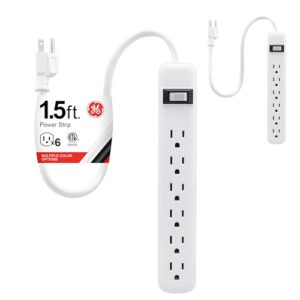
Six outlets sounds like plenty until you count your ceramic heater, thermostat, mister, and UVB fixture running at once.
That’s where the GE Heavy Duty Power Strip earns its keep. Grounded outlets matter here — reptile enclosure setups run sensitive electronics, and grounding cuts shock and short-circuit risk. The built-in circuit breaker trips before overload turns into a fire hazard, then resets with one flip once things cool down.
Keyhole slots let you mount it straight to the wall behind your rack, keeping cords out of reach of curious hands and off a floor that gets misted daily.
| Feature | Spec | Why It Matters |
|---|---|---|
| Outlets | 6 grounded | Runs full thermostat setup |
| Safety | Circuit breaker | Prevents overload damage |
| Mounting | Keyhole slots | Frees floor space |
| Weight | 1.1 lb/strip | Easy wall installs |
| Pack | 2 strips | Covers multiple enclosures |
It’s not a surge protector, so pair it accordingly.
| Reptile Use | Carpet Python Care |
|---|---|
| Skill Level | Beginner Friendly |
| Setup Effort | Moderate |
| Maintenance Frequency | Ongoing |
| Enclosure Role | Guide Reference |
| Target Climate | Tropical |
| Additional Features |
|
2. Etekcity Infrared Laser Temperature Gun
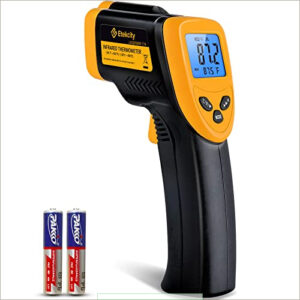
Wall power keeps your thermostats running, but you still need to verify those numbers at the source. Guessing at basking temps is how you end up cooking or chilling your python by accident.
The Etekcity infrared temperature gun solves that. Point it at the basking spot, cool zone, or substrate, and it reads surface temps in under 0.5 seconds — no probes, no waiting.
Its 12:1 distance-to-spot ratio means from 14 inches away, you’re reading a tight, accurate circle rather than guessing at an average. Adjustable emissivity (0.1–1.0) lets you dial in accuracy for glass, wood, or rock surfaces alike.
For monitoring thermoregulation across the reticulated python’s diverse Southeast Asian habitats, that precision and emissivity control makes a real difference across humid rainforest floors and sun-baked rocky outcrops alike.
Run checks at both ends of your gradient daily. Consistency catches drift before it becomes a health problem.
| Best For | Reptile owners who want to verify basking and cool-zone temperatures precisely instead of relying on thermostat readouts alone. |
|---|---|
| Reptile Use | Temperature Checking |
| Skill Level | Beginner Friendly |
| Setup Effort | Low |
| Maintenance Frequency | Daily |
| Enclosure Role | Diagnostic Tool |
| Target Climate | Any Climate |
| Additional Features |
|
- Rapid sub-0.5 second readings make daily gradient checks quick and easy
- Adjustable emissivity settings allow accurate readings across glass, wood, and rock surfaces
- Non-contact laser measurement keeps hands safely away from hot or cold surfaces
- Requires maintaining the 14-inch, 12:1 distance ratio for accurate readings
- Measures an average surface area rather than one precise point
- Not suitable for measuring human or animal body temperature
3. PetraTools HD201 Garden Sprayer
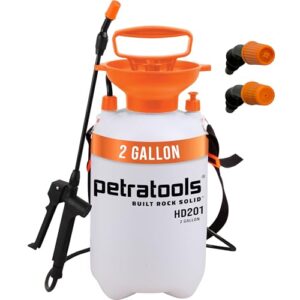
Temps checked, gradient confirmed — now you’ve got to keep humidity in line, and that’s a manual job unless you’ve got a misting rig wired in.
The PetraTools HD201 does the job well. Its 2-gallon translucent tank covers multiple enclosures before you need a refill, and the wide-mouth opening means no spilled water down the side while filling at the sink.
Two nozzles come standard: an adjustable tip for fine mist or a focused jet, plus a fan tip for broad coverage across substrate or cage walls. Switch between them without tools, mid-spray.
The ergonomic handle stays grippy even with gloves on, which matters when you’re maneuvering around a rack. No cords, no batteries — just pump pressure and go, holding your 40–60% humidity range steady without babysitting a machine.
| Best For | Reptile and terrarium keepers who need a reliable, no-frills way to maintain humidity across multiple enclosures without investing in a motorized misting system. |
|---|---|
| Reptile Use | Humidity Maintenance |
| Skill Level | Beginner Friendly |
| Setup Effort | Manual |
| Maintenance Frequency | Regular |
| Enclosure Role | Humidity Tool |
| Target Climate | Tropical |
| Additional Features |
|
- Large 2-gallon tank means fewer refills when covering multiple enclosures
- Dual nozzle options (adjustable mist/jet and fan tip) offer flexibility for different substrate and cage-wall coverage
- Ergonomic, glove-friendly handle makes it easy to use during routine rack maintenance
- Manual pumping is required to build and maintain pressure, which takes more effort than a motorized unit
- Handheld capacity is limited compared to larger, motorized sprayers
- No automation means you can’t "set and forget" humidity control like with a wired misting rig
4. Zoo Med ReptoSoil Bioactive Terrarium Soil
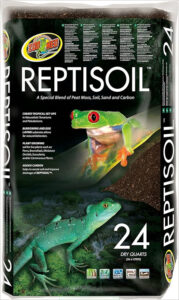
Misting keeps the air right, but what your carpet python actually sits on matters just as much. That’s where Zoo Med ReptiSoil earns its spot on the rack.
It blends peat moss, topsoil, sand, and coconut carbon into a loose, crumbly mix that holds humidity without turning swampy. The carbon component isn’t filler — it boosts porosity and feeds beneficial bacteria, which cuts down on lingering odor over weeks of use.
Burrowing is a natural behavior for carpet pythons, and this substrate makes it easy. The texture stays soft enough for digging and egg-laying, while still anchoring live plants if you’re running a bioactive setup.
One 24-quart bag covers a standard enclosure comfortably. For multi-tank setups, buy in bulk. It’s built for tropical humidity ranges, so skip it in arid or desert enclosures.
| Best For | carpet python owners and other tropical reptile or amphibian keepers who want a bioactive, humidity-retaining substrate for burrowing, egg-laying, and live plant growth. |
|---|---|
| Reptile Use | Substrate Base |
| Skill Level | Beginner Friendly |
| Setup Effort | Low |
| Maintenance Frequency | Weeks-Long |
| Enclosure Role | Substrate Layer |
| Target Climate | Tropical Only |
| Additional Features |
|
- Coconut carbon boosts porosity and supports beneficial bacteria, helping control odor over time
- Loose, crumbly texture makes burrowing and egg-laying easy while holding humidity without getting swampy
- Anchors live plants well, making it a solid choice for bioactive terrarium and paludarium setups
- Only suited for tropical, humid enclosures — not appropriate for arid or desert reptile setups
- At 17 pounds per bag, it can be heavy and a bit unwieldy to handle during setup
- Multi-tank owners will need to buy in bulk, since one bag only covers a standard enclosure
5. Rescue One Step Disinfectant Cleaner
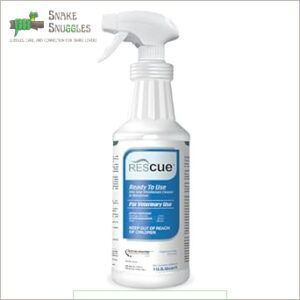
Sixty seconds is all it takes to knock out parvo, ringworm, and the fungal spores hiding in your carpet python’s substrate corners. Rescue One Step earns its place because it skips the mixing bowl entirely — grab the ready-to-use bottle and go.
The active ingredient is accelerated hydrogen peroxide, a formula that breaks down into water and oxygen once it’s done its job. That’s a real advantage over harsh bleach-based cleaners, which leave residue and fumes you don’t want near a snake’s respiratory system.
Spray hard, non-porous surfaces until visibly wet, let it dwell, then wipe. No rinse cycle, no chemical hangover. It’s EPA registered with the lowest toxicity rating, low-odor, and safe for enclosures once fully dry.
At 32 ounces and 2.09 pounds, one bottle covers routine cleanings and post-illness deep cleans alike — a staple for shelters, build care setups, and your reptile room.
| Best For | Reptile keepers, veterinary clinics, and shelter staff who need a fast, ready-to-use disinfectant that’s tough on pathogens but gentle enough to use around sensitive animal enclosures. |
|---|
- Kills parvovirus and other pathogens in as little as 60 seconds with no mixing required
- Breaks down into water and oxygen, leaving no harsh residue or fumes behind
- EPA registered with a low toxicity rating, making it safer for use near animals once dry
- Spray nozzle isn’t included, so you’ll need to supply your own
- Formulated specifically for veterinary and animal settings rather than general household use
- Requires letting the surface dry fully before it’s safe for enclosures, adding a wait time to cleaning routines
Carpet Python Feeding, Handling, and Health Care
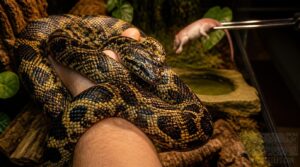
Your enclosure is dialed in, so now it’s time to keep your python fed and healthy for the long haul. Feeding, handling, and spotting trouble early make up the daily grind of good husbandry. Here’s what you need to get right.
Feeding Schedule by Age
Feed neonates every 5–7 days on frozen-thawed prey, never live rodents. As growth accelerates around 2–3 months, keep that same interval but size prey up slightly.
By adulthood, stretch feeding to 10–14 days—overfeeding here causes obesity, not growth. Track body weight weekly; steady gains without excess bulk mean your schedule’s dialed in. Adjust intervals based on appetite, not just age charts.
Safe Prey Size
Why do so many carpet python feeding mishaps trace back to one mistake? Wrong prey size.
Stick to these Ideal Girth Ratios:
- Hatchlings: 60–70% of midbody width
- Juveniles: match head width, no wider
- Adults: up to 1x girth, occasionally 1.5x
- Always follow Gradual Size Transitions—one class at a time
Regurgitation Prevention Tips matter: track digestion, adjust via Weight Monitoring Strategies.
Frozen-Thawed Feeding Tips
Freezer to fridge, never counter to bowl—that’s the golden rule for frozen thawed rodents. Cap room-temp thawing under two hours to curb bacterial growth. Warm gently in water, then wrist-test for even heat.
| Step | Method | Why |
|---|---|---|
| Thaw | Fridge overnight | Prevents bacteria |
| Warm | Water bath | Even temperature |
| Offer | Within 24 hrs | Freshness |
Log each feeding—prey size, scent cues, acceptance—to improve your python feeding schedule over time.
Common Illness Warning Signs
Your python’s body tells you when something’s wrong, if you know what to watch for. Open-mouth breathing, wheezing, or clicking sounds signal respiratory infections needing vet care fast. Mouth rot shows up as swollen, lesioned gums. Tremors or spasms point to neurological issues, common in certain morphs. Dull, flaky skin suggests parasites or stuck shed—both demand quick intervention before they escalate.
Stress-linked symptoms can easily mimic illness, so understanding rough green snake behavior and handling needs helps you tell defensive reactions from genuine health concerns.
Calm Handling Routine
Trust builds one session at a time. Start with a 2–3 minute acclimation period on a padded surface, then support the full body—no dangling, no squeezing.
Watch for:
- Tail whipping or hissing
- Refusal to coil
- Rapid, jerky movement
Any of these signal defensive behavior—stop and reassess. Track temperament after each session; calm coils and slow breathing mean you’re building genuine trust, not just tolerance.
Frequently Asked Questions (FAQs)
What are the different carpet python morphs?
One snake, six masks. Morelia spilota spans Jungle, Coastal, and Diamond subspecies, plus axanthic, albino, and jaguar morphs—each shaped by melanin deficiency, phenotype expression, and pattern variability, though interspecies hybrid risks raise real morph selection ethics questions.
Are carpet pythons easy to take care of?
Yes, for keepers who stick to a routine. Consistent feeding, cleaning, and gradient checks keep stress low. They’re calm, non-venomous, and forgiving—beginner-friendly overall, though long-term husbandry demands genuine daily commitment, not occasional attention.
Are carpet pythons easy to breed?
Nobody hands out breeding trophies for "easy," and pythons won’t fill out paperwork either. Seasonal cooling, correct photoperiod, and pheromonal cues drive it. Females need 5–5 years maturity, and clutches average 10–12 eggs.
How long does it take for a carpet python to fully grow?
Full growth takes 4 to 5 years, with juvenile growth spurts driving early gains and slowing near sexual maturity at 5–3 years. Diet, temperature, and housing shape final adult size, while lifespan often stretches decades beyond growth completion.
Are carpet pythons hard to care for?
Hard to master, easy to love — which is it?
Carpet python care rewards beginners with forgiving temperaments, yet punishes shortcuts in temperature regulation and humidity. Nail feeding frequency and daily maintenance, and this 20-year commitment becomes routine, not a struggle.
What do pythons do at night?
Once lights dim, nocturnal foraging instincts kick in. Your snake relies on heat-sensing pits and low-light perception to ambush prey from perches.
Keep handling minimal after dark—nighttime disturbances spike stress and disrupt natural thermoregulation, hunting rhythms, and healthy carpet python behavior overall.
Do carpet pythons have morphs?
Ten thousand color combinations, and counting. Yes, Morelia spilota shows massive genetic variation—from locality-based lines like Jungle and Coastal to selectively bred multi-gene animals such as Leucistic and Extreme Axanthic, each differing wildly from wild-type stability.
What not to use for snake bedding?
Skip cedar (oil toxicity), pine (respiratory risks), sand (impaction dangers), walnut shells (abrasions), and corncob (mold issues) entirely.
Your substrate choice matters — cypress mulch or cork bark rounds keep enclosure setup safe, dry, and mold-free.
How to care for carpet python?
Get the basics right and stress never enters the picture. Nail your thermal gradient, keep humidity in range, avoid impaction-risk substrates, and feed on schedule with proper supplements — solid reptile husbandry starts with consistency, not complexity.
What is the best substrate for carpet pythons?
A 40/60 coco fiber and reptile soil mix delivers solid moisture retention, dust-free comfort, and 3–4 inches of burrowing depth. This combo resists mold, helps with shedding, and mimics a naturalistic, bioactive enclosure floor without compacting into a soggy mess.
Conclusion
A jaguar morph’s wobble syndrome teaches the same lesson every enclosure gauge does: genetics and environment aren’t separate problems, they’re one connected system.
Carpet python morphs and care demand that same integrated thinking, whether you’re tracking a jungle’s blotching or a coastal’s growth spurt toward 12 feet. Master the gradient, the feeding schedule, the hide security, and morph becomes irrelevant. Your python won’t care about labels. It’ll only respond to what you actually got right.