This site is supported by our readers. We may earn a commission, at no cost to you, if you purchase through links.
When a ball python stops eating and hides for weeks, the substrate under its belly is often the first thing worth checking. Impacted digestive tracts, respiratory infections, and mite infestations trace back to bedding choices more often than owners realize, and the fix rarely requires anything expensive. Loose, dusty, or improperly maintained substrate stresses a snake’s system in ways that build quietly before symptoms appear.
Choosing among ball python safe bedding options means weighing moisture retention, particle size, and cleaning demands against your snake’s specific enclosure setup. Get it right, and shedding improves, humidity stabilizes, and you’ll spend less time troubleshooting health issues down the road.
Table Of Contents
- Key Takeaways
- Best Safe Bedding Options for Ball Pythons
- Top 10 Safe Ball Python Bedding Products
- 1. Zilla Reptile Terrarium Bedding
- 2. ReptiChip Coconut Reptile Substrate Bedding
- 3. ZeeDix Coconut Husk Reptile Substrate
- 4. Riare Coconut Husk Reptile Substrate
- 5. Repti Zoo Coconut Substrate
- 6. Fluker’s Tropical Cypress Reptile Bedding
- 7. SunGrow Coco Fiber Carpet
- 8. RediChip Coconut Reptile Bedding Substrate
- 9. ReptiChip Coconut Reptile Bedding
- 10. Exo Terra Forest Bark Substrate
- How to Choose Ball Python Bedding
- Humidity-Friendly Substrates for Healthy Sheds
- Unsafe Bedding to Avoid
- Frequently Asked Questions (FAQs)
- What bedding can I use for ball pythons?
- What should I put on the bottom of my ball python tank?
- What bedding is safe for snakes?
- What not to use for snake bedding?
- What can I use for ball python bedding?
- What type of bedding is best for pythons?
- How do I Choose bedding for a ball python?
- How do I choose the best Python bedding?
- What is the best Cypress bedding for ball pythons?
- What is a good substrate for a ball python enclosure?
- Conclusion
Key Takeaways
- Bedding choice directly affects your ball python’s health, since impaction, respiratory infections, and mite problems most often trace back to substrate that’s too dusty, too loose, or poorly maintained.
- Coconut husk, cypress mulch, and aspen shavings top the safe list because they control dust, buffer humidity in the 50-60% range, and lower impaction risk compared to sand or gravel.
- You should always avoid cedar, pine, sand, gravel, and fertilized potting soil, since these release irritating oils and dust or carry impaction and toxicity risks that outweigh any convenience.
- Keeping substrate depth between 1-4 inches, boosting humidity to 70-80% during shed cycles, and spot-cleaning daily will do more for your snake’s wellbeing than any specific brand you choose.
Best Safe Bedding Options for Ball Pythons
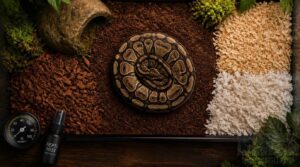
When you’re choosing bedding for your ball python, safety and humidity control matter more than looks. Not every substrate on pet store shelves meets those standards, so knowing which ones actually work makes your job easier. Here are five options you can trust in your enclosure.
The right substrate also plays a role in shedding success, so understanding how long ball python shedding takes and what affects it helps you fine-tune humidity before the process begins.
For a closer look at how each material holds moisture and stands up to daily use, this guide to ball python substrate options breaks down the pros and cons of every top pick.
Coconut Husk Bedding
Coconut husk holds moisture evenly without turning soggy, buffering humidity swings so your ball python sheds cleanly. It’s low-dust, protecting respiratory health, while its fibrous texture helps with burrowing without compacting. Spot-cleaning is simple, and the material resists mold when maintained properly. Non-toxic and pesticide-free, it also lowers impaction risk compared to finer substrates—making it a dependable, low-fuss choice.
Coconut husk bedding is commonly used in reptile terrarium substrate applications due to its moisture retention and natural composition. coconut husk bedding is a sustainable option valued for its biodegradability and comfort in animal enclosures.
Cypress Mulch
If you want bark that fights fungus on its own, cypress mulch earns its keep. Its natural oils give mold resistance and mild pest deterrence, while slow decomposition means fewer replacements. As a ball python substrate, it holds humidity well, supporting shed cycles:
- Rich, reddish tones
- Slow-release moisture
- Natural insulation
- Fungus-resistant fibers
Aspen Shavings
Aspen shavings give you a lighter-weight option when you’d rather skip heavy mulch. Sourced from virgin hardwood and kiln-dried processing, they cut moisture and pathogens while staying low in aromatic oils—safer for your snake’s respiratory tract than pine or cedar.
Expect solid moisture absorption and genuine dust control, plus enough give for mild burrowing support, all while keeping cleaning simple.
Paper Towels
Sometimes simplicity wins. When you need a quick, reliable option for Temporary Quarantine Bedding or Emergency Handling Support, paper towels deliver a non-slip surface, easy monitoring, and zero impaction risk.
- Clean white sheets absorbing spills instantly
- Snake resting on a smooth, flat surface
- No dust clouding the enclosure air
- Quick daily swap keeping things fresh
Maintain a Daily Replacement Routine to control moisture and protect respiratory health.
Reptile Carpet
A washable mat, reptile carpet gives you a reusable, low-mess alternative when loose substrate isn’t practical. It’s made from nontoxic materials, resists tearing, and trims easily for custom enclosure fits.
For hygiene, machine-wash it and let it air dry between uses—no harsh solvents. Keeping a spare on hand simplifies your spot cleaning routine and cuts downtime while your primary carpet dries.
Top 10 Safe Ball Python Bedding Products
Once you know which materials work for your ball python, the next step is finding a product you can actually trust on the shelf. Not every bag labeled "reptile safe" holds up to the same standard, so knowing specific brands saves you a lot of trial and error.
Here are ten options worth considering for your enclosure.
1. Zilla Reptile Terrarium Bedding
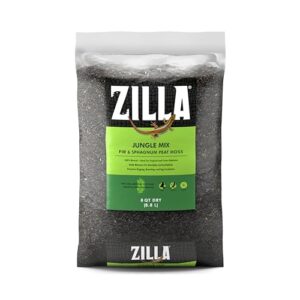
Zilla’s Jungle Mix blends aged Douglas fir bark with sphagnum peat moss into a soft, loamy substrate built for tropical burrowers.
Because substrate choice shapes everything from humidity to shedding success, it’s worth browsing a guide to safe substrate materials for juvenile snakes before settling on a mix.
For tips on choosing and maintaining the right substrate depth and moisture level, check out this beginner’s guide to snake substrate bedding.
At a 1-2 inch depth, it holds humidity effectively for frogs, geckos, and ball pythons alike, supporting shedding and even egg incubation. The organic composition contains no synthetic fragrances or additives.
Daily spot cleaning keeps waste under control, with full replacement recommended monthly. It’s a bioactive-compatible option, letting live plants and microfauna thrive alongside your snake.
| Best For | This substrate is best for owners of tropical, humidity-loving species like frogs, toads, rainforest geckos, and snakes who want a natural bioactive setup. |
|---|---|
| Material | Fir bark & peat moss |
| Humidity Range | High/tropical |
| Format | Loose bag |
| Burrowing Support | Excellent |
| Odor Control | Moderate |
| Cleaning Frequency | Daily/monthly |
| Additional Features |
|
- 100% organic, biodegradable blend that’s safe for bioactive ecosystems with live plants and microfauna
- Highly absorbent, holding humidity well for shedding, egg incubation, and overall habitat health
- Soft, loamy texture that encourages natural digging, burrowing, and nesting behaviors
- Requires daily spot cleaning to remove waste and soiled areas
- Needs full replacement monthly, which adds to ongoing cost and upkeep
- Only works within a narrow 1-2 inch depth range, limiting flexibility for deeper-digging species
2. ReptiChip Coconut Reptile Substrate Bedding
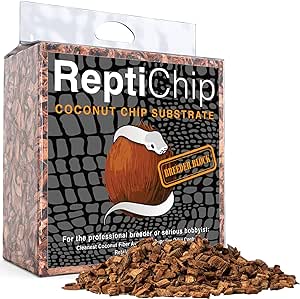
If you’ve ever wrestled a compressed brick of substrate into submission, you’ll appreciate why ReptiChip’s format matters. One 72-quart block expands into about ten pounds of triple-washed coconut chips, rinsed to strip excess salts and sodium before packaging.
That washing step matters clinically: lower sodium content means less risk of mineral buildup irritating your snake’s ventral scales during prolonged substrate contact. The medium-sized chips also resist compaction under a python’s body weight, so burrows hold their shape instead of collapsing.
Humidity sits in the 50-60% range at the surface, while deeper layers retain moisture longer, supporting sheds without soaking your snake in a swamp. Zoos and professional breeders favor this substrate because it absorbs urine and encapsulates waste between spot cleanings, cutting down on ammonia odor without relying on synthetic fragrances or chemical additives.
| Best For | Owners of tropical reptiles and invertebrates—like ball pythons, geckos, tortoises, and tarantulas—who want a natural, humidity-retentive substrate for bioactive setups. |
|---|---|
| Material | Coconut chips |
| Humidity Range | 50-60% |
| Format | Compressed brick |
| Burrowing Support | Good |
| Odor Control | High |
| Cleaning Frequency | Daily spot clean |
| Additional Features |
|
- Triple-washed to remove excess salt and sodium, reducing irritation risk during prolonged contact
- Holds humidity well, supporting healthy sheds without waterlogging the enclosure
- Compressed brick format saves storage space and expands into a large volume of usable substrate
- Requires soaking and manual breaking apart before use, which takes extra prep time
- Moisture levels need to be manually adjusted to suit different species’ needs
- Compressed weight and expansion process can be messy compared to ready-to-use substrates
3. ZeeDix Coconut Husk Reptile Substrate
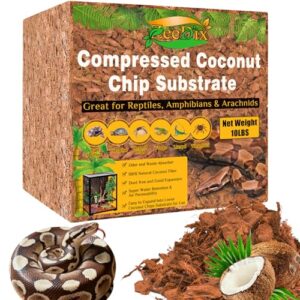
A single 10-pound brick hydrates into 72 quarts of loose coconut fiber, enough to fill a standard enclosure with 3-4 inches of burrowing depth once fully expanded. That range matters clinically, since shallower fill won’t hold the humidity gradient your python needs between warm and cool zones.
Chip size runs 10 to 35 millimeters, coarse enough to resist compaction but still fine enough to trap waste for quick spot cleaning. Expect surface humidity to settle near 50%, climbing toward the 65-70% window during shed cycles if you mist as needed.
Watch your hydration technique here: oversoaking creates standing water pockets that invite bacterial growth, while underhydrating leaves chips too dry to buffer humidity swings overnight.
| Best For | Reptile, amphibian, and invertebrate keepers—like ball python, tortoise, gecko, and tarantula owners—who need a natural substrate that holds steady humidity and supports burrowing. |
|---|---|
| Material | Coconut fiber |
| Humidity Range | 50-70% |
| Format | Compressed brick |
| Burrowing Support | Good |
| Odor Control | High |
| Cleaning Frequency | Daily spot clean |
| Additional Features |
|
- Expands from a compact 10 lb brick into 72 quarts of usable substrate, making storage and transport easy
- Naturally helps maintain balanced humidity for a wide range of reptiles and amphibians
- Dust-free, compostable, and effective at controlling odor and waste
- Needs manual hydration and prep time before it’s ready to use
- Easy to overwater, which can lead to soggy, bacteria-prone substrate
- May contain small debris like stones that require sorting out
4. Riare Coconut Husk Reptile Substrate
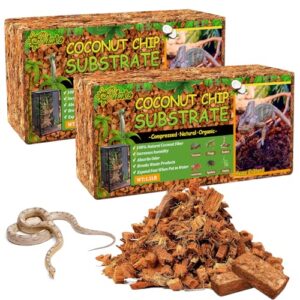
Two compressed bricks arrive dry and dense, each expanding to a soft, loose bed once you add water — no guesswork on hydration ratio, since one brick reliably yields enough volume for a standard enclosure at proper depth.
What sets this substrate apart clinically is its buffering behavior: it absorbs moisture without turning slick or waterlogged, which matters if you’re chasing that 65-70% shed-cycle window without inviting bacterial growth on the surface.
Your python will burrow through it easily, since the fibrous texture holds tunnel shape without collapsing on smaller snakes. Odor stays minimal between cleanings, though you’ll still want daily spot checks and partial replacement every few weeks.
One caution: because it’s marketed as biodegradable garden material, don’t assume it’s chemically treated for pest resistance the way some reptile-labeled substrates are.
| Best For | Reptile and amphibian keepers who want a natural, expandable substrate that supports burrowing species like snakes, tortoises, frogs, and lizards while helping maintain proper enclosure humidity. |
|---|---|
| Material | Coconut fiber |
| Humidity Range | 65-70% |
| Format | Compressed bricks |
| Burrowing Support | Good |
| Odor Control | High |
| Cleaning Frequency | Daily/periodic |
| Additional Features |
|
- Expands from compact, easy-to-store bricks into a soft, loose bed that holds tunnel shapes well for burrowing
- Naturally absorbs and retains moisture to help create stable humidity without becoming slick or waterlogged
- Free of dust and impurities, with a chunky texture that helps protect delicate skin from scratches
- Requires manual hydration and ongoing water spraying to reach and maintain the right moisture level
- Not chemically treated for pest resistance, unlike some other reptile-labeled substrates
- Needs periodic spot checks and partial replacement to keep odor and cleanliness in check
5. Repti Zoo Coconut Substrate
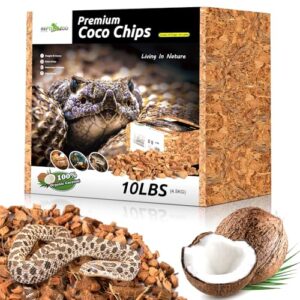
Backed by 16 years in reptile husbandry products, Repti Zoo’s compressed coconut substrate brick expands with roughly 30 liters of water into a fine, soil-like bed that buffers humidity well within the 50-60% daily range your python needs.
One brick yields 72 quarts, enough for a deep layer across multiple small enclosures or one large terrarium — practical if you’re managing several setups at once.
The fibrous matrix absorbs waste odor naturally, though you may occasionally find debris like seeds mixed in, since it’s a raw agricultural byproduct rather than a sterilized reptile-labeled product. That’s not a safety flaw, but it does mean a quick visual check before use.
Spot clean daily and swap soiled sections every four to eight weeks to prevent bacterial buildup. If your enclosure runs humid, monitor for mold formation, since coconut substrates hold moisture readily and won’t dry out on their own.
| Best For | Reptile, amphibian, and invertebrate keepers who need a natural, humidity-holding substrate for tropical or moisture-loving species like ball pythons and tortoises. |
|---|---|
| Material | Coconut fiber |
| Humidity Range | 50-60% |
| Format | Compressed brick |
| Burrowing Support | Good |
| Odor Control | High |
| Cleaning Frequency | Daily/4-8 weeks |
| Additional Features |
|
- Made from 100% natural coconut fiber that’s biodegradable and expands into a soft, soil-like bedding
- Naturally absorbs odors from waste while helping maintain a humid, tropical microclimate
- One brick expands to 72 quarts, offering good coverage for large tanks or multiple smaller enclosures
- Requires hydration before use, so it’s not ready straight out of the package
- Prone to mold if it gets too wet or isn’t refreshed regularly, especially in high-humidity setups
- Not a good fit for arid-dwelling species that need drier substrate conditions
6. Fluker’s Tropical Cypress Reptile Bedding
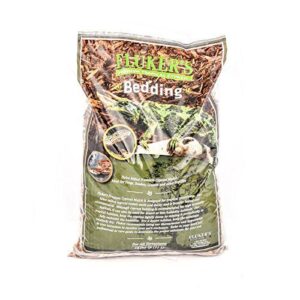
If moisture-buffering coconut fiber isn’t your style, cypress mulch gives you a different route to the same 50-60% humidity target.
Fluker’s uses twice-milled cypress bark, which breaks the material down into a softer, finer texture than raw mulch. That milling process also lowers dust output, a real benefit if you’re housing your python somewhere with limited airflow.
A 10-quart bag covers enough ground for a 2-3 inch layer, supporting light burrowing while cypress’s natural antimicrobial properties resist mold better than most wood-based substrates. You’ll still need to mist periodically since cypress won’t hold water as aggressively as coconut husk.
Spot clean weekly and plan on a full swap every four to six weeks. Breeders favor this one for its balance of moisture retention and decay resistance, making it a solid middle-ground choice between coco fiber and drier options like aspen.
| Best For | Reptile keepers and breeders housing active, burrowing species like pythons who want a mold-resistant, low-dust substrate for enclosures with limited airflow. |
|---|---|
| Material | Cypress bark |
| Humidity Range | 50-60% |
| Format | Loose bag |
| Burrowing Support | Light |
| Odor Control | Moderate |
| Cleaning Frequency | Weekly/4-6 weeks |
| Additional Features |
|
- Twice-milled cypress bark offers a soft, fine texture with less dust than raw mulch
- Natural antimicrobial properties help resist mold better than most wood-based substrates
- Supports a 2-3 inch layer, ideal for light burrowing and holding humidity in the 50-60% range
- Doesn’t retain moisture as well as coconut husk, so periodic misting is required
- Requires weekly spot cleaning and a full substrate swap every four to six weeks
- Listed specifications show conflicting details on material and color, so it’s worth confirming exact product info before purchase
7. SunGrow Coco Fiber Carpet
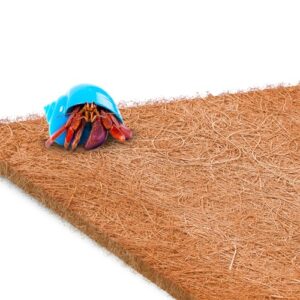
If loose substrate isn’t your preference, a woven coir mat solves the same humidity problem while giving you something reusable. SunGrow’s carpet measures 10 x 13 inches out of the package, and since it’s cut from 100% natural coconut fiber, you can trim it down to fit odd-shaped enclosures or piece multiple sections together for larger setups.
The dense weave gives your python secure footing during movement, and because the fibers are bound rather than loose, you won’t deal with stray debris getting caught in shed skin. Expect some initial fiber shedding when you first unpack it; a quick rinse takes care of that.
Cleaning is straightforward: rinse with mild soap, air dry completely before reuse, and replace once the material starts breaking down or holding odor despite washing. At 3.2 ounces, it’s lightweight, though it won’t buffer humidity as effectively as loose coco fiber substrate on its own.
| Best For | Reptile and small pet owners who want a reusable, low-mess substrate option for snakes, geckos, or hermit crabs, especially in setups where loose coco fiber would be too messy or hard to manage. |
|---|---|
| Material | Coconut fiber mat |
| Humidity Range | Moderate |
| Format | Woven mat |
| Burrowing Support | Footing only |
| Odor Control | Low |
| Cleaning Frequency | Rinse as needed |
| Additional Features |
|
- Reusable and washable, so you’re not replacing substrate constantly
- Custom-trimmable to fit odd-shaped or larger enclosures
- Dense weave keeps loose debris out of shed skin and gives pets secure footing
- Doesn’t hold humidity as well as loose coco fiber substrate
- Sheds some loose fibers the first time you unpack it
- Needs regular cleaning and full drying to avoid mold or odor buildup
8. RediChip Coconut Reptile Bedding Substrate
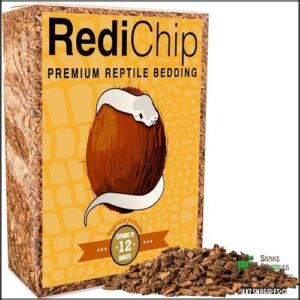
If reusable carpet isn’t your style, RediChip’s coconut chips give you a ready-to-pour option with none of the soaking hassle brick substrates demand. The medium chips support your python’s weight while staying dust-free enough to protect its respiratory tract.
Moisture retention stays balanced, resisting the wet pockets that invite mold growth, and you can use it dry or lightly moistened depending on your humidity target.
| Package Size | 12 quart |
| Material | Coconut chips |
| Species | Pythons, geckos, tarantulas |
Best For: Reptile and amphibian keepers who want a ready-to-pour coconut substrate for pythons, geckos, tarantulas, and similar species without the soaking prep that brick substrates require.
| Material | Coconut chips |
|---|---|
| Humidity Range | Variable dry/moist |
| Format | Ready-to-pour |
| Burrowing Support | Good |
| Odor Control | Moderate |
| Cleaning Frequency | Manual as needed |
| Additional Features |
|
- Ready-to-pour convenience with no soaking or breaking down bricks beforehand
- Dust-free, medium-sized chips that support your pet’s weight while protecting its respiratory tract
- Versatile for both dry (arid species) and lightly moistened (tropical species) setups
- Requires manual water addition to maintain humidity for tropical enclosures
- Can break down over time with prolonged moisture exposure
- Not pre-mixed with bioactive components, so extra substrates are needed for a full bioactive setup
9. ReptiChip Coconut Reptile Bedding
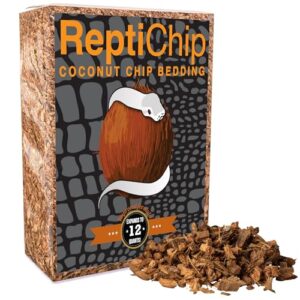
Compressed blocks are worth considering if storage space is tight: one brick expands into over 72 quarts once hydrated. Triple-washed chips keep dust low while holding 60-80% humidity without turning muddy.
The chunky texture dries top-down, so stirring the surface or wetting deeper layers lets you fine-tune moisture zones. Lignin-rich chips resist breaking down between full changes, provided you spot-clean waste daily to control bacterial buildup and odor.
| Best For | Reptile and invertebrate keepers—especially those with snakes, tortoises, geckos, tarantulas, or hermit crabs—who want a natural, odor-reducing substrate that holds humidity well for burrowing species. |
|---|---|
| Material | Coconut chips |
| Humidity Range | 60-80% |
| Format | Compressed brick |
| Burrowing Support | Good |
| Odor Control | High |
| Cleaning Frequency | Daily spot clean |
| Additional Features |
|
- Dust-free, triple-washed coconut chips maintain 60-80% humidity without becoming muddy
- High odor-absorption naturally encapsulates waste without chemical deodorants
- Compressed bricks are space-saving, with one expanding into over 72 quarts once hydrated
- Rapidly absorbs liquid waste, so more frequent spot-cleaning and substrate changes are needed
- May cause slight reddish staining on lighter-colored animals’ undersides
- Can attract insects if waste isn’t managed and cleaned regularly
10. Exo Terra Forest Bark Substrate
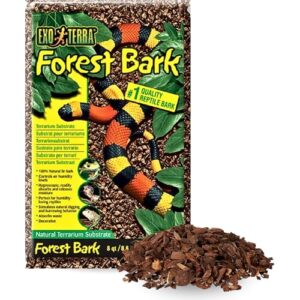
When you want a substrate that mimics an actual forest floor, kiln-dried Douglas fir bark delivers both texture and function. Its hygroscopic structure pulls moisture in and releases it slowly, which helps you hold humidity in the 60-70% range without tipping into mud or bacterial buildup.
The medium-sized chunks lower impaction risk compared to finer substrates, though feeding your python outside the enclosure remains good practice regardless. Bark particles also encourage the digging and burrowing instincts ball pythons rely on for security.
Plan on daily spot cleaning, with full replacement every eight weeks to prevent mold and odor retention. Rinse reusable pieces between changes to keep bacterial counts down. At 24 quarts per bag, it suits larger enclosures housing frogs, geckos, or snakes needing consistent humidity support.
| Best For | Reptile and amphibian keepers housing humidity-loving species like ball pythons, frogs, and geckos who want a natural, burrow-friendly substrate for their terrarium. |
|---|---|
| Material | Douglas fir bark |
| Humidity Range | Moderate/humid |
| Format | Loose bag |
| Burrowing Support | Good |
| Odor Control | Moderate |
| Cleaning Frequency | Periodic replacement |
| Additional Features |
|
- Naturally regulates humidity by absorbing and slowly releasing moisture
- Encourages healthy, natural digging and burrowing behaviors
- Eco-friendly, kiln-dried bark that’s safe for a range of humidity-loving species
- Not suitable for arid or desert-dwelling reptiles
- Needs full replacement roughly every eight weeks as it breaks down
- Can develop mold or odor if it gets too wet or lacks proper ventilation
How to Choose Ball Python Bedding
Not every safe-looking bedding is actually right for your snake, so picking one takes more than grabbing whatever’s cheapest at the pet store. When you know what to look for, the decision gets a lot easier and a lot safer. Here are the five factors that matter most before you fill that enclosure.
Non-Toxic Materials
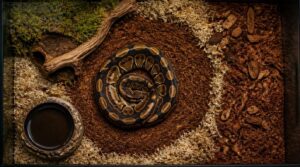
Toxicity is the line between a good exhibit choice and a liver-damaging mistake. Stick to coconut husk, aspen, cypress mulch, or paper products—all tested free of chromium, pesticides, and phenolic compounds.
Toxicity separates a good bedding choice from a liver-damaging mistake, so stick to tested, chemical-free materials
- Natural fibers: minimal synthetic additives
- Mineral substrates: chemically inert, won’t off-gas
- Plant-based options: high absorbency, low contamination risk
Reputable brands verify heavy-metal residues before labeling anything reptile-safe.
Low Dust Levels
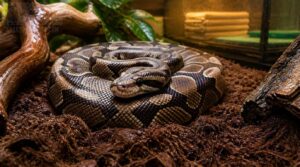
Every time your ball python inhales fine bedding particles, you’re risking respiratory irritation—so dust control matters as much as substrate choice itself.
| Material | Dust Level | Best Practice |
|---|---|---|
| Coconut husk | Low | Keep lightly damp |
| Aspen shavings | Moderate | Avoid over-handling |
| Paper products | Dustfree | Replace after soiling |
| Reptile carpet | Dustfree | Disinfect regularly |
Maintain 50-60% humidity and minimize agitation; dense, well-packed substrates simply release less airborne debris.
Safe Particle Size
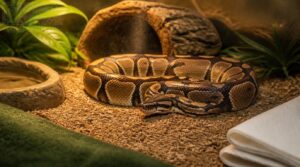
When you’re selecting bedding, particle size matters as much as the material itself. Aim for substrates where fewer than 10% of particles fall below 250 nanometers, and no more than 500 nanometers for routine safety. Uniform sizing reduces dust and impaction risk. Manufacturers should verify batch consistency—light scattering checks, microscopy, and number-based reporting make sure your python’s enclosure stays safe.
- Coconut husk: finely processed
- Cypress mulch: ground evenly
- Aspen shavings: splinter-free
- Paper towels: non-particulate
- Reptile carpet: dustless surface
Burrowing Support
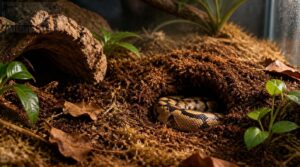
Watching your ball python vanish into the substrate isn’t just cute, it’s instinct at work.
Substrate compaction matters: coconut husk and aspen shavings hold tunnel walls together, while a 3-4 inch depth lets natural burrowing behavior unfold safely.
For bioactive substrate setups, gentle drainage slopes prevent pooling at tunnel mouths, keeping entrance areas stable without the mudding that causes collapses.
Easy Spot Cleaning
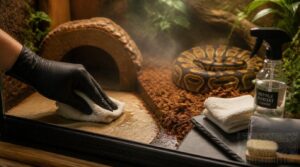
A five-minute spill response beats an hour of deep cleaning every time. Keep a dedicated kit—absorbent cloths, pH-neutral solution—nearby for fast spot cleaning on coconut husk or reptile carpet.
Blot, don’t scrub, working edges inward. Paper products offer the fastest turnaround since they absorb moisture without clumping, making stain removal and moisture control simple, sanitary tasks you’ll actually keep up with.
Humidity-Friendly Substrates for Healthy Sheds
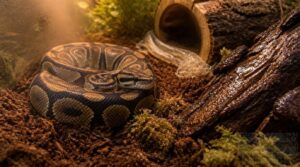
When your ball python’s humidity isn’t right, sheds come out patchy and stressful for everyone involved. Getting it right isn’t complicated, but it does depend on picking a substrate that holds moisture the way your snake needs. Here’s what actually keeps that balance steady, day to day and through every shed.
Ideal Humidity Range
When you’re dialing in your enclosure’s climate, aim for 50-60% relative humidity most days. Use a digital hygrometer near the basking area, log readings daily, and adjust seasonally—drier winters need 55-60%, humid summers stay lower.
- Coconut husk retains moisture well
- Set up a warm-to-cool humidity gradient
- Avoid readings below 40%, which risks dehydration
Shedding Humidity Boosts
Once your snake’s eyes turn milky, bump humidity to 70-80% to soften the old skin. A humid hide with damp sphagnum moss creates a local moisture pocket without soaking the whole enclosure. Coconut husk holds this moisture well, releasing it gradually.
Keep boosting until the shed completes, then ease back to baseline—patchy sheds often trace back to quitting too soon.
Substrate Depth Guide
Once shedding wraps up, get back to basics: depth of 1 to 2 inches works for most enclosures, letting waste stay near the surface for quick spot cleaning. Loose materials like coconut husk or aspen support light burrowing at this range without compacting.
Skip anything over 3 inches—it traps humidity, invites mold, and complicates drainage in ways that outweigh any burrowing benefit.
Moisture Without Mold
Getting depth right solves half the equation; the other half is keeping that substrate from turning into a mold farm.
- Wipe spills immediately, let the spot dry before re-covering
- Run a hygrometer, don’t guess at humidity balance
- Boost airflow if levels creep past 65%
- Swap damp coconut husk or cypress mulch sections early
Mold resistance starts with ventilation, not chemicals.
Warm and Cool Zones
Because ball pythons regulate body temperature by moving, not shivering, your enclosure needs a real temperature gradient: 26-30°C warm zone for basking, 24-26°C cool zone for retreat.
Darker substrate absorbs heat faster near the warm end, while moisture-retentive material keeps the cool zone humid without mold.
Keep both zones’ substrate 2-4 inches deep for safe burrowing, and always verify temperatures with a probe thermometer.
Unsafe Bedding to Avoid
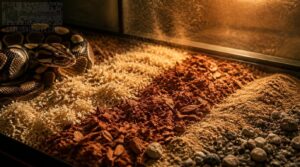
Not every bedding you find at the pet store belongs in your ball python’s enclosure, and some options carry real health risks you shouldn’t ignore.
When you know what to avoid, you’ll protect your snake from respiratory issues, impaction, and toxic exposure before they ever become a problem.
Here are four substrates that deserve a permanent spot on your "skip it" list.
Cedar and Pine
Cedar and pine shavings might smell "natural," but that pleasant aroma comes from aromatic oils that irritate your python’s respiratory tract. Both woods shed fine dust and resin, raising the risk of respiratory infections over time. Neither offers reliable substrate safety. Skip them entirely—coconut husk, cypress mulch, and aspen shavings give you the same rustic look without the toxicity risk.
Sand and Gravel
Sand and gravel pose serious impaction risk if your python ingests particles while striking prey—gravel’s 4.76-90mm size can lodge in the digestive tract. Fine dust irritates airways too. If you’re weighing safer options, coconut fiber and other apartment-friendly reptile substrates offer moisture retention without the impaction hazards sand and gravel carry.
Even "reptile-safe" sand lacks the moisture retention and particle consistency needed for proper substrate safety. Skip these mining-sourced aggregates entirely; they’re built for concrete, not digestive safety.
Fertilized Potting Soil
Would you reach for garden soil to bed your snake? Don’t. Potting soil formulated for houseplants carries nutrient content risks—salts and time-release fertilizers irritate skin and airways, while organic topsoil harbors pests and mold.
Three concerns matter most:
- Salt buildup from fertilizer residue
- Moisture fluctuation disrupting humidity
- Bacterial growth in nutrient-rich, nonreptile soils
Stick to inert substrates designed for reptile safety, not plant nutrition.
Moldy Wet Substrate
Musty odor and fuzzy patches signal trouble fast—wet substrate can spawn mold within 24-72 hours, harming both you and your snake.
| Sign | Risk | Action |
|---|---|---|
| Damp clumping | Bacterial growth | Remove immediately |
| Musty smell | Airway irritation | Improve ventilation |
| Gray/green patches | Aspergillus, Cladosporium | Replace substrate |
Even humidity-friendly coconut husk and cypress mulch need proper humidity control—drainage and airflow prevent mold from taking hold.
Frequently Asked Questions (FAQs)
What bedding can I use for ball pythons?
Some owners still reach for whatever’s cheapest at the pet store—glitter-dyed wood chips, anyone? Skip that. Stick with non-toxic materials: coconut husk, aspen shavings, cypress mulch, or paper products. Each helps with natural burrowing and easy cleaning.
What should I put on the bottom of my ball python tank?
Reach for coconut husk, cypress mulch, or aspen shavings at 2-4 inches deep for burrowing and humidity control.
Paper towels work well for quarantine setups, while reptile carpet suits easy cleaning—just avoid cedar, pine, sand, or gravel entirely.
What bedding is safe for snakes?
Safe bedding choices rely on non-toxic materials with low dust levels: coconut husk, aspen shavings, cypress mulch, and paper products. Each allows for burrowing and easy cleaning.
Reptile carpet and bioactive substrate suit quarantine or naturalistic setups without respiratory or impaction risks.
What not to use for snake bedding?
Cedar and pine shavings, sand, gravel, pebbles, walnut shell substrate, chemically treated bedding, scented wood chips, and artificial turf mats all pose toxicity, impaction, or dust-related respiratory risks—skip these entirely when stocking your enclosure.
What can I use for ball python bedding?
Four dust-free options work well: coconut husk, cypress mulch, aspen shavings, or plain paper towels.
Coconut husk and cypress support natural burrowing and humidity retention; aspen retention; aspen suits drier setups; paper towels are ideal bedding for hatchlings and bioactive substrate builds.
What type of bedding is best for pythons?
Your best bet holds humidity retention between 50-60%, stays non-toxic, and allows easy spot cleaning. Coconut husk, cypress mulch, and aspen shavings all fit that bill nicely—reptile carpet works too, minus natural burrowing support.
How do I Choose bedding for a ball python?
Picture your snake’s enclosure a month from now—too dry, too damp, or just right? That answer starts here.
Match your room’s humidity to a substrate’s moisture-holding ability, checking Material Safety, Dust Control, and Particle Size first, then confirm it allows burrowing depth and easy spot cleaning.
How do I choose the best Python bedding?
Match your substrate to humidity needs first, then run it through a Material Safety Checklist: non-toxic, low dust, safe particle size. Coconut husk or aspen shavings satisfy most setups. Weigh cleaning routine demands against your schedule before committing.
What is the best Cypress bedding for ball pythons?
Like a forest floor holding onto morning dew, quality cypress rewards patient care.
Zoo Med Forest Floor and Fluker’s Tropical Cypress Reptile Bedding offer reliable moisture retention and low dust; choose 100% pure cypress, sifted for uniform particle size, avoiding dyed or mixed-wood blends.
What is a good substrate for a ball python enclosure?
Look for a substrate that provides humidity regulation between 50-60%, allows natural burrowing, and stays non-toxic. Coconut husk, cypress mulch, and aspen shavings each buffer temperature well while keeping spot cleaning simple for daily maintenance.
Conclusion
Funny how the priciest terrarium setups still fail from something as humble as bedding. Your snake doesn’t care about aesthetics; it cares about stable humidity and clean substrate underfoot.
Among all the ball python safe bedding options covered here, the right choice isn’t the trendiest one, it’s the one you’ll actually maintain. Spot-clean weekly, watch moisture levels, and swap materials before mold takes hold. That consistency, not the brand name, keeps your python thriving.