This site is supported by our readers. We may earn a commission, at no cost to you, if you purchase through links.
Most reptile deaths in captivity trace back to one thing: bad husbandry, not bad luck. A corn snake doesn’t care how much you love it if the enclosure runs too cold. A bearded dragon won’t survive on good intentions without proper UVB lighting.
That’s the gap between wanting a reptile and actually keeping one alive past year one. Good reptile care for beginners isn’t complicated, but it does demand precision, the kind vets see missing in half their new-owner cases.
Get the species, setup, and daily habits right from the start, and you’ll skip the trial-and-error phase that costs reptiles their health.
Table Of Contents
- Key Takeaways
- Choose The Best Beginner Reptile Species
- Set Up a Safe Reptile Habitat
- Control Heat, Lighting, and Humidity
- Feed Your Reptile The Right Diet
- Keep Your Reptile Healthy and Calm
- Frequently Asked Questions (FAQs)
- How do I choose the best reptile pet for beginners?
- How do I know if a reptile is easy to care for?
- Are reptiles good pets?
- How do you care for a reptile & amphibian?
- How to care for a reptilian pet?
- How to bring a reptile home?
- What are the basics of reptile care?
- Do reptiles get attached to owners?
- How much does reptile ownership cost monthly?
- Can reptiles recognize their owners over time?
- Conclusion
Key Takeaways
- Most reptile deaths in captivity come from bad husbandry, not bad luck, so getting temperature, UVB lighting, and diet right from day one prevents most health problems.
- Picking a beginner-friendly species like corn snakes, leopard geckos, or bearded dragons matters because some animals forgive rookie mistakes better than others.
- A proper habitat needs the right enclosure size, safe substrate, hides, and a clear temperature gradient so your reptile can regulate its own body heat.
- Daily cleaning, careful handling, and knowing the warning signs of illness (like wheezing or stuck shed) let you catch problems before they become vet emergencies.
Choose The Best Beginner Reptile Species

Not every reptile makes a good first pet, no matter what that guy at the expo told you. Some species handle beginner mistakes better than others, and that’s exactly what you want when you’re still learning the ropes. Here are five solid options worth considering before you bring one home.
Before choosing your first scaly companion, brush up on beginner-friendly reptile handling tips so you and your new pet start off on the right foot.
Corn Snakes
Five feet of docile muscle, and it still can’t hurt you—that’s a corn snake for you. Native to the southeastern US, they sport red-orange blotches over checkerboard bellies.
Five feet of docile muscle that still can’t hurt you—that’s the corn snake’s quiet charm
They’re egg-laying constrictors, hatching at 10-12 inches from clutches of 10-30. These snakes are a nonvenomous biological classification.
- Calm temperament
- Easy handling
- Rodent-based diet
- Manageable size
Think of it as the golden retriever of snakes, not a diva.
Ball Pythons
Not every snake wants to hold you like a python does—except ball pythons genuinely tolerate it. Native to West and Central African savannas, they’re nocturnal ambush hunters using heat-sensing pits to find prey in the dark.
| Trait | Detail | Why It Matters |
|---|---|---|
| Size | 3-4 ft | Manageable |
| Lifespan | 20-30 yrs | Long commitment |
| Feeding | Every 7-14 days | Low upkeep |
Leopard Geckos
If pythons aren’t your speed, these guys are the low-drama roommate. Native to arid regions of India and Pakistan, they hunt at night, blink with actual eyelids, and store fat in their tails for lean times.
- 7-10 inches long
- No UVB required
- 30-40% humidity
- Nightly insect feeds
Their shedding cycle needs a moist hide—simple reptile care essentials.
Bearded Dragons
Want more personality than a gecko can offer? Bearded dragons deliver. These Australian natives grow 18-24 inches and love to bob their heads or wave an arm to signal status.
| Need | Detail |
|---|---|
| Basking | 95-110°F |
| UVB | Required |
| Diet | Omnivore |
| Size | 40+ gal |
Watch that beard darken—it’s mood, not menace.
For a bearded dragon’s terrarium setup that also respects safe, burrow-friendly substrates, check out this guide on boa constrictor tank requirements for smart habitat comparisons.
Russian Tortoises
Ever wanted a pet that outlives you? Russian tortoises hail from the arid desert steppes of Central Asia, and that harsh homeland shapes everything about them.
- Burrowing behavior keeps them cool
- Lifespan often tops 40 years
- Dietary fiber matters more than protein
Feed them weeds and greens, not fruit. Their shell health depends on calcium, not a fast metabolism.
Set Up a Safe Reptile Habitat
Picking the right species is only half the battle, because that animal still needs somewhere safe to live. A good habitat isn’t just a tank with a lid, it’s a whole little world you’re responsible for building right. Here’s what actually goes into setting one up.
Proper Enclosure Size

Size isn’t a suggestion, it’s survival math. Corn snakes need 1.5 times their length in floor space, bearded dragons scale from 40 gallons to 120, and tortoises want 4×2 feet minimum.
Always plan a 6 to 12 month growth margin, since hatchlings outgrow tanks fast. Bigger now beats buying twice.
Hides and Enrichment

Give your reptile more than one hideout, since a single box gets boring fast. Spatial exploration matters: rotate rock, moss, and tunnel hides weekly for different textures and microclimates.
- Rock hides for basking
- Moss hides for humidity during shedding
- Tunnel hides for burrow-like security
Pick washable, non-porous materials for easy cleaning. Habitat replication isn’t decoration, it’s enrichment your terrarium actually needs.
Safe Substrate Choices
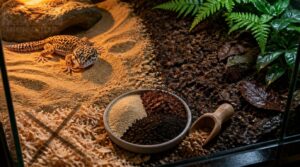
Substrate isn’t just bedding, it’s a health decision. Match it to habitat type: desert species like leopard geckos need fine sand (1-2 inches), while tropical setups thrive on coco coir or bioactive soil.
Avoid aromatic woods like cedar and pine entirely. Substrate impaction risks are real for young burrowers, so skip loose sand until they’re adults. Wash substrates first, and replace after contamination.
Climbing and Basking Areas

Think of your reptile’s enclosure as a tiny gym, not just a box with a lamp. Textured climbing surfaces give claws real grip, while non-toxic, heat-safe materials keep things sturdy.
Good setups mix:
- Rough branches for grip
- Angled ledges for easy basking
- Multi-level perches for variety
- Flat platforms (10-40 cm) under basking bulbs
A solid temperature gradient near 30-40°C keeps thermoregulation simple and safe.
Species-Specific Habitat Needs

Not every reptile wants the same setup, no matter what the pet store aisle suggests. Habitat requirements shift by species: corn snakes want natural shelter and vertical relief, geckos need burrowing substrates, bearded dragons crave dry thermal zones, and tortoises need open ground.
Nail the microclimate control for your species, and your reptile enclosure setup stops being guesswork.
Control Heat, Lighting, and Humidity

Your reptile’s enclosure is basically its whole world, so getting the climate right isn’t optional. Think of it as running a tiny climate-controlled apartment, not just a glass box with a lamp. Here’s what you need to get temperature, light, and humidity working in your favor.
Temperature Gradients
Because reptiles can’t generate their own body heat, they rely entirely on moving between warm and cool zones to regulate temperature. This is thermoregulation in action.
A proper setup needs:
- A warm basking lamp side
- A cooler shaded side
- Smooth middle ground between them
Heat flows hot to cool—basic physics. Skip the gradient, and you risk thermal stress or a reptile that’s perpetually miserable.
Thermostats and Heat Sources
Getting that gradient right isn’t guesswork—it’s math and equipment working together. A thermostat does the heavy lifting, cutting power when temps hit your set point and preventing dangerous spikes. Pair it with heat lamps, ceramic emitters, or under-tank heat pads depending on your species.
Calibrate sensors away from the heat source itself, or you’ll get false readings. Dual sensors (ambient and substrate) catch what one alone misses.
UVB Lighting Basics
UVB lighting is the part beginners love to skip, and it’s the one that lands reptiles at the vet. Your reptile needs it for Vitamin D3 synthesis, which drives calcium absorption. No UVB, no D3, weak bones.
- T5 tubes beat T8s for reach
- Keep bulbs 12-18 inches away to avoid burns
- Swap bulbs every 6-12 months, output fades
Humidity Monitoring Tools
Hygrometers aren’t optional accessories, they’re how you catch a dry enclosure before it causes shedding problems. Digital models beat analog dials for readability and often log data over time.
| Sensor Type | Best For |
|---|---|
| Capacitive | Stable, wide-range readings |
| Resistive | Budget setups |
| Digital hygrometer | Data logging, alerts |
Place sensors mid-enclosure, away from misters, for accurate microclimate control.
Preventing Temperature Spikes
Every reptile enclosure eventually throws a curveball, and that curveball is usually a heat spike. Guard plates on ceramic emitters prevent contact burns and sudden swings. Calibrate thermometers monthly, thermostats fail quietly. Keep a backup thermostat and spare bulb ready. Write a simple thermal spike protocol: unplug, ventilate, swap gear. Adjust setups seasonally, since summer sun through windows sneaks up on you.
Feed Your Reptile The Right Diet

Getting the habitat right was only half the job, because now you’ve got a hungry reptile to feed correctly. Diet isn’t one-size-fits-all here, and what works for a tortoise will make a corn snake very unhappy. Here’s what you need to know, species by species.
Herbivore Diet Basics
Salad isn’t optional here, it’s survival. Herbivorous reptiles like Russian tortoises need 70% leafy greens, 20% veggies, 10% fruit, plus real plant variety to dodge vitamin gaps.
That fiber isn’t filler, it fuels fermentation and gut bacteria doing the heavy lifting. Their flat teeth grind roughage all day. Adjust portions by size and age, not guesswork.
Omnivore Feeding Needs
Bearded dragons don’t stick to one menu, they need protein balance shifted by age. Juveniles eat mostly insects; adults flip to 80% greens.
Nutrient density matters more than volume—gut-loaded crickets, dusted with calcium, beat empty carbs. Keep feeding schedules consistent, small portions, multiple times daily for young dragons, tapering as they mature into steady, plant-heavy adults.
Whole Prey for Snakes
Snakes are carnivorous reptiles, and mice or rats aren’t optional, they’re the whole point.
Ideal prey size matches your snake’s midbody width.
Always follow thawing safety protocols: warm frozen prey to body temp, never microwave-hot.
Prey rotation benefits include better nutrition and less boredom.
Skipping this basic feeding requirement invites preventing regurgitation headaches down the road—think variety, not monotony, in reptile husbandry.
Gut-Loading Feeder Insects
A cricket’s only job before dinner is turning into a nutrient delivery truck. Feed insects calcium-rich foods like crushed oyster shell 24-72 hours out—that’s the best timing for gut-loading.
Nutrient-dense insect selection matters too: roaches and hornworms outperform mealworms here. Skip moldy feed (basic gut-loading feed safety), and your reptile gets a properly gutloaded, nutritious diet supporting healthy calcium-phosphorus ratios.
Calcium and Vitamin Supplements
Think of calcium powder as your reptile’s multivitamin, not an optional extra. Calcium carbonate vs citrate matters less than D3 dosing risks—too much D3 causes toxicity fast.
Supplementing without UVB means dusting every feeding; with proper lighting, cut back. Juvenile growth needs demand higher frequency than adults. Check labels for elemental calcium content, and match your dietary supplementation to what’s already in that nutritious diet.
Keep Your Reptile Healthy and Calm

Feeding your reptile right is only half the job. The other half is keeping it clean, calm, and healthy day to day, and that takes a little routine. Here’s what that routine actually looks like.
Daily Cleaning Routine
Honestly, sanitation is where lazy keepers get burned. Spot clean daily—waste, shed, uneaten food. Wipe glass, ledges, and water bowls to fight odors.
Weekly tasks:
- Sanitize water dishes
- Clean feeding tongs
- Disinfect hides
- Check substrate moisture
Monthly deep-cleans handle décor. Skip this cleaning sanitation regimen, and bacteria wins—your terrarium isn’t self-cleaning.
Safe Handling Tips
Clean glass doesn’t matter if your grip sends your gecko into a panic. Support the chest and abdomen, never the tail. Keep sessions to 5-10 minutes.
| Do | Don’t |
|---|---|
| Cradle low, near torso | Grab from above |
| Approach slowly, speak softly | Handle after feeding |
| Watch for hissing, gaping | Squeeze or restrict breathing |
Signs of Reptile Illness
Wheezing, clicking, or open-mouth breathing signals respiratory infection—get it checked, don’t wait.
Watch for stuck shed around toes (can cut off circulation), or cloudy, incomplete sheds.
Curd-like mouth residue and swollen gums point to oral disease.
Runny stool or blood in feces means gut trouble.
Stumbling or head tilting? That’s neurologic, often linked to metabolic bone disease from poor UVB or calcium.
Because reptiles mask weakness, catching subtle changes early matters, and this guide to reptile illness symptoms and treatment options helps you tell when a vet visit can’t wait.
Early intervention matters, so tracking the full picture of symptoms—from twitching to open-mouth breathing—through a resource like reptile disease diagnosis and symptom identification can help you act before neurological damage progresses.
Stress and Behavior Cues
Not every stress sign is a medical emergency, but ignoring it invites one. Facial stress signals like gaping mouths or darkened scales mean back off, now.
Watch for tail whipping, glass surfing, or sudden hiding—behavioral changes worth logging. Defensive handling responses, including quick lunges or bites, show poor tolerance.
Good animal behavior monitoring respects biological needs, not just cage aesthetics. Proper handling starts with reading the room first.
Finding a Reptile Veterinarian
Here’s the catch: your regular vet probably can’t help. Most clinics stick to cats and dogs, so you need a genuine herp vet through specialized directories like ARAV or Kingsnake.com.
Ask about their reptile caseload before booking. Prep questions on husbandry, prepare for emergencies, and expect wellness exams around $65-120. Preventative veterinary care beats a crisis every time.
Frequently Asked Questions (FAQs)
How do I choose the best reptile pet for beginners?
Roughly 80% of reptile surrenders trace back to mismatched expectations. Match species to your lifestyle, budget, and space first. Leopard geckos and corn snakes suit tight budgets and low-maintenance routines; bearded dragons reward daily interaction if you’ve got the room.
How do I know if a reptile is easy to care for?
Easy care means low upkeep, forgiving diets, stable temps, and calm handling.
Leopard geckos fit this bill: minimal UVB, readily available insects, docile temperament, modest space needs, and a manageable lifespan for first-time owners easing into exotic pet ownership.
Are reptiles good pets?
Yes, for the right person. Reptiles offer quiet companionship, low odor, and minimal daily fuss compared to cats or dogs. Just weigh the long-term commitment, dietary requirements, and legal, ethical sourcing questions before diving into exotic pet ownership.
How do you care for a reptile & amphibian?
Same routine, same care, same discipline, every single day. That’s how you keep any reptile or amphibian thriving: precise temperature and humidity control, species-specific diets, gut-loaded feeders, quarantine for new arrivals, and preventative vet visits catch problems before they turn deadly.
How to care for a reptilian pet?
Your reptile needs suitable environmental conditions: proper heat gradients, UVB lighting, safe substrate (avoiding impaction risks), species-specific humidity, and a solid feeding schedule.
Add quarantine protocols for new pets, watch respiratory health closely, and adjust care seasonally for lasting success.
How to bring a reptile home?
Funny thing: the ride home stresses reptiles more than the whole first week combined. Use a secure transport container, skip food beforehand, then let your pet exit calmly into its pre-set terrarium, starting a quiet acclimation period before any handling begins.
What are the basics of reptile care?
Boil it down to five pillars: species selection that fits your lifestyle, dialed-in habitat setup with UVB lighting and temperature regulation, correct feeding requirements, daily health monitoring, and weekly cleaning—master those, and exotic pet husbandry gets a lot less intimidating.
Do reptiles get attached to owners?
Yes, actually. Bearded dragons wobble their tails and approach at your voice, geckos track your movement, and corn snakes relax near familiar hands—genuine species bonding signals built through patient, consistent handling, not just food-driven instinct.
How much does reptile ownership cost monthly?
A single roach colony can knock $20 off monthly feeder costs. Expect $20-60 monthly for food, electricity, and substrate—geckos stay cheap, bearded dragons cost more. Budget extra for vet emergencies and calcium supplements to keep expenses predictable.
Can reptiles recognize their owners over time?
Your bearded dragon watching you walk in isn’t coincidence—it’s learned recognition through scent, voice, and repeated positive handling. Bonding builds over weeks via reward-based conditioning, making your reptile calmer and more responsive to you than to strangers.
Conclusion
A thriving reptile is like a well-tuned engine, quiet, steady, and only humming right when every part gets proper care. Get the temps, the UVB, the diet dialed in, and you’re not just avoiding disaster, you’re building a system that runs itself. That’s the whole secret behind reptile care for beginners: nail the basics early, and the guesswork disappears. Your scaly roommate won’t thank you out loud. But watch it thrive, and you’ll know you got it right.