This site is supported by our readers. We may earn a commission, at no cost to you, if you purchase through links.
Your snake’s eyes turned unsettling shade of blue overnight—and if you’ve never seen it before, it looks like something went wrong. Nothing did.
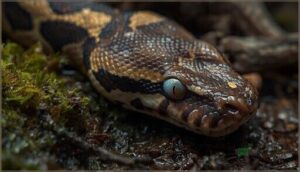
Those milky eye caps signal the start of ecdysis, the full-body shed cycle that replaces your snake’s skin, spectacle included. A transparent scale called the spectacle covers each eye permanently, and when lymphatic fluid builds between the old and new keratin layers, that ghostly opacity appears.
It clears on its own within three to five days. When it doesn’t, that’s when husbandry and health questions demand real answers.
Table Of Contents
- Key Takeaways
- What Are Milky Eye Caps in Snakes?
- Snake Eye Anatomy and Shedding
- Causes of Milky Eye Caps
- Recognizing Normal Vs. Problematic Eye Caps
- Preventing Eye Cap Problems in Snakes
- Treating Retained or Milky Eye Caps
- Snake Species and Eye Cap Issues
- Long-Term Eye Health and Monitoring
- Frequently Asked Questions (FAQs)
- Conclusion
Key Takeaways
- Milky, blue-grey eyes in snakes aren’t a health crisis — they’re lymphatic fluid building between old and new spectacle layers, a normal 3–5 day phase of the shedding cycle.
- If cloudiness persists more than a week after shedding completes, you’re likely dealing with retained eye caps — and low humidity (below 50%) is almost always the culprit.
- Before reaching for tools, try a 15–20 minute warm soak at 85–90°F and a humid hide with damp moss — most retained caps release with moisture alone, and forceps can cause permanent corneal damage.
- Long-term eye health comes down to consistency: daily humidity checks, a species-appropriate enclosure, whole-prey feeding, and a shedding log that catches problems before they stack.
What Are Milky Eye Caps in Snakes?
If your snake’s eyes look milky or bluish-grey, don’t panic — it’s usually not what you think.
It’s almost always a sign your snake is about to shed — and cloudy eyes before shedding in snakes is one of the most reliable clues that a new skin is on its way.
There’s a real difference between normal shedding changes and something that actually needs your attention.
Here’s what you need to know to tell them apart.
Definition of Milky Eye Caps
Milky eye caps happen when lymphatic fluid builds between the old and new keratin layers of your snake’s spectacle — that clear, fused scale protecting each eye. This fluid accumulation temporarily disrupts spectacle transparency, creating the cloudy eyes you’re seeing. It’s the opacity mechanism behind normal ecdysis. Vision takes a hit during this phase, but eye health stays intact.
low humidity issues can trigger retained eye caps, so monitoring enclosure moisture is essential.
Difference Between Normal and Abnormal Eye Caps
Timing tells you almost everything. Normal eye caps go milky blue for three to five days — then clear up before the shed completes. That’s your opacity timeline.
Abnormal retention means cloudiness persists longer than a week post‑shed. Cap texture shifts too: healthy spectacles feel smooth, while retained caps turn rough and wrinkled.
Vision impact worsens with each stacked layer. inadequate environmental humidity can lead to retained eye caps.
Common Misconceptions
Three myths trip up even careful keepers when cloudy eyes appear:
- Milky eyes don’t cause blindness — your snake still detects light and movement
- Clearing eyes doesn’t mean the shed failed; a 2–7 day gap before skin sloughs is normal
- Manual eye removal isn’t the fix — humidity correction prevents eye cap retention far better than picking
Skip the panic. Watch the pattern.
Snake Eye Anatomy and Shedding
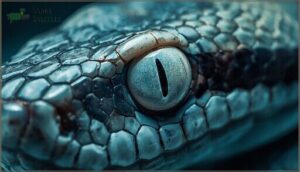
Snake eyes work differently than you’d expect — there are no eyelids, no blinking, just a fixed transparent scale called the spectacle sitting over each eye. Understanding that structure explains a lot about why milky eyes happen and what they actually mean.
Here’s what’s going on beneath the surface.
Structure of The Spectacle and Eye Cap
Your snake’s eye isn’t exposed the way yours is — it’s sealed beneath a fused scale called the spectacle. This structure manages everything from keratin layering to stroma composition. Eye cap anatomy runs deep.
| Layer | Thickness | Key Feature |
|---|---|---|
| Outer epithelial | 3.5–10.5 µm | Alpha/beta keratin |
| Stroma | 9–132 µm | Collagen fibrils |
| Inner epithelial | 1.6–3.6 µm | Lacrimal fluid border |
Spectacle thickness varies wildly — 74 µm in bush vipers, 244 µm in pipe snakes. Boundary zone morphology and inner epithelial structure both shape long-term ocular health.
Role of Eye Caps in Snake Vision
Vision depends entirely on spectacle health — and your snake’s eye caps do more than protect.
- Light transmission: The spectacle passes visible and near-UV wavelengths, enabling full color detection.
- Refraction contribution: It bends incoming light alongside the cornea, sharpening retinal focus.
- Spectacle hydration: The fluid layer beneath maintains visual acuity by keeping the cornea moist.
- UV perception: Diurnal species rely heavily on the spectacle’s optical clarity for hunting precision.
Changes During The Shedding Cycle
The shedding cycle rolls out in stages — and the eyes tell the whole story. Skin dullness progression kicks in first, fading patterns within 1 to 2 days.
Shortly after, the eyes cloud over completely — a reliable heads-up that the shed is near, as covered in this guide to recognizing and resolving snake shedding problems.
Then fluid opacity timing takes over: lymph floods the cleavage zone around days 3 to 7, triggering visible eye cloudiness. This enzyme cleavage phase loosens old eye caps completely. Vision impairment period follows — then clearing, then post‑shed transparency recovery.
Causes of Milky Eye Caps
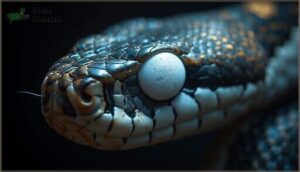
Milky eye caps don’t always mean something’s wrong — but context matters.
A few distinct causes can trigger that cloudy look, and knowing the difference helps you respond correctly.
Here’s what’s actually behind it.
Normal Shedding Process (Ecdysis)
Ecdysis isn’t random — it’s a finely orchestrated process driven by Hormonal Regulation along the pituitary-thyroid axis.
Growth Cycle Timing varies: younger snakes shed more often than adults, who average every 2–3 months.
Skin Renewal Stages unfold across 7–14 days, with milky eyes appearing mid-cycle. Normal shedding signs include:
- Eyes turning bluish-grey from lymph fluid buildup
- Dull, roughened scales across the body
- Reduced activity and appetite
- Eyes clearing 3–5 days before the actual shed
Retained Eye Caps (Ophthalmic Dysecdysis)
When the spectacle doesn’t release cleanly, you’re looking at ophthalmic dysecdysis — retained eye caps that linger after shedding.
| Factor | Risk Level | Action |
|---|---|---|
| Low Humidity | High | Humidity Monitoring daily |
| Poor Enclosure Substrate | Medium | Add rough surfaces |
| Multiple Layers | Critical | Veterinary Diagnostics needed |
| Visible cap edges | High | Spectacle Removal Tools |
| Infection Indicators present | Urgent | Vet immediately |
Preventing shedding problems starts with snake eye anatomy and care knowledge.
Eye Infections and Other Health Issues
Not every milky eye cap traces back to shedding.
Bacterial conjunctivitis, fungal keratitis, and parasite infestations — especially mites clustering near the spectacle — can all trigger persistent cloudiness.
Systemic sepsis signs sometimes show up first in the eyes.
Nutritional deficiencies weaken skin integrity, making retained eye caps more likely.
When cloudiness lingers post-shed, snake eye health demands veterinary assistance — fast.
Recognizing Normal Vs. Problematic Eye Caps
Not every cloudy eye means something’s wrong — but knowing the difference matters.
Your snake’s eyes can tell you a lot if you know what to look for.
Here’s how to read the signs, from normal pre-shed haziness to red flags that need your attention.
Expected Appearance Before Shedding
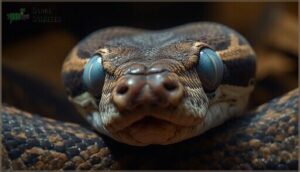
Both eyes turning a milky blue-grey? That’s the blue eye phase — and it’s completely normal.
Bilateral cloudiness hits both eyes equally. Fluid accumulation timing usually runs for 3–4 days, peaking 7–10 days before shedding. Pre‑shed eye opacity is caused by lymph fluid separating old and new spectacles.
| Phase | Timeline | What You’ll See |
|---|---|---|
| Onset | Days 1–3 | Symmetrical tint onset, dull skin |
| Peak opacity | Days 4–7 | Cloudy eyes, hazy pupil |
| Clearing | Days 8–10 | Eyes sharpen, activity increases |
Symmetrical tint onset across both eyes confirms healthy ecdysis — not a problem.
Signs of Retained or Stuck Eye Caps
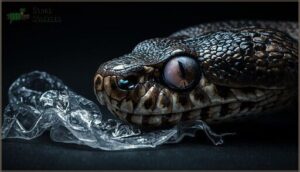
Once both eyes clear, shedding should complete — retained eye caps tell a different story.
Cloudy eye opacity that lingers post-shed is your first red flag. Check the shed skin for missing eye holes — shedding skin clues don’t lie. Eye contour anomalies like raised edges or asymmetry confirm retention fast.
| Sign | What It Means |
|---|---|
| Persistent cloudiness | Retained eye caps |
| Missing spectacles in shed | Failed cap release |
| Asymmetric eye clarity | Unilateral retention |
| Face-rubbing behavior | Behavioral vision cues signaling discomfort |
| Inaccurate striking | Vision impairment signs |
Symptoms of Underlying Eye Problems
Retained eye caps are one thing — but sometimes the problem runs deeper.
Infection, injury, or systemic illness can all cloud the picture. One eye affected more than the other? That’s not a symptom. That’s a warning.
| Symptom | What It Signals | Urgency |
|---|---|---|
| Cloudy Vision (one-sided) | Eye infections or corneal damage | High |
| Eye Swelling or discharge | Subspectacular abscess | Immediate |
| Discharge Color (yellow/green) | Bacterial or fungal infection | Immediate |
| Feeding Reluctance + Light Sensitivity | Vision impairment from eye cap health and retention failure | High |
Preventing Eye Cap Problems in Snakes
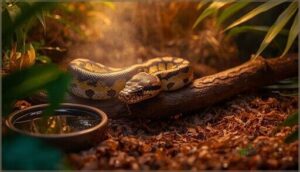
eye cap problems don’t come out of nowhere — they’re usually the result of conditions you can actually control.
humidity and enclosure setup are the two biggest levers you have. Here’s what to get right before your snake ever hits a shed cycle.
Importance of Proper Humidity Levels
Humidity does more work than most keepers realize. For ball pythons, keeping reptile humidity between 60–70% during the blue phase softens the spectacle membrane — letting eye caps detach cleanly. Drop below 50%, and you’re inviting milky retained caps and dehydration‑related infections.
For ball pythons, letting humidity drop below 50% is an open invitation to retained eye caps and infection
Use digital hygrometers daily. Species‑specific humidity matters too — ideal humidity ranges shift with each snake’s native climate.
Optimizing Enclosure Environment
Getting humidity right is only half the equation. The enclosure itself needs to work as a complete system — temperature gradient, substrate, airflow, and climbing structures all pulling together.
- Set a warm side at 88–92°F for ball pythons; cool side stays around 75–80°F
- Use cypress mulch or coconut fiber for steady humidity management for snakes
- Add ventilation control with top-and-bottom vents plus daily hygrometer checks
- Place rough cork bark or branches as climbing structures near hides
- Substrate selection matters — replace bedding every 4–6 weeks to prevent bacterial buildup
Treating Retained or Milky Eye Caps
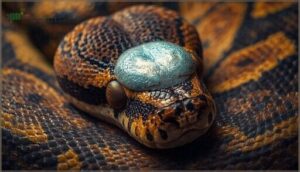
Retained eye caps can look alarming — but in most cases, you have real options before calling a vet.
Knowing the right approach matters, because the wrong move can cause more harm than the problem itself.
Here’s what actually works, when to step back, and what to avoid entirely.
Safe Home Remedies and Techniques
Most retained eye caps respond well to home remedies — if you act methodically.
Start with a Warm Water Soak: 85–90°F water, 15–20 minutes, repeated several times weekly. Follow with Mineral Oil Treatment — dab pharmaceutical‑grade oil using a Cotton Swab Massage in gentle circles. A Humid Hide Setup with damp sphagnum moss helps ongoing humidity management for snakes between sheds.
| Technique | Key Detail |
|---|---|
| Warm Water Soak | 85–90°F, 15–20 min |
| Mineral Oil Treatment | Pharmaceutical‑grade only |
| Tape Removal | Sticky‑side‑out, nose‑to‑neck direction |
When to Seek Veterinary Assistance
Home treatment has its limits — and knowing when to stop is just as important as knowing how to start.
Reach out to a reptile vet when you notice:
- Persistent cloudiness lasting more than 7 days post-shed
- Swelling and discharge beneath the spectacle
- Multiple retained caps stacking across shedding cycles
- Behavioral changes like striking, refusing food, or excessive rubbing
These signal infection or vision loss — professional intervention matters.
Avoiding Common Treatment Mistakes
Rushing treatment is where most keepers go wrong. One careless move — forceps on a living spectacle, dry cotton on the rim — and you’re looking at corneal scarring or permanent blindness.
| Mistake | Why It’s Dangerous |
|---|---|
| Skipping Humidity Monitoring | Retained eye caps recur without 50–70% humidity |
| Poor Tool Sterilization | Spreads eye infections in snakes quickly |
| Rough or Excessive Handling | Stress delays natural cap release |
| Ignoring Mite Prevention | Ophionyssus natricis reinfests periocular crevices |
| Delaying professional vet referral | Stacked caps distort vision permanently |
Snake Species and Eye Cap Issues
Not every snake sheds the same way — and species really does matter here.
Some are naturally more prone to retained eye caps than others, thanks to differences in skin thickness, humidity needs, and growth rate.
Here’s a breakdown of which species tend to need extra attention and why.
Species More Prone to Retained Eye Caps
Not all snake species handle shedding equally.
Ball pythons, with their large protruding eyes, top the list for retained eye caps — multiple layers can stack over successive sheds.
Boa constrictors and indigo snakes share similar risks.
Kingsnakes and corn snakes struggle most when humidity drops below 40%.
Understanding your snake species and shedding patterns is the first line of defense.
Shedding Variations Among Common Snake Species
Every species runs on its own internal clock — and that timeline shapes eye cap risk more than most keepers realize.
- Ball pythons enter the blue phase every 6–8 weeks, with juveniles cycling as fast as every 4–6 weeks.
- Corn snake hatchlings shed every 2–4 weeks — growth rate influence at its fastest.
- Adult garter snakes shed just 2–3 times yearly.
Shedding frequency, driven by hormonal triggers and species-specific timing, directly affects how often humidity impact becomes a problem.
Special Care for Sensitive Species
Some species simply won’t tolerate a one-size-fits-all approach.
Green tree pythons need microclimate enclosures with live plants — humidity management in snake enclosures must stay between 60–80 percent. Ball pythons respond well to humidity spike strategies during blue phase.
Leopard geckos require targeted vitamin supplements weekly.
Species-specific soaking and monitoring cap transparency after every shed are your sharpest tools for preventive snake care.
Long-Term Eye Health and Monitoring
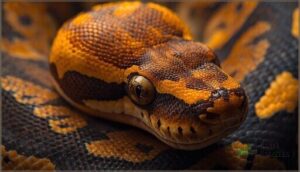
Keeping your snake’s eyes healthy long-term comes down to consistency — not guesswork.
A few core habits make the biggest difference between catching problems early and missing them entirely.
Here’s what to stay on top of.
Regular Observation and Health Checks
Staying consistent with daily visual checks takes just a minute — but it’s your first line of defense. Healthy eyes look clear and symmetrical.
Weekly physical exams let you feel for raised edges around spectacles. Pair behavior monitoring with a shedding log tracking each cycle’s dates and eye clarity.
Veterinary follow-up confirms retained eye caps are fully resolved. Long-term monitoring catches cloudy eyes before they become bigger problems.
Diet and Nutritional Support for Eye Health
What you feed your snake shows up in the spectacles over time. A whole prey diet manages most of the heavy lifting — delivering Vitamin A benefits, prey hydration, essential fats, and trace mineral roles in one package. Nutritional deficiencies in snakes often surface quietly, through dull or retained caps.
- Whole prey diet supplies preformed vitamin A for healthy eye tissues
- Prey hydration from thawed rodents keeps spectacles flexible during shedding
- Essential fats support cell membranes in the cornea and retina
- Trace mineral roles — zinc especially — help eye caps shed cleanly
- Balanced diet prevents long‑term snake eye health from quietly declining
Maintaining Optimal Husbandry Practices
Good nutrition lays the groundwork — but your snake enclosure setup locks it in. Microclimate monitoring, substrate moisture, and ventilation management work together to prevent retained eye caps before they start. Keep humidity stable, run a consistent lighting schedule, and limit handling frequency during the blue phase.
Poor husbandry quietly compounds over time. Fix the environment optimization details now, not after problems appear.
Frequently Asked Questions (FAQs)
Can milky eye caps affect a snakes behavior?
Yes — milky eye caps trigger real behavior changes.
Expect defensive posture, feeding hesitation, navigation errors, and activity reduction.
Vision impairment in snakes from eye cloudiness or retained eye caps turns even calm snakes into stress signals on legs.
Do wild snakes experience eye cap problems?
Wild snakes do get retained eye caps — but rarely.
Habitat humidity, seasonal shedding cycles, and natural rough surfaces help most species shed cleanly. Environmental stress and field detection gaps mean problems stay underreported.
How do age and size impact eye cap shedding?
Age shapes how often shedding happens — juveniles cycle every four to six weeks, while adults slow to three to six times yearly.
Size adds pressure too: bigger enclosures demand higher humidity to protect each spectacle shed.
Can stress cause abnormal eye cap appearance?
Think of your snake like a tree in a storm — chronic stress bends the whole system. Yes, stress triggers retained eye caps by disrupting hormones, lowering shed quality, and compounding environmental stressors.
Are milky eye caps more common in certain seasons?
Not exactly.
Seasonal humidity shifts matter more than the season itself.
Winter dryness and summer air conditioning drop humidity quickly — and low humidity is the real driver behind retained eye caps and prolonged eye cloudiness.
Conclusion
Milky eye caps on snakes, find alarming, are actually proof your animal is thriving—growth demands change, and change looks strange at first.
The opacity clears. The shed follows.
Your job is simply to support that process: steady humidity, a proper hide, and clear eyes on your end.
Watch the timeline. Know the warning signs.
When something lingers past five days, act—don’t wait.
A snake that sheds clean is a snake kept right.
- https://www.pets4homes.co.uk/pet-advice/retained-eye-caps-in-snakes-explained.html
- https://enviroliteracy.org/do-snakes-get-eye-caps/
- https://journals.biologists.com/jeb/article/216/22/4190/11762/Blood-flow-dynamics-in-the-snake-spectacle
- https://treeoflifeexotics.vet/education-resource-center/for-clients/snakes/retained-eye-caps-in-snakes
- https://thetyedyediguana.com/blog/the-completely-common-reason-behind-your-snakes-cloudy-eyes/