
This site is supported by our readers. We may earn a commission, at no cost to you, if you purchase through links.

Scaling a snake collection sounds exciting—until your electricity bill arrives and one of your colubrids is sitting in a 90°F hot spot because you grabbed whatever heat mat was cheapest. Temperature mismanagement kills snakes. It’s that straightforward.
Running reptile heat mats across multiple snake enclosures demands more than just plugging in hardware; it requires matching wattage to enclosure footprint, respecting each species’ thermal sweet spot, and building fail-safes before something goes wrong at 2 a.m. The six mats reviewed here were evaluated on exactly those standards.
Table Of Contents
- Key Takeaways
- Key Considerations for Heating Multiple Snake Enclosures
- Choosing The Right Reptile Heat Mat
- Top Reptile Heat Mats for Multi-Enclosure Setups
- Temperature Control and Safety Essentials
- Common Mistakes When Heating Multiple Enclosures
- Frequently Asked Questions (FAQs)
- Can I put a heating pad under my snakes tank?
- Should I leave my snakes heat pad on all night?
- Is a heat lamp or heat mat better for snakes?
- Can one thermostat control multiple heat mats?
- How often should heat mats be replaced?
- Do heat mats work inside rack systems?
- Are heat mats safe for gravid females?
- Can heat mats cause respiratory issues in snakes?
- Conclusion
Key Takeaways
- Pairing every heat mat with a thermostat isn’t optional—unregulated mats can push surface temperatures past 120°F, turning your enclosure floor into a burn hazard overnight.
- Each species runs its own thermal script: ball pythons need 88–92°F belly heat, corn snakes top out around 82°F on the warm end, and garter snakes die above 91°F air temperature—one-size heating kills.
- Your mat should cover only one-third of the enclosure floor; go beyond that and you will wipe out the cool zone your snake needs to thermoregulate.
- Deep substrate—anything past 1.5 inches—drops heat mat output by 15–20°F and spikes burn risk when snakes burrow down to the warm layer and contact near-90°F surfaces directly.
Key Considerations for Heating Multiple Snake Enclosures
Heating multiple snake enclosures isn’t just about plugging in a heat mat and calling it done. You’ve got to think through size, species needs, energy load, and safe installation before anything else.
Before committing to a setup, it helps to compare your options side by side — this guide to snake enclosure heating systems breaks down how each method works and where it fits best.
Here are the key factors to get right from the start.
Assessing Enclosure Size and Layout
Before buying a single heat mat, map your available floor area ratio and think about heat zone mapping across each enclosure.
A 20‑gallon tank needs roughly an 8×12‑inch mat covering one‑third of the floor—no more.
Modular rack design simplifies heat source placement across stacked tubs, while edge clearance of 20–40 mm prevents wall overheating.
Smart layout decisions make temperature control essentials far easier to manage.
Proper essential thermostat control is key for maintaining safe and accurate temperatures.
Species-Specific Temperature Requirements
Layout sorted? Now think species. Every snake on your rack runs a different thermal script.
- Ball Python Basking hot spot: 88–92°F belly heat, cool side 78–82°F
- Corn Snake Cool Zone: 75–82°F, warm end near 90°F
- Kingsnake Night Temps: never below 70°F
- Hognose Heat Spot: 86–90°F warm zone, ambient 75–82°F
Species-specific temperature requirements aren’t suggestions—they’re survival math. Carpet Python Hot End targets 88–92°F; drop below that and digestion stalls. Remember that Hognose snakes require a long‑term commitment for Hognose, often living up to 20 years.
Creating Effective Thermal Gradients
Once you’ve nailed species temps, the next challenge is getting heat to flow correctly across the enclosure.
Gradient Zone Placement means your warm end sits at 88–92°F while the cool side holds 75–80°F—a 10–15°F spread minimum.
Mat-to-Envelope Ratio matters here: cover one-third of the floor, not more.
Substrate Conductivity affects delivery too—aspen spreads heat evenly; thick layers kill belly warmth.
Probe Calibration Techniques to verify both ends daily.
Energy Efficiency and Power Management
Running multiple enclosures adds up fast on your power bill. Low-watt heat mats—usually 4 to 16 watts—already beat heat bulbs on efficiency. Pair them with thermostat power cycling to cut consumption by up to 50%.
Multi-outlet power controllers handle several mats without circuit strain. Add reflective insulation techniques beneath each mat, and energy-saving scheduling strategies to squeeze even more out of every watt.
Safe Placement and Installation Practices
Even small installation mistakes can cost your snake its safety. Attach mats to the outside bottom of glass enclosures, then use shims for air gap installation—a 5mm clearance stops heat from trapping under the tank.
Add a polystyrene underlay beneath the mat to direct warmth upward.
Probe sandwiching keeps thermostat readings accurate, while edge securing blocks any snake access underneath.
Choosing The Right Reptile Heat Mat
Not all heat mats are built the same—and when you’re running multiple enclosures, the wrong choice compounds quickly.
There are a few key factors that will separate a reliable setup from a frustrating one. Here’s what to look for before you commit to anything.
Sizing Heat Mats for Multiple Enclosures

Getting the coverage ratio right is half the battle. Your heat mat size should cover one-third to one-half of each enclosure floor—never the whole base.
For thermostat zoning across multiple heating systems, group tanks with matching temperature needs together. Match your wattage allocation to enclosure size and shape considerations, and always plan mat alignment before installation.
Don’t forget airflow spacing underneath.
Waterproof and Humidity-Resistant Options

Humidity is the silent killer of cheap heating equipment. In multi-snake setups, moisture from substrate, water dishes, and ambient humidity accumulates quickly.
That’s why IP67 Sealing matters—mats rated IP67 handle full submersion up to one meter, making humidity management in terrariums far less stressful.
PVC Waterproofing adds another defense layer, while Far‑Infrared Films distribute heat evenly.
Always prioritize Sealed Electrical Connections for reptile heat‑mat safety and heat‑mat maintenance and longevity.
Integration With Thermostats for Control
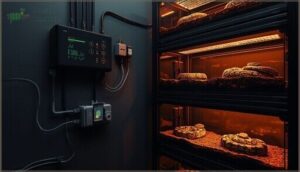
A heat mat without thermostat control is just a liability waiting to happen.
For multi‑enclosure setups, Multi‑Channel Wiring paired with PID Calibration keeps surface temps locked within one degree—no guessing.
Pulse Dimming thermostats deliver steady warmth without cycling spikes.
Remote App Sync lets you monitor every enclosure from your phone.
Use Power Strip Management to keep total wattage under your thermostat integration for heat‑mat limits.
Substrate Compatibility and Heat Retention

Your substrate choice makes or breaks heat mat performance. Paper Towel Layer setups deliver impressive Heat Transfer Efficiency—surface temps can hit 90°F with minimal loss.
Aspen Bedding Thickness keep under half an inch for reliable 84–87°F readings.
Bioactive Soil Insulation kills gradient control fast—thick layers drop surface temps 10–20°F, straining mats dangerously.
Match substrate to species-specific temperature requirements before anything else.
Top Reptile Heat Mats for Multi-Enclosure Setups
Not every heat mat works the same in a multi-enclosure setup — wattage, surface coverage, and thermostat compatibility all matter more when you’re running several tanks at once.
The six options below were chosen specifically for their reliability, consistent heat output, and practical fit for snake keepers managing multiple enclosures.
Here’s what made the cut.
1. Oiibo 60W Reptile Heating Panel
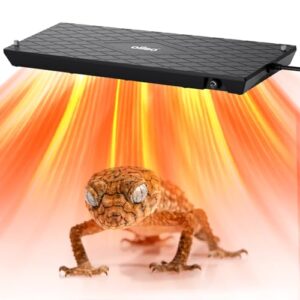
The Oiibo 60W Reptile Heating Panel punches well above its weight for multi-enclosure setups.
It covers tanks up to 48″×24″×24″ and runs between 68°F and 108°F—a solid range for ball pythons and leopard geckos alike.
The built-in fan eliminates hot spots without emitting light, so your animals’ day-night cycles stay intact.
Installation is straightforward: mount it on top of the mesh with the air outlet facing down.
caveat—don’t pair it with a thermostat or timer.
| Best For | Reptile owners with larger terrariums who want consistent, light-free heat for snakes, geckos, or tortoises. |
|---|---|
| Power | 60W |
| Color | Black |
| Thermostat Compatible | No |
| Reptile Suitable | Yes |
| Weight | 1.75 lbs |
| Material | ABS Plastic |
| Additional Features |
|
- Covers big enclosures well and holds a wide temp range (68°F–108°F)
- Built-in fan spreads heat evenly without any light disruption
- Simple to mount and easy to adjust on the fly
- Some users have noticed a loud fan or quality issues over time
- Not a great fit for smaller tanks or tight enclosures
- Can’t be used with a thermostat or timer, which limits automation options
2. ReptiKing Reptile Heat Pad
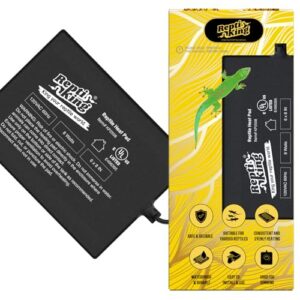
If you need reliable under-tank warmth without breaking the bank, the ReptiKing Reptile Heat Pad is worth a look.
At 16 watts and 8×12 inches, it covers roughly one-third to one-half of a standard glass terrarium floor—enough to build a proper warm zone for leopard geckos, ball pythons, or small terrestrial snakes.
It’s thermostat-ready, waterproof, and mounts externally with adhesive backing.
Just don’t skip the thermostat—there’s no built-in control, and unregulated heat is a burn risk.
| Best For | Reptile owners who want a simple, affordable heat pad for small glass terrariums and don’t mind pairing it with a separate thermostat. |
|---|---|
| Power | 8W |
| Color | Black |
| Thermostat Compatible | Yes |
| Reptile Suitable | Yes |
| Weight | 6.4 oz |
| Material | N/A |
| Additional Features |
|
- Waterproof and durable, so it holds up well even in humid setups
- Easy to install — just peel and stick to the outside of the tank
- Works with any thermostat, giving you flexibility over temperature control
- No built-in thermostat, so you’ll need to buy one separately to use it safely
- Only 8W and compact in size, meaning larger enclosures may need multiple units
- Not compatible with acrylic tanks, which limits where you can use it
3. BN LINK Reptile Heat Pad
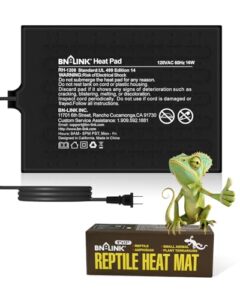
Budget-friendly doesn’t have to mean unreliable.
The BN-LINK Reptile Heat Pad runs at 16 watts on 120 volts—enough consistent output to warm the floor zone of a 10 to 20 gallon enclosure without spiking your electricity bill across multiple setups. It’s waterproof, flexible, and sticks firmly with adhesive backing.
One catch: no built-in thermostat. Without external temperature control, you’re gambling with your animal’s safety. Pair it with a quality thermostat, and it becomes a solid, low-cost workhorse.
| Best For | Budget-conscious reptile keepers who already own a thermostat and want a simple, reliable heat source for smaller enclosures. |
|---|---|
| Power | 16W |
| Color | Black |
| Thermostat Compatible | Yes |
| Reptile Suitable | Yes |
| Weight | 1 g |
| Material | Plastic |
| Additional Features |
|
- Waterproof and easy to wipe down, so tank cleanings don’t turn into a headache
- Flexible and low-profile at just 1 gram—sticks flat against the glass without bulking things up
- 16 watts gives steady, consistent warmth for 10–20 gallon setups without running up your energy bill
- No built-in thermostat means you’ll need to buy one separately to keep temps safe
- Once the adhesive sticks, it’s stuck for good—no repositioning if you place it wrong
- The grip can weaken over time, which gets frustrating if it starts peeling mid-use
4. KABASI 25W Reptile Heating Pad
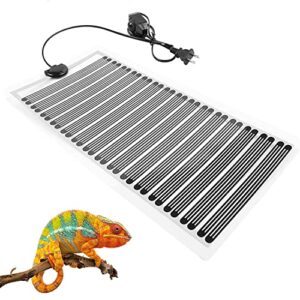
Step up in wattage and you step up in coverage. The KABASI 25W Reptile Heating Pad measures 16.5 by 8.7 inches—enough surface area to warm enclosures up to 20 gallons evenly.
At 25 watts, it heats quickly without creating dangerous hot spots, and its waterproof PVC layer holds up in humid setups like ball python tanks.
No thermostat onboard, though. Run it without one and you’re risking overheating.
Pair it right, and it’s a dependable mid-range option for rack setups.
| Best For | Reptile owners with mid-sized enclosures up to 20 gallons who need solid, even heat coverage for snakes, lizards, tortoises, or other cold-blooded pets. |
|---|---|
| Power | 25W |
| Color | Black |
| Thermostat Compatible | Yes |
| Reptile Suitable | Yes |
| Weight | 4.6 oz |
| Material | Thin Plastic |
| Additional Features |
|
- Big coverage area at 16.5 x 8.7 inches — works well for larger tanks without leaving cold corners
- Mounts on the bottom or side, so it’s flexible depending on your setup
- Glue-free design makes it easy to reposition or swap out without a hassle
- No built-in thermostat means you really need to buy one separately — it can overheat on its own
- No digital display, so you’re flying blind on exact temps without extra gear
- Not safe for direct pet contact, which limits where and how you can position it
5. FIPASEN Reptile Heating Mat Adjustable
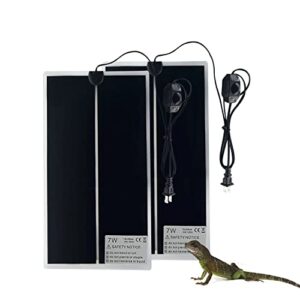
Want built-in control without buying a separate thermostat right away? The FIPASEN Adjustable Heating Mat gives you a rotary knob that dials surface temps between roughly 113°F and 122°F—handy when you’re tuning heat across multiple tubs.
Its PET film element spreads warmth evenly, and the 7W draw keeps your electricity bill manageable in larger rack setups.
Just don’t skip the thermostat entirely long‑term. At peak output, this mat runs hot enough to cause real problems without backup temperature regulation.
| Best For | Reptile and amphibian owners running multi-tub rack setups who want some built-in temperature control without relying solely on a separate thermostat. |
|---|---|
| Power | 7W |
| Color | Black |
| Thermostat Compatible | Yes |
| Reptile Suitable | Yes |
| Weight | 7.4 oz |
| Material | N/A |
| Additional Features |
|
- The rotary knob lets you dial in surface temps between 113°F and 122°F, so you get basic control right out of the box.
- At only 7W, it won’t spike your electricity bill even when running multiple mats at once.
- The PET film spreads heat evenly across the mat, so there are no hot spots baking one corner of the enclosure.
- It can get dangerously hot at peak output, so skipping a thermostat long-term is a real risk.
- You can’t fold, bend, or cover it with non-conductive materials, which limits how you can set it up.
- Without a thermostat backing it up, temperature regulation is basically guesswork.
6. Erinnyees Reptile Terrarium with Ventilation
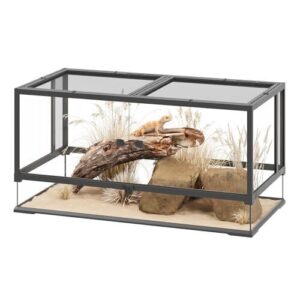
Heat mats are only part of the equation—your enclosure has to work with them. The Erinnyees Reptile Terrarium does exactly that.
Its raised aluminum frame creates a clean gap underneath for heat mat placement, while the waterproof base manages humidity without warping. At 35.8 × 18.1 × 17.7 inches, it fits most mid-sized snakes comfortably.
Interchangeable mesh and glass panels let you dial in airflow for desert or humid setups. Anti-escape door locks add a practical safety layer during feeding.
| Best For | Reptile owners keeping mid-sized species like bearded dragons, ball pythons, or leopard geckos who want a solid, escape-proof setup that works well with heating equipment. |
|---|---|
| Power | N/A |
| Color | Black |
| Thermostat Compatible | Yes |
| Reptile Suitable | Yes |
| Weight | 46.1 lbs |
| Material | Aluminum/Glass |
| Additional Features |
|
- The raised aluminum frame makes heat mat placement a breeze — no awkward rigging required
- Interchangeable mesh and glass panels let you fine-tune airflow for desert or tropical setups
- Front-opening doors with secure locks make feeding and cleaning way less stressful
- At 50 gallons, it’s not going to cut it for larger reptiles or if you’re housing multiple animals together
- At 46 pounds, moving or repositioning it isn’t exactly a one-person job
- You’ll likely need to buy additional heating or lighting gear separately to get temps just right
Temperature Control and Safety Essentials
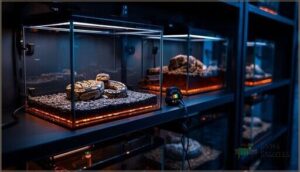
Getting the heat right is only half the battle—keeping it safe and consistent is where things really matter.
Whether you’re managing two enclosures or ten, a few core practices separate a thriving setup from a dangerous one.
Here’s what you need to know about temperature control and safety before anything goes wrong.
Thermostat Selection and Setup
Thermostat control is the backbone of any multi-enclosure setup. Get this wrong, and you’re gambling with your animals’ lives. Here’s what to match before you plug anything in:
- On/Off Thermostats cycle power fully—reliable for single mats under 100W
- Pulse Proportional Control delivers steadier heat output, handling up to 600W
- Wattage Matching Guidelines matter: never exceed your thermostat’s rated load
- Dual‑Zone Probe Setup gives independent temperature monitoring per enclosure
- WiFi Monitoring Integration lets you track thermostat integration for heat mats remotely via app alerts
Preventing Overheating and Hot Spots
Overheating doesn’t announce itself—it creeps up through poor airflow management and mat insulation issues you didn’t catch in time. Keep a 0.25-inch gap under your mats for heat distribution, and never fold or stack them.
Temperature sensors catch power cycling irregularities before they create hot spots.
Safety considerations are simple: one mat, one zone, flat and ventilated.
Infrared Temperature Monitoring Techniques
Your IR thermometer is doing more work than you think. For accurate infrared temperature monitoring across racking systems, hold the gun 2–13 cm from surfaces—spot distance optimization keeps your readings tight.
Set emissivity calibration to 0.95 for organic substrates.
Run a gradient mapping protocol twice daily, and use min-max logging to catch fluctuations.
Laser targeting hits exact reptile heat mat zones without disturbing your snakes.
Backup Heating Solutions for Emergencies
Power goes out—your snakes don’t care about the reason. Having backup heating systems ready isn’t optional; it’s the difference between a minor inconvenience and a dead collection.
Backup heating isn’t optional; it’s the difference between a minor inconvenience and a dead collection
- UPS Power buys you roughly one hour to act—enough time to deploy Heat Packs or Hot Water Bottles.
- Solar Generators run 12–18 hours, maintaining thermal gradient management without interruption.
- Insulation Techniques—blankets, Styrofoam, cardboard—extend any backup heating system’s effectiveness substantially.
Heat Mat Maintenance and Longevity
neglected heat mat is a ticking clock. Daily inspections during the first 3–5 days catch uneven heating before it becomes dangerous.
From there, a cleaning routine every 3–4 weeks—gentle scrubbing with diluted Dawn, thorough rinsing, full air-dry—keeps performance consistent. Thermostat integration and physical protection extend lifespan considerably.
Without them, expect failure well before the 8,000–9,000-hour usage limit.
Common Mistakes When Heating Multiple Enclosures

Even experienced keepers slip up when managing heat across multiple enclosures—and the consequences can be serious.
A few missteps consistently show up, regardless of species or setup size.
Here are the mistakes worth knowing before they cost you.
Neglecting Temperature Monitoring
Skipping temperature monitoring is how burns happen quickly. Misplaced Probe Errors let floors quietly climb past 120°F while your controller reads normal. Thermometer Drift in cheap dials hides 5–10°F swings. Hidden Hot Spots form under hides.
Power Strip Failures and Untracked Temperature Drops can affect entire racks overnight. Solid heat mat safety and installation mean nothing without consistent monitoring to catch equipment failure early.
Inadequate Cool Zones or Thermal Gradients
Temperature monitoring catches equipment failure—but what it monitors matters just as much.
Heat Mat Saturation kills thermal gradients fast. When your mat covers more than one-third of the floor, cool zones disappear.
Zone Insulation Failure and Ambient Room Influence push cool ends above 78°F, triggering Species Stress Indicators like lethargy and incomplete sheds.
Gradient Monitoring Gaps mean your snake can’t thermoregulate at all.
Using Heat Mats With Deep Substrate
Deep substrate kills heat penetration fast. Beyond 1.5 inches, your mat’s output drops 15–20°F—meaning burrowing burn risks spike when snakes dig to the warm bottom layer and contact near-90°F surfaces directly. Substrate insulation effects work against you here.
Side-mounted placement solves this cleanly, and overhead radiant alternatives handle deep setups better than any under-tank mat can.
Overlooking Species-Specific Needs
One-size-fits-all heating doesn’t work across species. Each snake has distinct thermoregulation behavior that drives where and how it uses heat.
- Ball pythons need a 90°F basking spot placement with nighttime temperature drops no lower than 70°F.
- Corn snakes run cooler—75–82°F on the cool side.
- Garter snakes die above 91°F air temperature.
- Species gradient variability means heat mat compatibility and heat distribution must match each enclosure individually.
Relying on Low-Quality Equipment
Cheap heat mats aren’t just inefficient—they’re genuinely dangerous. Fire hazard risks climb fast when unregulated mats hit 130°F without thermostat control.
Thermal inconsistency creates hot spots that cause burn injuries and thermal stress in rack-housed snakes. Electrical failure from faulty wiring can drop temps 20°F overnight. Durability issues compound quickly under 24/7 cycles.
Safety guidelines for reptile heat mats, including proper temperature monitoring and heat mat safety and installation practices, protects your entire collection.
Frequently Asked Questions (FAQs)
Can I put a heating pad under my snakes tank?
Yes — but only if pad is labeled for external glass use and paired with a thermostat.
Without one, surface temps can exceed 120°F, turning your tank floor into a burn risk.
Should I leave my snakes heat pad on all night?
Leaving it on all night isn’t just fine—it’s necessary.
Most snakes need steady overnight warmth, and your thermostat manages Nighttime Heat Cycling automatically, keeping temperatures safe without thermal burns or wasted energy.
Is a heat lamp or heat mat better for snakes?
It depends on your snake.
Heat mats win for nocturnal species—ball pythons love belly heat and humidity retention.
Lamps suit diurnal baskers but risk dryness.
Match the heating method to your species.
Can one thermostat control multiple heat mats?
One thermostat can control multiple heat mats—but wattage limits matter.
Stay under your thermostat’s rated capacity, use power‑strip safety practices, and keep probe placement strategies consistent for even heat distribution across all enclosures.
How often should heat mats be replaced?
Replace heat mats every 3–5 years under normal use. Watch for Visual Damage Signs like charring or warping, and trust Performance Degradation—uneven heat distribution—as your clearest Replacement Frequency Guideline.
Do heat mats work inside rack systems?
heat mats work well in rack systems.
Place them beneath tubs with a 1-inch air gap for even heat distribution, and always pair with a thermostat to prevent dangerous 130°F spikes.
Are heat mats safe for gravid females?
Heat mats can be safe for gravid females—if thermostat calibration is dialed in. Skip it, and belly burn risks become very real, very fast.
Can heat mats cause respiratory issues in snakes?
They can. Substrate drying and humidity loss drop moisture below 60%, while ammonia buildup from heated waste irritates respiratory tracts. Burn risk and airflow restriction compound the problem fast.
Conclusion
A single mismatched heat mat can unravel months of careful husbandry in one overnight failure. That’s not an exaggeration—it’s the reality every multi-enclosure keeper eventually faces.
Choosing the right reptile heat mats for multiple snake enclosures isn’t just about warmth; it’s about building a system where every animal sits within its required thermal range, every night, without supervision. Nail the wattage, pair each mat with a thermostat, and your collection runs itself.
- https://www.thebiodude.com/blogs/how-do-i-create-a-bioactive-vivarium/here-s-why-you-shouldn-t-be-using-a-heat-mat-for-your-reptile
- https://reptilekages.com/pages/snake-enclosure-guide
- https://www.nps.gov/subjects/biodiversity/reptiles.htm
- https://nationalzoo.si.edu/animals/reptiles-and-amphibians
- https://reptile-database.reptarium.cz/