This site is supported by our readers. We may earn a commission, at no cost to you, if you purchase through links.

Ball pythons don’t complain loudly. They don’t pace the room or knock things off shelves to get your attention.
When something feels wrong in their enclosure, the signals are quieter—a snake pressed flat against the glass, a tail that won’t uncurl, a meal left untouched for the third week in a row.
Most owners chalk these up to quirks or bad moods. Knowing the signs that your ball python feels insecure in its enclosure changes that completely. Once you can read what your snake is actually telling you, fixing the problem becomes straightforward.
Table Of Contents
- Key Takeaways
- Signs Your Ball Python Feels Insecure in Its Enclosure
- Glass Surfing and Pacing Along Enclosure Walls
- Defensive Balling and Sustained Hissing
- Striking, Biting, and Aggressive Lunging
- Freezing, Flinching, or Jerking Away When Touched
- Constant Hiding Even During Calm Periods
- Erratic or Unusually Rapid Movements
- Stress-Induced Defecation or Urination During Handling
- Enclosure Problems That Trigger Ball Python Insecurity
- How Insecurity Affects Feeding and Shedding
- Handling Habits That Make Ball Pythons Feel Unsafe
- How a Comfortable Ball Python Actually Behaves
- Frequently Asked Questions (FAQs)
- Is 70 degrees too cold for a ball python at night?
- How to tell if a ball python is comfortable?
- How often should I weigh my ball python?
- Can substrate choice affect my ball pythons security?
- What lighting schedule works best for ball pythons?
- How long before handling a newly acquired snake?
- When should I take my ball python to a vet?
- Conclusion
Key Takeaways
- Ball pythons show stress through subtle behaviors like glass surfing, defensive balling, hiding, erratic movements, and stress-induced toileting.
- Common enclosure problems—such as incorrect temperatures, poor humidity, cramped space, insufficient hides, noisy placement, and frequent decor changes—often trigger insecurity.
- Handling mistakes like picking up too soon after feeding, long or frequent sessions, inadequate body support, and sudden movements can make your snake feel unsafe.
- comfortable ball python explores calmly at night, eats regularly, sheds without issues, and shows relaxed body language with loose coils and steady tongue flicks.
Signs Your Ball Python Feels Insecure in Its Enclosure
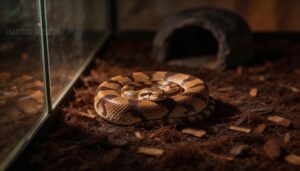
Ball pythons can’t tell you when something feels off — but their behavior will. Most of the time, insecurity shows up in ways that are easy to miss if you don’t know what you’re looking at.
Once you learn to read the signs, common ball python stress signals and what they mean become a lot harder to overlook.
seven signs are the ones worth paying attention to.
Glass Surfing and Pacing Along Enclosure Walls
When your ball python won’t stop pressing against the glass and moving back and forth, that’s perimeter pacing — and it’s one of the clearest stress signals you’ll see.
Watch for these behavioral signs and body language cues:
- daytime activity along the front panel
- Reflection glare causing boundary confusion
- space mapping phase after enclosure changes
- Vibration sensitivity driving restless pacing in its enclosure
Improper reflections on glass can cause the python to pace the perimeter.
Fix temperatures first.
Defensive Balling and Sustained Hissing
When pacing shifts to stillness, pay attention. Defensive balling and sustained hissing mean your ball python has crossed from uneasy into threat perception mode.
It tucks its head deep into the coil — classic head tucking — and holds that locked-down posture. The hissing isn’t a one-time sound. It repeats.
These body language cues together signal serious distress, often triggered by vibrational sensitivity or sudden enclosure disturbance.
Striking, Biting, and Aggressive Lunging
When defensive balling and hissing aren’t enough, a ball python escalates fast. Prestrike coil tension builds in the neck and upper body, followed by rapid head projection mechanics toward your hand.
That lunge is a clear distress signal. Lunging speed indicators and defensive posture shifts — combined with striking, biting, and aggressive lunging — confirm serious stress indicators that your setup or approach needs addressing immediately.
Freezing, Flinching, or Jerking Away When Touched
After a strike or bite, you might notice flinches or jerks when touched—classic behavioral signs of stress in captive snakes.
Touch Location Sensitivity matters; a ball python often freezes or tenses up, especially if you reach for its head or neck.
Escape Path Preference kicks in, with quick body withdrawals and stiff muscle tension levels, all shaped by your handling rhythm effects and stress hormone indicators.
Constant Hiding Even During Calm Periods
Even when the room is completely quiet, an insecure ball python stays buried inside its hide. This Hide Preference Consistency — choosing one snug hiding spot repeatedly — is one of the clearest stress signs to watch for.
Micro-Emergence Patterns tell the story too: a brief head peek, then immediate retreat.
Prolonged Concealment and Recovery Delay after any disturbance confirm your python isn’t settled.
Erratic or Unusually Rapid Movements
When a ball python starts showing erratic or unusual movements — rapid jerking across the enclosure floor, sudden Ballismus Fling-like lurches, or Myoclonus Spasms that interrupt normal gliding — those are serious stress signals worth acting on.
Chorea Restlessness and Hyperkinetic Twitching, paired with Rapid Head Bobbing, tell you your snake feels genuinely unsafe, not simply active.
These aren’t quirks; they’re urgent ball python body language screaming that something’s wrong with its environment.
Stress-Induced Defecation or Urination During Handling
If your ball python defecates or urinates the moment you pick it up, that’s Acute Stress Toileting — and it’s one of the clearest stress signs you’ll encounter. Lifting-Induced Defecation, Temperature Shock Urination, and Smell-Induced Stress can all trigger this response.
Watch for these red flags:
- Defecating and urinating on you immediately after lifting
- Enclosure Transfer Stress causing sudden bathroom release in unfamiliar rooms
- Overhandling leading to repeated toileting during routine sessions
- Handling stress worsens when body support feels unstable or awkward
Enclosure Problems That Trigger Ball Python Insecurity
Most ball python stress isn’t random — it traces back to something specific inside the enclosure. The setup itself can quietly work against your snake before you even notice a problem.
Here are the six most common enclosure issues that leave ball pythons feeling exposed and on edge.
Incorrect Temperature Gradient on Warm and Cool Sides

Temperature gradient design for reptile enclosures isn’t just about hitting a number — it’s about giving your snake real choices.
Hot spot size matters: a narrow warm zone forces your ball python to overshoot or miss entirely.
Cold corner formation, substrate insulation blocking heat transfer, poor thermostat placement, and thermometer accuracy gaps can all quietly undermine temperature control, leaving your snake tense and avoidant without obvious cause.
Humidity Too Low or Too High for Comfort
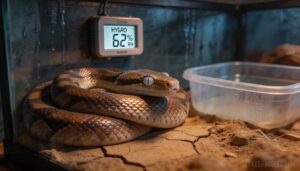
Humidity that drifts out of range — either direction — quietly disrupts your snake’s comfort. Target 45–60% daily, raising to 70–90% during shedding cycles. Stress-induced shedding problems in ball pythons often trace back to a single ignored hygrometer.
- Water Dish Placement — Warm-side positioning boosts evaporation naturally
- Misting Frequency — Adjust daily based on actual readings, not habit
- Hygrometer Calibration — Drifting gauges silently mislead your humidity control
- Ventilation Management — Poor airflow traps moisture, accelerating Mold Prevention failures
Enclosure Too Small to Support Natural Movement
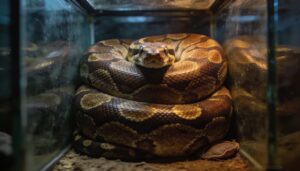
A cramped enclosure isn’t just uncomfortable — it actively works against your snake’s instincts. Without adequate usable travel space, your ball python can’t complete full-body turns without hitting walls, and barrier proximity stays constant. Microclimate separation collapses, escape route choice disappears, and turning radius shrinks to nothing.
Enclosure size guidelines for adult ball pythons start at 4×2 feet — for good reason.
Insufficient or Poorly Placed Hides
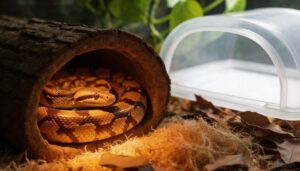
Space matters, but so does shelter. A snug fit hide gives your ball python that "fully wrapped" sense of safety it needs — too large, and it feels exposed; too small, and it can’t tuck in properly.
Hide positioning, hide temperature mismatch, and hide light exposure all affect whether your snake actually uses those hiding spots.
Insufficient hides and poor hide entrance obstruction drive stress signals fast.
High-Traffic or High-Noise Enclosure Placement
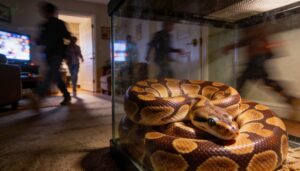
Where you put the enclosure matters just as much as what’s inside it.
Foot traffic proximity, ambient noise exposure, and visual disturbance from a busy hallway or living room all act as constant stress triggers in reptiles. Loud noises and vibrations, airflow drafts from opening doors, and temperature instability can quietly suppress appetite and cause stress-induced shedding problems before you even notice something’s wrong.
Frequently Rearranged Decor Disrupting Familiarity
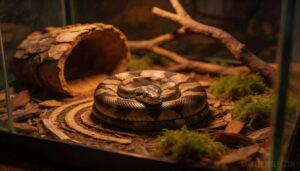
Noise isn’t the only stress trigger—sudden environmental changes inside the enclosure can rattle your ball python just as much. When you move hides or branches, you’re causing:
- Scent Disorientation
- Visual Cue Shift
- Hide Relocation Anxiety
- Substrate Disruption and Feeding Confusion
Consistent routines and snug hiding spots help prevent these identifying ball python stress signals from cropping up.
How Insecurity Affects Feeding and Shedding
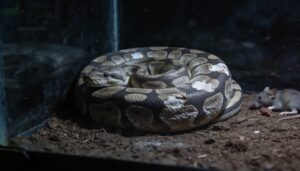
A stressed ball python doesn’t just act differently — it eats differently and sheds differently too. When the enclosure isn’t right, those changes often show up in the most basic survival behaviors first.
Here’s what to watch for.
Repeated Meal Refusal Linked to Enclosure Stress
Repeated meal refusal is one of the clearest signs that something’s off. When Feeding Schedule Disruption, Enclosure Vibration, or Lighting Inconsistency stacks up, Stress Hormone Effects basically flip the feeding switch off. A stable environment and consistent routines matter more than prey size.
| Environmental Stressor | Effect on Feeding |
|---|---|
| Substrate Discomfort | Refusal to eat |
| Inconsistent lighting | Disrupted hunger cues |
Regurgitation as a Stress Response Signal
Regurgitation isn’t just a feeding mistake — it’s often your snake’s body waving a red flag. Sympathetic Activation from Stress indicators like Insufficient Hides and Enrichment, Excessive Handling, or Attempting to Escape triggers Esophageal Sphincter Relaxation, creating an Acid Reflux Trigger. Feeding Timing Mismatch worsens Digestive Disruption dramatically.
Watch for these warning signs:
- Food reappearing within hours of feeding
- Passive, simple regurgitation with no retching
- Undigested or lightly processed prey
- Regurgitation following handling stress
- Recurring episodes despite proper prey sizing
Progressive Weight Loss From Prolonged Anxiety
When anxiety becomes a constant in your ball python’s life, the body starts paying the price. Metabolic energy shift kicks in — stress hormones redirect resources away from digestion and growth, creating a gradual appetite decline trend.
Chronic anxiety redirects a ball python’s resources away from digestion and growth, quietly starving it from within
That’s how stress-induced anorexia develops quietly over weeks.
| Weight Monitoring Sign | What It Means |
|---|---|
| Thinning spine visible from above | Early body condition scoring concern |
| Loss of rounded mid-body shape | Muscle mass decline underway |
| Missing two or more meals | Appetite decline trend — act now |
| Scale monitoring frequency showing drops | Prolonged anxiety driving weight loss |
Incomplete or Patchy Sheds Caused by Low Humidity
Low humidity is one of the most direct causes of incomplete sheds. When air stays too dry, the fluid layer drying out too fast bonds old skin to the new layer underneath. That’s when you’ll notice tail tip stuck patches, neck patchy shedding, or eye cap retention.
Flake accumulation and uneven peeling signals that humidity control during shedding cycles needs immediate adjustment.
Withdrawn Behavior During Pre-Shed Discomfort
Pre-shed discomfort reshapes your ball python’s whole routine. You’ll notice reduced night activity, altered hide preference, and increased water visits — sometimes staying glued to the bowl for hours. Elevated soaking frequency and pre-shed skin itching drive this sedentary, withdrawn hiding behavior.
These are stress-induced shedding problems in ball pythons worth watching. Shedding complications as stress indicators don’t lie; behavioral signs of stress in captive snakes show up here first.
Handling Habits That Make Ball Pythons Feel Unsafe
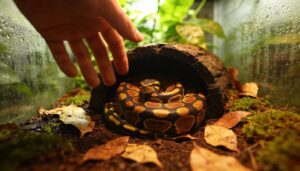
Even the best enclosure setup won’t matter much if your handling habits are working against your snake. Ball pythons are sensitive to how, when, and how often you pick them up — and small mistakes can undo weeks of progress.
These are the handling habits most likely to make your ball python feel unsafe.
Handling Too Soon After Feeding
Feeding your ball python isn’t the end of the interaction — it’s actually the start of a critical hands-off window. Handle too soon, and you’re risking regurgitation, defensive balling and hissing, or flat-out refusal to eat next time.
- Wait 48–72 hours after every meal before any contact
- Avoid excessive or rough handling that disrupts digestion
- Use gentle support if an emergency move is necessary
- Watch for stress-induced anorexia after repeated early handling
- Let post-meal calm fully set in before resuming your routine
Sessions That Are Too Long or Too Frequent
More isn’t always better regarding handling. Session frequency impact is real — too many sessions without enough post-handling recovery leads to behavioral fatigue, where your snake starts defensive rather than curious. Stress hormone persistence means tension lingers after the enclosure door closes.
Keep sessions to 15–30 minutes, one or two times weekly, and watch for subtle stress signs between visits.
Inadequate Body Support During Lifting
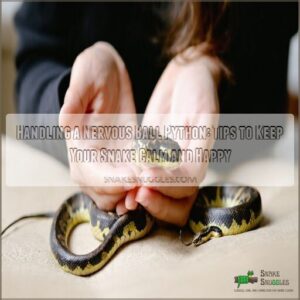
How you lift matters just as much as how often you lift. two-hand grip — head-tail support from nose to tail — keeps your ball python’s spine in alignment and prevents the vertical swing that triggers instant defensiveness.
- Support behind the head to prevent neck droop
- Use a second hand under the mid-body
- Keep the snake close to horizontal
- Balance grip pressure — firm but never squeezing
- Avoid mid-lift grip adjustments that cause slipping
Sudden Movements and Unpredictable Hand Paths
Even if your grip is solid, a jerky reach can undo it. Ball pythons track your hand’s path instinctively — any sudden change in speed or direction reads as a threat.
Controlled hand speed and a predictable approach path reduce stress triggers substantially. Move slowly, keep air disturbance minimal, and manage visual cues by approaching from the side, never above.
Skipping Acclimation Time for Newly Acquired Snakes
A new snake needs time before it needs you. The first week is an Environmental Familiarization Period — your job is Stress Free Observation, not interaction.
Skipping this step and handling too soon trigger defensive responses fast.
Give it 7 to 14 days minimum, maintain a basic Acclimation Log tracking food refusal and emergence times, and introduce Gradual Handling Introduction only once the snake is eating confidently.
How a Comfortable Ball Python Actually Behaves

Once you know what stress looks like, it’s easier to recognize when things are actually going well.
A settled ball python has a handful of reliable tells, and they’re not hard to spot once you know what to look for. Here’s what a genuinely comfortable ball python looks like in daily life.
Slow, Purposeful Exploration During Evening Hours
When evening settles and household lights dim, a secure ball python gets moving. You’ll notice slow, deliberate nocturnal behavior — edge following along enclosure walls, belly maintaining steady substrate contact, gradual route selection between hiding spots.
Quiet environmental cues guide each pause and direction shift. This low light navigation, paired with calm tongue flicking, is one of the clearest behavioral indicators that your snake feels genuinely at ease.
Loose Coiling and Relaxed Muscle Tone at Rest
A comfortable ball python at rest tells you everything through its body language. Look for loose coil gaps between body loops, a head resting outside the coil, and partial body stretches along the enclosure floor. Multiple contact points with the surface show soft, settled muscle tone — calm breathing, no rigid bracing.
These are the clearest physical and behavioral signs of a relaxed ball python.
Calm, Steady Tongue Flicking at a Moderate Rate
Watch for a steady flick rhythm during nighttime scent checking — it’s one of the clearest relaxed snake body language cues you’ll see. Calm environmental scanning means your ball python is doing active chemical mapping of its space, not panicking.
Scent exploration at a moderate pace signals confidence. No flicking of the tongue or frantic bursting often points toward stress signs worth addressing.
Consistent Feeding Response Without Hesitation
A relaxed ball python doesn’t hesitate at mealtime. Feeding Schedule Regularity matters more than most keepers realize — stress-induced anorexia creeps in quietly and is one of the clearest physical and behavioral signs of snake stress to watch for.
Signs your snake is truly settled:
- Approaches food without retreating or head-pulling
- Accepts prey immediately when Prey Temperature Warmth is consistent
- Responds calmly in a Quiet Feeding Enclosure with Predictable Food Placement
- Shows no loss of appetite after Minimal Pre-Feeding Handling
Gentle Grip on Handler Without Tight Constriction
A snake that feels safe doesn’t try to escape your hands. When you use supportive hands with fingers spread and even pressure underneath the body, your ball python wraps loosely — not in a tight, defensive coil.
That gentle grip and calm release tell you everything. Well-supported handling that avoids head restraint and sudden lifts is one of the clearest behavioral signs that your snake actually trusts the interaction.
Frequently Asked Questions (FAQs)
Is 70 degrees too cold for a ball python at night?
Yes, 70°F is right at the edge — most guides target 75–78°F at night. Below that, metabolic slowdown and digestive efficiency drop.
Add a thermostat-controlled, lightless nighttime heat source if your home dips that low.
How to tell if a ball python is comfortable?
A comfortable ball python shows calm breathing, a stable weight trend, predictable hide use, a steady activity rhythm, and completes a regular shedding cycle without issues.
How often should I weigh my ball python?
Think of your scale as a monthly health report card.
Weigh adults once a month on an empty stomach, using the same scale each time, to catch weight loss or gain trends early.
Can substrate choice affect my ball pythons security?
Absolutely. Moisture retention, burrowing comfort, and substrate hygiene all shape how secure your ball python feels.
Poor choices raise impaction risk, invite mold, and undermine hide comfort — quietly stacking stress signs before you notice them.
What lighting schedule works best for ball pythons?
A 12-hours-on, 12-hours-off day/night cycle works best. Ball pythons are crepuscular, so consistent timer use helps their circadian rhythms naturally. Skip red light — they can still see it.
How long before handling a newly acquired snake?
Wait at least 24 to 72 hours before your first handling attempt. Many snakes need a full settling time of one to two weeks, especially those with an uncertain stress history.
When should I take my ball python to a vet?
Take your ball python to a vet when you notice persistent wheezing, open mouth breathing, visible skin lesions, dehydration symptoms, abnormal fecal output, loss of appetite, weight loss, shedding complications, or any signs of respiratory infection.
Conclusion
Knowing your ball python’s subtle cues and responding to their needs transforms their life—and yours. A secure snake explores with purpose, eats with enthusiasm, and interacts with calmness.
By recognizing the signs your ball python feels insecure in its enclosure, you create a sanctuary where they thrive. With a comfortable environment and gentle handling, your relationship deepens, and your snake’s well-being soars.
A happy ball python is a joy to behold, and a joy to care for always.
- https://pmc.ncbi.nlm.nih.gov/articles/PMC12244313/table/jfb16069-tbl-0002/
- https://smalldogsheaven.com/how-to-stop-a-dog-from-lunging/
- https://burncenters.com/safety/animal-aggression-what-to-look-out-for/
- https://medlineplus.gov/ency/article/003196.htm
- https://ufhealth.org/conditions-and-treatments/movement-unpredictable-or-jerky