This site is supported by our readers. We may earn a commission, at no cost to you, if you purchase through links.
Most burrowing snakes die from substrate problems their owners never see coming. Wrong particle size causes impaction. Dusty bedding inflames respiratory tissue. Substrates that can’t hold moisture collapse tunnels and leave your snake exposed, stressed, and vulnerable to temperature swings. The damage builds quietly, long before symptoms appear.
Choosing the right snake substrate bedding for burrowing species isn’t about aesthetics or convenience—it’s about replicating underground conditions precisely enough that your snake behaves like it would in the wild. Get the substrate right, and everything else—humidity control, thermoregulation, feeding response—usually follows.
Table Of Contents
- Key Takeaways
- Key Features of Substrate for Burrowing Snakes
- Matching Substrate to Snake Species
- Top 6 Substrates for Burrowing Snake Species
- Substrate Depth and Enclosure Setup
- Cleaning and Maintenance of Burrowing Substrates
- Health and Safety Risks of Substrate Choices
- Tips for Optimizing Burrowing Snake Habitats
- Frequently Asked Questions (FAQs)
- Conclusion
Key Takeaways
- Wrong particle size and dusty bedding are the leading causes of silent, slow damage in burrowing snakes — impaction and respiratory inflammation build long before symptoms appear.
- Substrate depth isn’t optional: small species need at least 8–10 cm, medium burrowers 20–30 cm, and getting this wrong collapses tunnels and strips away your snake’s ability to thermoregulate.
- Cedar, pine, clumping clay, and unsterilized garden soil aren’t just bad choices — they actively damage liver tissue, irritate airways, and introduce pesticide residue through direct scale contact.
- Monitor humidity at burrow depth, not wall level — burrow readings run 10–20% higher than surface air, and chasing the wrong number will quietly wreck your moisture management.
Key Features of Substrate for Burrowing Snakes
Not all substrates work the same way, and the wrong one can quietly stress your snake over time. Before you pick anything off the shelf, there are five features worth understanding. Each one directly shapes how well your snake burrows, breathes, and stays healthy.
If you’re setting up an arid environment, this guide on desert snake substrate and bedding options breaks down which materials actually replicate natural conditions.
Particle Density and Burrowing Ease
Particle size makes or breaks your substrate selection. Fine, rounded grains between 0.5 and 2 millimeters let burrowing snakes flow through with minimal effort — angular or coarse particles fight back. For reptile substrates, aim for medium bulk density around 0.3–0.8 g/cm³ to support tunnel stability without exhausting smaller species.
- Fine particles fill gaps, improving density gradients
- Soil compaction crushes burrowing mechanics over time
- Substrate depth amplifies burrowing behavior naturally
Moisture Retention and Humidity Control
Particle density sets the stage, but moisture retention keeps it livable. Coconut fiber and reptile soil hold 5–8× their dry weight in water — that’s what gives you stable humidity levels without daily misting. Poor water holding means rapid evaporation rates, and your snake loses its moisture gradients fast.
| Substrate | Moisture Retention | Humidity Control |
|---|---|---|
| Coconut Fiber | High | Excellent |
| Aspen Shavings | Low | Poor |
| Reptile Soil Blend | High | Excellent |
Burrow hygrometry matters more than surface readings — bury your probe at burrow depth.
Depth and Tunnel Stability
Moisture tells you what the substrate can hold — depth tells you whether the tunnel will last. Soil mechanics research confirms smaller, uniform particles reduce collapse risk by supporting natural soil arching.
For burrowing snakes, substrate depth and tunnel stability come down to a few non-negotiables:
- Small species need at least 8–10 cm for stable burrow dynamics
- Medium burrowers benefit from 20–30 cm for multi-level tunnel engineering
- Wetter, finer soils improve structural integrity and reduce collapse
- Irregular or coarse particles — like gravel — compromise stability factors fast
- Depth requirements scale with body size; don’t guess, measure.
Proper substrate selection is vital for maintaining ideal burrowing species health.
Absorbency and Odor Management
Depth gets the burrow standing — absorbency keeps it livable. Coconut fiber absorbs 4 to 5 times its dry weight, locking urine into small, removable patches instead of soaking the entire substrate depth. That’s your first line of odor control.
For burrowing snakes, moisture balance matters at burrow level: wet enough to hold tunnels, dry enough on top to slow ammonia release and simplify waste management.
Non-Toxic Materials and Safety
Every substrate your burrowing snake touches becomes part of its air, skin, and diet. Getting this wrong isn’t just a maintenance headache — it’s a health risk.
Every substrate a burrowing snake touches becomes part of its air, skin, and diet — choose wrong, and it’s a health risk, not just a hassle
Stick to these snake safety guidelines when evaluating reptile substrates:
- Skip pine and cedar — their phenols damage liver tissue and airways
- Avoid dyed or scented bedding — volatile chemicals irritate the respiratory lining
- Choose chemical-free substrates: kiln-dried aspen, reptile-grade coconut fiber, or commercial reptile soil
- Never use garden soil without heat-sterilization — fertilizer and pesticide residues absorb through scales
- Confirm packaging shows no added perfumes, antimicrobials, or dust-control coatings
Non-toxic materials aren’t optional. They’re the baseline.
Matching Substrate to Snake Species
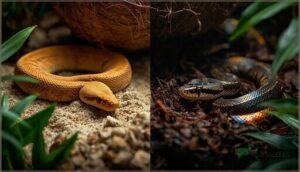
Not every substrate works for every snake — what keeps a sand boa happy will stress out a rainbow boa fast. Getting the match right comes down to your specific species’ humidity needs, burrowing habits, and life stage.
Here’s how to break it down.
Desert-Dwelling Burrowing Snakes
Sand boas and hognose snakes aren’t just hiding — they’re engineering. In the wild, these desert species rely on fine-to-medium sand mixed with slight loam for tunnel stability and humidity microclimates that hover around 20–40%.
For captive reptile substrates, match that with clean play sand blended with sandy soil, minimum 10–15 cm substrate depth, and keep it dry. Desert snake behavior depends on it.
Tropical Burrowing Snake Requirements
Tropical burrowers like Calabar pythons and sunbeam snakes demand more than just damp dirt — they need a carefully engineered environment. Nail these three things:
Start with the substrate itself — cedar and pine are off the table, since their oils can wreck your snake’s respiratory system over time, so check out this guide to safe burrowing substrates for tropical snakes before you fill that enclosure.
- Substrate Mix: 50–70% coconut fiber, 20–40% chemical-free topsoil, 10–20% leaf litter for tunnel stability
- Substrate Depth: 10–30 cm depending on size, enabling natural snake behavior
- Moisture Gradients: Keep one side at 80–90% humidity, the other around 60%
Bioactive substrate setups thrive here. Moisture retention keeps burrowing snakes healthy — dry substrates cause incomplete sheds fast.
Moderate Humidity Species Considerations
Not every burrowing snake needs a swamp — moderate humidity species sit right in the middle, and that balance is easier to wreck than you’d think.
Target ambient humidity between 45–65%, with burrow humidity running 5–15% higher than surface air. Your substrate blends should clump lightly when squeezed but crumble when poked.
| Factor | Target Range | Risk if Wrong |
|---|---|---|
| Ambient Humidity | 45–65% | Scale rot above 70% |
| Burrow Humidity | 55–75% | Poor shedding below 45% |
| Substrate Blend | 50–70% fiber + 30–50% structure | Compaction or dry-out |
| Surface Dryness | Dry between mistings | Mold growth if always wet |
| Moisture Gradients | Damp lower third, dry upper layers | Respiratory stress |
Use humidity monitoring at burrow depth — not wall level. Ventilation systems should allow the top 1–2 cm to dry fully between waterings for healthy moisture retention and stable snake care.
Hatchling and Juvenile Burrower Needs
Hatchlings aren’t just small adults — their substrate needs are genuinely different, and the wrong setup can kill them fast.
- Keep burrow depth at 1–1.5× body length for hatchling care
- Use fine, sifted particles for substrate safety — no sharp chips
- Build a humidity control gradient: damp lower third, dry surface
- Feed off-substrate to cut impaction risk
- Do full changes every 3–4 weeks for growth monitoring
Top 6 Substrates for Burrowing Snake Species
Not every substrate works for every snake, and the wrong pick can cause real problems fast.
The six options below cover the most reliable choices for burrowing species, from desert dwellers to tropical diggers.
Each one brings something different to the table, so let’s break them down.
1. Zoo Med Reptile Soil Substrate
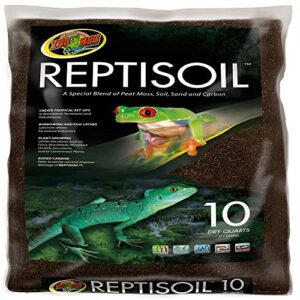
Zoo Med Reptile Soil Substrate is one of the more thoughtfully engineered options available for burrowing species. Its blend of peat moss, soil, sand, and carbon does real work — the sand adds structural grip so tunnels don’t collapse, while the peat absorbs and slowly releases moisture to limit humidity swings. The carbon content helps control odor without synthetic additives.
It’s best suited to forest-floor and scrubland species, not arid desert snakes. A single 10-quart bag fits a standard 20-gallon long setup.
| Best For | Reptile and amphibian owners building bioactive or tropical setups who want a substrate that supports natural behaviors like burrowing, holds humidity well, and keeps plants alive long-term. |
|---|---|
| Material | Peat moss, soil, sand, carbon blend |
| Odor Control | Coconut carbon reduces odors |
| Burrowing Support | Yes |
| Humidity Retention | High |
| Ease of Cleaning | Moderate |
| Reptile Safe | Yes |
| Additional Features |
|
- The peat, sand, and soil blend holds tunnels together and manages moisture without big humidity swings
- Coconut carbon cuts down on odors naturally — no synthetic additives needed
- Works well for a wide range of animals, from tropical lizards and amphibians to tarantulas and hermit crabs
- Gets sticky and messy when damp, which can make spot-cleaning a bit of a hassle
- Some bags have turned up larger woodchips or debris that could be a risk to smaller animals
- Costs more than basic substrates, and some users aren’t happy with changes made to the newer formula
2. Zilla Reptile Terrarium Bedding Liner
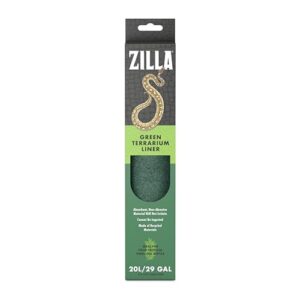
Unlike Zoo Med’s soil blend, the Zilla Reptile Terrarium Bedding Liner takes a completely different approach — it’s a flat, enzyme-treated fabric mat, not a loose substrate. That matters for burrowing snakes because it offers zero digging depth on its own.
Where it earns its place is in quarantine setups or as a base layer under deep loose substrate, simplifying full clean-outs. The enzyme treatment genuinely reduces odors, and the non-particulate surface eliminates impaction risk entirely.
| Best For | Beginner reptile owners, quarantine setups, and anyone who wants a no-fuss, easy-to-clean surface for snakes, lizards, or turtles. |
|---|---|
| Material | Recycled plastic |
| Odor Control | Enzyme-treated odor reducer |
| Burrowing Support | No |
| Humidity Retention | Low |
| Ease of Cleaning | Easy |
| Reptile Safe | Yes |
| Additional Features |
|
- Enzyme treatment actually cuts down on odors — not just masking them
- Zero impaction risk since there’s no loose material to accidentally swallow
- Super easy to clean and swap out during full terrarium cleanouts
- No digging depth at all, so burrowing species won’t be happy on this alone
- If you let waste dry and harden on it, cleaning gets a lot more annoying
- Over time, odors can build up enough that you’ll need to replace it entirely
3. Zoo Med Forest Floor Bedding
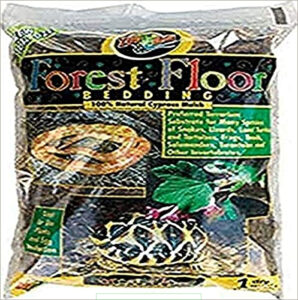
If flat liners are too restrictive for your snake’s instincts, cypress mulch is the natural next step. Zoo Med Forest Floor Bedding is 100% natural cypress — no dyes, no added fragrance, no aromatic oils that irritate lungs.
It holds moisture without turning soggy, making it a reliable choice for humidity-loving species targeting 50–80% ambient humidity. Pack it at least 5–8 centimeters deep and it accommodates shallow scrapes and mounded hides well.
Spot clean frequently; full replacement every 4–8 weeks keeps bacterial buildup in check.
| Best For | Snake and reptile owners keeping humidity-loving species like boas, corn snakes, or tropical tortoises who want a natural-looking setup that actually holds moisture. |
|---|---|
| Material | Cypress mulch |
| Odor Control | Natural odor absorption |
| Burrowing Support | Yes |
| Humidity Retention | High |
| Ease of Cleaning | Easy |
| Reptile Safe | Yes |
| Additional Features |
|
- 100% natural cypress with no dyes or artificial scents — safe for sensitive respiratory systems
- Holds moisture well, making it easy to dial in humidity for tropical species
- Looks great in a terrarium and lets snakes burrow and explore naturally
- Can get pricey if you’re filling a large enclosure and replacing it every 4–8 weeks
- Waste can be hard to spot against the dark, textured substrate
- May include oversized pieces that need to be picked out before use
4. Zilla Alfalfa Reptile Bedding
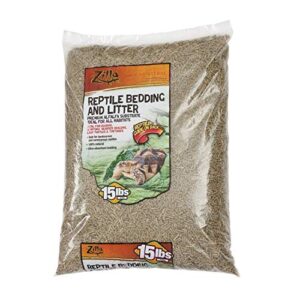
Alfalfa takes a different approach entirely. Zilla’s Alfalfa Reptile Bedding is 100% natural, digestible, and bacteriostatic — meaning it actively slows bacterial growth rather than just absorbing waste. That’s a real advantage for odor control in low-humidity setups.
Here’s the catch: alfalfa doesn’t hold a tunnel. The granular particles shift and collapse, so dedicated burrowers won’t get far. Use it as a surface layer or dig-area mix — not as your primary substrate for active burrowing species.
| Best For | Carnivorous reptile owners who want a natural, odor-controlling bedding for low-humidity setups and aren’t relying on deep burrowing. |
|---|---|
| Material | Alfalfa meal pellets |
| Odor Control | Bacteriostatic odor minimizer |
| Burrowing Support | Yes |
| Humidity Retention | Low |
| Ease of Cleaning | Moderate |
| Reptile Safe | Yes |
| Additional Features |
|
- 100% natural and digestible, so accidental ingestion isn’t a safety crisis
- Bacteriostatic formula actively slows bacterial growth, keeping odors down longer
- Biodegradable and made in the USA — easy to feel good about using
- Gets soggy and moldy fast, so any moisture exposure is a real problem
- Has a strong farm smell that not everyone can live with
- Doesn’t hold tunnels well, making it a poor fit for active burrowing species
5. Zoo Med Eco Earth Coconut Fiber Substrate
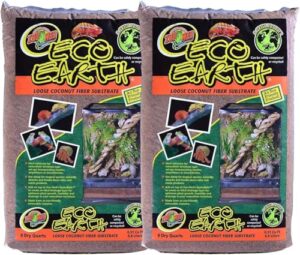
If tunnels matter to you, coconut fiber is hard to beat. Zoo Med Eco Earth, made from compressed coconut husk, is a standout choice. One brick expands to roughly 7–8 liters, enough to layer 2.5 inches deep in a 10-gallon tank.
Dampen it slightly, and those fibers interlock, holding burrow walls stable without collapsing. It also maintains humidity well, making it a strong pick for tropical burrowers.
Just don’t soak it — waterlogged Eco Earth grows mold fast.
| Best For | Reptile, amphibian, and invertebrate owners who want a natural burrowing substrate that holds humidity well in tropical or bioactive setups. |
|---|---|
| Material | Coconut fiber |
| Odor Control | Absorbs and breaks down odors |
| Burrowing Support | Yes |
| Humidity Retention | High |
| Ease of Cleaning | Easy |
| Reptile Safe | Yes |
| Additional Features |
|
- Coconut fiber interlocks when damp, so burrow walls actually hold their shape
- Great at maintaining humidity — solid choice for tropical species
- Works in bioactive terrariums and pairs with HydroBalls for drainage
- Can arrive dry from older batches, so you may need to rehydrate it before use
- Pricier than some other substrate options on the market
- Packaging sometimes differs from what’s advertised — you might get one bag instead of two
6. Zoo Med Aspen Snake Bedding
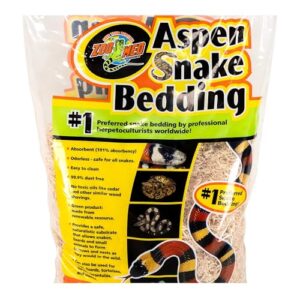
Zoo Med Aspen Snake Bedding is the go-to for dry-climate burrowers like corn snakes, kingsnakes, and western hognose snakes. Those small, curled shavings stay loose — snakes push right through without hitting a compacted wall.
At 191% absorbency, urine clumps into removable patches instead of spreading. It’s dust-free, odorless, and contains no aromatic oils.
Just don’t use it for tropical species; aspen dries out fast and won’t hold the humidity they need.
| Best For | Dry-climate snakes like corn snakes, kingsnakes, and hognose snakes — plus other burrowing reptiles, invertebrates, and even some plants. |
|---|---|
| Material | Aspen wood shavings |
| Odor Control | Odorless with 191% absorbency |
| Burrowing Support | Yes |
| Humidity Retention | Low |
| Ease of Cleaning | Easy |
| Reptile Safe | Yes |
| Additional Features |
|
- 191% absorbency means messes clump up and are easy to spot-clean
- No toxic oils, dust, or odors — totally safe for your animals
- Loose shavings let burrowing species dig through naturally
- Dries out quickly, so it’s not a good fit for tropical or high-humidity species
- 8 quarts per bag may not go far in a large enclosure
- Not always stocked in stores, so you’ll likely need to order it online
Substrate Depth and Enclosure Setup
Getting the substrate depth right can make or break your burrowing snake’s setup. Too shallow, and your snake can’t thermoregulate properly or feel secure — both of which lead to stress.
Here’s what you need to know about depth, tunnel stability, and enclosure setup before you fill that enclosure.
Recommended Depth for Small Vs. Large Species
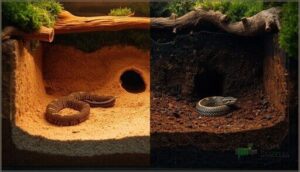
Burrow depth isn’t one-size-fits-all — snake size drives everything. Small burrowing snakes under 60 cm, like western hognose or sand boas, need just 5 to 10 cm of substrate layer. Medium species benefit from 15 to 20 cm. For large snakes exceeding 1.5 m, aim for 10 to 15 cm minimum.
Always match enclosure height to species needs so the substrate depth doesn’t eat your vertical space. When selecting a substrate, consider the benefits of a bioactive substrate for your snake’s environment.
Creating Stable Burrows and Tunnels
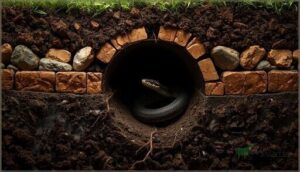
Stable tunnel architecture doesn’t happen by accident — it starts with smart substrate mixing. A blended topsoil and coconut fiber mix with 20–30% play sand gives burrowing snakes the lateral wall pressure they need.
Here’s what drives burrow stability:
- Keep moisture retention at 40–60% saturation — damp enough to clump, not drip
- Bury cork rounds or flat rocks as tunnel anchors before adding substrate depth
- Hand-pack layers in 2–3 cm increments for a dense, collapse-resistant base
- Create a front-to-back slope to guide natural burrowing behavior
- Carve starter holes to direct tunnels toward supported edges
Moisture control is the real foundation.
Thermoregulation Benefits of Deep Substrate
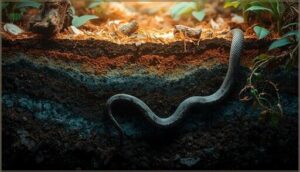
Deep substrate serves a dual purpose: it acts as both thermal mass and a cool refuge. Surface temperatures near 30–32°C can drop to 25–27°C just 10–15 cm down, creating a built-in temperature gradient that snakes navigate instinctively.
Moist microclimates in the lower layers enhance heat balance and humidity control simultaneously. For burrowing snakes, this depth is essential—it’s how they regulate their body temperature without stress.
Cleaning and Maintenance of Burrowing Substrates
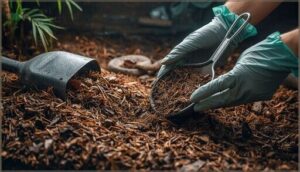
Keeping a burrowing snake’s substrate clean isn’t complicated, but it does require a consistent routine. Neglect it, and you’re looking at mold, mites, and a stressed snake fast.
Here’s what you need to stay on top of it.
Spot Cleaning Practices
Daily Inspections matter more with burrowing snakes — waste disappears under the surface fast. Check once a day, ideally after evening activity. Rake the top 1–2 cm near burrow entrances, water bowls, and basking spots.
For Waste Removal, scoop 5–10 cm deep around any soiled area.
Good Burrow Maintenance and Odor Control start here, before problems compound.
Full Substrate Replacement Frequency
Spot cleaning buys you time — but not forever. Substrate lifespan depends on species size, humidity effects, and burrowing behavior.
Small burrowing snakes like juvenile sand boas can go 6–8 weeks with consistent spot cleaning. Larger species need full replacement every 4–6 weeks.
Replacement schedules also shift with humidity control — humid setups compress faster. Read the substrate, not just the calendar.
Preventing Mold, Mites, and Odors
Full replacement isn’t the finish line — mold prevention, mite control, and odor management run between every change. Freeze new reptile bedding at −18°C for 48–72 hours before it touches the enclosure. Pull feces within 24 hours; uneaten prey within 12.
For bioactive substrate, add Stratiolaelaps mites — they handle soil pests quietly. Cross-ventilation keeps humidity balance from tipping into mold territory.
Fluffing and Turning Substrate
Beyond mold prevention, substrate aeration keeps your setup actually livable between full changes. Compact substrate is a quiet stressor — burrowing snakes can’t easily rework tunnels through hard-packed layers.
Fluff and turn weekly for:
- Moisture control across warm and cool sides
- Burrow maintenance without destroying established tunnels
- Tunnel stability along frequently traveled routes
- Snake health checks — scan for shed, waste, or hidden debris
Health and Safety Risks of Substrate Choices
The wrong substrate doesn’t just make your snake uncomfortable — it can seriously hurt them. From impaction to respiratory damage, the risks are real and worth knowing before you commit to a bedding choice. Here’s what to watch out for.
Impaction Risks and Prevention
Impaction is one of the quieter dangers hiding in your substrate choice. Burrowing snakes hunt close to the ground, meaning they swallow bedding constantly without you noticing. Coarse particles — crushed walnut shell, corn cob, pea gravel — are the worst offenders for blockage prevention.
| Impaction Signs | Action to Take |
|---|---|
| No stool for weeks | Check hydration, raise temps |
| Firm lump along body | Stop feeding immediately |
| Loss of appetite | Monitor weight closely |
| Straining without output | Seek vet care now |
| Dry, flaky skin | Improve hydration methods |
Fine-textured substrate with solid moisture retention — coconut fiber, loose topsoil blends — passes through more safely. For digestion support, keep warm-side temps stable and your snake properly hydrated. Substrate safety starts with particle size. When impaction is suspected, don’t wait.
Respiratory Health and Dust Control
Substrate safety doesn’t stop at impaction. Dusty bedding hits burrowing snakes differently — fine particles under 10 micrometers stay airborne longer and reach deep into the airway. Watch for open-mouth breathing, nose rubbing, or audible wheezing after digging.
Humidity control helps: keeping moisture retention stable around 40–60% binds particles down. Good airflow management clears what humidity can’t — cross-ventilation beats dead air every time.
Toxic Substrates to Avoid
Cedar and pine are off the table — aromatic oils from these woods damage liver tissue over time and cause skin abrasions in burrowing snakes. Chemical risks multiply fast in closed enclosures.
Clumping clay and calcium sand carry impaction hazards, while garden soil with fertilizer residue introduces hazardous additives no reptile substrate selection should allow.
For aspen-based options, verify it’s untreated — toxic materials hide in plain sight.
Monitoring for Pests and Mold
Mold Inspection starts at the water bowl — that’s where moisture retention creates the first problem. Lift hides weekly, scrape a test patch to the glass, and sniff for musty or sour odors during every spot clean. Odor Monitoring catches issues before they’re visible.
For Pest Control, press a damp white paper towel along burrow entrances. Moving specks mean mites.
Humidity Checks near burrow depth, not surface level, complete the picture.
Tips for Optimizing Burrowing Snake Habitats
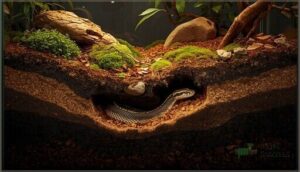
Getting the substrate right is only half the battle — how you manage the habitat around it matters just as much. A few targeted adjustments can mean the difference between a snake that thrives and one that slowly declines.
Here’s what to focus on when fine-tuning your burrowing snake’s setup.
Using Hygrometers at Burrow Level
Your wall-mounted hygrometer is lying to you — burrow humidity runs 10–20% higher than open air. Here’s how to monitor it accurately:
- Bury the probe tip at burrow level, sensor exposed inside the tunnel.
- Calibrate with a salt test; acceptable drift is under 5%.
- Use two probes for humidity gradients across warm and cool sides.
- Route cables along walls to prevent snake dislodging sensors.
- Wipe probe tips every few weeks to clear substrate dust.
Balancing Humidity and Ventilation
Too much humidity suffocates your snake’s burrow; too little dries it out. Nail the balance with these quick reference points:
| Enclosure Type | Humidity Retention |
|---|---|
| Glass tank, full screen lid | Loses 10–20% faster |
| PVC/HDPE, front vents only | Holds 10–20% higher |
| Plastic tub, small side vents | Moderate, stable retention |
Cover 50–75% of screen lids to dial in proper moisture levels without killing airflow management.
Choosing Substrate for Bioactive Setups
Bioactive Design isn’t plug-and-play — it’s a living system. Your bioactive substrate base should run roughly 40–60% topsoil, with coco fiber, sand, and leaf litter filling the rest.
Cycle it 4–8 weeks before adding your snake so Microbe Balance stabilizes.
Clean Up Crews need organic matter to thrive, and solid Drainage Systems with lava rock prevent waterlogged burrows from collapsing on your snake.
Adapting Substrate as Snakes Grow
Your snake’s substrate needs change as it grows — treat it as a system that evolves through Growth Stages, not a one-time setup. Start hatchlings on fine-particle reptile bedding at 5–10 cm, then deepen to 20–30 cm for adults.
Substrate Gradation, Humidity Shifts, and Burrow Dynamics all shift with Maturation Needs, so adjust your substrate selection and management gradually — every few months, not all at once.
Frequently Asked Questions (FAQs)
Where do snakes go in October?
In October, burrowing snakes vanish almost overnight — heading toward hibernation sites like rock crevices, rodent burrows, and frost-free foundations.
Autumn migration peaks as temperatures drop below 10°C, triggering winter denning instincts across regional climates.
Do snakes burrow in substrate?
Yes, many burrowing snakes instinctively push through loose bedding using side-to-side movements.
This natural burrowing behavior is core to how they thermoregulate, hunt, and stay secure — substrate selection directly aids it.
Can mixed substrates improve burrowing snake enrichment?
Absolutely — mixed substrates reveal real burrow complexity. A 60/40 coco fiber-to-sand blend creates humidity gradients that support natural snake behavior, letting burrowing snakes choose moisture levels and tunnel angles independently.
How does lighting affect substrate temperature gradients?
Lighting placement drives thermal gradients across your substrate. A basking lamp over one end creates surface temps 6–10 °C warmer than the shaded side, giving burrowing snakes real depth and lateral temperature choices.
Should substrate differ during snake shedding periods?
Not really. For most burrowing snakes, shedding substrate stays the same — you just tweak moisture levels locally. A humid corner or damp hide manages burrow microclimate needs without disrupting the whole setup.
How do feeding habits influence substrate contamination risks?
Where you feed matters as much as what you feed. Prey fluids soaking into burrow entrances raise bacterial loads fast. Separate feeding tubs and prompt spot-cleaning keep contamination risks low and burrow hygiene intact.
Conclusion
Underground, your snake isn’t decorating—it’s surviving. The snake substrate bedding for burrowing species you choose either aids that survival or quietly works against it.
Wrong particles don’t just frustrate burrowing; they invite the kind of slow internal damage that shows up too late to fix easily.
Get the depth right, match moisture to species, and monitor what you can’t see. The substrate beneath your snake is doing more work than anything visible above it.
- https://journals.biologists.com/jeb/article/224/11/jeb242244/269100/How-head-shape-and-substrate-particle-size-affect
- https://pmc.ncbi.nlm.nih.gov/articles/PMC9605616
- https://reptifiles.com/corn-snake-care-guide/corn-snake-substrate
- https://dallas.aaacwildliferemoval.com/blog/snake/what-surface-do-snakes-hate
- https://www.zenhabitats.com/blogs/reptile-care-sheets-resources/corn-snake-complete-substrate-guide