This site is supported by our readers. We may earn a commission, at no cost to you, if you purchase through links.
Quarantine protocols collapse when a snake’s immune system does—and a 10°C temperature swing can slash pathogen-killing capacity by half while spiking stress hormones within hours.
I’ve watched respiratory infections erupt in newly acquired animals housed in enclosures where analog dials drifted 7°F below actual substrate temperatures, creating thermal stress that compounded the physiological burden of relocation and pathogen exposure.
Snake thermometers for quarantine setups aren’t optional insurance; they’re the difference between successful acclimation and preventable mortality when an animal’s defenses are already compromised.
Digital models with ±1°F accuracy and probe placement at snake level—not mid-air—deliver the data you need to maintain the narrow thermal range that sustains digestion, immune function, and recovery during isolation periods.
Table Of Contents
- Key Takeaways
- Why Accurate Temperature Matters in Quarantine
- Key Features of Snake Thermometers
- Types of Thermometers for Quarantine Setups
- Best Practices for Thermometer Placement
- Sanitation and Biosecurity in Quarantine
- Integrating Thermometers With Heating Systems
- Top 10 Snake Thermometers for Quarantine
- 1. Reptile Thermometer Humidity Gauge
- 2. Mini Digital Hygrometer Thermometer
- 3. Paizoo Reptile Thermometer Hygrometer
- 4. Oasirep Reptile Thermometer Hygrometer
- 5. Digital Reptile Thermometer Hygrometer
- 6. Repti Zoo Reptile Thermometer Hygrometer Gauge
- 7. SunGrow Reptile Thermometer Hygrometer
- 8. Weewooday Reptile Thermometer Hygrometer
- 9. Repti Zoo Digital Thermometer Hygrometer
- 10. Reptispa Digital Thermometer Hygrometer
- Tips for Reliable Temperature Monitoring
- Frequently Asked Questions (FAQs)
- Where to put a thermometer in a snake enclosure?
- How to quarantine a snake?
- What is the best hygrometer for reptiles?
- Are cheap digital hygrometers accurate?
- How often should I replace thermometer batteries?
- Can infrared guns replace traditional probe thermometers?
- Whats the ideal quarantine enclosure temperature range?
- Should I use separate thermometers for transport?
- Do thermometers need calibration after disinfection?
- Conclusion
Key Takeaways
- Quarantine snakes face immune suppression during the first 72 hours post-relocation, and temperature swings as small as 10°C can slash pathogen-killing capacity by half while spiking stress hormones—making ±1°F accuracy from digital thermometers non-negotiable for survival during this critical window.
- Effective thermal monitoring requires probe placement at snake level (substrate or basking surfaces, not mid-air), dual-zone tracking of warm and cool ends, and dedicated thermometers per enclosure to prevent cross-contamination while verifying that thermostat outputs match actual microclimate conditions.
- Digital models with external probes, 1+ meter cables, integrated humidity sensors, and battery backup outperform analog gauges by eliminating parallax errors, providing continuous data logging, and maintaining precision through power outages when immunocompromised animals can’t afford environmental lapses.
- Biosecurity protocols demand equipment isolation (one thermometer per quarantine enclosure), routine disinfection with F10SC or chlorhexidine between rotations, and regular calibration checks against ice-water references to catch sensor drift before measurement errors compromise thermal control during disease monitoring.
Why Accurate Temperature Matters in Quarantine
You can’t expect a quarantined snake—already stressed from relocation, handling, or illness—to maintain normal immune function if its enclosure swings 5°F above or below target ranges. Newly translocated reptiles face immunosuppression during the critical first 72 hours, and even minor thermal instability compounds that vulnerability, opening the door to respiratory infections, refusal to feed, and delayed recovery.
That’s why monitoring your snake’s baseline health and understanding early warning signs of snake respiratory health problems can mean the difference between quick intervention and a full-blown infection.
Even minor temperature swings can leave a quarantined snake defenseless, compounding stress and immune suppression during its most vulnerable hours
Precision matters more in quarantine than in any other phase of husbandry, so let’s break down exactly why stable temperature control protects your animal when it’s most at risk.
A comprehensive ball python quarantine guide covers the full spectrum of environmental controls that keep stress-related illness from taking hold during isolation.
Snake Thermoregulation and Stress Reduction
Thermal comfort directly governs snake behavior—your quarantine animal selects body temperatures within a narrow 4–8°C window to maintain metabolic stability, immune function, and digestion.
Providing the right number of hides in both thermal zones lets your snake regulate its body temperature through strategic movement between areas.
Without proper temperature gradients offering distinct warm and cool zones, snakes display stress signals: restlessness, escape attempts, food refusal, and suppressed basking.
Thoughtful hide placement across temperature zones ensures your snake can thermoregulate naturally while maintaining the security needed to reduce chronic stress.
Effective thermoregulation strategies depend on accurate reptile thermometer readings that verify thermal gradients at snake level, not ambient air, supporting snake care and health during isolation. For more on recognizing and addressing health effects of improper gradients, consult expert resources.
Risks of Temperature Fluctuations During Quarantine
Quarantined snakes under fluctuating thermal regimes face measurable harm: shifts of just 10°C trigger plasma corticosterone spikes—thermal stress signals—and slash plasma bacteria-killing ability, confirming immune suppression. Combined stressors accelerate mortality rates when digestive issues (prey decomposition, regurgitation trauma) and respiratory problems converge. Your reptile thermometer must track temperature fluctuations continuously:
- Verify stable temperature gradients hourly during equipment failures
- Prevent suboptimal thermal zones that suppress immune function
- Detect overnight drops compromising snake care and health
Impact on Immune Response and Recovery
Thermal regulation directly governs immune boosting and infection control: snakes at 26°C showed 67% survival versus 0% at 20°C in ophidiomycosis trials, with warmer animals mounting granulomatous inflammation that contained fungal spread. Temperature gradients within preferred ranges—measured by your reptile thermometer—accelerate recovery rates by halving clearance time when behavioral fever is permitted, essential for snake care and maintenance during reptile health crises and temperature fluctuation risks. Recent studies have shown that identifying the severity of is vital for disease monitoring and management.
Key Features of Snake Thermometers
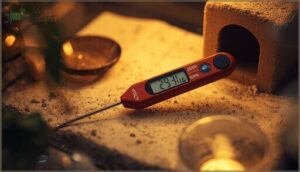
Not all thermometers deliver the precision you need when a quarantined snake’s immune system hangs in the balance. The right device combines accuracy, probe design, and real-world usability to catch temperature drift before it compromises recovery.
Here’s what separates reliable quarantine thermometers from hardware that introduces more risk than reassurance.
Temperature Accuracy and Reliability
A digital thermometer with stated accuracy of ±1 °F or ±1 °C provides reliable temperature gradients essential for quarantine. Analog dials often drift 5–7 °F under low wattage, risking thermal stress.
You’ll want digital readouts verified through sensor calibration against ice water at 32 °F, because probe accuracy determines whether temperature fluctuation stays within safe limits or compromises immune response when your snake can’t afford additional stressors.
Dual Temperature and Humidity Sensors
A reptile thermometer with integrated humidity sensors—accuracy standards near ±5% RH—tracks concurrent moisture levels that rise when thermal gradients fail, because elevated enclosure temperatures naturally suppress relative humidity. Probe materials like stainless steel resist corrosion during disinfection cycles, while wireless connectivity and data logging capture overnight fluctuations invisible during manual checks.
You’ll verify humidity control alongside temperature gradients, preventing respiratory complications when immunosuppressed snakes can’t compensate for environmental errors.
Display Readability and Size
You need rapid visual confirmation of thermal parameters when handling multiple quarantine enclosures. Digit size—0.75-inch LCD numerals on most reptile thermometers versus laboratory displays readable at 15 meters—determines whether you’ll catch a heating failure during routine checks.
Screen resolution, viewing angle, and display clarity affect readability through glass. Backlit digital thermometer models with high-contrast LCDs prevent interpretation errors in dimly lit reptile rooms, where temperature monitoring mistakes compromise immunosuppressed snakes.
Probe Placement and Cable Length
Standard 10-foot probe cables (3 meters) let you position sensor placement at snake level—floor substrate for terrestrial species, mid-height perches for arboreals—while keeping digital thermometer displays outside quarantine tubs for contamination control.
Secure probes with cable ties at warm and cool ends to track thermal gradients accurately; loose wire routing permits dislodgement, compromising probe accuracy and risking unmonitored hotspots.
Thermometer calibration and cable management directly prevent temperature monitoring failures during immunosuppression windows.
Power Source and Battery Life
CR2032 lithium coin cells power most compact digital thermometers for 1–5 years, depending on backlight use and wireless features—Bluetooth transmission drains batteries faster than passive LCDs.
AA alkaline thermometers deliver roughly 12 months of continuous temperature monitoring before replacement.
Rechargeable USB models eliminate battery swaps but require charging cycles; maintain spare coin cells stored airtight to preserve capacity during critical quarantine intervals and power outages.
Types of Thermometers for Quarantine Setups
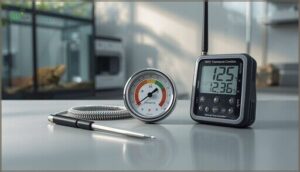
You’ll find three main categories of thermometers suited to quarantine work—each with distinct accuracy profiles, ease of sanitation, and placement flexibility that affect your ability to catch thermal drift before it compromises a stressed animal. Digital models dominate veterinary and research quarantine protocols due to their precision (±1°F) and external probes, but analog dials and wireless hygrometer combos still fill niche roles in multi-enclosure setups.
Below, I’ll walk you through digital versus analog trade-offs, integrated hygrometers for dual monitoring, and external probe configurations that let you verify temperatures without disturbing newly translocated snakes.
Digital Vs. Analog Thermometers
You’ll face a straightforward choice between digital and analog models. Electronic thermometers resolve to 0.1°F with consistent reading accuracy, eliminating parallax errors inherent to dial gauges, while analog limitations include slower sensor response and drift beyond ±1°C tolerances over time.
For quarantine setups requiring precise temperature monitoring and reliable thermometer calibration, digital accuracy via LCD display and modern sensor technology outperforms mechanical alternatives in both measurement precision and data retention.
Integrated Hygrometers for Humidity Tracking
Dual-sensor units combine temperature monitoring and humidity control in one digital thermometer hygrometer, essential for quarantine enclosures where environmental monitoring demands concurrent tracking of microclimate control parameters.
Most reptile thermometer models offer independent sensors—temperature gradients measured via probe, relative humidity via internal hygrometer—enabling you to verify whether conditions remain within species-specific ranges.
Hygrometer calibration against known references ensures measurement accuracy when analog units would drift by 10 percentage points.
External Probes and Wireless Options
Wireless probe systems transmit readings via Bluetooth Low Energy or RF, with typical ranges reaching 30 meters. This allows you to monitor multiple quarantine tubs without the cable clutter that can harbor pathogens.
External sensors positioned at substrate level reduce enclosure disturbance during checks. However, signal interference inside dense vivaria demands buffer memory for data logging.
Probe calibration against known references confirms that wireless options deliver the ±1°F accuracy quarantine animals require.
Best Practices for Thermometer Placement
Probe placement determines whether your quarantine thermometer delivers accurate data or misleading numbers that compromise thermal control during a snake’s most vulnerable days. You’ll need to position sensors at substrate level—not mid-air or against glass—while accounting for gradient zones, cable routing, and the risk of curious snakes dislodging equipment.
Here’s how to set up your thermometers for reliable monitoring in simplified quarantine enclosures.
Positioning Probes at Snake Level
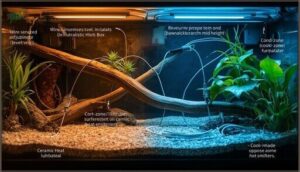
Probe placement determines whether your thermometer reports fiction or fact—only sensors positioned at snake level reveal the microclimate your animal actually experiences. Enclosure design demands thermometer probes aligned with basking heights, hide interiors, and substrate surfaces where reptiles rest, not mid-air or against glass where readings misrepresent thermal gradients and basking spots:
- Fix probes inside warm hides at substrate level for ball pythons and terrestrial species
- Attach sensors to basking branches at perch height in arboreal setups
- Place cool-side probes on substrate opposite heat sources to define gradient endpoints
- Secure probes with zip ties or adhesive clips to prevent displacement during cleaning
- Avoid burying sensors in substrate—insulation skews surface temperature readings upward
Monitoring Warm and Cool Zones
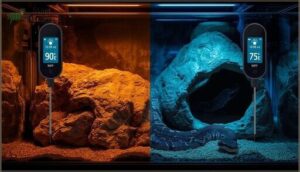
Once you know where probes belong, install dedicated sensors in both thermal zones—warm basking spots and cool retreats—to map the gradient your snake navigates daily.
Temperature gradients define microclimate control: thermal mapping with separate thermometers confirms heat distribution across basking spots and thermal management in cool zones, preventing the stress spikes that immunosuppression triggers during quarantine’s first 72 hours.
Preventing Probe Dislodgement
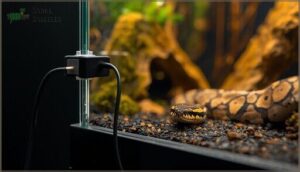
Snakes will dislodge unanchored probes—daily movement across hides and substrate can shift sensors 5–10 cm overnight, invalidating your thermal gradients.
Secure thermometer probes with medical-grade heat-shrink tubing or silicone adhesive at enclosure entry points, position sensor placement at snake level with a shallow bend away from travel paths, and reinforce micro-cables with strain relief to absorb tugging during quarantine handling.
Cable Management and Safety
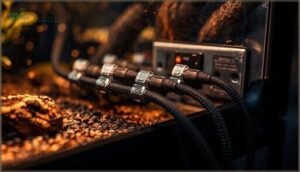
Beyond dislodgement, loose thermometer probes create electrical safety risks. Route cables outside enclosures to prevent chewing injuries, secure them with braided sleeving or heat-shrink tubing for cord protection, and avoid overloading circuits with clustered heat management devices that exceed 1320 watts per 15-amp line.
Proper wire organization of reptile thermometer cables prevents fire hazards while maintaining your thermal gradients during quarantine temperature management.
Sanitation and Biosecurity in Quarantine

Quarantine protocols fail when pathogens hitch a ride on the tools you trust—thermometers included. You can’t scrub away disease risk with wishful thinking; every probe, sensor, and display surface that enters an isolation enclosure becomes a potential vector for cross-contamination.
Here’s how to lock down your biosecurity without sacrificing the precision monitoring that keeps immunocompromised snakes alive.
Dedicated Thermometers for Each Enclosure
You’ll need a dedicated reptile thermometer for each enclosure—thermal isolation prevents cross-contamination and thermal lag in quarantined animals. Independent digital thermometer probes enable precise microclimate control and sensor calibration per tank, simplifying device redundancy workflows and enclosure monitoring.
Multi-tank reptile keeping demands individual thermometer probes to track microclimates accurately, supporting reptile temperature management and clearer biosecurity audits without shared instruments risking pathogen transfer.
Cleaning and Disinfecting Protocols
Your reptile thermometer and hygrometer must undergo routine equipment sterilization between quarantine rotations—probe sanitation directly impacts biosecurity measures and reptile care outcomes. Proper disinfectant selection and cleaning frequency prevent pathogen persistence on temperature-monitoring devices.
- Remove organic debris with hot soapy water before applying disinfectant
- Use F10SC (1:250 general, 1:100 high-risk) or 10% chlorhexidine on probe surfaces
- Maintain 10-minute wet contact time for bleach solutions at ≤10% concentration
- Rinse bleach thoroughly; F10 and chlorhexidine require no rinsing
- Air-dry completely before reinstalling probes into enclosures
Dedicated cleaning tools for quarantine thermometers reduce cross-transmission risk in reptile temperature management protocols.
Preventing Cross-contamination
Your quarantine thermometer touches high-risk surfaces daily. Strict biosecurity protocols and equipment isolation prevent fomite-mediated pathogen transfer between enclosures. Implementing spatial segregation, dedicated probe sanitation, and hand hygiene workflows protects your entire collection from disease spread during environmental monitoring.
| Biosecurity Measure | Implementation | Pathogen Risk Reduction |
|---|---|---|
| Equipment Isolation | Dedicated digital thermometer per enclosure | Eliminates shared-tool transmission |
| Hand Hygiene | Glove changes between enclosures | Blocks skin-mediated transfer |
| Spatial Segregation | Quarantine-room storage only | Prevents clean-area contamination |
| Workflow Control | Service healthy animals first | Minimizes high-to-low risk contact |
Thermometer selection and use must account for disinfection frequency. Choose models with sealed probes and non-porous housings that withstand F10SC or chlorhexidine without degradation. Reptile health depends on maintaining these separation barriers throughout daily temperature checks and reptile thermometer handling.
Integrating Thermometers With Heating Systems
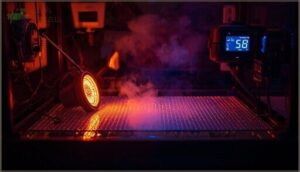
Your thermostat controls heat output, but only an independent thermometer confirms what your snake actually experiences—that separation prevents reliance on a single point of failure.
Unregulated heat mats and ceramic emitters can spike beyond safe thresholds locally, so you’ll need external verification through digital probes or infrared guns to catch those hotspots before they cause thermal burns.
Power outages and equipment malfunctions happen without warning, making redundant monitoring non-negotiable during the immunosuppressed quarantine window.
Using Thermostats and Thermometers Together
Your thermostat controls heat output, but you need an independent reptile thermometer for temperature verification—relying on thermostat readouts alone masks dangerous hotspot errors.
Position the thermostat sensor at your heat source while placing separate digital probe thermometers at snake level in warm and cool zones; this dual-sensor placement reveals gradients the thermostat misses, supporting precise thermal calibration and gradient control that prevents burns and stress during quarantine.
Verifying Hotspot and Ambient Temperatures
Surface hotspot verification with an infrared thermometer gun confirms that your basking slate stays at 30–32°C, while digital thermometer probes track ambient air gradients from the high 20s°C cool side to low 30s°C warm side—cross-checking thermostat settings against independent measurements prevents localized overheating and guarantees proper heat gradient thermal profiling for effective reptile temperature control.
- Position digital thermometer probes one inch above substrate on both warm and cool sides for accurate ambient monitoring
- Scan basking surfaces with your infrared gun at multiple points—uneven heating creates dangerous hot spots exceeding 35°C even when average readings appear safe
- Compare thermostat display values to independent digital thermometer and infrared gun data until hotspot verification confirms stable 30–32°C surface equilibrium
- Recheck temperature calibration after changing bulb wattage, enclosure configuration, or room conditions—these variables shift the relationship between thermostat set points and actual thermal distribution over time
Monitoring During Power Outages and Equipment Failures
Battery-powered digital thermometers with wireless alerts serve as your first line of defense when mains power fails—Lascar EL-WiFi DTC loggers run for two years on batteries, email you when temperatures drop below species-specific thresholds, and track thermal decay rates as enclosures cool. Position devices at warm and cool ends for failure detection, verify auxiliary heat-pack outputs with infrared guns, and delay feeding until your reptile thermometer confirms 24-hour thermal recovery post-outage.
| Outage Scenario | Emergency Heating Method | Thermometer Role |
|---|---|---|
| 6–12 hour power loss, room 13–18°C | Blanket wrap + warm water bottles near enclosure | Monitor cool-side drift; confirm >13°C minimum |
| Extended outage, room 35°C burns | ||
| Equipment failure, one heat source offline | Backup ceramic emitter on separate circuit | Track asymmetric gradient collapse; detect single-side loss |
| Generator power quality issues | Confirm thermostat reboot and setpoint retention | Independent digital thermometer verifies actual output vs display |
| Quarantine tub during transport or relocation stress | Insulated container + monitored heat pack | Continuous data logger preserves 72-hour thermal record |
Top 10 Snake Thermometers for Quarantine
The following units represent field-tested options that balance accuracy, durability, and practical utility in quarantine contexts—each selected for specific performance characteristics rather than brand recognition alone.
You’ll find dedicated dual-sensor models with external probes, compact stick-on units for space-limited tubs, and wireless systems that allow remote monitoring without opening enclosures.
These recommendations prioritize ±1°F precision, probe cable length of 1+ meters, and features that support biosecurity protocols during the critical 72-hour post-acquisition window.
1. Reptile Thermometer Humidity Gauge
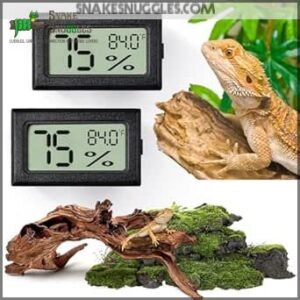
You’ll want a device that delivers ±0.9°F sensor accuracy when newly relocated snakes can’t afford thermal guesswork—the Vodolo dual-probe digital thermometer hygrometer tracks both temperature gradients and humidity control simultaneously across warm and cool zones.
Its LED digital display reads clearly in dim quarantine rooms, cordless adhesive mounting prevents cable tangles, and the integrated hygrometer eliminates the need for separate moisture monitors.
Battery-powered reliability ensures temperature and humidity control persists during equipment checks, while thermometer calibration against infrared guns confirms readings stay within reptile temperature control tolerances.
| Best For | Reptile keepers who need to monitor both temperature and humidity in quarantine enclosures or multi-zone terrariums where accurate readings across warm and cool spots are essential for newly relocated snakes, bearded dragons, geckos, and other sensitive species. |
|---|---|
| Temperature Accuracy | ±0.9°F |
| Humidity Accuracy | Not specified |
| Display Type | Digital LED |
| Power Source | Battery |
| Mounting Method | Double-sided adhesive |
| Unit Count | 2 |
| Additional Features |
|
- High-precision 0.9°F accuracy and clear LED display make it easy to verify temperature gradients and humidity levels even in dimly lit quarantine setups.
- Cordless adhesive mounting and compact design allow flexible placement inside or outside the enclosure without dealing with messy wires or drilling holes.
- Battery-powered operation with replaceable batteries ensures continuous monitoring during power outages or equipment maintenance, plus you get two units in the package for monitoring multiple zones.
- Water-resistant but not waterproof, so direct spray or submersion can damage the unit—requires careful placement away from misters or water bowls.
- Some users reported inaccurate temperature readings over time, and the adhesive may lose grip in high-humidity environments, causing the thermometer to fall.
- Battery replacement will be needed eventually, and there’s no low-battery warning mentioned in the specs, so you might get unexpected dead readings if you don’t track battery life.
2. Mini Digital Hygrometer Thermometer
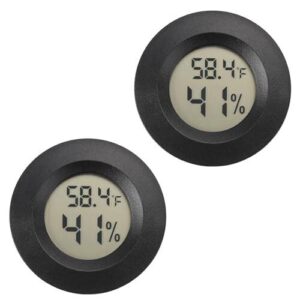
Embedded panel designs measuring 48 × 28.6 mm fit cleanly into tub-style quarantine lids without interfering with animal space. The generic mini digital hygrometer thermometer delivers ±1°F temperature control and ±5% humidity control through rapid 10-second refresh cycles that catch dangerous swings before immunocompromised animals decompensate.
Digital displays convert between Celsius and Fahrenheit on demand, and the LR44 button-cell battery lifespan extends 6–9 months under continuous operation. Sensor calibration against infrared guns validates readings at snake level, where reptile thermometer accuracy matters most during the critical 72-hour quarantine window.
| Best For | Reptile keepers managing quarantine enclosures or multiple terrariums who need affordable, accurate monitoring without sacrificing cage space. |
|---|---|
| Temperature Accuracy | ±1°F |
| Humidity Accuracy | ±3%RH |
| Display Type | Digital |
| Power Source | LR44 button cell |
| Mounting Method | Sticky pads |
| Unit Count | Not specified |
| Additional Features |
|
- Fast 10-second refresh rate catches temperature and humidity swings before they stress vulnerable animals during quarantine periods.
- Compact 48 × 28.6 mm panel-mount design installs flush in tub lids without taking up valuable enclosure space or creating obstacles.
- Celsius/Fahrenheit toggle and ±1°F accuracy let you validate readings against infrared guns at animal level where precision matters most.
- Small LCD screen can be difficult to read for users with vision problems, especially in low-light conditions.
- Button-cell battery lasts only 6–9 months under continuous use, requiring more frequent replacement than AA or lithium coin-cell models.
- ±5% humidity accuracy trails higher-end models, which may be a concern for species requiring tight humidity control like chameleons or dart frogs.
3. Paizoo Reptile Thermometer Hygrometer
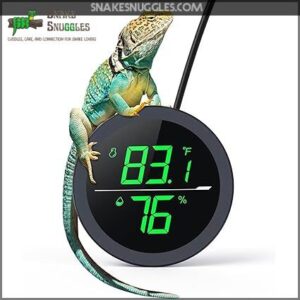
USB-powered units like the PAIZOO eliminate mid-quarantine battery failures. A 2.56-inch HD LED display with continuous power ensures thermal readings remain stable when newly translocated snakes need uninterrupted monitoring most.
The integrated hygrometer tracks humidity alongside temperature control, and sensor accuracy within ±1°F guides precise reptile care during immunosuppressive quarantine phases. Digital displays toggle Celsius–Fahrenheit readings, while mounting options include 3M double-sided tape for acrylic surfaces in tub setups.
Power efficiency through USB connection enables thermometer calibration routines without mid-cycle interruptions that compromise digital thermometer reliability.
| Best For | Reptile owners who need reliable, continuous temperature and humidity monitoring without worrying about dead batteries during critical quarantine periods. |
|---|---|
| Temperature Accuracy | Not specified |
| Humidity Accuracy | Not specified |
| Display Type | Digital LED |
| Power Source | USB |
| Mounting Method | 3M double-sided tape |
| Unit Count | 1 |
| Additional Features |
|
- USB-powered design eliminates battery replacement hassles and keeps readings stable when constant monitoring matters most
- Clear HD LED display shows both temperature (±1°F accuracy) and humidity at a glance, with easy Celsius-Fahrenheit switching
- Compact 2.56-inch size and included 3M tape make it simple to mount in tight spaces like tub setups
- Multiple users report the humidity sensor can give inaccurate readings over time
- Needs access to a USB outlet, which limits placement options in some enclosures
- Some units reportedly fail after just a few weeks or months of use
4. Oasirep Reptile Thermometer Hygrometer
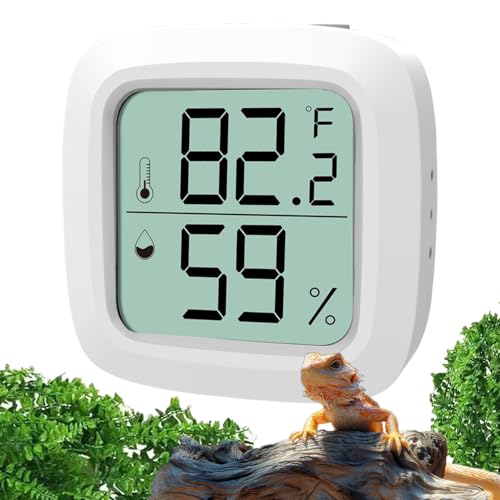
The Oasirep’s twelve-month battery life from a single CR2032 coin cell sets it apart from quarantine devices that require mid-cycle replacements. This is especially critical when stressed snakes demand stable temperature control without handler disturbances.
The compact design mounts via double-sided adhesive inside glass or acrylic tubs, placing the digital thermometer and integrated hygrometer at snake level for accurate microclimate readings.
Sensor accuracy within ±1.8°F and ±5% RH enables eco-friendly reptile care protocols. However, the non-waterproof housing requires placement away from misting zones where device calibration could drift.
| Best For | Snake keepers who need reliable long-term monitoring during quarantine periods without frequent battery changes or enclosure disturbances. |
|---|---|
| Temperature Accuracy | ±1.8°F |
| Humidity Accuracy | ±5%RH |
| Display Type | Digital LCD |
| Power Source | CR2032 battery |
| Mounting Method | Double-sided adhesive |
| Unit Count | 1 |
| Additional Features |
|
- Twelve-month battery life from a single CR2032 coin cell means fewer mid-quarantine interruptions when handling stressed animals.
- Mounts at snake level with adhesive backing to capture accurate microclimate data where your reptile actually lives, not just ambient room conditions.
- Dual readouts for temperature (±1.8°F accuracy) and humidity (±5% RH) give you complete environmental control in one compact unit.
- Non-waterproof housing limits placement options in high-humidity setups or near misting systems where moisture could damage electronics.
- Double-sided adhesive pad may be tricky to reposition once stuck, and some users report unclear installation diagrams.
- ABS plastic construction, while lightweight, may not hold up as well as metal-bodied alternatives in very warm basking zones.
5. Digital Reptile Thermometer Hygrometer
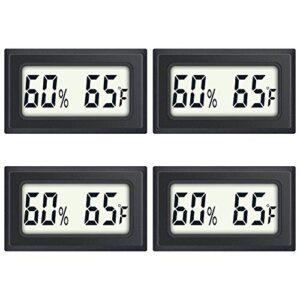
This general-purpose digital thermometer and hygrometer delivers a −10 to 50°C indoor range (14–122°F) with an external probe extending to −50 to 70°C (−58–158°F)—critical when monitoring both ambient quarantine conditions and surface hotspots where basking snakes rest.
Temperature control accuracy of ±1°C and humidity control within ±5% RH facilitates routine accuracy testing without frequent sensor recalibration.
The dual-zone sensor technology lets you track enclosure gradients through a single digital display, streamlining reptile care protocols while maintaining the precision quarantine biosecurity demands.
| Best For | Reptile keepers running quarantine setups who need to monitor both ambient cage temperature and specific basking spot heat with a single dual-probe unit. |
|---|---|
| Temperature Accuracy | ±2°F |
| Humidity Accuracy | ±2%RH |
| Display Type | Digital |
| Power Source | Battery |
| Mounting Method | Embedded or tape |
| Unit Count | 4 |
| Additional Features |
|
- Wide temperature range (−50 to 70°C on external probe) covers everything from cool hides to hot basking surfaces
- Dual-zone monitoring through one display saves space and simplifies gradient tracking in smaller enclosures
- ±1°C accuracy holds up well enough for routine quarantine checks without constant recalibration
- ±5% RH humidity variance means you might miss subtle moisture shifts that matter during shed cycles
- Indoor sensor maxes out at 50°C, so you can’t use it to verify ceramic heat emitter output in high-temp zones
- No mention of min/max recording or alarms, unlike some competitors that flag dangerous swings automatically
6. Repti Zoo Reptile Thermometer Hygrometer Gauge
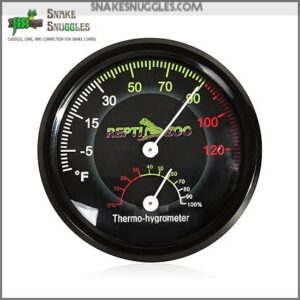
You’ll find this Reptile Thermometer brings quarantine-specific advantages to biosecurity-focused setups. The Repti Zoo digital thermometer hygrometer gauge combines a 14–122°F range with ±2°F temperature accuracy and ±5% RH humidity precision—measurements that align with immunosuppressed snake monitoring during the critical first 72 hours post-relocation.
The suction-cup mount places sensors at snake level in simple tubs without adhesive residue, supporting strict equipment isolation protocols.
Two included LR1130 batteries provide over one year of continuous monitoring, ensuring reliable temperature control and sensor calibration throughout extended quarantine periods without frequent device replacement.
| Best For | Reptile keepers who need reliable temperature and humidity monitoring in quarantine setups without the hassle of frequent battery changes or complicated installation. |
|---|---|
| Temperature Accuracy | Not specified |
| Humidity Accuracy | Not specified |
| Display Type | Analog |
| Power Source | None required |
| Mounting Method | Sticky pad |
| Unit Count | 1 |
| Additional Features |
|
- Accurate dual sensing with ±2°F temperature and ±5% humidity precision, updating every 5 seconds to catch environmental shifts quickly
- Strong suction cup mount lets you reposition the gauge easily without leaving sticky residue on quarantine tubs or glass
- Year-long battery life from two included button cells means you won’t need replacements during extended isolation periods
- Fahrenheit-only display won’t work for keepers who prefer Celsius readings
- Some users report accuracy concerns, especially compared to higher-end digital tools or thermal guns
- Lacks removable velcro backing, so you’re stuck with suction cup mounting only
7. SunGrow Reptile Thermometer Hygrometer
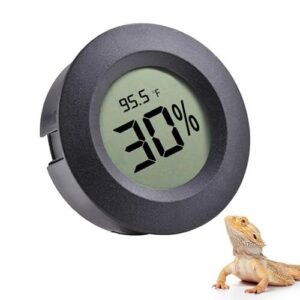
The SunGrow reptile thermometer hygrometer delivers -58 to 158°F monitoring with 0.1° resolution—sensor accuracy sufficient for detecting subtle thermal shifts in quarantine tubs where small temperature errors affect the entire usable space.
This digital thermometer incorporates dual temperature control and humidity tracking (10–99% RH, ±5%) through a compact 1.8×1.8×0.6″ housing with adhesive mounting options that secure digital displays to enclosure walls without obstructing immunosuppressed animals.
The pre-installed LR44 button cell ensures multi-month battery efficiency during continuous reptile care monitoring, though device calibration against infrared guns verifies hygrometer performance in high-humidity microhabitats.
| Best For | Hobbyists who need affordable dual monitoring in small quarantine enclosures where compact size and fast 10-second updates matter more than long-term durability. |
|---|---|
| Temperature Accuracy | Not specified |
| Humidity Accuracy | 1% resolution |
| Display Type | Digital |
| Power Source | LR44 battery |
| Mounting Method | Not specified |
| Unit Count | 1 |
| Additional Features |
|
- Wide temperature range (-58 to 158°F) with 0.1° resolution catches subtle thermal shifts that affect stressed or sick reptiles in tight quarantine spaces.
- Compact 1.8″ housing with adhesive mount fits small tubs without blocking the animal, while the digital display stays readable from outside the enclosure.
- Pre-installed battery and simple ℉/℃ switching get you monitoring immediately, with multi-month operation before replacement is needed.
- Battery life averages around 2 weeks according to user reports, requiring more frequent replacements than competing models.
- Durability concerns include reported internal corrosion and adhesive failure in high-humidity setups, limiting reliability for long-term tropical installations.
- ±5% humidity accuracy and occasional early device failures mean you may need backup gauges to verify readings during critical quarantine periods.
8. Weewooday Reptile Thermometer Hygrometer
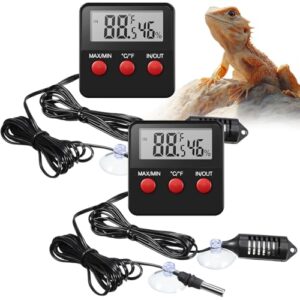
The Weewooday reptile thermometer hygrometer monitors -50 to 70°C (-58 to 158°F) across 1.5-meter probes. This cable length allows digital displays to be placed outside snake enclosures while maintaining sensor accuracy at basking-spot microclimates, where thermometer placement determines detection of local overheating.
This dual-probe design tracks separate thermal zones with 10–95% RH humidity control through memory functions recording maximum and minimum readings. Probe calibration against infrared guns verifies hygrometer performance in quarantine tubs.
Single AAA battery operation enables multi-month reptile care monitoring without mains-power dependency during equipment failures.
| Best For | Reptile keepers who need affordable, basic temperature and humidity monitoring across different zones in terrariums, incubators, or snake enclosures without requiring lab-grade precision. |
|---|---|
| Temperature Accuracy | Not specified |
| Humidity Accuracy | Not specified |
| Display Type | Digital |
| Power Source | AAA battery |
| Mounting Method | Clip and magnetic |
| Unit Count | 1 |
| Additional Features |
|
- The 1.5-meter probe cable lets you place the display outside the enclosure while monitoring specific microclimates like basking spots or cool zones inside
- Memory function tracks max and min readings so you can catch temperature spikes or humidity drops even when you’re not watching
- Runs on a single AAA battery for months, keeping your monitoring going even during power outages
- Accuracy issues reported by some users, especially at certain temperature and humidity ranges
- No backlight makes it tough to read the display in dim conditions or at night
- Suction cups don’t stick well according to user feedback, limiting mounting options
9. Repti Zoo Digital Thermometer Hygrometer
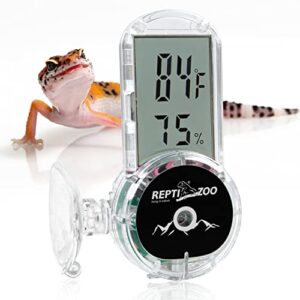
The Repti Zoo digital thermometer hygrometer measures 14–122°F with ±2°F sensor accuracy, while its dual LCD displays track 20–99% RH humidity—critical parameters you’ll monitor during quarantine’s immune-suppressive first 72 hours.
Five-second sampling intervals update readings continuously, though suction-cup mounting options may fail in high-humidity setups where glass condensation weakens adhesion.
Two LR1130 button cells deliver a 12-month battery lifespan, eliminating mains-power dependency.
Probe-equipped variants extend 900-millimeter cables across thermal gradients, enabling remote hotspot verification against your thermostat’s control point for reptile temperature control precision.
| Best For | Reptile owners who need affordable dual monitoring of temperature and humidity in vivariums, brooders, or terrariums where accurate environmental tracking supports healthy captive conditions. |
|---|---|
| Temperature Accuracy | Not specified |
| Humidity Accuracy | Not specified |
| Display Type | Digital LCD |
| Power Source | Battery |
| Mounting Method | 4-sides mounting |
| Unit Count | 1 |
| Additional Features |
|
- Five-second sampling updates give you real-time temperature (14–122°F) and humidity (20–99%) readings on a clear dual LCD display
- Year-long battery life from two included LR1130 cells means no outlet dependency or frequent replacements
- Probe-equipped models offer 900mm cables for remote hotspot verification across thermal gradients in larger enclosures
- Suction cup mounting often fails in high-humidity setups when glass condensation weakens adhesion
- ±2°F temperature accuracy may not meet precision needs for species requiring tight thermal regulation
- Some users report the LCD becomes hard to read without backlighting, especially in dimly lit enclosure areas
10. Reptispa Digital Thermometer Hygrometer
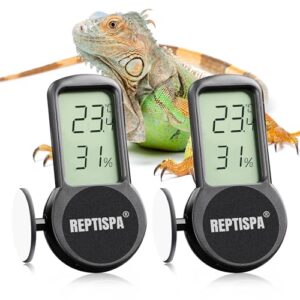
The Reptispa digital thermometer hygrometer delivers a −4 to 140°F range with ±1.8°F accuracy—tighter tolerances than many entry-level reptile thermometers—while its dual LCD tracks 10–99% RH humidity across ten-second update cycles.
Two-pack configuration gives you dedicated devices per quarantine enclosure, preventing cross-contamination without sensor-sharing risks.
Compact plastic housing mounts via suction cups for probe placement at snake level, though display readability suffers in dim lighting conditions where power efficiency from button-cell operation extends multi-year battery lifespan without requiring device calibration against reference standards.
| Best For | Snake keepers running multiple quarantine enclosures who need affordable, dedicated monitoring in each setup without sharing probes between potentially infected animals. |
|---|---|
| Temperature Accuracy | ±1.8°F |
| Humidity Accuracy | ±5%RH |
| Display Type | Digital LCD |
| Power Source | Battery |
| Mounting Method | 360° angle adjustment |
| Unit Count | 2 |
| Additional Features |
|
- Two-pack configuration lets you assign one monitor per enclosure, eliminating cross-contamination risks from moving shared sensors between quarantine bins.
- Tighter ±1.8°F temperature accuracy outperforms typical analog gauges, helping you catch subtle environmental shifts that might stress immune-compromised snakes.
- Multi-year button-cell battery life means you won’t scramble for replacements mid-quarantine when observation consistency matters most.
- Dim LCD becomes hard to read in low-light conditions, forcing you to use a flashlight during evening checks or risk missing critical readings.
- Some users report slow humidity response times, so sudden spikes from misting or water-bowl refills may not register immediately on the display.
- Suction cups can fail on textured plastic tubs, leaving the unit lying on substrate where snakes may knock it around or bury it.
Tips for Reliable Temperature Monitoring
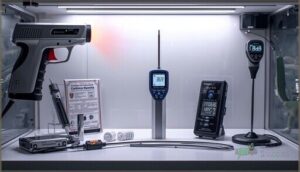
Even the most accurate thermometer won’t protect your quarantined snake if you’re not using it correctly—calibration drift, dead batteries, and poor probe placement create blind spots that can compromise your entire monitoring system.
You need consistent verification protocols, redundancy for critical enclosures, and efficient daily workflows that catch temperature excursions before they affect immunosuppressed animals.
Here’s how to maintain reliable thermal oversight throughout the quarantine period.
Regularly Checking Thermometer Accuracy
Periodically verify your reptile thermometer against a 0 °C ice bath—crushed ice, cold water, and a five-minute stabilization window—to catch temperature drift before it compromises quarantine conditions.
Digital thermometer technology can shift ±2–3 °F over months, especially after drops or heavy use, so cross-check readings with an infrared gun and document calibration methods, error analysis, and any adjustments to maintain accuracy standards against your thermostat’s setpoints.
Maintaining Backup Devices
Once you’ve confirmed your primary thermometer reads true, keep a second calibrated unit on hand—power failures, probe malfunctions, and battery deaths don’t wait for business hours, and a quarantined snake can’t afford the six-to-twelve-hour gap while you order replacements online.
Device redundancy means maintaining spare equipment alongside backup power for thermostats and heat management, ensuring failover plans preserve temperature control during outages or digital thermometer failures.
Streamlining Daily Temperature Checks
Backup devices stand ready—now standardize your temperature logging routines so quarantine rounds take seconds, not minutes. Min-max digital thermometers capture overnight highs and lows in a single glance, automated alerts from WiFi-enabled loggers notify you of excursions before they become crises, and remote monitoring via smartphone dashboards lets you confirm every enclosure’s thermal gradient without opening a single tub or disturbing immunocompromised animals during their critical first seventy-two hours.
Frequently Asked Questions (FAQs)
Where to put a thermometer in a snake enclosure?
Position your reptile thermometer probe at snake level—one on the basking surface beneath heat sources, another at the cool end on substrate—avoiding direct contact with heat mats or glass to capture accurate microclimate monitoring data.
How to quarantine a snake?
To minimize disease risk while acclimating a new arrival, isolate your snake in dedicated quarantine tanks for 30–90 days.
Maintain species-specific thermal gradients, monitor reptile health daily, and use separate equipment to prevent pathogen transmission.
What is the best hygrometer for reptiles?
The best hygrometer for reptiles combines ±2–3% humidity sensors with ±5°F temperature control, fast refresh rates under 10 seconds, and data logging.
Govee H5075 and SensorPush HT.w deliver clinical-grade environmental monitoring for demanding terrarium maintenance.
Are cheap digital hygrometers accurate?
Like a compass that’s lost true north, most budget hygrometers drift ±5–10% without sensor calibration. This is acceptable for general humidity tracking but unreliable for precise reptile thermometer setups. In such cases, temperature and humidity variance directly impacts digital thermostat accuracy testing.
How often should I replace thermometer batteries?
Replace batteries in your reptile digital thermometer every 6 to 12 months under typical use. CR2032 cells powering continuous displays drain faster than shelf estimates suggest, and low voltage causes drift before complete failure.
Can infrared guns replace traditional probe thermometers?
Picture a watchtower—you spot fires but miss the wind’s subtle shifts. Infrared guns excel at surface checks, yet for reliable Reptile Temperature control and ongoing Thermal Monitoring, only probe placement provides lasting accuracy and true enclosure safety.
Whats the ideal quarantine enclosure temperature range?
Most quarantine enclosures require a thermal gradient between 75–90 °F, with warm zones around 85–88 °F and cool refuges near 75–80 °F. Species variations demand precise temperature control to support immune function and stress reduction.
Should I use separate thermometers for transport?
Transport safety demands its own thermal monitoring. Insulated carriers create microclimates that differ from room readings, so dedicated reptile thermometers verify biosecurity measures and temperature control without disrupting your quarantine enclosure’s digital thermometer or thermostat probe.
Do thermometers need calibration after disinfection?
Standard wipe-down disinfection won’t shift calibration—manufacturer intervals (usually annual) matter more than cleaning frequency.
Harsh chemicals, liquid ingress, or repeated soaking can cause temperature drift, so verify accuracy against a reference thermometer after aggressive disinfection or suspected sensor damage.
Conclusion
A single degree becomes a lifeline when stress and pathogens converge—quarantine isn’t just isolation, it’s immune triage conducted in tenths of a Fahrenheit. Snake thermometers for quarantine setups transform guesswork into measurable control, anchoring recovery in the thermal precision that sustains digestion, antibody production, and survival itself.
Probe placement, ±1°F accuracy, and dedicated devices per enclosure aren’t perfectionism—they’re the infrastructure that separates successful acclimation from preventable loss. Your thermometer choice dictates outcomes before symptoms ever surface.
- https://wpvet.com/exotic-pets-care-guides/corn-and-rat-snakes/
- https://wildwoodvet.com/carnivorous-reptiles-snakes-monitors/
- https://thetyedyediguana.com/blog/the-72hour-survival-protocol-of-newly-translocated-reptiles/
- https://www.petsmart.com/learning-center/reptile-care/reptile-supplies-checklist
- https://www.merckvetmanual.com/exotic-and-laboratory-animals/reptiles/management-and-husbandry-of-reptiles