This site is supported by our readers. We may earn a commission, at no cost to you, if you purchase through links.
A reptile thriving under the wrong UVB setup doesn’t always show it—until metabolic bone disease does the talking.
For large terrariums, the stakes climb higher because fixture coverage gaps, weak output at distance, and mismatched UVB percentages can leave your animal chronically deficient despite having a light overhead. The difference between a 24-inch and 48-inch T5 HO fixture isn’t cosmetic—it’s the difference between a basking zone and a UV-dead zone.
Choosing the right UVB lighting systems for large terrariums means matching output strength, beam angle, and species-specific Ferguson Zone requirements to every square inch of that enclosure.
Table Of Contents
- Key Takeaways
- Top 9 UVB Lighting Systems for Large Terrariums
- 1. LuminPacific Reptile UVB Light
- 2. Repti Zoo T5 UVB Lighting Kit
- T5 HO 10.0 UVB Reptile Light
- 3. T5 UVB Reptile Light Fixture Kit
- 4. Hygger Reptile Light Fixture Combo Kit
- 5. Reptile UVB Light Fixture Combo Kit
- 6. Reptile UVB Light Fixture
- 7. Repti Zoo Dual Reptile Light Fixture
- 8. Reptile Systems Eco T5 Lighting Kit
- Choosing The Right UVB System Size
- UVB Bulb Types and Replacement Schedule
- Ferguson Zones and UVB Needs by Species
- Installation and Maintenance for Large Setups
- Pairing UVB With Heat and Visible Light Sources
- Monitoring and Verifying UVB Levels Over Time
- Frequently Asked Questions (FAQs)
- What size UVB do I need for a 40 gallon tank?
- What is the best light for a bioactive terrarium?
- Should UVB cover the whole enclosure?
- Is UV light the same as UVB light?
- Should UVB cover the whole terrarium?
- What size UVB bulb for a 20 gallon tank?
- Can a reptile have too much UVB?
- Is a basking light the same as an UVB light?
- Can UVB penetrate mesh or screen tops effectively?
- Do live plants block UVB for basking reptiles?
- Conclusion
Key Takeaways
- Matching your UVB fixture length to at least two-thirds of your enclosure prevents the UV dead zones that quietly cause metabolic bone disease before you notice anything’s wrong.
- T5 HO tubes can lose 30–50% of their UVB output while still glowing bright, so monthly meter checks — not your eyes — are the only reliable way to know your reptile is actually getting what it needs.
- Your reptile’s Ferguson Zone determines everything about UVB percentage choice, from 2.4% for shade dwellers all the way up to 10% for desert baskers — getting this wrong means poor appetite and weak bones no matter how good your fixture is.
- Running separate UVB and heat sources gives you independent control over every zone in a large terrarium, so you can swap a fading bulb, adjust a basking temp, or go lights-out at night without throwing the whole setup off balance.
Top 9 UVB Lighting Systems for Large Terrariums
Finding the right UVB lighting for a large terrarium can make or break your reptile’s long-term health.
If you’re starting with something smaller, this guide to UVB lighting systems for small enclosures is a great place to build your foundational knowledge before scaling up.
These nine systems cover a solid range of needs, from shade-dwellers to intense sun baskers. Here’s what made the cut for 2026.
1. LuminPacific Reptile UVB Light
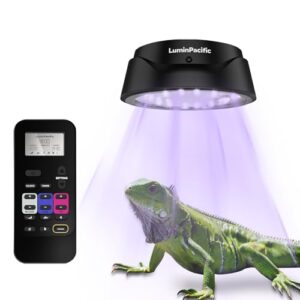
The LuminPacific Reptile UVB Light brings LED strip technology to large terrariums, giving you a slim, lightweight fixture that spreads light evenly across the full enclosure length. It emits UVB, UVA, and far-red wavelengths from a single unit, supporting vitamin D3 synthesis and natural behaviors like feeding and reproduction.
The built-in LCD remote lets you dim brightness across 10 levels and set automatic sunrise-sunset cycles. Available in 12W and 20W versions, it suits a range of enclosure sizes.
| Best For | Reptile owners with large terrariums who want an all-in-one UVB lighting setup with smart controls for species like bearded dragons, turtles, frogs, and snakes. |
|---|---|
| UVB Output | UVB/UVA/FR LED |
| Power | Not specified |
| Material | Polycarbonate |
| Reptile Compatible | Yes |
| D3 Synthesis | Yes |
| Weight | 1.32 lbs |
| Additional Features |
|
- Covers UVB, UVA, and far-red light in one slim fixture — no need for multiple bulbs
- Easy to customize with 10 dimming levels, 5 preset modes, and an automatic sunrise/sunset timer
- Long-lasting LED tech (up to 12,000 hours) keeps running costs low
- The timer can be finicky and may need troubleshooting to work reliably
- The magnet mount isn’t always strong enough to hold the light securely
- Doesn’t produce heat, so you’ll still need a separate heat lamp for warmth-dependent species
2. Repti Zoo T5 UVB Lighting Kit
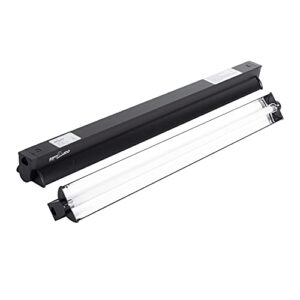
If you want a step up in raw UVB punch, the Repti Zoo T5 HO UVB Lighting Kit delivers. It comes ready to run with a Desert 10.0 T5 tube already included, so you’re not hunting for a separate bulb on day one.
The polished curved reflector pushes more UVB downward into the basking zone, and the built-in electronic ballast fires up fast. Available in 24W, 39W, and 54W versions, it scales neatly to your enclosure length.
| Best For | Desert reptile owners who want strong UVB output and a ready-to-go setup without buying extra bulbs. |
|---|---|
| UVB Output | 10.0 UVB T5 |
| Power | 24W |
| Material | Aluminum/Plastic |
| Reptile Compatible | Yes |
| D3 Synthesis | Yes |
| Weight | 1.1 lbs |
| Additional Features |
|
- Comes with the Desert 10.0 UVB bulb included — no extra shopping needed
- Polished curved reflector pushes more UVB right where your reptile basks
- Electronic ballast starts fast and keeps the lamp running at full efficiency
- Bulbs can burn out sooner than expected, sometimes within a month
- Replacement bulbs aren’t cheap, so factor that into the long-term cost
- Some units show up flickering or damaged, which points to inconsistent quality control
T5 HO 10.0 UVB Reptile Light
The T5 HO 10.0 UVB Reptile Light is a straightforward pick for desert species that need serious UVB intensity. Your terrarium lighting design gets a real boost here — this bulb doubles the output of a standard T8 tube and pushes usable UVB up to 36 inches down.
- Promotes reptile health by driving vitamin D3 synthesis
- T5 HO ballast required — won’t run in older T8 fixtures
- Ideal terrarium size: medium to large open-sun setups
- Promotes natural basking behavior in bearded dragons and uromastyx
- Replace every 9–12 months to maintain effective UVB lighting levels
The lamp’s high UVB output is specifically designed to help prevent in captive reptiles.
3. T5 UVB Reptile Light Fixture Kit
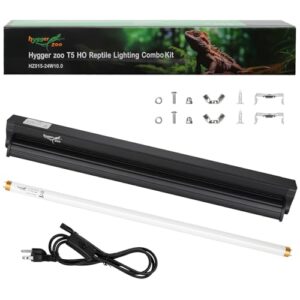
If your build calls for a complete package, the T5 UVB Reptile Light Fixture Kit takes care of that without asking you to source parts separately. The housing sits low on screen tops, and the built-in electronic ballast runs flicker-free — something skittish reptiles genuinely benefit from.
A polished curved reflector pushes UVB deeper into the enclosure, giving you reliable coverage across a large basking zone. It’s the kind of grab-and-go kit that just works.
| Best For | Reptile and amphibian owners who want a ready-to-use UVB setup for desert species without hunting down separate components. |
|---|---|
| UVB Output | 10.0 UVB T5 |
| Power | 24W |
| Material | Aluminum |
| Reptile Compatible | Yes |
| D3 Synthesis | Yes |
| Weight | 1.65 lbs |
| Additional Features |
|
- The polished curved reflector pushes UVB deeper, so your reptile actually gets the light it needs for D3 synthesis and calcium absorption.
- At 24W with an aluminum build, it runs efficiently and stays cool — better longevity than cheaper plastic options.
- Flicker-free electronic ballast is a small detail that makes a real difference for nervous or skittish reptiles.
- Not a great fit for larger tanks — if you’re running 120 gallons or more, you’ll likely need something bigger.
- Bulb lifespan is inconsistent; some users get a year out of it, others much less.
- A few users have noted it can shift around on the enclosure, so don’t expect it to stay perfectly locked in place.
4. Hygger Reptile Light Fixture Combo Kit
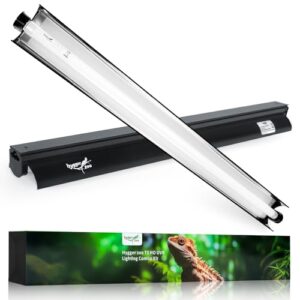
The Hygger Reptile Light Fixture Combo Kit gives you everything in one box — fixture, T5 HO tube, mounting hardware, and a 5.9-foot power cord.
If you’re dialing in UVB for a ball python, this kind of all-in-one setup pairs well with the guidance in UVB lighting systems for ball pythons to help you hit the right Ferguson Zone at your basking distance.
The 22-inch, 24-watt version works well for mid-to-large enclosures, and its polished curved reflector pushes UVB where it counts: straight down at the basking zone. You get a 10% UVB and 30% UVA output, which hits the mark for desert species like bearded dragons and tortoises.
Just plan on replacing the bulb every 6 to 12 months.
| Best For | Reptile owners with mid-to-large enclosures housing desert species like bearded dragons, lizards, or tortoises who want an all-in-one UVB lighting setup. |
|---|---|
| UVB Output | 10.0 UVB T5 |
| Power | 24W |
| Material | Aluminum |
| Reptile Compatible | Yes |
| D3 Synthesis | Yes |
| Weight | 1.45 lbs |
| Additional Features |
|
- Comes with everything you need out of the box — fixture, T5 HO tube, and mounting hardware
- Polished curved reflector directs UVB right where it matters most, the basking zone
- Energy-efficient design with a handy on/off switch and removable power cable
- Some users have had bulbs burn out fast or arrive dead on arrival
- Quality control seems inconsistent, with reports of damaged units
- Not quite as reliable as premium brands like Arcadia
5. Reptile UVB Light Fixture Combo Kit
This kit doesn’t mess around. The REPTIDLDB T5 Reptile Light Fixture ships ready to run — aluminum housing, built-in electronic ballast, and a polished alloy reflector that pushes UVB straight down where your animal actually basks. At 24 watts with 10% UVB and 30% UVA output, it’s a solid pick for bearded dragons, tortoises, and other desert species.
The low-profile design sits cleanly on screen tops without crowding your setup. Swap the bulb every 6 to 12 months to keep UVB output where it needs to be.
| Best For | Reptile owners keeping bearded dragons, tortoises, or other desert species who want a reliable, ready-to-run UVB setup without a lot of fuss. |
|---|---|
| UVB Output | 10.0 UVB T5 |
| Power | 24W |
| Material | Glass |
| Reptile Compatible | Yes |
| D3 Synthesis | Yes |
| Weight | 1.17 lbs |
| Additional Features |
|
- Strong 10% UVB and 30% UVA output with an alloy reflector that actually directs light where your reptile basks
- Lightweight aluminum build with a built-in ballast — just mount it and go
- Replaceable bulb means you’re not tossing the whole fixture every 6–12 months
- Some users have seen the bulb holder peel or crinkle after a few months of use
- Limited size and wattage options, so it may not scale well for larger enclosures
- Not ideal for non-desert species that need lower UVB levels
6. Reptile UVB Light Fixture
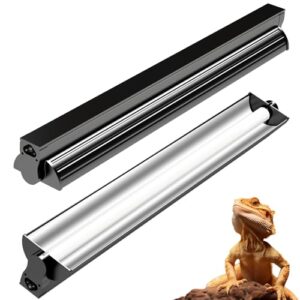
Flexibility is the name of the game here. This T5 reptile UVB fixture comes in four sizes — 12, 22, 34, and 46 inches — so you can match it precisely to your enclosure without compromise.
The built-in electronic ballast runs flicker-free, and the alloy reflector pushes UVB straight into the basking zone. At 10% UVB and 30% UVA output, it covers bearded dragons, turtles, and desert species well. Plan to swap the bulb every 12 months.
| Best For | Reptile owners with desert or tropical species — especially bearded dragons, turtles, and snakes — who want a right-sized UVB setup for their enclosure. |
|---|---|
| UVB Output | 10% UVB 10.0 |
| Power | 24W |
| Material | Aluminum |
| Reptile Compatible | Yes |
| D3 Synthesis | Yes |
| Weight | 1.45 lbs |
| Additional Features |
|
- Comes in four sizes (12 to 46 inches) so it fits almost any tank without awkward gaps or overhang
- The alloy reflector focuses UVB output right where it matters, making that 10% UVB rating actually count
- Detachable cable and on/off switch make daily use and setup way less of a hassle
- The bulb holder has been known to peel or crinkle over time, which is worth keeping an eye on
- You’ll need to replace the UVB bulb roughly every year, adding to the long-term cost
- The fixed UVB and UVA output percentages may not suit every reptile species or habitat type
7. Repti Zoo Dual Reptile Light Fixture
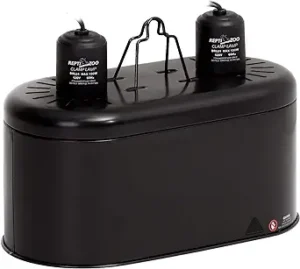
The Repti Zoo Dual Reptile Light Fixture is based on a simple idea: two bulbs, one fixture. Each ceramic socket accommodates up to 150 watts, so you can run a UVB bulb in one dome and a ceramic heat emitter in the other.
Independent rocker switches let you control each bulb separately without unplugging anything. The ETL-certified metal build stays durable under daily heat stress. At 11.2 inches wide, it fits neatly over most basking zones without crowding your setup.
| Best For | Reptile owners who want to run UVB and heat lighting together without juggling two separate fixtures. |
|---|---|
| UVB Output | 10% UVB 10.0 |
| Power | 8W–54W |
| Material | Aluminum |
| Reptile Compatible | Yes |
| D3 Synthesis | Yes |
| Weight | 9.6 oz |
| Additional Features |
|
- Two ceramic sockets handle up to 150W each, so you can run a UVB bulb and a heat emitter side by side
- Independent rocker switches let you control each bulb separately — no unplugging needed
- ETL-certified metal build holds up to daily heat stress, and it fits neatly over most basking zones
- Runs very hot, so you need to be careful when adjusting or handling it
- Some users have reported loose sockets or buzzing noises out of the box
- Quality control can be hit or miss — a few buyers received dented or damaged units
8. Reptile Systems Eco T5 Lighting Kit
The Reptile Systems Eco T5 Lighting Kit is built for keepers who want precision out of the box. It comes in 24W, 39W, and 54W sizes, each paired with a matched HOT5 UVB tube for its Ferguson zone.
The wide 103-degree beam angle spreads UVB evenly across large tank floors. A flicker-free ballast is built right in — no extra hardware needed. You can also daisy-chain up to ten units from one power source, making it easy to cover long enclosures cleanly.
| Best For | Reptile owners caring for occasional baskers like Green Anoles or Box Turtles who need moderate, reliable UVB without overexposing their pets. |
|---|---|
| UVB Output | UVB Compatible |
| Power | 150W max |
| Material | Metal |
| Reptile Compatible | Yes |
| D3 Synthesis | Yes |
| Weight | 1 lb |
| Additional Features |
|
- Supports vitamin D3 synthesis and calcium absorption, keeping your reptile’s bones healthy
- Flicker-free performance means no stress for your animals (or you)
- Easy to expand — daisy-chain multiple units without a mess of extra hardware
- Zone 2 only, so high-UVB species like bearded dragons won’t get what they need
- Compatibility with non-standard fixtures can be hit or miss
- No clear info on bulb lifespan, so you’ll have to track replacement schedules yourself
Choosing The Right UVB System Size
Getting the size right is the foundation of any solid UVB setup. The wrong fixture length or wattage can leave your reptile with dead zones or overexposure — neither is a good look.
Here’s what to think about before you commit to a UVB setup.
Matching Fixture Length to Terrarium Dimensions
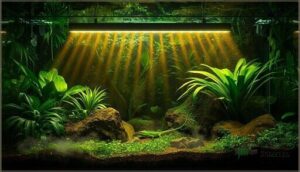
Ever notice how the right lamp fixture can shape your Terrarium Lighting like sunlight through a forest canopy? Coverage Ratios matter—most keepers aim for two-thirds of the enclosure length, balancing Species Needs and Gradient Creation.
Mounting Impact shifts UVB Lighting effectiveness, so match fixture length to your setup for ideal Reptile Lighting and Terrarium Setup and Maintenance. Understanding the importance of is essential when planning your lighting system.
| Fixture Length | Coverage Ratio |
|---|---|
| 24″ | 2/3 |
| 36″ | 3/4 |
| 12″ | 1/2 |
Coverage Area and Beam Angle Considerations
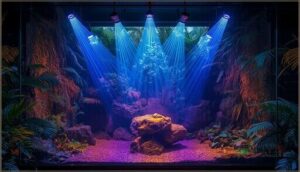
The Beam Angle shapes everything about how your UVB Gradient lands across the enclosure.
Wide-beam Terrarium Lighting Systems spread UVB Radiation evenly, giving active species a broad zone to move through. Narrow beams create strong UVB Output in one spot but leave corners underexposed.
Smart Fixture Placement and understanding Coverage Patterns keeps your Light Distribution balanced—so your animal actually benefits from the UVB Lighting you’ve invested in.
Wattage and Bulb Strength for Bigger Habitats
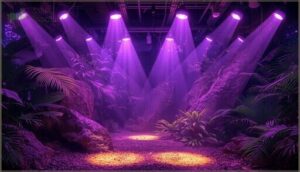
Once you’ve mapped your beam angles, Bulb Wattage becomes your next lever.
Larger habitats need at least 24 to 39 watts of T5 HO UVB Output to hit safe UV index levels at basking depth.
Compact 8-watt bulbs just can’t cut it in big builds.
Match your Fixture Sizing to enclosure volume, and your Reptile Lighting Solutions will actually do their job.
UVB Bulb Types and Replacement Schedule
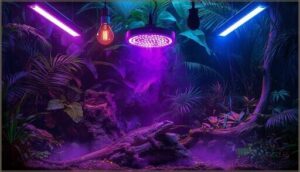
Not all UVB bulbs work the same way, and picking the wrong type can quietly set your reptile back.
From T5 HO tubes to newer LED systems, each option comes with its own strengths, UVB output levels, and replacement timeline. Here’s what you need to know before committing to a setup.
T5 HO Bulbs Vs LED UVB Systems
Two solid terrarium lighting solutions exist: T5 HO bulbs and LED UVB systems. T5 HO fixtures win on upfront lighting costs and deliver a smooth, broad UVB spectrum across wide basking zones.
LEDs beat them on energy efficiency and heat output, running cooler with sleeker fixture design. Your choice depends on your budget, your species’ needs, and how often you want to swap bulbs.
UVB Percentage Options (2.4%, 5.0%, 7%, 10.0%)
Once you’ve picked your fixture type, UVB percentage becomes your next decision. The 2.4% bulb suits shade dwellers, while 5.0% accommodates forest species.
Step up to 7% for partial sun baskers, and 10.0% for desert reptiles needing intense UVB output. Match your reptile lighting to species research first — your terrarium lighting design and reptile health depend on getting this right.
Measuring UVB Effectiveness Over Time
Consistency is everything in reptile care and health. A UVB meter calibration check at your basking spot every month reveals bulb decay rates before they harm your animal.
T5 HO tubes can quietly lose 30–50% UVB output while still looking bright. UV index tracking and UVB gradient mapping across your terrarium lighting dynamics help you catch those invisible drops and keep your UVB lighting solutions working hard.
T5 HO tubes can silently lose half their UVB output while still glowing bright
Ferguson Zones and UVB Needs by Species
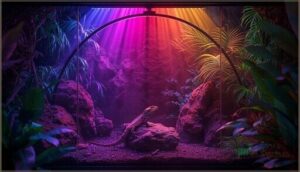
Not every reptile needs the same amount of UVB — and that’s exactly where Ferguson Zones come in. They give you a reliable framework to match your lighting setup to your specific animal’s wild UV exposure.
Here’s what you need to know before picking a system.
What Ferguson Zones Mean for Large Terrarium Planning
Ferguson Zones are your blueprint for terrarium design. They sort species into four UV exposure groups based on field research, giving you real UVI targets instead of guesswork.
For large terrarium setup and lighting layouts, that matters. You can build proper UVB gradients with defined basking zones, dial in your UVB lighting, and create terrarium lighting solutions that genuinely support reptile care and health in bioactive terrariums.
UVB Index Levels for Partial Sun Vs Open Sun Baskers
Partial sun baskers need a UVB gradient running from UVI 0.0 in shade up to roughly UVI 1.0 at the basking spot.
Open sun baskers want that peak closer to UVI 3 to 6. Species adaptation drives your lighting design choices here — get it wrong and you’ll see poor appetite or weak bones.
Matching UVB index to basking behavior is the foundation of solid reptile care and health.
Installation and Maintenance for Large Setups
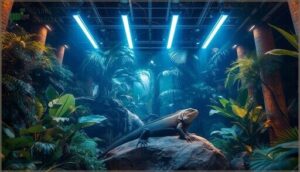
Getting a large terrarium set up right takes more than just picking a good bulb. How you mount your fixtures, space them out, and keep them running strong makes a real difference in your animal’s health.
Here’s what you need to know to get it done properly.
If your readings still seem off after calibrating, common reasons hygrometers give inaccurate readings include worn mechanical sensors whose hair or coil no longer responds reliably to humidity changes.
Mounting Options and Fixture Placement
Where you mount your lamp fixture changes everything. Mounting lighting fixtures for terrariums inside the enclosure cuts mesh filtration loss dramatically, since mesh can block 30–50% of UVB.
For top-mounted terrarium light setups, keep basking zones 8–13 inches away. Internal mounting styles push that to 14–20 inches. Run your LED terrarium light horizontally to spread UVB distribution evenly across multiple basking zones.
Using Reflectors to Maximize UVB Distribution
Your reflector geometry does more than bounce light — it shapes your entire basking zone. Reflector geometry directly controls UVB beam control and coverage width.
Deep parabolic designs push UVB rays into a focused hotspot, while shallow curves spread light diffusion techniques across more floor space. Premium reflective materials like polished aluminum maintain up to 95% reflectivity, keeping your lighting fixtures for terrariums and reptile care setups performing at their best.
Running Multiple Fixtures Across Long Enclosures
Long enclosures need more than one lamp fixture — a single tube leaves cold, UV-dead zones your animal can’t avoid.
Space your terrarium light fixtures evenly across the length, offsetting them slightly to blend basking zones without harsh gaps. Mind your fixture height, keep cable management tidy along the back rail, and remember that mesh blocking can cut UVB output substantially, so mount below the screen when possible.
Checking Ballasts and Avoiding UVB Hotspots
Once you’ve sorted your fixture spacing, ballast inspection becomes your next priority. A buzzing fixture or a tube that won’t ignite cleanly signals trouble — don’t ignore it.
- Safety Precautions first: Cut power before checking any T5 bulb socket for burn marks or loose contacts.
- UVB Metering: Scan basking spots with a Solarmeter for hotspot prevention — aim for 3–4.5 UVI max.
- Fixture Alignment: A tilted terrarium light concentrates UVB into one corner, leaving the rest dark.
Pairing UVB With Heat and Visible Light Sources
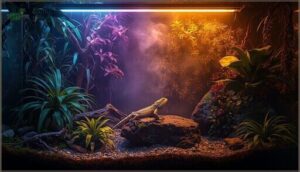
UVB alone won’t carry the whole load in a large terrarium. Your animal needs heat, visible light, and UVB working together — each dialed in separately so nothing gets out of balance.
Here’s how to pair those sources the right way.
Why Separate UVB and Heat Sources Benefit Large Setups
Running separate UVB lighting and heat sources gives you independent control over every zone in a large terrarium. That flexibility means flexible zoning across basking spots, shaded retreats, and planted corners — without compromise.
It also means reduced overexposure risks and safer nighttime temperatures using ceramic emitters alone. For reptile care and maintenance, easier maintenance wins too: swap a fading UVB tube without touching your heat setup.
Combining T5 HO UVB Tubes With LED or Halogen Lights
Once your UVB and heat sources are separate, the next step is building a light spectrum that actually mimics the sun. Pair your T5 HO UVB tube with LED or halogen lights to cover what a single T5 bulb can’t do alone.
- LEDs boost visual comfort and terrarium brightness without adding heat
- Halogens deliver infrared warmth right at the basking zone
- Fixture design lets you fine-tune UVB intensity independently
- Energy efficiency stays high when LEDs handle ambient lighting
Photoperiod Control for Simulating Natural Day-Night Cycles
Your terrarium light doesn’t stop at bulb choice — timing it right changes everything. Photoperiod Control means your reptile’s body clock stays synced naturally. Use Timer Automation to run full spectrum lighting on a consistent schedule, and build in Dawn/Dusk Effects so transitions feel gradual, not jarring.
| Setting | Summer | Winter |
|---|---|---|
| Light On | 6:30 AM | 7:30 AM |
| Light Off | 8:30 PM | 5:30 PM |
| Total Hours | 14 hrs | 10 hrs |
Seasonal Shifts support Circadian health — and Remote Control features let you adjust everything without opening the enclosure.
Avoiding Overexposure by Balancing Light Components
Balance is everything in reptile habitat lighting. Too much UVB without matching visible light can push your animal away from basking zones entirely.
Build smart UVB gradients — peak intensity at the basking spot, fading toward the cool end. Pair UVB rays with full spectrum lighting benefits your reptile’s vision needs, and watch basking behavior normalize naturally. Separate controls give you real command.
Monitoring and Verifying UVB Levels Over Time
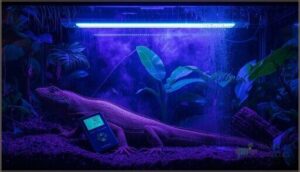
Getting your lighting right is only half the job — keeping it right is where most keepers fall short.
UVB output drops quietly over time, even when bulbs still look bright, so you need a system for staying on top of it. Here’s what you should know to monitor your setup with confidence.
How to Use a UV Index Meter in a Large Terrarium
Think of your UV Index meter as the truth-teller in your setup. Hold the sensor at your reptile’s back height, facing the terrarium light directly — tilting it skews readings.
For UVB mapping, test the warm end, middle, and cool zones separately. Cross-reference every reading with your animal’s Ferguson Zone targets. That’s how you keep terrarium safety from being guesswork.
How Often to Test UVB Levels at Basking Spots
Monthly testing frequency is the baseline for solid UVB metering at every basking spot — but don’t stop there. After rearranging décor, swapping bulbs, or cleaning the screen top, retest immediately.
For reptile and amphibian care in large setups, weekly checks keep terrarium safety tight. Once a bulb nears 3,000 hours, increase your lighting maintenance checks to catch UVB rays dropping before your animal does.
Keeping Records to Track Bulb Performance and Replacement Dates
A simple log transforms guesswork into control. For UVB lighting for reptiles across large setups, solid record keeping keeps your terrarium maintenance and care on point.
- Write the install date directly on each terrarium light bulb
- Log UVI readings and distance at every basking spot
- Set replacement planning alerts at 10–12 months for T5 HO tubes
- Track reptile and amphibian care notes alongside UVB tracking data to spot behavior shifts tied to dropping UVB rays
Frequently Asked Questions (FAQs)
What size UVB do I need for a 40 gallon tank?
For a 40 gallon tank, a 22 to 24 inch T5 HO UVB tube hits the sweet spot.
It gives strong UVB intensity across the basking zone while leaving a shaded retreat on the cooler side.
What is the best light for a bioactive terrarium?
The best light for a bioactive terrarium combines a TerraSky UV LED for plant growth needs, animal color rendering, and energy efficiency.
It also includes a custom light spectrum that addresses humidity, UVB lighting for reptiles, and LED terrarium light coverage together.
Should UVB cover the whole enclosure?
No, UVB shouldn’t blanket your entire terrarium. Your reptile needs lighting gradients — a bright basking zone and true shade — so it can self-regulate vitamin D3 naturally through smart enclosure design.
Is UV light the same as UVB light?
No, they’re not the same. UV spectrum covers UVA, UVB, and UVC.
UVB is just one slice of that broader range — the part with real biological impact for your reptile’s health.
Should UVB cover the whole terrarium?
No, it shouldn’t. Gradient necessity is real — your reptile needs shaded retreats to self-regulate. Species specific coverage prevents overexposure risks. Aim for two-thirds with a T5 HO lamp fixture.
What size UVB bulb for a 20 gallon tank?
For a 20 gallon tank, an 18 to 24 inch T5 bulb hits the sweet spot. A ReptiSun 0 T5 works well at typical 8 to 12 inch basking distances.
Can a reptile have too much UVB?
Yes, too much UVB acts like sunburn from the inside out.
Reptile health suffers through eye damage, skin burns, and vitamin imbalance when UVB intensity exceeds what your reptile’s Ferguson Zone allows.
Is a basking light the same as an UVB light?
No, they’re not the same. A basking light covers your reptile’s heat sources and basking needs, while a UVB light provides UVB output for vitamin D
Your reptile habitat lighting needs both for complete reptile lighting safety.
Can UVB penetrate mesh or screen tops effectively?
Screen tops block more UVB than most keepers expect. Fine mesh can cut UVB intensity by 30 to 50 percent, so your reptile gets far less than the bulb actually puts out.
Do live plants block UVB for basking reptiles?
Live plants can slash UVB at your reptile’s basking spot by up to 90%.
In a bioactive terrarium, leaf UV filtering and plant canopy effects are real — foliage management keeps your basking spot optimized.
Conclusion
It’s no coincidence that reptiles under properly matched uvb lighting systems for large terrariums tend to eat better, move more, and live longer—their biology was built for precision light, not guesswork.
Every fixture length, UVB percentage, and mounting height you’ve read about here connects directly to what your animal experiences daily. Get those variables right, and your terrarium stops being a box with lights. It becomes an environment that actually works.