This site is supported by our readers. We may earn a commission, at no cost to you, if you purchase through links.

Your snake coils in the corner, barely moving when you approach—a behavior that might signal something more serious than a calm temperament. Cold stress in reptiles doesn’t announce itself with dramatic symptoms; instead, it manifests as subtle shifts in behavior and physiology that many keepers mistake for normal variation.
When your snake’s core temperature drops below its ideal range, metabolic processes slow to a crawl: digestion stalls, immune function weakens, and the cascade of enzyme-dependent reactions that sustain life begins to falter. Recognizing the signs your snake needs more heat requires understanding both your species’ specific thermal requirements and the warning signals that indicate your current setup isn’t delivering adequate warmth—because by the time lethargy becomes obvious, the damage to your snake’s system may already be underway.
Table Of Contents
- Key Takeaways
- Why Snakes Need Proper Heat
- Common Signs Your Snake Needs More Heat
- Behavioral Changes Indicating Cold Stress
- Physical Symptoms of Insufficient Heat
- How to Check and Improve Enclosure Heat
- When to Seek Professional Help
- Frequently Asked Questions (FAQs)
- Should I leave my snakes heat lamp on all day?
- How much heat does a snake need?
- How often should I replace my snakes thermometer?
- Can room temperature changes affect my snakes enclosure?
- Do baby snakes need different heat than adults?
- Whats the ideal nighttime temperature drop for snakes?
- Can humidity levels interfere with proper heating?
- Conclusion
Key Takeaways
- Snakes require external heat not for comfort but as an absolute physiological necessity that powers digestion, immune function, and every enzyme-dependent metabolic process—inadequate warmth triggers cascading system failures long before lethargy becomes obvious.
- Key behavioral warning signs include persistent hiding during normal activity periods, frequent heat-seeking behavior near elements or enclosure walls, refusal to eat despite regular feeding schedules, and cool-to-the-touch body temperature below your established baseline.
- Proper thermal management demands species-specific gradients verified through digital thermometers with multiple probe placements—ball pythons need 88-92°F warm zones while corn snakes require 85-90°F basking spots, with cool retreats providing 6-12°F temperature drops.
- Professional veterinary intervention becomes necessary when symptoms persist 48-72 hours after correcting temperatures, or when you observe respiratory distress, inability to right itself when rolled, absence of defensive responses, or visible swelling and lesions indicating systemic failure beyond simple cold stress.
Why Snakes Need Proper Heat
Your snake’s survival depends on heat—not as a comfort preference, but as an absolute physiological requirement that governs every critical bodily function from digestion to immune defense. Without proper thermal regulation, even the most well-fed snake will experience metabolic shutdown, leaving it vulnerable to infection, organ failure, and premature death.
Recognizing early warning signs that your snake’s enclosure is too cold can mean the difference between catching a fixable temperature issue and facing a full-blown health crisis.
Heat isn’t comfort for your snake—it’s the absolute physiological requirement that powers digestion, immunity, and survival itself
Understanding why heat matters, how temperature affects specific biological processes, and what your individual species requires will determine whether your snake thrives or slowly deteriorates in your care.
Ectothermic Physiology and Heat Dependence
Your snake’s ectothermic physiology means it can’t generate heat internally—every metabolic process depends on external warmth you provide. Without proper temperature regulation, enzyme activity slows, energy production drops, and survival becomes uncertain.
- Heat availability determines metabolic rate and energy use in ectotherms
- Body temperature directly influences locomotor performance and escape responses
- Thermal conditions shape growth rates and ectotherm development timelines
- Snakes use behavioral thermoregulation strategies—basking and seeking shade—to reach preferred body temperatures
- Microhabitat selection creates essential thermal gradients within enclosures
Snakes, like other ectothermic animals, rely on external sources for temperature regulation.
Temperature’s Role in Digestion and Immunity
Proper thermal regulation directly drives digestive enzyme activity—warmer core temperatures accelerate gut motility, nutrient breakdown, and bile release essential for fat digestion. Temperature also governs immune response: adequate warmth enhances gut immune cells, promotes secretory immunoglobulin production, and maintains intestinal barrier integrity.
Without consistent heat, your snake faces metabolic impairment, microbiome imbalance, and compromised defenses against ingested pathogens. Understanding the effects of temperature on digestion can further highlight why maintaining proper heat is critical for your snake’s health.
Species-Specific Heat Requirements
Each species demands distinct thermal zones—ball pythons need a warm side at 88 to 92°F and a cool retreat near 78 to 82°F, while corn snakes thrive with basking spots around 85 to 90°F.
Use a reliable snake tank thermometer to verify both zones and prevent dangerous temperature swings.
Enclosure design must reflect these species-specific needs through deliberate heat source placement, substrate choice, and gradient monitoring to support reptile thermoregulation and maintain ideal snake health across daily activity cycles.
Common Signs Your Snake Needs More Heat

When your snake isn’t getting enough heat signals, its body sends clear signals—you just need to know what you’re looking for.
These warning signs often appear gradually, making them easy to miss if you aren’t monitoring behavior and physical responses closely.
Recognizing these indicators early allows you to correct temperature deficiencies before they compromise your snake’s metabolism, immune function, or long-term health.
Lethargy and Reduced Activity
When your ectothermic snake sits motionless for hours—barely responding to movement or light—cold stress signs are likely at play. Insufficient thermal gradient disrupts thermoregulation, triggering metabolic impairment that forces energy conservation.
Understanding cold weather snake feeding protocols helps prevent digestive complications when temperatures drop below your snake’s optimal range.
- Minimal exploration during normal activity periods despite adequate enclosure space
- Reduced tongue-flicking and investigative behavior compared to baseline snake behavior
- Prolonged basking attempts without improved activity levels post-warming
- Delayed responses to external stimuli, signaling compromised snake health
Thermal monitoring and prompt heat adjustment restore normal function.
Persistent Hiding or Inactivity
Sustained inactivity that persists through daytime hours signals a cold shock scenario affecting snake behavior. When your ectothermic animal refuses to emerge from hides even during peak activity windows, compromised thermal comfort disrupts normal thermoregulation.
Environmental factors—particularly inadequate thermal gradient or temperature control failures—force energy conservation that overrides exploration drives, threatening snake health long-term.
Refusal to Eat or Poor Appetite
Appetite disruption tracks directly to temperature-dependent digestion issues—when ambient heat drops below your snake’s species-specific optimum, digestive enzymes lose efficiency and gut motility slows, creating metabolic impairment that suppresses feeding drive.
This ectothermic vulnerability means thermal gradient failures trigger cascading metabolic support breakdown: inadequate warmth halts prey processing, your snake refuses meals, and prolonged cold stress compounds immune suppression that jeopardizes snake health beyond simple feeding strategies or appetite stimulation, demanding immediate temperature adjustments.
Frequent Seeking of Heat Sources
When your snake repeatedly moves toward warm spots—often pressing against heating elements or returning to basking zones during rest periods—you’re witnessing active thermoregulation signaling inadequate ambient heat. This heat-seeking behavior indicates your thermal gradient lacks sufficient warmth: the snake behavior demonstrates compensatory temperature regulation as the animal attempts to raise core temperature because existing heat sources can’t maintain species-specific thermal requirements, demanding immediate heat source selection adjustments and temperature control recalibration.
- Check that heat sources remain accessible and aren’t blocked by hides or décor
- Verify your thermal gradient provides distinct warm, mid-range, and cool zones for choice
- Reassess thermostat accuracy if continuous heat-seeking persists despite adjustments
- Monitor for heat stress signs if your snake remains near elements excessively long
Cool-to-the-Touch Body
When you handle your snake and find its body cooler than your established baseline, you’re detecting cold stress that signals immediate enclosure temperature recalibration—this physical temperature drop indicates your thermal gradient can’t maintain ectothermic health requirements.
Body temperature below species-specific optima compromises snake thermoregulation, reducing metabolic efficiency and digestive function, requiring heat regulation adjustments to restore thermal comfort and support proper reptile temperature requirements for snake health.
Behavioral Changes Indicating Cold Stress
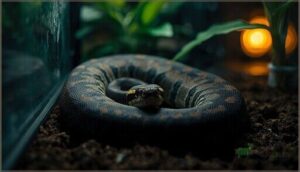
Cold stress doesn’t just make your snake sluggish—it triggers specific behavioral patterns that signal your animal is struggling to maintain core body temperature.
These movements and postures often look unusual or out of character, which is your snake’s way of actively compensating for inadequate environmental heat. Recognizing these behavioral red flags allows you to intervene before cold stress progresses to metabolic suppression or immune compromise.
Increased Restlessness or Unusual Movement
When your snake paces repeatedly along glass walls or shifts locations every few minutes, you’re witnessing active thermoregulation—the animal is searching for thermal comfort it can’t locate.
Movement patterns like rapid coil tightening, frequent climbing attempts, or continuous tongue-flicking signal restlessness signs driven by inadequate heat distribution. This behavior indicates your thermal gradient isn’t meeting species-specific needs for proper temperature control and snake health.
Pressing Against Enclosure Walls or Heat Elements
When you observe your snake flattening its body along enclosure walls or positioning itself directly over heat mats, you’re witnessing a critical thermoregulation response to inadequate warmth distribution—this Wall Contact Behavior reveals urgent deficiencies in your Thermal Gradient Design and Heat Source Placement that demand immediate correction.
Key indicators of cold-driven contact:
- Prolonged alignment against warm-side glass or acrylic where the snake presses its ventral surface flat for 4–6 hours continuously, rather than briefly contacting surfaces during normal exploration
- Direct coiling over or beside heat elements with the body centered on basking zones measuring 85–92°F while the tail extends toward cooler regions, maximizing radiant warmth exposure
- Repeated repositioning along Enclosure Surface Effects zones where glass conducts heat differently than substrate, prompting the animal to shift between wall contact and floor basking every 20–30 minutes
- Temporary body indentations or flattened contact areas visible after extended wall pressure, indicating the snake is compensating for insufficient ambient heat by increasing surface contact with any warmer boundary
This Snake Thermoregulation pattern signals your temperature gradient lacks the 6–12 inch gradation zone necessary for species-specific snake temperature requirements—your warm zone should occupy 25–40 percent of floor area with substrate and hide placement supporting reptile heat access without forcing wall dependency.
Abnormal Postures or Curling
Beyond wall-pressing, you’ll notice distinct Cold Stress Signs when your snake curls into abnormally tight coils, forms shallow S-curves near midbody, or elevates its head with a gentle neck arch—these Posture Analysis indicators reveal failing thermoregulation and inadequate Thermal Comfort.
Such Snake Body Language patterns, including reduced tail muscle tone and compact heat-conserving loops, demand immediate Heat Adjustment Tips through improved temperature control and repositioned heat sources.
Physical Symptoms of Insufficient Heat
Beyond behavioral changes, insufficient heat produces measurable physical symptoms that require your immediate attention—these aren’t subtle warning signs but documented physiological responses to thermal deficiency.
You’ll notice these changes developing over days to weeks, often overlapping with the behavioral indicators discussed earlier but representing more serious metabolic compromise. The following symptoms demand prompt assessment of your enclosure’s thermal gradient and heat source performance.
Slow Weight Gain or Unexplained Weight Loss

Persistent metabolic imbalance from inadequate heat directly disrupts your snake’s ability to process nutrients—even when feeding strategies appear sound. Insufficient warmth slows digestion, prevents protein absorption, and creates nutrient deficiency that manifests as stalled growth or dropping body mass over weeks to months.
Environmental factors—specifically temperature control within species-specific ranges—determine whether your snake can metabolize food effectively. Health supplements won’t compensate for poor thermal ecology and behavior; reptile temperature requirements govern every aspect of reptile care.
Key indicators you must monitor:
- Weight plateaus despite regular feeding schedules and appropriate prey size
- Gradual body mass reduction visible along the spine and ribs
- Failure to gain expected weight between sheds, particularly in juveniles
If your snake’s weight doesn’t respond to improved snake thermoregulation within two feeding cycles, veterinary assessment becomes essential to rule out parasites, organ dysfunction, or chronic infection.
Dull or Discolored Scales
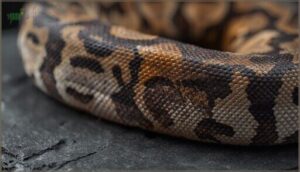
Inadequate thermal gradients often trigger scale health deterioration—you’ll notice dull patches, uneven shading along dorsal surfaces, or persistent chalky discoloration that lingers after a complete shed cycle.
Color changes reflect ectothermic stress: when your snake can’t access species-appropriate warmth, skin moisture regulation fails, shedding issues compound, and scales lose their characteristic luster—a visible marker demanding immediate thermal ecology reassessment.
Sluggish Response to Handling

Beyond visual changes, you’ll detect thermal regulation failures through handling—cold snakes respond slowly, taking several seconds to initiate movement when lifted, with reduced muscle tension and delayed defensive reflexes.
This metabolic impairment stems from inadequate environmental factors: without proper thermal comfort, ectothermic species can’t generate the energy needed for normal responsiveness, signaling urgent temperature control adjustments before immune suppression compounds handling-related stress.
How to Check and Improve Enclosure Heat
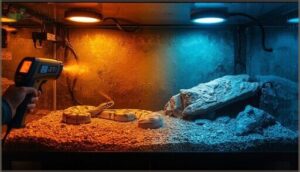
Once you suspect heat is the issue, your next step is confirming exactly what’s happening inside that enclosure—and then fixing it with precision. Accurate measurements, proper gradient design, and correctly calibrated equipment separate guesswork from real solutions.
Here’s how you verify temperatures, establish the thermal zones your snake needs, and adjust your heating setup to eliminate cold stress.
Using Digital Thermometers for Accurate Readings
Analog gauges often drift by 5–7°F, so you must rely on digital thermometers to capture real-time conditions with 0.1°C resolution and ±0.3°C accuracy—essential for snake thermoregulation and thermal regulation.
Your temperature control depends on precise heat monitoring through strategic probe placement:
- Position probes at basking surfaces and inside hides, never against walls
- Verify thermometer calibration against a known reference every few months
- Install multiple temperature sensors to confirm your temperature gradient across zones
- Choose models with fast response times to detect shifts before cold stress develops
- Record readings daily to spot drift and maintain digital accuracy
Creating and Monitoring a Thermal Gradient
A functional thermal gradient demands that you position your heat source at one enclosure end, creating a warm zone of 30–32°C and a cool retreat near 24–27°C—mirroring natural thermal regulation patterns.
Your snake thermoregulation depends on this temperature gradient spanning at least 20–30 cm, enabling deliberate movement between microclimates for ideal temperature control and gradient design within your enclosure heating system.
Adjusting Heat Sources and Thermostat Settings
Once you’ve measured your thermal gradient, fine-tune your thermostat to hold the warm end at species-appropriate levels—adjusting in one-degree increments and monitoring over 24 hours to prevent temperature fluctuation.
Heat source selection matters: ceramic heat emitters provide steady radiant warmth without light disruption, while heat lamps require careful wattage matching and guard installation for heating element safety during thermostat calibration checks.
When to Seek Professional Help

You’ve adjusted the heat sources, verified the gradient with digital thermometers, and confirmed your thermostat settings—but if your snake still shows signs of cold stress or declining health after 48-72 hours, professional intervention becomes necessary.
Some symptoms indicate underlying illness rather than simple temperature issues, and distinguishing between the two requires veterinary expertise. Recognizing when home adjustments aren’t enough protects your snake from complications that worsen with delayed treatment.
Persistent Symptoms Despite Heat Adjustment
If your snake’s lethargy, poor appetite, and heat-seeking behavior persist despite stabilizing the thermal gradient within species-appropriate ranges, you’re facing a red flag—temperature regulation alone won’t resolve underlying pathology.
Environmental factors like inadequate heat cycling, thermostat malfunctions causing thermal fluctuations, or overheating can complicate diagnosis, but persistent symptoms demand immediate health monitoring and veterinary intervention to rule out infection, parasites, or organ dysfunction.
Signs of Illness or Severe Lethargy
When lethargy persists beyond 48 hours despite verified thermal regulation and control, you’re observing Cold Stress Symptoms that signal deeper Snake Health Issues requiring immediate Veterinary Care—respiratory distress, open-mouth breathing, or unresponsiveness point to systemic failure beyond temperature alone.
Watch for these critical reptile health and wellness warning signs:
- Wheezing, mucus discharge, or labored breathing indicating respiratory infection
- Pronounced muscle weakness preventing normal coiling or defensive postures
- Refusal to right itself when gently rolled, signaling severe neurological compromise
- Visible swelling, discoloration, or lesions suggesting Thermal Injury or infection
- Absence of tongue flicking or eye tracking when stimulated, reflecting metabolic collapse
Consulting a Reptile Veterinarian
When your snake’s symptoms persist or escalate beyond basic heat adjustments, you need a board-certified reptile veterinarian or ARAV member practice—call ahead to confirm they handle diagnostic tools like radiology and bloodwork.
Verify staff experience with your species’ thermoregulation needs, and ask about emergency protocols for respiratory distress or metabolic collapse requiring immediate specialist referrals and intensive care.
Frequently Asked Questions (FAQs)
Should I leave my snakes heat lamp on all day?
No—your heat lamp shouldn’t run 24/7, as continuous exposure disrupts the day-night cycle and stresses your snake.
Use a thermostat-controlled timer for 10–12 hours daily, creating proper temperature regulation through thermal gradient zones.
How much heat does a snake need?
Your species’ thermal regulation demands specific targets: most tropical snakes require 80–85°F daytime warmth with a basking hotspot, while a thermal gradient lets them control their snake metabolism through temperature regulation and enclosure heating choices.
How often should I replace my snakes thermometer?
You should replace digital thermometers every two to three years to maintain calibration accuracy.
Replace them sooner if humidity causes corrosion, readings drift beyond two degrees, or sensors fail to respond reliably to temperature fluctuations.
Can room temperature changes affect my snakes enclosure?
Ambient shifts—those subtle climate control variations in your home—directly impact enclosure insulation and heat transfer, altering your snake’s thermal gradient.
Room temperature fluctuations undermine temperature regulation, forcing constant thermostat adjustments to maintain stable reptile heat zones.
Do baby snakes need different heat than adults?
Yes—hatchling care demands warmer basking zones, tighter thermal gradients, and closer monitoring than adult heat requirements, because snake development accelerates at higher temperatures, driving rapid digestion, growth, and species-specific needs for thermal regulation in snakes.
Whats the ideal nighttime temperature drop for snakes?
Most snakes thrive with nighttime drops of 5–10°F from daytime highs—tropical species tolerate smaller shifts, while temperate species handle larger ones.
Species-specific drops prevent cold stress, so thermostat regulation maintains proper temperature gradient for thermoregulation.
Can humidity levels interfere with proper heating?
High moisture disrupts thermal balance by altering heat transfer efficiency and thermostat accuracy—moisture control between 30–50 percent optimizes temperature regulation, ensuring your equipment maintains consistent thermal regulation in snakes without moisture-related interference.
Conclusion
The assumption that snakes will simply seek warmth when cold ignores a critical reality: by the time signs your snake needs more heat become unmistakable—the unresponsive coil, the refused meal, the scales cool beneath your fingertips—cellular damage may already be progressing.
Your thermometer readings matter more than behavioral interpretation alone; trust the numbers, not your snake’s apparent tolerance. Adequate heat isn’t optional for survival—it’s the foundation upon which every metabolic process depends, and recognizing deficiency early determines whether intervention restores health or merely delays decline.