This site is supported by our readers. We may earn a commission, at no cost to you, if you purchase through links.
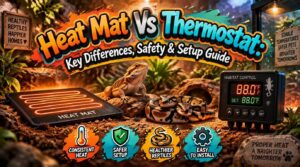
A heat mat without a thermostat is a fire hazard, not a heating solution. That’s the part most reptile guides skip, and it’s the part that sends snake owners rushing to the vet with burned animals.
The difference between thermostat and heat mat is more fundamental than it looks. The mat delivers heat through conduction; the thermostat keeps that heat from becoming dangerous. Grab a smart home thermostat off the shelf and you’ve got a mismatch that can injure your animal or trip a breaker.
Knowing how both work, and what to avoid, keeps your snake safe and your setup reliable.
Table Of Contents
- Key Takeaways
- Heat Mat Vs. Thermostat: What’s The Difference?
- How Heat Mats Warm Snake Enclosures
- How Thermostats Control Heat Mats Safely
- Top 3 Home Thermostats Unsuitable for Heat Mats
- Heat Mat and Thermostat Safety and Maintenance
- Frequently Asked Questions (FAQs)
- Do you need a thermostat with a heat mat?
- Can I leave the heat mat on all the time?
- Are heat mats worth it?
- What temperature should a heat mat be?
- Do I need a thermostat for a heat mat?
- Do I need a thermostat for my seedling heat mat?
- What is a heat mat thermostat?
- Can heat mats be used for other pets?
- How often should thermostat sensors be replaced?
- Do heat mats work during power outages?
- Conclusion
Key Takeaways
- A heat mat generates heat through conduction but has no self-regulation, so without a thermostat it’ll keep climbing in temperature until it becomes a burn risk or fire hazard.
- Your thermostat’s probe placement determines everything — press it flat under the warmest zone of the substrate, because that’s where your snake actually contacts the heat.
- Smart home thermostats like Nest, Ecobee, and Honeywell are built for 24V HVAC systems and can’t read surface temps or handle heat mat loads, making them genuinely dangerous substitutes for a purpose-built reptile controller.
- Inspect your heat mat monthly for worn insulation or crushed sections, and replace the thermostat probe every one to two years — a degraded probe drifts silently and throws your entire temperature gradient off before you notice anything’s wrong.
Heat Mat Vs. Thermostat: What’s The Difference?
Two devices, one goal: keeping your snake’s enclosure at the right temperature. They’re not the same thing, and mixing them up can get your animal killed.
Understanding which tool does what—and why it matters—is exactly what separates a thriving snake from a preventable loss, as this guide to digital terrarium thermometers for corn snakes makes clear.
One enclosure, two devices, one critical distinction—confuse them and you risk your snake’s life
A heat mat is a heat source. It warms the surface of your enclosure through internal heating elements, but it has no ability to regulate its own output. Leave it plugged in without oversight and it’ll just keep heating.
A thermostat is a control device that reads ambient or surface temperature via a probe and cycles power on and off to hit your target. That’s the distinction. The difference between heat lamp and heat mat aside, both are just sources. Heat mats with a thermostat work. Without thermostat control, you’re taking a serious risk.
How Heat Mats Warm Snake Enclosures

That heat mat under your enclosure isn’t warming the air; it’s warming the floor directly through conduction. Your snake presses against that surface, absorbs heat through contact, and thermoregulates. It’s a fundamentally different process than a lamp heating the air above.
Here’s what’s actually happening inside a snake enclosure:
- The mat’s heating elements raise the floor surface temperature through direct contact, not convection.
- Substrate type matters: dense substrates like reptile carpet transfer heat more efficiently than loose sand or bedding.
- A proper thermal gradient forms when the mat covers roughly a third of the floor, leaving a cooler retreat zone.
That gradient isn’t optional. Without it, your snake has nowhere to cool down, and heat mat safety breaks down fast.
How Thermostats Control Heat Mats Safely
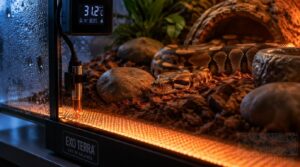
A thermostat doesn’t just add convenience—it’s the difference between a safe enclosure and a fire hazard. Getting it right comes down to three things: picking the right controller, placing the probe correctly, and dialing in a proper temperature gradient. Here’s what you need to know about each.
Choosing a Reptile Thermostat
Imagine your ball python’s enclosure hitting 42°C because the mat ran unchecked all night. That’s exactly what a reptile thermostat prevents.
Pairing your heat mat with a thermostat is a simple step covered well in this guide to safe reptile heat mats for ball pythons, which walks through keeping surface temps in that safe sub-90°F range.
| Feature | Why It Matters | What to Look For |
|---|---|---|
| Probe input | Allows accurate temperature control | Dedicated reptile-specific probe port |
| High/low limit settings | Prevents dangerous overheating | Adjustable range covering 20-40°C |
| Fault protection | Cuts power during probe failure | Automatic shutoff on error |
Pick a unit with adjustable high/low limits, a dedicated probe input for precise temperature control, and built-in fault protection. A discreet power switch adds real convenience. Always do thermostat calibration at installation, especially after any reptile enclosure heating adjustments.
A quality reptile digital thermometer calibration tool lets you verify your thermostat’s probe readings are accurate before your snake ever moves in.
Proper Probe Placement
Good probe placement starts beneath the heat mat, not on top of it. Press the thermostat probe flat against the substrate, at 0.5-2 cm depth, under the warmest zone. That’s where your snake contacts the heat, so that’s where the readings matter.
Keep the probe perpendicular to the surface. Tilt it and you’re measuring trapped air, wrecking your sensor accuracy.
Temperature Gradient Setup
Precision drives everything. Without a true thermal gradient, your snake can’t thermoregulate, so probe placement matters. Give it a warm basking zone at one end and a cool retreat at the other. Three steps:
- Set your thermostat probe 3 cm above the mat.
- Keep the gradient zone about 5 cm wide.
- Place three thermometers diagonally and verify within six hours.
Top 3 Home Thermostats Unsuitable for Heat Mats
Home thermostats are built for HVAC systems, not low-voltage reptile heating elements, and pairing them with a heat mat is a serious compatibility mismatch. The three models below show up most often in reptile forums as supposed alternatives, and they’re all wrong choices for this application. Here’s why each one falls short.
1. Ecobee Smart Thermostat Premium
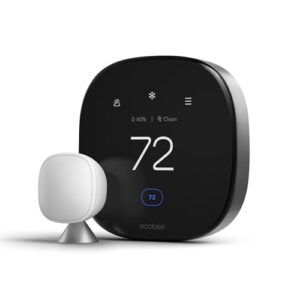
The ecobee Smart Thermostat Premium has real credentials. It reduces heating costs by up to 26 percent, tracks pollutants and humidity through a built-in air quality monitor, and integrates Alexa and Siri into a compact metal housing.
It’s not built for reptile setups, though. This thermostat drives 24VAC HVAC systems like furnaces and boilers, reading ambient air temperature, not substrate surface temperature. There’s no substrate probe input, response cycles are slow, and the load relay isn’t sized for heat mat demands. Your snake’s warm side could overheat long before this unit catches up.
Keep it on your wall instead.
| Best For | Homeowners wanting smart energy savings and air quality monitoring |
| Smart Control | Alexa, Siri, Google Assistant |
| Energy Star | Yes |
| Remote Access | Yes, via app |
| Programming | Smart scheduling |
| Display Type | Touchscreen |
| Alerts | Air quality alerts |
| Additional Features | SmartSensor, air quality monitor, built-in smart speaker |
Best For: Homeowners who want smart energy savings, air quality monitoring, and seamless integration with Alexa or Siri.
| Remote Access | Yes, via app |
|---|---|
| Voice Control | Alexa, Siri, Google |
| Display Type | Touchscreen |
| HVAC Compatibility | 24VAC HVAC systems |
| Energy Star | Yes |
| Scheduling | Smart scheduling |
| Additional Features |
|
- Cuts heating and cooling costs by up to 26% with ENERGY STAR certification and smart scheduling
- Built-in air quality monitor tracks pollutants and humidity in real time
- Works with Alexa and Siri, and supports DIY installation even without a C-wire using the included Power Extender Kit
- Siri requires an Apple home hub, and smart security features need a paid ecobee subscription
- Users report inconsistent temperature accuracy and occasional smart home connectivity issues
- Not suitable for specialized setups like reptile enclosures — it reads ambient air, not surface temperature, and isn’t designed for heat mat loads
2. Honeywell Smart Color Thermostat
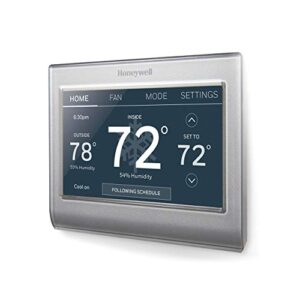
Using the Honeywell Smart Color Thermostat (RTH9585WF1004/W) to control a heat mat is like hiring a commercial HVAC contractor to fix a desk lamp. The skill set simply doesn’t translate.
This thermostat is designed exclusively for central HVAC systems, covering forced air, hot water, steam, and heat pumps with electric backup. Your snake’s heat mat is completely outside its operating scope. It also needs a C-wire for permanent power and mounts directly to your wall, hardwired into your home’s heating infrastructure.
The customizable color touchscreen, Alexa compatibility, and 7-day programmable scheduling are genuinely useful features for homeowners. But here’s the real problem: the temperature sensor can read up to 4°F too high, with only a ±3°F manual calibration range available to compensate. That kind of inaccuracy in reptile care is genuinely dangerous to your snake.
| Best For | Homeowners with central HVAC systems who want remote control, smart home integration, and energy tracking from a single wall-mounted thermostat. |
|---|---|
| Remote Access | Yes, via app/web |
| Voice Control | Alexa |
| Display Type | Color touchscreen |
| HVAC Compatibility | Central HVAC systems |
| Energy Star | N/A |
| Scheduling | 7-day programmable |
| Additional Features |
|
- Controls virtually any central HVAC system, including forced air, hot water, steam, and heat pumps with electric backup
- Wi-Fi connectivity lets you adjust temperature remotely via smartphone, web portal, or Alexa
- Monthly energy reports and intelligent maintenance alerts help you save money and stay on top of upkeep
- Temperature sensor can read up to 4°F too high, and the calibration range only corrects up to ±3°F, leaving a potential gap
- Depends on Honeywell’s cloud servers, which have a history of outages and slow response times
- Incompatible with electric baseboard heating (120–240V) and requires a C-wire, limiting installation options
3. Google Nest Smart Thermostat
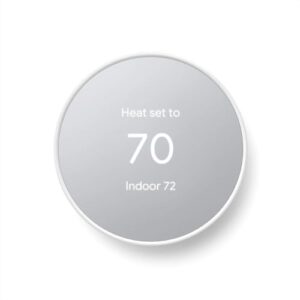
Say you’ve just installed a Nest in your home and you think, "This thing’s so smart, why not run my snake’s heat mat through it?" It won’t work, and trying would be a mistake.
The Google Nest Smart Thermostat (model GA01334-CA) is built for 24V residential HVAC systems, not low-voltage reptile heating equipment. It controls whole-home heating and cooling, and that’s all it does.
For homeowners, it’s genuinely useful. You get remote control via Google Home on Android, iPhone, or web, voice commands through Google Assistant, HVAC monitoring alerts, and ENERGY STAR certification. It even works without a C-wire on compatible systems and includes auto away detection to reduce energy use when you leave the house.
None of that translates to your ball python’s enclosure. You need a purpose-built reptile thermostat, not a smart home device.
| Best For | Homeowners with standard 24V residential HVAC systems who want to save energy and control their home’s temperature remotely. |
|---|---|
| Remote Access | Yes, via Google Home |
| Voice Control | Google Assistant, Matter |
| Display Type | 1.07-inch screen |
| HVAC Compatibility | Heat pump systems |
| Energy Star | Yes |
| Scheduling | Occupancy-based |
| Additional Features |
|
- Control your thermostat from anywhere using the Google Home app or voice commands through Google Assistant.
- ENERGY STAR certified with auto away detection that automatically reduces energy use when you’re not home.
- DIY-friendly installation that most people can complete in 30 minutes or less, no electrician needed.
- Requires a stable Wi-Fi connection for remote control and alerts — without it, smart features stop working.
- Some systems (heating-only, cooling-only, or zone-controlled) may need a C-wire or additional power accessory.
- Temperature and humidity readings aren’t officially guaranteed for accuracy, with precision estimated at around 1%.
Heat Mat and Thermostat Safety and Maintenance
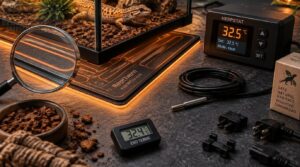
Heating pad safety starts before there’s a problem. Inspect your mat monthly, checking for crushed sections, worn insulation, and loose connections. Heat mat durability drops fast when substrate piles up against the surface, so clear that buildup every cleaning session and unplug the mat before you start.
Thermostat calibration matters more than most keepers realize. Verify your thermostat’s readings against a calibrated thermometer at least once a year. If they disagree by more than a degree or two, recalibrate or replace the unit. Loose probes and poor electrical heating safety practices cause most of the failures you’ll read about in reptile forums.
Also, don’t ignore thermostat sensor replacement. A degraded probe gives false readings, quietly undermining everything you’ve done right. Swapping in a fresh reptile thermostat probe sensor every year or two is cheap insurance against the silent drift that throws your whole temperature gradient off.
Frequently Asked Questions (FAQs)
Do you need a thermostat with a heat mat?
Think of a heat mat as a stove burner left on with no one watching.
Without a thermostat for temperature control, it’s a fire hazard. You need one. A thermostat probe keeps your snake safe.
Can I leave the heat mat on all the time?
Yes, but only with a thermostat. Without one, your mat runs at full power constantly, creating dangerous hot spots. A thermostat cycles it on and off automatically, keeping temperature control precise and your snake safe.
Are heat mats worth it?
Absolutely worth every cent in reptile care. A heat mat delivers consistent, affordable bottom warmth, and when you pair it with a thermostat for proper temperature control, cold spots and fire hazard concerns just disappear.
What temperature should a heat mat be?
Your heat mat’s surface should run between 28 and 32°C (82 to 90°F). Don’t let it ever climb past 38°C, or burns become a real risk. A reptile thermostat probe keeps your temperature control precise.
Do I need a thermostat for a heat mat?
A thermostat isn’t optional in snake husbandry. Without one, your heat mat can easily exceed 120°F, causing ventral burns that are painful and often fatal. The thermostat probe keeps temperatures regulated and your snake safe.
Do I need a thermostat for my seedling heat mat?
A seedling mat left uncontrolled can push surface temps past 85°F, killing germination entirely. A thermostat with probe fixes that, cycling power on and off to hold your root zone at a steady 70°F safely.
What is a heat mat thermostat?
It’s not just an on/off switch. A heat mat thermostat reads your enclosure’s warmth through a thermostat probe and adjusts power output automatically, keeping temperature control precise and your snake reliably safe from dangerous overheating.
Can heat mats be used for other pets?
Practically every reptile and small mammal except birds can benefit from a heat mat. You can safely use one for hamsters or lizards, but always pair your setup with a thermostat to prevent dangerous overheating.
How often should thermostat sensors be replaced?
Like a battery quietly losing charge, your thermostat probe wears out without warning. For reptile heat mat setups, replace it every one to two years. Spot temperature drift beyond 2°C or fraying insulation? Act immediately.
Do heat mats work during power outages?
The second a power outage hits, your heat mat becomes completely dead weight. It won’t generate any warmth without electricity, and your snake’s enclosure will cool fast. A portable power station buys you critical time.
Conclusion
Some keepers assume any temperature controller will do. It won’t. The difference between thermostat and heat mat is the difference between a safe enclosure and a burned animal, and a smart home device designed for rooms can’t manage the precise, low-wattage control a reptile setup demands.
Get a purpose-built reptile thermostat, place the probe correctly, and check your setup regularly. Your snake can’t tell you something’s wrong until it already is.