This site is supported by our readers. We may earn a commission, at no cost to you, if you purchase through links.
Your ball python hasn’t eaten in three weeks, and you’re starting to worry. You’ve checked everything—clean water, fresh prey, proper hide spots—but here’s what most snake owners miss: nighttime temperatures directly control your snake’s appetite, digestion, and immune response.
Drop below 70°F overnight, and your snake’s metabolism grinds to a halt, turning even healthy feeders into stubborn fasters. Push above 85°F, and you’re creating chronic stress that mimics a low-grade fever. The sweet spot sits between 70-80°F for most species, with a deliberate 5-10°F drop from daytime highs that mirrors their natural circadian rhythm.
Getting this balance right isn’t just about comfort—it’s the difference between a thriving snake and one that’s quietly struggling.
Table Of Contents
- Key Takeaways
- What Temperature Do Snakes Need at Night?
- Why Nighttime Temperatures Matter for Snakes
- Nighttime Temperature Needs by Snake Species
- Safe Heating Methods for Nighttime Use
- Monitoring and Maintaining Nighttime Temperatures
- Frequently Asked Questions (FAQs)
- What temperature should a snake be at night?
- What temperature is too cold for snakes to be out at night?
- Should I leave my snakes heat lamp on all night?
- What is too cold for a ball python at night?
- Can snakes survive without any nighttime heating?
- Do baby snakes need different nighttime temperatures?
- How does room temperature affect snake enclosures?
- Should nighttime temperatures vary by season?
- What happens during power outages in winter?
- Conclusion
Key Takeaways
- Most snakes need nighttime temperatures between 70-80°F with a natural 5-10°F drop from daytime highs to support healthy metabolism, digestion, and immune function.
- Temperatures below 70°F trigger cold stress that slows digestion and invites respiratory infections, while temps above 85°F create chronic stress that mimics fever.
- Different species have specific requirements—ball pythons need 75-82°F, corn snakes tolerate cooler ranges at 75-82°F on the cool side, and boa constrictors need 75-80°F.
- Use non-light heat sources like ceramic emitters, heat mats, or radiant panels paired with accurate thermostats and dual thermometers to maintain stable gradients without disrupting your snake’s circadian rhythm.
What Temperature Do Snakes Need at Night?
Most snakes need nighttime temperatures between 70-80°F, though this varies by species. A slight drop from daytime heat is natural and healthy, mimicking what happens in the wild.
Choosing the right heat lamp or alternative heating method ensures your snake stays comfortable overnight without interfering with their sleep cycle, as explained in this guide to nighttime heating for snakes.
Getting the nighttime range right protects your snake from serious health problems while supporting normal behavior.
Typical Nighttime Temperature Ranges
Most snake species require nighttime temperatures between 70 and 90°F, depending on their natural habitat. Desert-dwelling snakes tolerate drops to 70–78°F, while tropical species need 75–82°F overnight.
You’ll want to maintain a temperature gradient even at night, allowing your snake to thermoregulate between warmer and cooler zones. Nighttime drops of 5–10°F from daytime basking temperatures support healthy thermal cycles without shocking your reptile’s system.
Importance of Nighttime Cooling
Controlled nighttime cooling promotes healthy reptile thermoregulation by mimicking your snake’s natural circadian rhythm. A temperature drop of 5–10°F reduces metabolic stress, aids digestion, and promotes ideal shedding cycles.
This thermal balance between day and night also stabilizes nighttime humidity levels within your enclosure. Without proper cooling systems, constant heat disrupts snake behavior and can trigger chronic stress responses that compromise long-term health.
Risks of Incorrect Nighttime Temperatures
When nighttime temperatures fall outside your snake’s range, you risk serious health consequences. Cold stasis slows digestion and invites respiratory infections, while excessive heat causes dehydration effects through increased water loss.
Temperature stress from sudden thermal shock disrupts immune function, and large swings between day and night create metabolic strain.
Proper temperature regulation protects your snake from these preventable health risks through consistent reptile thermoregulation.
Why Nighttime Temperatures Matter for Snakes
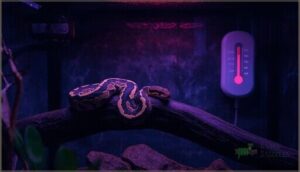
Understanding why nighttime temperatures matter starts with understanding how snakes work. Unlike mammals, your snake can’t generate its own body heat—it depends entirely on its environment to maintain proper metabolic function.
Snakes can’t generate their own body heat, so nighttime temperatures directly control every aspect of their metabolism and health
Getting nighttime temps wrong doesn’t just make your snake uncomfortable; it can trigger serious health problems that affect everything from digestion to immune response.
If you’re unsure whether your setup is dialed in correctly, learning how to tell if your snake is getting the right temperature will help you spot warning signs before they escalate into bigger issues.
Snake Thermoregulation Explained
Unlike mammals, your snake can’t generate its own warmth—it relies entirely on external heat sources to power every biological function. Here’s how thermoregulation works:
- Your snake moves between warmer and cooler zones to maintain its preferred thermal balance
- Basking raises body heat before activity; retreat to substrate layers triggers cooling
- Rostral orientation toward heat indicates active temperature adjustment
- Temperature gradient choices guide snake behavior throughout day and night cycles
- Proper reptile temperature regulation directly impacts digestion, movement, and overall reptile health
For a deeper understanding, learn how ectothermy is a key characteristic of snakes that shapes their thermal regulation needs.
Effects on Metabolism and Behavior
Temperature directly controls your snake’s metabolic rate. Cooler nights reduce energy use by up to 15 percent, shifting fuel sources toward fat. This drop slows digestion and extends rest cycles, supporting natural circadian rhythms.
Moderate cooling triggers precise sheltering behavior and energy conservation, while unstable nighttime temperatures cause restless pacing, irregular feeding cues, and disrupted nocturnal activity patterns that stress your snake.
Health Consequences of Temperature Fluctuations
Thermal stress from unstable nighttime temperatures compromises your snake’s immune defense and organ function. Poor temperature regulation triggers serious health risks:
- Respiratory issues develop when cold air irritates airways, causing mucus buildup and labored breathing.
- Dehydration risks increase as metabolic problems disrupt fluid balance.
- Cardiovascular strain from repeated temperature swings weakens circulation.
- Consistent thermal gradient maintenance protects long-term reptile health.
Nighttime Temperature Needs by Snake Species

Different snake species have evolved in vastly different climates, which means their nighttime temperature needs aren’t one-size-fits-all. What works perfectly for a ball python from West Africa won’t necessarily suit a corn snake native to temperate North America.
Let’s break down the specific nighttime requirements for the most commonly kept pet snakes so you can dial in the right temperatures for your species.
Ball Python Nighttime Requirements
Ball Pythons need nighttime temperatures between 75 and 82°F to support healthy digestion rates and thermal cycles. Your setup should maintain this range using temperature control equipment paired with proper humidity control.
Don’t let temperatures drop below 70°F, as this disrupts snake behavior and slows metabolism. A consistent temperature gradient allows your ball python to thermoregulate naturally, meeting snake temperature requirements without the stress of nighttime heat extremes.
It’s also important to use equipment like digital thermometer/hygrometers to regularly monitor both temperature and humidity in the enclosure.
Corn Snake Nighttime Requirements
Corn Snakes tolerate cooler nighttime heat than many other species, with the cool zone holding steady at 75 to 82°F. Hatchling Night Temps benefit from the upper end to support Metabolism Support during their first year.
Maintain a stable temperature gradient using Non-Light Heating equipment and temperature control devices. This Gradient Stability helps meet snake temperature requirements without disrupting circadian rhythm, preventing respiratory stress, and ensuring proper thermoregulation.
Boa Constrictor and Other Common Species
Boa constrictors need a cool-side nighttime temperature between 75 and 80°F to mirror their natural habitat cycles. Species variations among constrictors demand attention to detail:
- Larger females require broader temperature gradient zones for proper thermoregulation
- Stable temperature control prevents metabolic stress and aids snake nutrition absorption
- Nighttime temperature drops to 75°F encourage natural constrictor behavior patterns
- Consistent reptile hygiene paired with correct snake temperature requirements reduces respiratory infections
Safe Heating Methods for Nighttime Use
Choosing the right nighttime heating equipment protects your snake from temperature drops while respecting their natural need for darkness. You’ll want heat sources that don’t emit visible light, since constant illumination disrupts their circadian rhythm and causes stress.
Let’s examine the most effective options that maintain stable temperatures throughout the night.
Heat Mats and Under-Tank Heaters
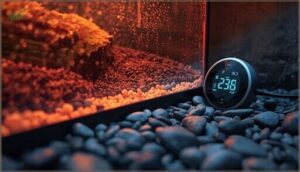
Under-tank heaters provide steady nighttime heat without light disturbance. Mount your heat mat externally beneath one-third of the tank’s base to create a proper thermal gradient. You’ll need a reliable thermostat—proportional models prevent dangerous temperature swings. Position the probe near the warm zone and calibrate regularly.
| Setup Element | Best Practice |
|---|---|
| Mat Coverage | One-third of tank base |
| Placement | External mounting under glass |
| Thermostat Type | Proportional with safety cutoff |
| Probe Position | Near warm zone substrate surface |
Ceramic Heat Emitters and Radiant Panels
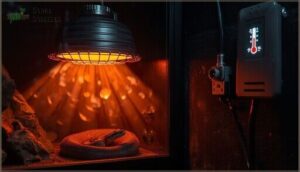
When light-free reptile heating is your priority, ceramic heat emitters and radiant heat panels provide excellent heat source options. CHEs convert electrical energy into infrared radiation within minutes, delivering rapid nighttime temperature control. Radiant panels offer excellent heat distribution across broader surfaces, improving thermostat compatibility and reducing hot spots.
Consider these ceramic emitter safety and maintenance factors:
- Install protective guards to prevent contact burns from heated surfaces
- Mount radiant panels away from substrates that warp under sustained heat
- Clean emitters monthly using non-abrasive methods to maintain peak emitter efficiency
- Inspect connections regularly for moisture damage or coating deterioration
Using Thermostats for Temperature Control
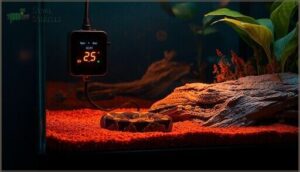
Thermostats transform your heat source options from guesswork into precision reptile temperature regulation. You’ll want models with digital temperature sensors that read within ±1°F accuracy.
Proper thermostat placement—positioned at mid-enclosure height—ensures reliable nighttime temperature control without false readings from drafts.
Thermostat calibration matters: verify settings against a separate thermometer weekly. This approach delivers consistent temperature regulation while improving energy efficiency throughout your snake’s nocturnal cycle.
Monitoring and Maintaining Nighttime Temperatures
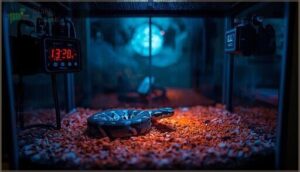
Getting your heating equipment set up is only half the battle—you need reliable tools to track what’s actually happening inside the enclosure. Without accurate monitoring, you won’t know if your snake is experiencing dangerous temperature swings during the night.
Let’s cover the essential equipment and strategies that keep your snake’s nighttime environment stable and safe.
Best Thermometers for Snake Enclosures
Accurate temperature monitoring protects your snake’s thermoregulation and long-term health. You’ll need reliable temperature sensors positioned across the gradient to track both ambient air and surface readings.
Digital probes deliver instant readings with 0.5-degree precision, while infrared guns scan warm zones in seconds.
Wireless systems support multiple probes with app-based alerts, and thermostat controllers automate temperature control for consistent reptile care throughout the night.
Preventing Dangerous Temperature Drops
Power outages and drafty rooms can push overnight temperatures into dangerous zones without warning. Position your enclosure away from exterior walls and vents that funnel cold air during night hours, reducing heat loss by up to 40 percent. Pair ceramic heaters with under-tank mats for redundant heat source options, and install a thermostat with a 1-to-2-degree deadband to maintain your thermal gradient.
| Risk Factor | Prevention Strategy |
|---|---|
| Sudden drops below 60°F | Secure warm refuge within 6 inches of heat source |
| Power failures | Battery backup or redundant heating system |
| Draft exposure | Close doors, use blackout curtains, insulate sides |
This layered approach to enclosure insulation and temperature control safeguards against snake health risks linked to respiratory infection and torpor.
Tips for Consistent Nighttime Heating
Consistently, you’ll maintain stable nighttime heat by placing two digital thermometers at opposite ends of your thermal gradient—one near the heat source, one in the cool zone. Set thermostat settings between 75 and 85°F for most species, and monitor humidity levels alongside temperature control.
Check readings midway through each night to catch drift early, ensuring your nighttime temperature stays within safe parameters.
Frequently Asked Questions (FAQs)
What temperature should a snake be at night?
Your snake needs nighttime temperatures between 70 and 80°F on the warm side, with cooler zones dropping to 65-75°F.
This thermal gradient facilitates proper thermoregulation and mirrors natural nocturnal conditions for healthy snake behavior.
What temperature is too cold for snakes to be out at night?
Most pet snakes experience cold stress when nighttime temperature drops below 70°F (21°C). Extended exposure under 60°F (15°C) slows metabolism dangerously, impairing digestion and immune function in ectothermic animals.
Should I leave my snakes heat lamp on all night?
You shouldn’t leave a bright heat lamp on overnight—it disrupts natural circadian rhythms and risks overheating. Instead, switch to ceramic heat emitters or regulated heat mats that maintain your thermal gradient without light.
What is too cold for a ball python at night?
For Ball Pythons, nighttime temperatures below 75°F trigger cold stress symptoms like lethargy and weakened immunity.
Maintain your nighttime habitat’s thermal gradient between 78-82°F on the cool side, with proper temperature control preventing dangerous temperature fluctuations that affect snake behavior.
Can snakes survive without any nighttime heating?
While some keepers skip nighttime heat, doing so risks cold stress and respiratory infections. Your snake’s ectothermic nature demands proper temperature control—even brief nocturnal drops below 70°F can disrupt thermoregulation and trigger dangerous temperature fluctuation.
Do baby snakes need different nighttime temperatures?
Yes, hatchlings need a warm gradient with nighttime temperatures 5 to 10°F cooler than daytime basking areas.
Baby snake care requires stable temperature control to support thermoregulation and prevent metabolic stress in growing snakes.
How does room temperature affect snake enclosures?
Room temperature directly influences your enclosure’s baseline warmth, especially the cool zone. Most homes drop 5 to 10 degrees overnight, requiring supplemental heat sources and proper enclosure insulation to maintain stable temperature gradients.
Should nighttime temperatures vary by season?
Your snake’s nighttime temperature requirements don’t change with the calendar. Maintain consistent thermal gradients year-round—snakes rely on steady temperature ranges for proper thermoregulation, regardless of seasonal temperature fluctuation outside their enclosure.
What happens during power outages in winter?
During winter power grid failure, your snake faces cold shock within hours as temperatures plummet. Emergency preparedness requires backup heat sources, insulated enclosures, and temperature monitoring to prevent hypothermia effects and maintain critical nighttime heat.
Conclusion
Picture your snake coiled comfortably in its hide, body temperature dropping in sync with the night—that’s proper husbandry at work. Understanding what temperature do snakes need at night transforms guesswork into precision care.
You’ve invested in the right equipment, mastered thermostat settings, and learned your species’ specific requirements. Now your snake can do what millions of years of evolution designed it for: rest, digest, and thrive in conditions that mirror its natural habitat.