This site is supported by our readers. We may earn a commission, at no cost to you, if you purchase through links.

A ball python curled in the corner of a 10-gallon tank isn’t just cramped—it’s trapped in a cycle of stress that affects everything from feeding to shedding. Tank dimensions shape your snake’s entire world, determining whether it can thermoregulate properly, exhibit natural behaviors, or simply stretch out without hitting glass on both ends.
Too small, and you’ll see the telltale signs: refusal to eat, constant glass-surfing, or defensive striking. Too large for a hatchling, and temperature gradients become impossible to maintain.
Getting appropriate snake tank dimensions right from the start means understanding your species’ adult size, activity patterns, and whether those coils belong on the ground or wrapped around branches twenty inches high.
Table Of Contents
Key Takeaways
- Tank dimensions directly affect your snake’s ability to thermoregulate, exhibit natural behaviors, and avoid chronic stress that suppresses feeding and immune function.
- Proper enclosure size is calculated by ensuring the combined length and width equal or exceed your snake’s adult body length, with terrestrial species prioritizing horizontal space and arboreal species requiring 24-48 inches of vertical height.
- Most adult ball pythons need at least 48″L × 24″W × 12″H, corn snakes require around 48″L × 18-24″W, and boa constrictors demand 8’L × 4’W × 2-3’H minimum to allow full extension and comfortable coiling.
- Upgrading becomes necessary when your snake reaches about 60% of the current enclosure size, with secure lids, multiple hides covering 20% of floor area, and proper temperature gradients (warm side 80-88°F, cool side 75-78°F) being non-negotiable safety requirements.
Why Snake Tank Dimensions Matter
Your snake’s tank isn’t just a container—it’s the foundation of their entire world. The right dimensions affect everything from their stress levels and activity patterns to their ability to thermoregulate and stay healthy.
Getting the measurements right from day one prevents costly upgrades later—check out this complete guide to appropriate snake enclosure sizes to match your specific species’ needs.
Your snake’s tank isn’t just a container—it’s the foundation of their entire world, affecting stress, activity, and health
Let’s look at why getting the size right matters so much for your snake’s well-being.
Impact on Snake Health and Behavior
The right snake tank size shapes everything from muscle tone to appetite. When your enclosure meets species-specific needs, you’ll notice healthier behavioral changes and easier health monitoring. Environmental factors like space directly influence reptile health and welfare considerations:
- Proper dimensions support natural S-shaped movement and climbing
- Adequate room facilitates thermoregulation and reduces snake stress
- Sufficient hiding spots preserve normal exploratory behavior
- Appropriate enclosure size improves feeding response and digestion
Preventing Stress and Escape
Stress reduction starts with secure enclosures that prevent both anxiety and escapes. Install lids with locking seams and check hinges for gaps—snakes will press their heads against any weak spot. Use lid clamps on glass tanks and inspect door latches weekly for wear.
A well-sized tank with stable temperatures and quiet surroundings calms your snake while escape-proofing protects both pet and household.
Long-Term Welfare Considerations
Beyond preventing immediate escapes, your enclosure size shapes years of reptile welfare. A cramped tank breeds chronic stress, suppressing immune function and appetite throughout your snake species’ lifespan.
Plan for adult dimensions now—proper snake tank size facilitates health monitoring, environmental enrichment, and dietary needs as your pet matures. Regular veterinary care and space upgrades form the backbone of long-term snake care, not afterthoughts.
Key Factors Influencing Tank Size
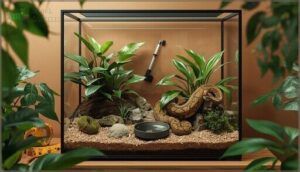
Picking the right tank size isn’t just about measuring gallons and calling it a day. Your snake’s adult size, natural habitat style, and energy level all play a role in determining how much space they actually need.
If your snake gets injured, you’ll also need to adjust its setup temporarily—here’s a guide to housing an injured snake safely during recovery.
Let’s break down the three main factors that should guide your decision.
Adult Size and Growth Rate
Your snake’s adult length determines its lifelong enclosure size, so understanding growth rate is essential. Ball pythons reach 4 to 5 feet, while boa constrictors stretch 6 to 8 feet—massive size factors that demand proper tank upgrades.
Most snakes hit adult size within 3 to 5 years, but growth patterns vary by species. Planning your snake tank size guide around adult dimensions prevents costly enclosure replacements down the road.
Species-Specific Needs (Terrestrial Vs. Arboreal)
Different lifestyles demand different enclosure size strategies. Terrestrial species like ball pythons prioritize horizontal space for ground-level exploration, while arboreal needs shift focus upward—green tree pythons won’t thrive without vertical climbing structures.
Habitat design should mirror snake behavior: terrestrial requirements favor wide floor areas with burrowing substrate, whereas arboreal species research reveals tall setups with sturdy branches supporting species-specific needs.
For a deeper understanding of these distinctions, review the definitions and habitat preferences that set arboreal and terrestrial animals apart.
Activity Level and Enrichment Requirements
Active snakes require more than floor space—they need environmental enrichment that stimulates behavioral patterns. Species-specific needs drive habitat design: arboreal snakes demand climbing branches, while terrestrial burrowers benefit from varied substrate layers.
Regular activity monitoring confirms your snake’s exercise levels remain healthy. Rotate enrichment items weekly to maintain behavioral stimulation, ensuring your enclosure size accommodates both movement and meaningful exploration opportunities that reduce stress.
Recommended Tank Dimensions by Species
Different snake species have wildly different space requirements, and picking the right tank size starts with knowing what your specific snake needs. A ball python won’t thrive in the same setup as a boa constrictor, and arboreal species need completely different dimensions than ground-dwellers.
Let’s break down the recommended tank sizes for some of the most popular pet snake species.
Ball Python Tank Size Guidelines
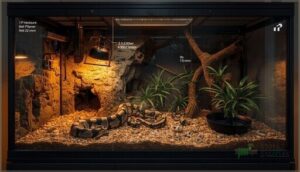
When you’re housing a ball python, you can’t just guess. Adults stretch to 4 or 5 feet, so you’ll need an enclosure at least 48 inches long, 24 inches wide, and 12 inches tall to meet species-specific needs and proper tank size calculations.
- Enclosure size for larger individuals: 6 to 8 feet long allows full coiling
- Enclosure materials like glass or acrylic need tight seals against escape
- Hiding spots should cover 20 percent of floor area
- Temperature gradient: 80°F basking side, 78°F cool side
- Humidity control and ventilation systems maintain 50 to 60 percent moisture
Snake growth rates demand planning ahead, not reacting later.
Corn Snake Enclosure Requirements
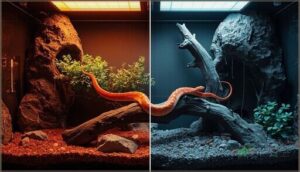
You’ll want your adult corn snake to stretch without stress. These snakes average 4 to 5 feet, so plan for enclosures around 48 inches long and 18 to 24 inches wide—a standard 55-gallon tank works well. Narrow cages restrict movement and trigger shedding problems. Corn snake habitats need at least 12 inches of height for climbing enrichment.
| Enclosure Size | Corn Snake Care and Housing | Temperature Control |
|---|---|---|
| 48″ L × 18″ W | Secure lid, multiple hides | Warm side: 85°F |
| 55-gallon capacity | Snake substrate: aspen or paper | Cool side: 75°F |
| 12″+ height | Enclosure lighting: 12-hr cycle | Humidity management: 40-50% |
| Tank size guide | Rails/branches for climbing | Heat gradient essential |
Boa Constrictor Minimum Dimensions
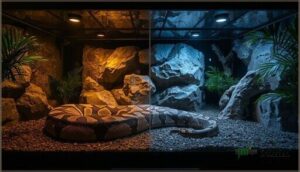
Boa constrictors grow massive—8 feet or more—and need enclosures to match their scale. You’re looking at a minimum of 8 feet long, 4 feet wide, and 2 to 3 feet tall for a proper boa habitat. That’s roughly 120 gallons or more.
Larger boas benefit from custom setups that support heavy hides and vertical space for enrichment. Ground area must equal your snake’s length to allow full extension and comfortable coiling.
Heat gradients matter too: 85°F warm side, 75°F cool side.
King and Garter Snake Needs
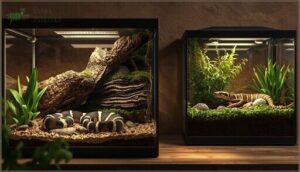
King snakes and garter snakes are the compact cousins of the snake world. They don’t demand massive real estate, but you still need to get the enclosure size right.
Here’s your baseline terrarium setup for these species:
- King snake tank size: 40 gallons minimum (36 inches long, 18 inches wide) for adults up to 5 feet
- Garter snake habitat design: 30 to 40 gallons for active adults
- Snake substrate and enrichment: Floor space for full extension, with hides covering 20% of ground area
Both species benefit from species-specific needs—garter care includes moisture gradients, while king snake feeding areas need secure spacing.
Arboreal Snake Height Considerations

Snakes that live in trees turn the sizing game vertical. Arboreal species like green tree pythons need 24 to 48 inches of vertical height to perch and patrol naturally.
Think canopy design, not floor plans. Secure climbing structures and properly spaced branch placement create tree snake habitats that support natural behavior.
Your enclosure size strategy shifts upward when vertical space becomes the priority.
How to Calculate Proper Snake Tank Size
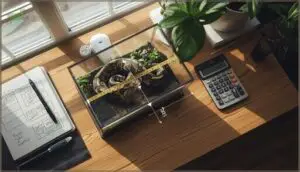
Getting the tank size right isn’t guesswork—it’s math based on your snake’s actual measurements and activity needs. The formulas below help you figure out the minimum dimensions, whether you’re buying your first enclosure or planning an upgrade.
Let’s break down the calculations so you can confidently choose a tank that fits your snake’s lifestyle.
Length and Width Vs. Snake Length
Calculating proper enclosure size starts with understanding snake length metrics and body proportions. Measure your snake’s total length while it’s relaxed and straight, then confirm the combined tank dimensions (length plus width) equal or exceed that measurement.
For most species, aim for a tank length at least two-thirds your snake’s body length, with width providing room to stretch without constant curling.
Gallon Capacity Calculations
Once you’ve confirmed dimensions, you’ll need to convert them into usable gallon numbers. For rectangular tanks, multiply length times width times height (all in inches), then divide by 231 to get your tank volume in gallons. This conversion formula prevents capacity errors that might leave your snake cramped.
Round to the nearest 0.1 gallon for your tank size guide, and double-check with measurement tips from a calculation tool if you’re unsure.
Upgrading as Your Snake Grows
Once you’ve measured capacity, watch your snake’s growth rate to time tank upgrades right. You’ll know it’s time for habitat expansion when your snake’s length reaches about 60 percent of the enclosure size.
Growth monitoring every month helps you plan ahead, ensuring species-specific needs stay met. Size adjustments prevent stress and support proper snake enrichment as your pet reaches its full adult dimensions.
Creating a Safe and Functional Snake Enclosure
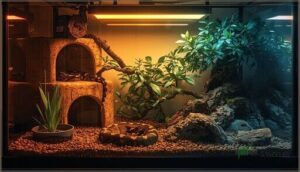
Getting the tank size right is only half the equation. Your snake also needs an enclosure that keeps them secure, accommodates natural behaviors, and maintains the right environmental conditions.
Let’s cover the essential elements that turn a properly sized tank into a safe, functional home.
Secure Lids and Escape Prevention
Even the most perfectly sized enclosure won’t keep your snake safe if it can escape. Lid lock mechanisms and secure fasteners form your first line of defense—think of them as the final checkpoint between proper care and an empty tank. Lid clamps rated for reptile use prevent prying or lifting, especially on glass aquariums where standard covers simply rest on top.
- Magnetic clasps alone won’t cut it for larger species; add a hasp or secondary clip
- Check gaskets and sealants regularly to catch cracks before they become exit routes
- Test your setup with gentle upward pressure to identify weak points early
Tank reinforcement through locking vent panels and reinforced edges stops escape attempts before they start. For arboreal species that push boundaries, internal strap latches add a fail-safe layer. Your enclosure size matters, but without proper safety features, even the best snake tank size becomes a temporary home. Additional escape prevention strategies, such as various lid securing methods, are widely recommended by exotic pet keepers.
Optimal Layout for Movement and Hiding
Smart enclosure design sets up snake pathways that let your animal move freely between thermal gradients and hide placement zones. Position at least two hides at opposite ends—one warm, one cool—so your snake can thermoregulate without crowding.
Movement zones need clear corridors at least 1.5 times your snake’s girth, preventing bottlenecks that cause stress and letting species-specific needs drive your reptile enclosure design decisions.
Balancing Space, Temperature, and Humidity
Your snake’s tank size directly shapes temperature control and humidity levels—larger enclosures need more deliberate ventilation systems to prevent stagnant air while maintaining stable thermal zones.
Species-specific needs dictate whether you prioritize basking gradients (78–88°F) or humidity retention (40–60%), so match enclosure dimensions and design choices to your snake’s behavior, ensuring proper airflow without sacrificing microclimate stability.
Frequently Asked Questions (FAQs)
How big should my snake tank be?
Think of your snake’s enclosure as a studio apartment—not a closet.
Tank size depends on adult length, species-specific needs, and activity level, with proper enclosure dimensions supporting reptile health factors and natural movement.
Can a ball python live in a 4x2x2?
Yes, a 4x2x2 enclosure works well for most adult ball pythons. This ball python care standard provides adequate space for thermoregulation, python behavior, and enrichment while meeting species-specific needs for both movement and security.
Can multiple snakes share the same tank safely?
Most snakes are solitary and shouldn’t share enclosures due to stress, aggression, and cohabitation risks.
Even species-specific needs like garter snakes tolerating multi snake setups require ample space, animal enclosures with multiple hides, and careful monitoring for snake compatibility issues.
Do baby snakes need smaller starter tanks?
Contrary to popular belief, hatchlings thrive in cozy 10 to 20 gallon starter enclosures rather than oversized tanks.
Compact spaces reduce stress, support warmth control, and help baby snakes feel secure during critical growth stages.
How often should I replace my snakes tank?
You don’t need frequent tank replacement—upgrade when your snake outgrows it (usually every 1-2 years) or when damage, persistent odors, or failed seals compromise enclosure safety and humidity control.
What materials work best for snake tank construction?
Building a terrarium requires selecting the right foundation. PVC enclosures offer excellent heat retention, while glass panels provide visibility. Acrylic hybrids, HDPE materials, and melamine boards each bring unique benefits for reptile enclosures.
Conclusion
Your snake’s quality of life hinges entirely on those first measurements you take. Getting appropriate snake tank dimensions right isn’t about ideal conditions—it’s about giving your animal room to behave like the predator it’s.
Measure twice, upgrade when growth demands it, and watch feeding responses improve when your python can finally patrol its territory without bumping glass. The difference between surviving and thriving often comes down to twelve additional inches of floor space.