This site is supported by our readers. We may earn a commission, at no cost to you, if you purchase through links.

Corn snakes make terrible first impressions on nervous beginners—and great ones on everyone else. They’re calm, handleable, and small enough that a 20-gallon tank fits comfortably on a desk. The catch? Setting up that tank incorrectly is the fastest way to stress out a snake that was otherwise perfectly easy to keep.
Most beginners don’t struggle with the snake itself; they struggle with the setup. The right corn snake kit for beginners takes the guesswork out of temperatures, substrate depth, and ventilation before your new pet ever comes home. Knowing which kits actually deliver on that promise makes all the difference.
Table Of Contents
- Key Takeaways
- Essential Components of Corn Snake Kits
- Choosing The Right Enclosure Size
- Setting Up Your Corn Snake Habitat
- Top 7 Corn Snake Kits for Beginners
- Tips for Successful Corn Snake Care
- Frequently Asked Questions (FAQs)
- What do corn snakes need in their tank for beginners?
- Are corn snakes easy for beginners?
- Do corn snakes need a heat lamp 24 7?
- How much does a corn snake typically cost?
- What prey size is right for hatchlings?
- How often should I feed my corn snake?
- When can I handle my snake after feeding?
- How do I check my snakes overall health?
- Conclusion
Key Takeaways
- Setting up your corn snake’s enclosure correctly before it arrives—with stable heat, proper substrate depth, and hides on both ends—is the single biggest factor in keeping your new pet healthy and stress-free.
- A 20-gallon tank works for juveniles, but once your snake hits around 18 inches, upgrading to a 40-gallon is a must—cramped spaces cause real health problems, not just discomfort.
- Every kit needs a heat mat, thermostat, dual thermometers, and hides on both the warm and cool sides; skipping any of these means your snake can’t thermoregulate properly.
- Most beginner kits on the market are better suited for hatchlings or small invertebrates, so read the dimensions carefully—what’s marketed as a “starter kit” often needs an upgrade within months.
Essential Components of Corn Snake Kits
A good corn snake kit isn’t just a box with stuff thrown in—every piece has a job to do. Knowing what to look for makes the difference between a setup that works and one that leaves you troubleshooting at midnight.
Here’s what every solid beginner kit should include.
For corn snakes specifically, check out this guide on small snake breeds that stay manageable to make sure your setup fits their size from day one.
Secure Glass Terrariums for Safe Housing
A glass terrarium is your corn snake’s entire world, so getting this part right sets the tone for everything else. When shopping for a reptile enclosure or starter kit, keep these five things in mind:
- Terrarium materials should be thick, quality glass
- Glass safety means no sharp edges inside
- Secure lids prevent escape attempts—corn snakes are clever
- Ventilation systems keep airflow healthy
- Escape prevention beats chasing your snake around the house
Proper Heating and Lighting Equipment
Once your terrarium is locked down and escape-proof, the next thing your corn snake is counting on you to get right is temperature and lighting. A heat mat on one side paired with a heat lamp above gives you a proper warm-to-cool gradient. Use a thermostat to lock the warm side around 85°F. Add a thermometer to verify it, and a UVB lighting strip keeps their day/night cycle on track.
Safe Substrate Options for Burrowing
With your heating and lighting dialed in, it’s time to think about what’s actually going on the floor of that tank — and your corn snake’s going to have some strong opinions about it.
Substrate isn’t just filler. It shapes humidity control, comfort, and your snake’s ability to burrow naturally. Most starter kits include aspen shavings, which is a solid reptile care staple. A bioactive mix is a worthy upgrade.
Top burrowing materials to ponder:
- Aspen shavings — absorbent, affordable, widely available
- Bioactive mix — fosters naturalistic behavior and humidity control
- Sphagnum moss — great for a humid hide corner
- Coconut fiber — soft and burrow-friendly
- Avoid cedar or pine — toxic to corn snakes
Aim for at least two to three inches of substrate depth so your corn snake can actually dig in.
Must-have Accessories (hides, Water Dishes, Thermometers)
Now that your snake has a cozy floor to dig into, the next thing on your list is making sure the inside of that tank actually feels like home — and that starts with three things your corn snake absolutely can’t live without: hides, a water dish, and a thermometer.
Place snake hides on both the warm and cool sides of the substrate. Your water dish should sit on the cool side to keep humidity balanced. And don’t skip a thermometer — accurate thermometer placement tells you whether that heat mat is actually doing its job.
Inclusion of Beginner-friendly Care Guides
A solid care guide tucked into your starter kit is worth more than you might think — it’s basically a cheat sheet for keeping your new corn snake alive and thriving through those first confusing weeks. Good ones cover feeding strategies, snake handling basics, habitat maintenance, and health monitoring all in one place.
Think of it as your new pet acquisition guide — corn snake husbandry made simple, right from day one.
Choosing The Right Enclosure Size
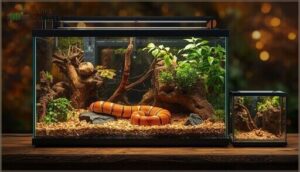
Getting the enclosure size right is honestly one of the most important decisions you’ll make as a new corn snake owner. A tank that’s too small now will just mean more work and expense later when your snake outgrows it.
Here are the key things to understand about sizing before you pick your first setup.
Starter Tank Sizes for Juvenile Corn Snakes
Most beginner kits start you off with a 20-gallon tank, which is a decent home for a juvenile corn snake—but don’t get too comfortable with it, because your little escape artist will outgrow it faster than you’d expect.
For hatchlings, that starter kit terrarium works fine short-term. Just make sure it has solid ventilation systems, a reliable heat mat, and UVB lighting to support healthy snake growth rates from day one.
Upgrading Enclosure as Your Snake Grows
Once your corn snake hits around 18 inches, that starter tank stops feeling like a cozy home and starts feeling more like a studio apartment it can’t wait to escape. That’s your cue for a habitat upgrade.
Aim for a 40-gallon terrarium as a solid next step. Scale up your heat mat and UVB lighting too—snake growth means your reptile enclosure design needs to grow right along with it.
Risks of Undersized Habitats
Cramming a corn snake into a too-small terrarium isn’t just uncomfortable — it’s genuinely harmful. Poor thermoregulation sets in when your heat mat and UVB lighting can’t create a proper gradient across a short enclosure.
Stress signs like wall-pacing and frantic tongue-flicking follow fast. Feeding issues emerge next, then real health impacts: muscle atrophy, stuck sheds, even spinal problems. Injury risks from escape attempts round out the damage.
For a detailed overview of, it’s essential to provide an appropriate enclosure environment.
Setting Up Your Corn Snake Habitat
Once you’ve got the right size enclosure picked out, it’s time to actually make it feel like home—for your snake, anyway. Getting the setup right from the start means less stress for your new pet and fewer headaches for you down the road.
Here’s how to nail each part of the habitat before your corn snake ever sets foot inside.
Creating Effective Temperature Gradients
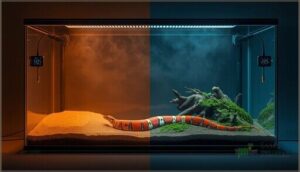
Think of your enclosure like a personal climate zone — one warm end, one cool end, and your snake decides where it wants to be. That’s thermoregulation in action.
Aim for 80–85°F on the warm side using a heat mat, and 75–82°F on the cool side. Digital thermometers with multiple probes make temperature monitoring and gradient design simple and accurate.
For further insight on temperature and humidity levels essential for corn snake care, consult expert resources.
Installing Heating and Lighting Systems
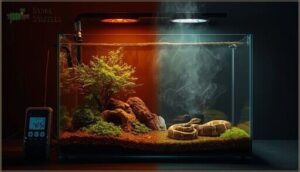
Getting the heating and lighting right is honestly the part that makes or breaks your whole setup. A reptile heating pad under one side covers your heat mat basics, but pair it with a digital temperature controller so you’re not guessing. Thermometer placement matters — one probe per side.
For lighting, a simple daylight bulb on a 12-hour timer keeps everything consistent without the stress.
Arranging Substrate and Decorations

Now that your heat and light are locked in, it’s time for the fun part — layering in the substrate and decorations that’ll make your snake actually feel at home. Pour aspen shavings about three inches deep for proper substrate depth — corn snakes love to burrow.
For decor placement, tuck hiding places on both ends of the terrarium. A vine or fake plant adds aesthetic design without crowding the space.
Establishing a Healthy Day/night Cycle
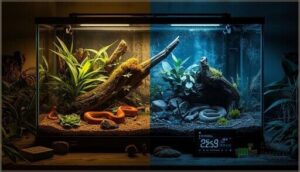
Your snake’s home is looking great — but don’t forget that corn snakes thrive on a steady rhythm of light and dark, just like they’d experience in the wild. A consistent 12-hours-on, 12-hours-off photoperiod regulation maintains their natural circadian rhythm. Use a timer on your terrarium light to stay consistent.
Your thermometer and hygrometer will confirm that temperature control and humidity management stay stable through both cycles.
Top 7 Corn Snake Kits for Beginners
Now that your habitat plan is in place, it’s time to find the right kit to bring it all together.
These seven options cover a solid range of sizes, features, and price points — so there’s something here whether you’re working with a tight budget or ready to invest a little more.
Let’s take a look at what each one brings to the table.
1. Helime Reptile Terrarium Kit
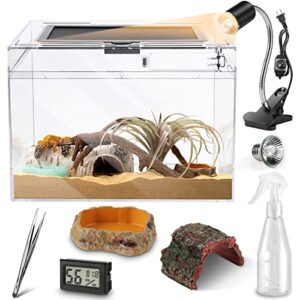
The HELIME Reptile Terrarium Kit is a compact, lightweight option that works well as a temporary starter home for a hatchling corn snake. Built from shatterproof polycarbonate, it measures just 12 by 7 inches with a 3.2-gallon capacity — fine for a tiny hatchling, but you’ll need to upgrade quickly as your snake grows.
It comes with a ventilated mesh lid, front-access doors, and basic accessories. Think of it as a launchpad, not a forever home.
| Best For | Beginners, classroom educators, and breeders who need a compact, escape-proof starter home for small reptiles like geckos, frogs, or hatchlings. |
|---|---|
| Material | Polycarbonate |
| Escape-Proof Design | Secure sliding top |
| Ventilation | Mesh lid |
| Transparency | Clear polycarbonate |
| Dimensions | 11.7 x 8.9 x 7 in |
| Starter Kit | 7-piece kit |
| Additional Features |
|
- Comes as a complete 7-piece kit, so you’re not scrambling to buy accessories separately
- Lightweight and stackable, which makes it easy to store or set up multiple enclosures
- Works for both desert and rainforest setups, giving you some flexibility
- The mesh top has large enough gaps that tiny animals can escape — and a tarantula can tear right through it
- The heat lamp can melt the plastic lid if placed too close, which is a real safety concern
- Assembly instructions are lacking, and the small screw pieces tend to pop out of their holes easily
2. Exo Terra Snake Terrarium Kit
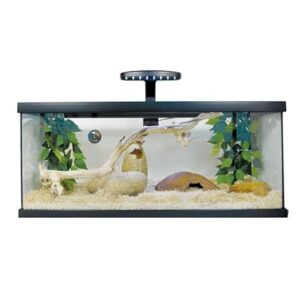
If you’re ready to step up from a bare-bones hatchling enclosure, the Exo Terra Snake Starter Kit is worth a serious look. The 24 x 18 x 12-inch glass terrarium gives a juvenile corn snake real room to explore.
You get a 16-watt heat mat, a UVB100 compact bulb, a reptile cave hide, a water dish, and a moss mat — all bundled together.
The dual front-opening doors make feeding and spot-cleaning surprisingly painless for first-time keepers.
| Best For | Anyone just getting started with a small or juvenile snake, like a corn snake, who wants everything they need in one box. |
|---|---|
| Material | Glass/Aluminum/Plastic |
| Escape-Proof Design | Screen top |
| Ventilation | Screen top |
| Transparency | Glass panels |
| Dimensions | 31.8 x 14 x 14.6 in |
| Starter Kit | 10-piece kit |
| Additional Features |
|
- Comes with all the basics — bedding, hide, water bowl, heater, and lighting — so you’re not scrambling to piece things together
- The 20-gallon long layout gives young snakes enough space to actually move around and explore
- Screen top helps with ventilation, which keeps humidity from getting out of hand
- Some buyers have gotten tanks that arrived cracked or broken, which points to some frustrating packaging issues
- The heating setup really should have a thermostat to be safe — that’s an extra cost they don’t mention upfront
- The water bowl runs small, and the included substrate might not work for every keeper’s setup
3. Azv Reptile Terrarium Starter Kit
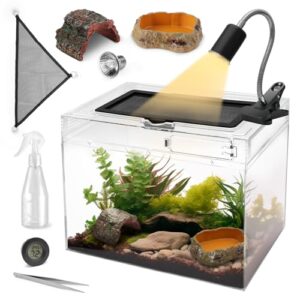
The Azv Reptile Terrarium Starter Kit is a solid pick if you’re housing a hatchling or small invertebrate. At roughly 15.6 x 8 x 10 inches, it’s compact — desktop-friendly, but not really a long-term home for a growing corn snake.
The eight-piece bundle covers the basics: heat lamp, combo hygrometer-thermometer, hide cave, sprayer, tweezers, feeding bowl, and a hammock. The escape-proof locking lid is genuinely reassuring for beginners.
Just keep the heat lamp on a timer — the polycarbonate material doesn’t love prolonged direct heat.
| Best For | Beginners, families, and hobbyists who want an easy-to-set-up home for small reptiles, geckos, frogs, or spiders. |
|---|---|
| Material | Polycarbonate |
| Escape-Proof Design | Locking lid |
| Ventilation | Mesh top |
| Transparency | Transparent |
| Dimensions | 15.6 x 8 x 10 in |
| Starter Kit | 8-piece kit |
| Additional Features |
|
- The escape-proof locking lid is a genuine peace of mind for new owners
- Polycarbonate build is sturdy, clear, and easy to wipe down
- Comes with everything you need to get started right out of the box
- Prolonged heat lamp use can warp or melt the plastic
- The included hammock may be too big for the space
- No good spot to mount the thermometer inside the enclosure
4. AZV Reptile Terrarium Tank
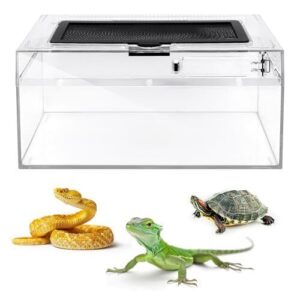
A step up from the starter version, the AZV Reptile Terrarium Tank gives you a bit more floor space — roughly 19.5 x 9.4 x 10.5 inches — making it a better fit for a juvenile corn snake that’s already outgrown a hatchling setup.
The bundled 50W UVA/UVB 3.0 heat lamp manages both warmth and light in one fixture, which simplifies things for beginners. Just replace that bulb every 6 to 12 months — UV output fades even when the light still looks bright.
For a full rundown of everything else your setup needs, check out this snake cage accessories checklist, which covers secure lid locks that keep escape-prone snakes safely contained.
| Best For | Parents or beginner reptile keepers looking for a compact, easy-to-observe enclosure for small lizards, frogs, geckos, or other tiny reptiles. |
|---|---|
| Material | ABS Plastic |
| Escape-Proof Design | Door locks |
| Ventilation | Ventilation holes |
| Transparency | Clear/360-degree view |
| Dimensions | 6.29 x 5.78 x 12.16 in |
| Starter Kit | Tank only |
| Additional Features |
|
- Crystal-clear 360-degree view makes it easy to watch your pet from any angle
- Escape-proof locks and one-piece design mean you’re not constantly worrying about jailbreaks
- Works for both desert and rainforest setups, so it’s flexible depending on what you’re keeping
- The plastic won’t hold up well to heat lamps left on too long — it can actually melt
- Not built for bigger or heavier reptiles, so it’ll feel small fast if your pet grows
- Instructions can be confusing, which might cause headaches during setup
5. Sanosy Reptile Terrarium Starter Kit
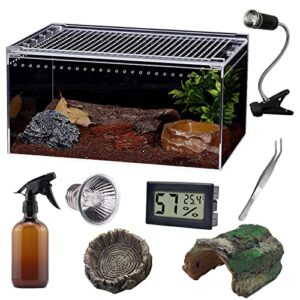
The Sanosy Reptile Terrarium Starter Kit is a compact, lightweight option that looks appealing on the shelf — but let’s be real about what it’s. At just 724.52 cubic inches and 12″L x 8″W x 6″H, it’s closer to a critter keeper than a true snake enclosure.
For a corn snake, that’s too small, even for a hatchling long-term. It’s better suited for feeder insects or small invertebrates. If you’re housing a corn snake, skip this one as a primary home.
| Best For | Hobbyists who need a compact enclosure for small invertebrates, feeder insects, or temporary transport — not a long-term home for corn snakes or other larger reptiles. |
|---|---|
| Material | Polycarbonate/Stainless Steel |
| Escape-Proof Design | Anti-escape door lock |
| Ventilation | Sturdy screen top |
| Transparency | Transparent/360-degree view |
| Dimensions | 12 x 8 x 6 in |
| Starter Kit | 8-piece kit |
| Additional Features |
|
- The 360-degree glass view looks great and makes it easy to watch your animals from any angle.
- The anti-escape door lock and screen top give you some peace of mind when housing small critters.
- Lightweight and compact enough to move around the house or use on the go.
- At 724.52 cubic inches, it’s just too small for most snakes — even hatchlings will outgrow it fast.
- Several buyers reported cracks and broken accessories right out of the box, which raises durability concerns.
- The included light bulb and thermometer have had reliability issues, so you may end up replacing them quickly.
6. Kakooti Reptile Acrylic Terrarium Kit
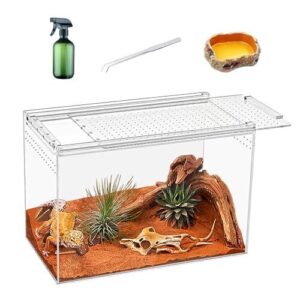
The Kakooti Reptile Acrylic Terrarium Kit is more of a display case than a true snake home — and that’s not a bad thing, as long as you know what you’re getting.
At roughly 18″L x 8″W x 9.5″H, it’s compact and crystal clear, making it ideal for monitoring a hatchling closely or using as a quarantine box. The magnetic lid stays secure, and the acrylic holds warmth nicely.
Just don’t plan on keeping a growing corn snake here permanently.
| Best For | Small reptile and insect owners who want a clear, compact enclosure for easy observation, feeding, or temporary housing. |
|---|---|
| Material | Acrylic |
| Escape-Proof Design | Magnetic sliding lid |
| Ventilation | Ventilation holes |
| Transparency | 360-degree full view |
| Dimensions | 11 x 6 x 8 in |
| Starter Kit | Tank only |
| Additional Features |
|
- Crystal-clear 360-degree acrylic walls make it easy to watch your pet without disturbing them
- Magnetic sliding lid keeps things secure while still being simple to open when it’s feeding time
- No assembly needed and the compact size means it fits just about anywhere without taking over your space
- Not a long-term home for anything that grows — larger or heavier animals will outgrow it fast
- Acrylic can warp or crack over time, and some users have noticed seam splitting with regular use
- The ventilation holes may need to be modified depending on what you’re keeping inside
7. Kathfly Reptile Terrarium Starter Kit
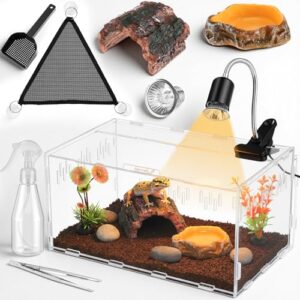
Think of the Kathfly kit as a tiny ecosystem in a box — and a surprisingly complete one at that. This 13-piece acrylic setup measures just 11.81 x 7.87 x 5.91 inches, so it won’t house a corn snake long-term. But it earns its place as a feeder insect enclosure, quarantine tank, or starter habitat for small invertebrates.
At around $37.99, it bundles a thermometer, hygrometer, heating lamp, hides, and more. Beginners love the 360-degree visibility — you’ll spot problems before they become serious.
| Best For | Beginners, hobbyists housing feeder insects, small invertebrates, or using it as a quarantine tank for tiny reptiles and amphibians. |
|---|---|
| Material | Acrylic/Plastic |
| Escape-Proof Design | Locking lid |
| Ventilation | Cross air flow slits |
| Transparency | Transparent acrylic |
| Dimensions | 11.81 x 7.87 x 5.91 in |
| Starter Kit | 13-piece kit |
| Additional Features |
|
- Comes with everything you need out of the box — thermometer, hygrometer, heating lamp, hides, and more
- Crystal-clear acrylic walls give you a full 360-degree view of your pet
- Compact size makes it easy to fit on a desk or shelf without taking over the room
- Too small to be a permanent home for most reptiles or amphibians as they grow
- Ventilation slits may be wide enough for tiny spiders to squeeze through and escape
- The heat lamp can warp or melt the acrylic if you’re not careful about placement and wattage
Tips for Successful Corn Snake Care
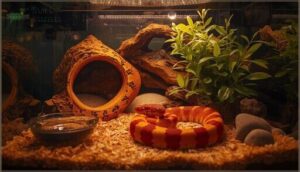
Getting the basics right makes all the difference when you bring a corn snake home. A few simple habits—set up early, monitored consistently, and adjusted as your snake grows—will keep things running smoothly.
Here’s what experienced keepers say matters most.
Setting Up Kits Before Bringing Your Snake Home
Setting up your corn snake’s home before you bring it through the door isn’t just good advice—it’s the difference between a smooth first night and a very stressed little snake. Full kit preparation means your terrarium is heated, lit, and stable before your snake ever arrives. Think of it like preheating an oven—your corn snake habitat setup should be ready, not warming up.
Set up your corn snake’s habitat before it arrives — a stressed snake on night one is a tough way to start
Monitoring Temperature and Humidity
Once your kit is running, keeping a close eye on temperature control and humidity levels makes all the difference. A digital thermometer and hygrometer are your best tools here—place probes at snake level inside each hide.
- Warm side surface: 88–90°F
- Cool side: 75–80°F
- Humidity target: 65–75%
- During shed cycles, nudge humidity toward 70%
Good thermometer placement and a reliable heat mat paired with a thermostat keep conditions stable. Proper ventilation systems prevent moisture buildup that can irritate your snake’s respiratory tract.
Providing Hides on Both Warm and Cool Sides
Once your temps are dialed in, the next piece of the puzzle is making sure your corn snake actually has somewhere comfortable to hide on both ends of that gradient. Hide placement matters more than most beginners expect.
One hide on the warm side, one on the cool side—that’s the baseline for solid snake security. Without both, your corn snake is forced to choose between feeling safe and regulating its body temperature. That’s unnecessary stress you can easily avoid.
Adjusting Kit Components as Your Snake Matures
Your corn snake won’t stay small forever, and the starter kit that worked perfectly for a juvenile will start showing its limits faster than you’d expect. As your corn snake moves through different snake growth stages, enclosure upgrades become necessary—not optional.
Swap out that starter kit tank for a larger snake habitat, revisit your heating options, and tighten up your environmental controls. Staying ahead of these changes keeps snake health and wellness on track.
Frequently Asked Questions (FAQs)
What do corn snakes need in their tank for beginners?
You’ll need a secure terrarium with proper substrate depth, snake hides, a water dish, and a hygrometer for humidity control.
Tank decorations, water quality, and starter kit essentials round out a stress-free setup.
Are corn snakes easy for beginners?
Yes, corn snakes are one of the best reptiles for beginners. Their calm snake behavior, forgiving habitat maintenance needs, and straightforward feeding challenges make reptile care and maintenance surprisingly manageable for first-time pet owners.
Before bringing one home, it’s worth weighing the full pros and cons of having a corn snake as a pet to set realistic expectations.
Do corn snakes need a heat lamp 24 7?
No, a heat lamp running all night would actually stress your corn snake out. Turn it off at night to support natural heating cycles and healthy snake thermoregulation. A heat mat manages nighttime temperature control just fine.
How much does a corn snake typically cost?
A standard “normal” corn snake usually costs around $25 at a pet store. Morph prices climb higher based on color and pattern. Breeder fees vary, so shop around for healthy, well-handled reptiles.
What prey size is right for hatchlings?
Smaller meals actually mean faster, healthier growth—that’s the essence of hatchling nutrition.
Follow prey size charts and match feeders to your corn snake’s widest body point for safe, stress-free feeding schedules.
How often should I feed my corn snake?
Hatchlings need feeding every 5–7 days, while adults do well on a meal every 10–14 days.
Matching feeding frequency to your corn snake’s growth rate keeps snake nutrition on track and promotes long-term pet health.
When can I handle my snake after feeding?
Wait at least 48 hours after feeding before handling your corn snake. Jumping in too soon raises regurgitation risk, which stresses your pet and disrupts digestion.
Patience is a big part of solid snake care and maintenance.
How do I check my snakes overall health?
A quick snake inspection goes a long way. Check for smooth scale condition, clear eyes, and an active feeding response. Watch for shedding issues like retained skin.
Regular health checks keep your reptile care routine on track.
Conclusion
Corn snake kits for beginners take the guesswork out of one thing that trips up almost every new keeper: the setup. Once your temperatures are dialed in, your hides are placed, and your substrate is deep enough to burrow, you’ll wonder what you were ever worried about.
These snakes don’t ask for much—just a well-built home and a little consistency. Nail those two things, and you’ve already got this in the bag. Scale and all.
- https://reptifiles.com/corn-snake-care-guide/corn-snake-terrarium-size/
- https://exo-terra.com/products/terrariums/terrarium-kits/snake-starter-kit/
- https://www.happydragons.com/buying-guides/corn-snake-starter-buying-guide
- https://www.zenhabitats.com/blogs/reptile-care-sheets-resources/corn-snake-complete-lighting-and-heating-guide
- https://www.thebiodude.com/collections/biodegradable-leaf-litter