This site is supported by our readers. We may earn a commission, at no cost to you, if you purchase through links.
Most snake keepers don’t realize their enclosure has a problem until their snake tells them—through behavior, not words. A snake that won’t eat, hides constantly, or rubs its face against the glass is often reacting to something in its environment, and dirty bedding ranks among the most overlooked culprits.
Waste breaks down slowly beneath the surface, building ammonia and bacteria long before anything looks wrong. Knowing the signs you need to replace snake bedding—and acting on them early—keeps your snake healthier and your maintenance routine simpler than you’d expect.
Table Of Contents
- Key Takeaways
- Common Signs Your Snake Bedding Needs Replacing
- Unusual Odors and What They Mean
- Mold, Dampness, and Excess Moisture
- Snake Behavior Changes Linked to Bedding
- Accumulation of Waste and Debris
- Substrate Clumping and Texture Changes
- Frequency of Bedding Changes by Type
- Health Risks of Dirty Snake Bedding
- Factors Affecting How Often to Replace Bedding
- Top 7 Snake Bedding Products for Easy Replacement
- Frequently Asked Questions (FAQs)
- Conclusion
Key Takeaways
- Your snake’s behavior—refusing food, hiding more, or rubbing against the glass—is often the first real sign that its bedding has gone bad.
- Smell before you see: ammonia means buried waste is breaking down, while a musty scent points to mold already forming beneath the surface.
- Different substrates wear out on different timelines, so match your cleaning schedule to what’s actually in the enclosure, not just a generic monthly reminder.
- Skipping bedding changes isn’t just a cleanliness issue—it’s a direct path to scale rot, respiratory infections, and parasite infestations that are tough to reverse.
Common Signs Your Snake Bedding Needs Replacing
Your snake’s bedding tells you more than you might think. A few key signs show up before things get serious, and catching them early makes all the difference. Here’s what to watch for.
Pairing bedding checks with a solid understanding of snake behavior basics for beginners helps you connect the dots faster when something’s off.
Visible Feces and Urates
Fresh feces or chalky white urates sitting on top of your snake’s bedding are your clearest, most immediate signal that spot cleaning can’t wait.
Daily Waste Inspection keeps bacterial growth from taking hold fast. Here’s what to do:
- Remove surface waste immediately using a scoop or gloves
- Apply a reptile-safe disinfectant to the exposed substrate area
- Replace pulled substrate with fresh snake bedding right away
Strong or Unusual Odors
Your nose is one of your best tools for catching bedding problems that your eyes might miss. A sharp ammonia smell usually means waste has soaked deep into the substrate. A musty or sour scent points to mold risk building beneath the surface.
Either way, don’t wait — a full substrate change and a wipe-down with reptile-safe disinfectant will restore safe air quality fast.
Mold or Mildew Growth
While bad smells warn you early, visible mold on the bedding means the problem has already taken hold. Look for fuzzy white or gray patches — that’s fungal growth thriving in excess moisture. High humidity levels accelerate mold risk fast.
Pull out the affected substrate immediately, do a full substrate change, and wipe the enclosure down with a reptile-safe disinfectant. Consistent humidity management is your best defense.
Bedding Discoloration
Color changes in your snake’s bedding are just as telling as any smell or fuzzy patch — and just as easy to miss if you’re not looking. Dark staining, fading substrate, or yellowish patches are classic discoloration causes — usually waste soaking deep into the material.
When your snake substrate looks noticeably off from its original color, that’s bedding deterioration talking. Don’t wait. A full substrate change keeps your reptile enclosure safe.
Unusual Odors and What They Mean

Your nose is often the first thing that tells you something’s off in the enclosure. Different smells point to different problems, and knowing the difference helps you act fast. Here’s what each type of odor is actually telling you.
Ammonia Smell From Waste Buildup
That sharp, eye-watering smell hitting you when you open your snake’s enclosure isn’t just unpleasant — it’s your snake’s habitat sending you an urgent warning. Ammonia smell comes from urine breaking down in old substrate. Left unchecked, it damages your snake’s respiratory system fast.
For proper odor control and snake health, do a substrate change immediately, clean the enclosure with a reptile-safe disinfectant, and add fresh snake bedding.
Musty or Sour Scent From Mold
A musty or sour scent creeping out of your snake’s enclosure is mold telling you it’s already taken hold. High humidity levels create the perfect setup for fungal growth, especially in coconut fiber or cypress mulch.
For effective odor management and mold prevention, do a full substrate change right away. Dial in your humidity control after, or mold risk will just keep coming back.
Detecting Subtle Changes in Odor
Your nose picks up on problems before your eyes do, so trust it when something smells even slightly off in your snake’s enclosure. Subtle stenches in reptile care are easy to dismiss, but smell variations often signal the need for a substrate change before things get serious. Use these scent markers as your guide:
- A faint sour note hints at early mold growth tied to high humidity levels
- A stale, closed-in smell means waste is buried and breaking down beneath the surface
- An earthy sharpness that wasn’t there before points to bacterial buildup in the snake bedding
- Any new foul smell after cleaning signals incomplete disinfection — switch to a reptile-safe disinfectant next time
Mold, Dampness, and Excess Moisture
Moisture is one of the sneakiest threats to your snake’s enclosure — it builds up quietly and causes real damage before you notice. Damp bedding creates the perfect conditions for mold, bacteria, and skin problems that can make your snake seriously ill.
Here’s what to look for so you can catch it early.
Identifying Damp Patches
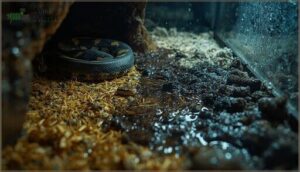
Damp patches in your snake’s enclosure don’t announce themselves — they hide under the surface, quietly turning a healthy habitat into a breeding ground for bacteria and rot. Regular bedding inspection is your first line of defense. Press your fingers lightly into the substrate; if it clumps or feels cold, moisture has soaked in.
| Damp Spot Detection | What You’ll Notice | Action Needed |
|---|---|---|
| Substrate Monitoring | Cold, clumped bedding | Spot substrate change |
| Bedding Inspection | Discolored patches | Remove affected area |
| Humidity Management | Condensation on walls | Improve ventilation |
Good reptile hygiene and sanitation means checking these zones daily, especially under hides and water dishes — the sneakiest spots in any snake bedding setup.
Recognizing Mold or Fungal Spots
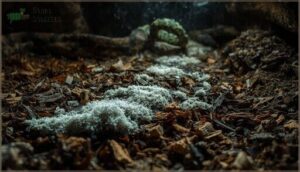
Mold doesn’t wait for an invitation — it moves in the moment conditions are right, and your snake’s bedding is often the first place it sets up camp. Mold detection starts with spotting fuzzy white, green, or black patches on the substrate. Fungal growth thrives where moisture lingers, especially in bioactive substrate setups.
Here’s what to watch for:
- White or gray fuzz forming on damp substrate surfaces
- Discolored patches that don’t wipe away with spot cleaning
- A stale, musty smell even after using a reptile-safe disinfectant
When you see these signs, don’t wait — that section needs an immediate substrate change.
Impact of Humidity on Bedding Lifespan
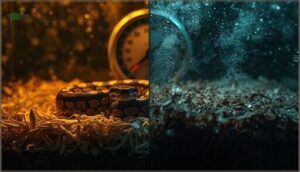
Humidity is the hidden variable that quietly decides whether your snake’s bedding lasts two weeks or two months. Every bedding type has a moisture retention limit — push past it, and you’ve hit the substrate saturation point where bacterial proliferation speed spikes fast.
Here’s how common humidity levels affect different bedding types in reptile care:
| Bedding Type | Ideal Humidity Range | Avg. Lifespan |
|---|---|---|
| Aspen Shavings | 30–50% | 4–6 weeks |
| Coconut Fiber/Coir | 60–80% | 2–4 weeks |
| Bioactive Substrate | 70–90% | Spot-clean ongoing |
| Paper Towels | Any | 3–7 days |
High-humidity setups — especially bioactive substrate builds — demand closer monitoring. Don’t let your snake pay the price for a soggy floor.
Snake Behavior Changes Linked to Bedding
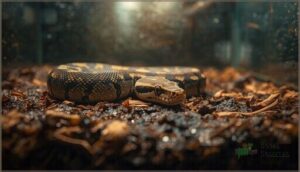
Your snake can’t tell you when something’s wrong — but its behavior usually will. Dirty or degraded bedding often shows up first as changes in how your snake moves, eats, or reacts to handling.
Lighting also plays a role — proper vivarium lighting for snake health affects behavior in ways that are easy to misread as husbandry issues.
Here are the key behavioral signals worth watching for.
Increased Hiding or Agitation
When your snake suddenly retreats deeper into its hide or starts restlessly pushing against the enclosure walls, dirty bedding is often the quiet culprit. Stress signals like these hiding behaviors and agitation usually trace back to environmental factors — soiled substrate creates ammonia buildup that triggers real snake anxiety.
Think of it this way: you wouldn’t sleep well in a dirty room, and neither will your snake.
Just like you, your snake can’t rest well in a dirty room
Reduced Activity or Feeding
Beyond hiding and agitation, a snake that suddenly loses interest in food or barely moves around its enclosure is quietly telling you something is wrong.
Snake appetite and feeding habits are deeply tied to environmental stress. When snake bedding stays dirty too long, health decline follows fast.
Clean substrate isn’t optional in reptile husbandry — it’s how you protect your snake’s health and nutrition needs long-term.
Signs of Skin or Respiratory Irritation
Dirty bedding doesn’t just affect appetite — it can show up on your snake’s skin and in its breathing too. Watch for these red flags:
- Skin lesions or scale damage — soft, discolored, or blistered scales often signal scale rot from damp snake bedding.
- Mucous buildup around the mouth or nostrils — a warning sign of respiratory issues tied to poor reptile care.
- Wheezing or open-mouth breathing — humidity levels left unchecked accelerate infection control problems fast.
Catching these early protects your snake’s long-term reptile health.
Accumulation of Waste and Debris
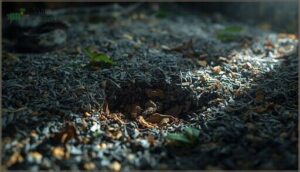
Even with regular spot cleaning, waste has a way of building up faster than you’d expect. Knowing exactly what to look for makes it much easier to catch problems before they affect your snake’s health.
Fecal matter that looks unusually watery or off-color can sometimes signal protozoan infections like those covered in this guide to snake parasite health risks and zoonotic concerns.
Here are the three most telling signs that debris has crossed the line from manageable to must-fix-now.
Clumped or Wet Substrate Areas
Wet, clumped substrate is one of the clearest warning signs that your enclosure is overdue for a full bedding change. Substrate moisture builds up fast under a snake’s favorite bathroom corner, and once it clumps, spot cleaning won’t cut it anymore. That whole section needs to go.
| Issue | Cause | Action |
|---|---|---|
| Wet Spot | Urine or spilled water | Wet spot removal immediately |
| Clumped Bedding | Absorbed liquid waste | Full substrate change |
| Persistent Dampness | Poor humidity control | Review ventilation and substrate selection and management |
Staying ahead of this through regular reptile care routines — plus smart bedding replacement scheduling — keeps clump prevention simple and your snake comfortable.
Repeated Appearance of Urates
If you keep finding small white chalky deposits scattered across the bedding even after a recent spot clean, your enclosure is telling you something important. Those deposits are urates — the solid byproduct of your snake’s waste management process.
Repeated urate formation signals that older, buried waste is breaking down beneath the surface, quietly compromising substrate quality and reptile health. That’s your cue for a full substrate change.
Buried or Decomposing Waste
Some of the most dangerous waste in your snake’s enclosure is the kind you can’t even see. Fecal matter buried beneath the surface breaks down silently, and standard spot cleaning won’t catch it. Decomposition rates accelerate in warm enclosures, turning buried debris into a bacterial breeding ground fast.
Watch for these buried waste red flags:
- A faint sour smell that lingers even after spot cleaning
- Substrate that feels soft or spongy underfoot when you press it
- Dark staining deep in the bedding layers during a full substrate management check
- Your snake avoiding certain enclosure zones entirely
Substrate Clumping and Texture Changes
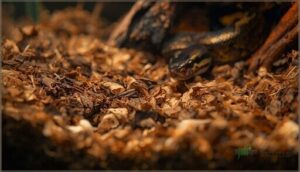
Bedding doesn’t just get dirty — it also wears out. Over time, the texture shifts in ways that tell you it’s no longer doing its job.
Here are the key signs to watch for.
Matted or Compacted Bedding
Bedding that once felt loose and fluffy under your fingers is telling you something when it starts packing down like a brick. Compaction risks include blocked burrowing paths and poor airflow at substrate level. Matting factors like humidity effects, snake traffic, and missed spot cleaning all speed up substrate breakdown. Check your snake bedding weekly by pressing it lightly — if it doesn’t spring back, it’s done.
| Bedding Type | Compaction Risk | Key Matting Factor |
|---|---|---|
| Aspen Shavings | High | Moisture exposure |
| Coconut Fiber | Medium | Overwatering |
| Reptile Carpet | Low | Waste buildup |
| Cypress Mulch | Medium | High humidity |
| Paper Towels | High | Single use only |
Loss of Absorbency
A substrate that can’t soak up moisture anymore is basically just decoration — and your snake deserves better than that. Run a quick absorbency test: pour a small amount of water onto the bedding material and watch what happens. Fresh substrate pulls it in fast. Old, degraded substrate just lets it pool.
When moisture levels stop being managed properly, humidity control becomes a guessing game — and in reptile husbandry, that’s a dangerous game to play.
Bedding Breaking Apart Easily
When your bedding starts crumbling at the touch, that’s your enclosure telling you something important. Degraded bedding material loses its structural integrity, meaning it can’t support proper humidity control or give your snake a stable surface to move across. That kind of breakdown signals the substrate quality has run its course.
Watch for these three clear signs:
- Aspen shavings turn to fine dust when pressed
- Coconut fiber breaks into dry, stringy clumps instead of holding shape
- Any substrate selection and management effort becomes pointless because the material can’t perform its job
Schedule a full bedding replacement before your snake habitat suffers for it.
Frequency of Bedding Changes by Type
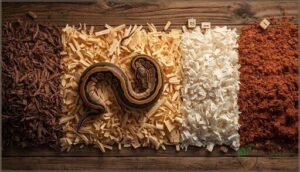
Not all bedding follows the same schedule — how often you swap it out depends entirely on what’s inside the enclosure. Some substrates hold up for months with simple spot cleaning, while others need a full change far sooner.
Here’s a breakdown of the most common types and how frequently each one needs replacing.
Paper Towels and Newspaper
Paper towels and newspaper are the budget-friendly side of reptile care — low on Bedding Costs, easy to swap, and honest about their limits. Paper Towel Absorbency is minimal, so change them immediately after every bowel movement. Newspapers can trap Newspaper Odor fast, especially under high-humidity species where moisture control matters.
Most keepers replace all paper substrate weekly, regardless of visible mess. For more guidance, it’s important to review the to guarantee a clean habitat.
Aspen Shavings
Aspen shavings suit snakes with a dry-habitat Snake Preference, and Aspen Maintenance is straightforward once you get into a rhythm.
With good Shaving Depth and consistent spot cleaning, full changes usually fall every one to three months.
Keep an eye on Bedding Quality — any lingering odor after spot cleaning means it’s time to replace, regardless of your schedule.
Coconut Fiber and Coir
Coconut fiber and coir offer strong Fiber Absorbency and reliable Humidity Control, making this Coconut Substrate a go-to for tropical species.
Most keepers replace coconut fiber every one to three months with consistent spot cleaning. In bioactive setups, that window can stretch to six months.
Reptile Hygiene still comes first — if it smells off, swap it out.
Reptile Carpet and Liners
Unlike loose substrates, reptile carpet and liners leave waste sitting right on the surface — so Carpet Cleaning happens after every bowel movement, no exceptions.
Smart substrate selection makes Snake Comfort and Reptile Hygiene straightforward.
- Keep two sets of Liner Materials for quick swaps
- Deep clean with a reptile-safe disinfectant every 4–8 weeks
- Retire worn carpet after several months of repeated washing
Health Risks of Dirty Snake Bedding
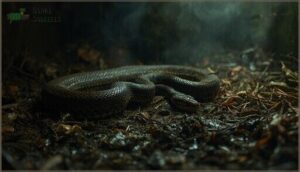
Dirty bedding doesn’t just look bad — it can make your snake genuinely sick. The risks range from stubborn skin infections to breathing problems that are hard to reverse. Here’s what you’re actually up against when bedding changes get skipped.
Respiratory Infections
Dirty snake bedding quietly poisons the air your snake breathes every single day. Ammonia from built-up waste irritates the lung directly, and poor air quality turns minor breathing issues into full infections fast.
Spot cleaning with a reptile-safe disinfectant and managing humidity levels are your first line of infection control — especially for moisture-sensitive snake species.
Owners should learn more about the importance of maintaining an appropriate environment to avoid potential health risks for reptiles.
| Warning Sign | What It Means |
|---|---|
| Wheezing or clicking sounds | Possible respiratory infection starting |
| Open-mouth breathing | Lung function already compromised |
| Excess mucus around nostrils | Bacterial infection from soiled snake bedding |
| Frequent tongue flicking with lethargy | Early breathing issues from poor air quality |
Scale Rot and Skin Issues
Scale rot doesn’t announce itself — it sneaks up through belly scales that have been sitting on wet, soiled snake bedding too long. Bacterial growth and fungal exposure soften the skin, turning small scratches into infected wounds fast.
Watch for these skin infection warning signs:
- Red, swollen, or blistered ventral scales
- Unusual scale discoloration or peeling edges
- Slow-healing spots despite wound care and a reptile-safe disinfectant
Increased Parasite Risk
Neglected snake bedding quietly becomes a breeding ground for mites and other parasites. These tiny hitchhikers hide in dirty substrate, crawl onto your snake at night, and cause anemia and skin irritation over time.
Consistent spot cleaning, smart substrate selection and management, and regular treatment with a reptile-safe disinfectant are your best tools for parasite control, snake hygiene, and long-term parasite prevention.
Factors Affecting How Often to Replace Bedding

Not every snake keeper needs to clean on the same schedule, and that’s actually fine. How often you replace bedding comes down to a handful of things specific to your setup and your snake. Here’s what to look at.
Snake Species and Size
Your snake’s species and size shape how fast the bedding breaks down. Large constrictor waste is far heavier and wetter than what smaller colubrids produce, which directly affects substrate selection and management timelines.
Consider these species-specific care and housing differences:
- Large constrictors need full snake bedding changes every 3–4 weeks.
- Small colubrids can go 6–8 weeks with prompt spot cleaning.
- High-metabolism feeders produce waste more often, demanding tighter schedules.
Enclosure Size and Design
Your enclosure size and design quietly control how fast bedding breaks down. A large habitat spreads waste across more space, so smart habitat design and spatial planning let you stretch full changes to every 1–2 months. Tight setups concentrate mess fast.
| Enclosure Layout | Replacement Frequency |
|---|---|
| Large, open tanks | Every 1–2 months |
| Small or cramped setups | Every few weeks |
Humidity, Temperature, and Ventilation
Heat and moisture are bedding’s worst enemies. High humidity levels speed up bacterial growth, meaning your substrate spoils faster than you’d expect. Poor ventilation systems trap warmth and moisture, turning fresh bedding damp within days.
Strong air flow management and smart temperature control — including stable temperature gradients — keep things drier longer, so spot cleaning stays effective and full changes stay manageable.
Diet and Waste Output
What your snake eats directly shapes how often you’ll need to replace its bedding. Larger prey means bigger, wetter waste that soaks deeper into substrate. Feeding frequency also matters — snakes fed more often produce excretion patterns that challenge even the best waste management routine.
Spot cleaning with a reptile-safe disinfectant manages small messes, but dietary needs and nutrient balance affect snake behavior and overall reptile hygiene and sanitation.
Top 7 Snake Bedding Products for Easy Replacement
Finding the right bedding makes replacement day a lot less frustrating. These seven options are easy to swap out, widely available, and suited to different snake species and setups.
Here’s what each one brings to the enclosure.
1. Zoo Med Reptile Soil
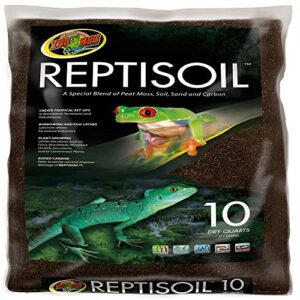
Zoo Med ReptiSoil is a solid pick if you’re housing tropical species that need consistent humidity. It blends peat moss, soil, sand, and coconut carbon — a mix that holds moisture without turning swampy.
The carbon layer also fosters beneficial bacteria, which helps break down waste naturally. That makes it a smart fit for bioactive setups with live plants and cleanup crews.
One thing to watch: rinse your hands after handling it, and inspect each bag for debris before use.
| Best For | Tropical lizard, amphibian, and invertebrate keepers who want a naturalistic, bioactive setup that supports live plants and holds humidity well. |
|---|---|
| Material | Coconut fiber/carbon |
| Odor Control | Coconut carbon reduces odor |
| Ease of Cleaning | Easy spot cleaning |
| Absorbency | Holds moisture well |
| Animal Safety | Safe for listed species |
| Availability | 10 qt quantity |
| Additional Features |
|
- Coconut carbon encourages beneficial bacteria, so waste breaks down naturally — great for low-maintenance bioactive builds.
- Holds moisture consistently without getting waterlogged, which is a win for tropical species that need steady humidity.
- Supports burrowing, egg laying, and plant growth all in one substrate.
- Some bags have shown up with large woodchips or sharp debris, so a quick inspection before use is a must.
- A bit pricey compared to similar substrates on the market.
- Not a universal fit — depending on your species and setup, it might not be the right call.
2. Zilla Reptile Terrarium Bedding Liner
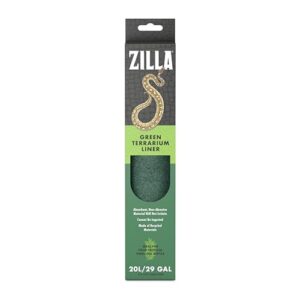
If soil-based setups feel like too much work, the Zilla Reptile Terrarium Bedding Liner is a welcome change of pace. It’s a soft, non-abrasive fabric sheet treated with a biodegradable enzyme that breaks down odors between cleanings.
No scooping, no mess — just pull it out, rinse it under cold water, and let it dry. Many keepers rotate two liners so the tank’s never bare.
It fits tanks from 10 to 125 gallons and can be trimmed to fit odd-shaped enclosures.
| Best For | Beginner reptile owners and those who want a low-fuss, easy-to-clean setup for snakes, lizards, or turtles. |
|---|---|
| Material | Polyethylene/Polypropylene |
| Odor Control | Enzyme-treated odor reducer |
| Ease of Cleaning | Easy to clean and reinstall |
| Absorbency | Absorbent material |
| Animal Safety | Non-ingestible design |
| Availability | Multiple sizes available |
| Additional Features |
|
- Super easy to clean — just rinse, dry, and reuse
- Enzyme treatment helps cut down on odors between washes
- Safe, soft, and non-abrasive for reptiles
- Can snag on claws or teeth over time
- Not a good fit for reptiles that like to burrow
- May need trimming to fit non-standard tank shapes
3. Zoo Med Forest Floor Bedding
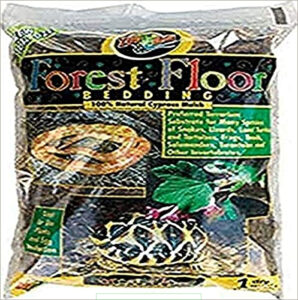
For keepers who want something that feels more natural, Forest Floor Bedding from Zoo Med is worth a look. It’s made from 100 percent natural cypress mulch — no dyes, no artificial fragrances.
That matters because additives can irritate sensitive respiratory systems. The mulch holds moisture well, making it a solid pick for ball pythons and tropical species that need steady humidity.
Spot clean daily, replace fully every three months, and you’re set.
| Best For | Keepers of snakes, amphibians, and tropical tortoises who want a natural-looking substrate that helps maintain humidity. |
|---|---|
| Material | Cypress mulch |
| Odor Control | Natural odor absorption |
| Ease of Cleaning | Easy spot checking |
| Absorbency | Retains moisture |
| Animal Safety | Safe for listed species |
| Availability | Large 10.6 lb bag |
| Additional Features |
|
- Made from 100% natural cypress mulch — no dyes or artificial additives that could irritate your animals
- Holds moisture well, making it great for humidity-dependent species like ball pythons
- Gives the enclosure a realistic forest floor look that’s easy on the eyes
- Can get pricey fast if you’re filling a large enclosure
- May contain oversized chunks that need to be picked out to avoid injury risks
- Hard to spot waste on its own — works better for cleanliness when mixed with another substrate
4. Zilla Alfalfa Reptile Bedding
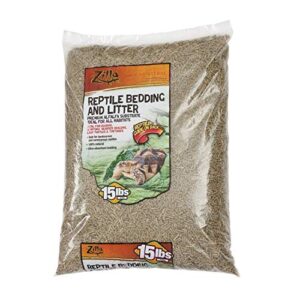
If you’re housing a bearded dragon or tortoise alongside your snake collection, Zilla Alfalfa Reptile Bedding pulls double duty nicely. These compressed alfalfa meal pellets are 100 percent natural, unscented, and digestible — so if your snake accidentally swallows a piece while striking at prey, you’re not looking at an impaction risk.
They absorb liquid waste quickly and expand slightly when soiled, making spot cleaning easy. Just keep humidity low; this one gets moldy fast in damp setups.
| Best For | Reptile owners housing bearded dragons, tortoises, or other carnivorous reptiles who want a natural, digestible substrate that’s easy to spot clean. |
|---|---|
| Material | Alfalfa meal |
| Odor Control | Bacteriostatic agent |
| Ease of Cleaning | Easy to clean |
| Absorbency | Absorbs waste |
| Animal Safety | Non-toxic if ingested |
| Availability | 15 lb bag |
| Additional Features |
|
- 100% natural and biodegradable, so accidental ingestion won’t cause impaction issues
- Absorbs liquid waste quickly and makes spot cleaning pretty straightforward
- Has a bacteriostatic agent that helps keep bacteria and odors in check
- Gets soggy and moldy fast in humid or damp enclosures
- The natural alfalfa smell can be pretty strong and off-putting for some people
- Not great as a standalone substrate — needs more frequent cleaning when soiled
5. Zoo Med Coconut Fiber Substrate
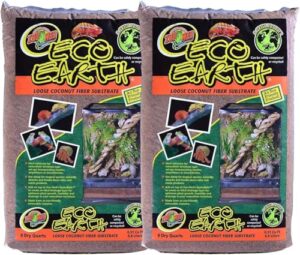
Tropical species owners, this one’s for you. Zoo Med Coconut Fiber Substrate holds moisture exceptionally well, making it a natural fit for ball pythons, boa constrictors, and other humidity-loving snakes.
It’s made from 100 percent coconut husk fiber — no added fertilizers or perfumes — so it’s safe if your snake burrows through it. The loose texture encourages natural digging behavior and helps reduce stress.
Best of all, spent substrate can go straight into your garden compost.
| Best For | Tropical reptile and amphibian owners who need a substrate that holds humidity well and lets their animals dig around naturally. |
|---|---|
| Material | Coconut fiber |
| Odor Control | Breaks down odor and waste |
| Ease of Cleaning | Easy to clean |
| Absorbency | Highly absorbent |
| Animal Safety | Safe for listed species |
| Availability | Pack of 2, 8 qt each |
| Additional Features |
|
- Holds moisture really well — great for ball pythons, boas, and other humidity-loving species
- All-natural coconut fiber with no added chemicals, so it’s safe for burrowing animals
- Works double duty as a drainage layer or even garden compost when you’re done with it
- Can get pricey compared to other substrate options out there
- May arrive dry if it’s been sitting in a warehouse for a while
- Not a one-size-fits-all solution — some species just don’t do well with this type of substrate
6. Zoo Med Aspen Snake Bedding
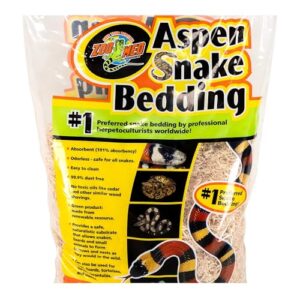
For dry-climate snakes like corn snakes and king snakes, aspen is hard to beat. Zoo Med Aspen Snake Bedding is 99.9% dust free and carries a 191% absorbency rating — meaning it holds nearly twice its weight in moisture before it starts breaking down.
It’s made from natural aspen wood with no toxic oils, so respiratory irritation isn’t a concern.
Spread it at least two inches deep, spot clean daily, and plan a full swap every two to three months.
| Best For | Dry-climate snakes like corn snakes and king snakes, as well as other reptiles and small animals that thrive in low-humidity setups. |
|---|---|
| Material | Aspen wood |
| Odor Control | Odorless material |
| Ease of Cleaning | Easy spot clean |
| Absorbency | 191% absorbency rating |
| Animal Safety | No toxic oils |
| Availability | 8 quart bag |
| Additional Features |
|
- Absorbs like a champ — 191% absorbency rating means it handles messes well before needing a full swap
- No toxic oils and nearly dust-free, so it’s gentle on your snake’s respiratory system
- Easy to spot clean day-to-day, which keeps maintenance simple
- Not a great fit for humidity-loving species like ball pythons or tropical reptiles
- Availability can be spotty in stores, so you may have to order online
- No clear info on allergens or sensitivities, which could matter for some keepers
7. Prevue Pet Cage Liner
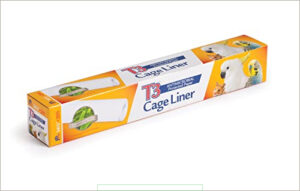
Paper liners aren’t just for birds. The Prevue Pet Cage Liner works surprisingly well as a clean, no-mess base layer for snake enclosures, especially during quarantine or recovery periods when you need to monitor waste closely.
It’s white and ink-free, so spotting abnormal droppings is easy. The antimicrobial surface slows odor-causing microbe growth between changes.
Cut it to fit your enclosure floor, swap it out the moment it’s soiled, and cleanup takes about thirty seconds.
| Best For | Snake owners who need a clean, easy-to-monitor liner during quarantine or recovery periods. |
|---|---|
| Material | Polyethylene |
| Odor Control | Reduces cage smell |
| Ease of Cleaning | Easy to clean |
| Absorbency | Absorbent liner |
| Animal Safety | Safe for listed species |
| Availability | 300-count roll |
| Additional Features |
|
- White and ink-free surface makes it easy to spot abnormal droppings
- Quick to swap out — cleanup takes about thirty seconds
- Works for more than just birds, including snakes and small animals like hedgehogs
- Can be flimsy and hard to keep flat — tends to curl back up
- Not as thick as some users would prefer
- May not control odor as well as expected for everyone
Frequently Asked Questions (FAQs)
How often should I change my snake bedding?
Most keepers spot clean daily and do a full bedding change monthly. With consistent spot cleaning, you can stretch that to every two or three months.
Can dirty bedding stress my snake out long-term?
Yes, it absolutely can. Dirty bedding keeps your snake in a state of low-level stress for weeks. Over time, that chronic tension can cause defensive behavior, food refusal, and a weakened immune system.
How do I safely dispose of old snake bedding?
Seal used bedding in a sturdy garbage bag, double-bag it if it’s heavily soiled, and toss it in your outdoor bin.
Never dump it outside — it can spread disease to wild reptiles.
What tools make bedding replacement faster and easier?
A few simple tools speed things up. Long tweezers grab waste without disturbing clean substrate.
A mesh scoop sifts debris fast.
A spray disinfectant treats surfaces quickly before fresh bedding goes in.
Should I quarantine my snake during a full clean?
Not usually. For a healthy snake with no signs of illness, a secure holding tub with a tight lid and paper towel lining works fine while you clean.
How do I transition my snake to a new substrate?
Mix a small amount of your snake’s old substrate into the new bedding so familiar scents ease the change.
Keep handling minimal for the first week or two while your snake adjusts.
Conclusion
Think of your snake’s enclosure as a living system—one that quietly shifts out of balance long before problems become visible. Learning the signs you need to replace snake bedding means you’re reading that system correctly, catching trouble early rather than treating it late.
Clean substrate isn’t just maintenance; it’s the foundation your snake’s health rests on every single day. Get the bedding right, and almost everything else in the enclosure gets easier.