This site is supported by our readers. We may earn a commission, at no cost to you, if you purchase through links.

A terrarium lives and breathes by its light. Too little, and mosses fade to dull green threads; too much, and leaves crisp before they can open. Most setups thrive on 8 to 12 hours of light a day, yet that simple range hides layers of nuance—species, humidity, and room temperature all tilt the balance.
A dart frog terrarium under an LED grow lamp won’t share the same rhythm as a sealed moss garden on a bookshelf. Understanding how long terrarium lights should stay on starts with reading your plants and animals as living clocks, not décor waiting to be lit.
Table Of Contents
- Key Takeaways
- How Long Should Terrarium Lights Stay On?
- Adjusting Light Schedules for Different Terrarium Types
- Choosing The Right Light Source for Your Terrarium
- Using Timers and Tools for Consistent Lighting
- Troubleshooting Common Terrarium Lighting Problems
- Frequently Asked Questions (FAQs)
- Do terrariums need light 24/7?
- Is 12 hours of light too much for plants?
- Is 10 hours of aquarium light too much?
- Can terrarium lights replace natural sunlight completely?
- How does seasonal daylight change affect indoor terrariums?
- What light spectrum works best for moss and ferns?
- How can I reduce glare from terrarium lights?
- Conclusion
Key Takeaways
- Most terrariums thrive with 8–12 hours of full‑spectrum LED light daily, followed by an equal dark period to support natural rhythms.
- Closed, humid terrariums need shorter, gentler light cycles, while open or reptile enclosures often require stronger or longer illumination to mimic natural day lengths.
- Automatic timers and proper light placement help maintain consistent photoperiods, prevent overheating, and reduce stress in both plants and animals.
- Over‑ or under‑lighting leads to leaf scorch, algae growth, or plant decline, so observing growth and adjusting duration in small steps ensures long‑term balance.
How Long Should Terrarium Lights Stay On?
Getting the light schedule right can make or break your terrarium’s health. Different setups and species call for their own daily rhythm of light and dark.
For help balancing natural cues with artificial lighting, check out this guide on choosing the right artificial and live plants for snakes.
Here’s how long you’ll want the lights on for each type of enclosure.
Recommended Daily Light Duration
Generally, your best starting point for Terrarium Lighting is a steady Daily Photoperiod of 8 to 12 hours of Terrarium Illumination each day, with an equal dark period so Plant Light Needs and Plant Lighting Requirements are met. Aim for simple Lighting Schedules—about 10 hours is ideal for most setups—and pair that with Full Spectrum lighting for easier Light Cycle Management and reliable results, one of the most practical Lighting Tips you can use.
Similarly, planted aquariums benefit from of around 8 hours per day, with intensity and duration carefully tuned to plant needs to prevent algae growth.
Factors Affecting Light Duration
You’ve got that 8–12 hour Light Cycle as a baseline, but how long you actually run your LEDs depends on the whole picture: Terrarium Size, Plant Density, Light Spectrum, and room conditions like Ambient Temperature and Humidity Levels.
A densely planted, closed nano tank under strong Full Spectrum light may only need moderate Light Intensity for 6–8 hours, while a larger, open setup in a cool room can comfortably stretch longer with the same fixture—one of the most overlooked Lighting Tips you can use.
If your setup is a mostly closed system, remember that self-sustaining terrarium ecosystems rely on balanced moisture, drainage, and plant choice as much as on light duration.
Effects of Incorrect Light Cycles
Stretch that light schedule too far and you’ll spark Light Stress—leaf scorch, algae blooms, and Photosynthesis Issues that stall growth. Too short, and plants thin out, leading to Plant Decline and Microfauna Imbalance.
Inconsistent Light Cycles cause heat swings, moisture loss, and full-blown Ecosystem Disruption, no matter how good your Terrarium Lighting or Lighting Tips are.
Adjusting Light Schedules for Different Terrarium Types
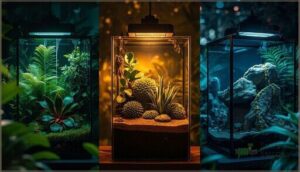
Different terrarium setups call for different lighting schedules, depending on what’s inside and how that mini‑environment holds heat and moisture. The right photoperiod keeps plants thriving and animals following their natural rhythms.
For more insight on balancing warmth, humidity, and light cycles, check out this snake terrarium lighting guide that explains how lighting shapes reptile behavior and habitat health.
Here’s how light duration varies across the most common types of terrariums.
Open Vs. Closed Terrariums
Think of Open vs Closed Terrariums as two very different climates you’re creating on purpose. Open designs pair best with drier Plant Selection, stronger Air Circulation, and more forgiving Terrarium Lighting Options, since heat and moisture escape easily.
Closed builds trap humidity, so you lean on cooler LED Grow Lights, shorter Light Cycles, and careful Humidity Control as the backbone of your Terrarium Design and everyday Terrarium Care.
Terrariums With Live Plants Only
In plant-only terrariums, steady light is your main driver of the Photosynthesis Process and Plant Growth Rates. Most terrarium plants thrive with 8–12 hours of balanced Light Intensity using full-spectrum LED Grow Lights that mimic Natural Sunlight.
Keep durations consistent to protect Soil Moisture levels and simplify long-term Terrarium Maintenance while supporting steady Plant Growth.
Terrariums Housing Reptiles
In reptile habitats, your lighting cycles must match natural sunrise and sunset patterns to maintain proper rhythms. Tropical species need steady 12-hour illumination, while desert reptiles benefit from longer summer days under LED grow lights or artificial lighting.
Balanced terrarium design blends plant growth support with precise environmental control customized to each species’ requirements.
Choosing The Right Light Source for Your Terrarium
Once you’ve decided how long your lights should run, the next step is choosing what kind of light to use. The right bulb can make the difference between lush plant growth and a stressed, overheated setup.
Here’s how the main options compare and what to look for in each.
LED Grow Lights Vs. Fluorescent Bulbs
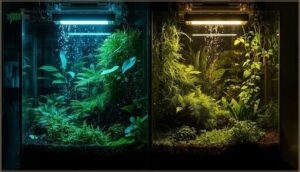
Want the short version? For most terrarium setups, a quality LED grow light is the safer, more efficient long‑term choice than fluorescent lights. LED grow lights give you better Energy Efficiency, lower Heat Output, and a far longer LED Lifespan, often 50,000 hours or more, which reduces replacements and keeps Lighting Requirements stable over years.
Fluorescent lights can still work as Grow Lights, but they waste more power as heat and usually need to sit higher above the tank, which can complicate your Light Spectrum and Cost Comparison if you’re trying to keep conditions tightly controlled.
In practice, choosing a modern LED Grow Light lets you meet your plants’ and animals’ needs with less electricity, less heat risk, and less maintenance over the life of the terrarium.
Benefits of Full-Spectrum Lighting
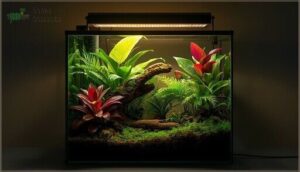
A full‑spectrum LED grow light gives your terrarium the balanced wavelengths it needs for healthy plant growth, natural color accuracy, and true reptile vision. By matching spectrum requirements from roughly 400–700 nm, a full‑spectrum bulb maintains steady day‑night cycles and ecosystem balance, keeping every leaf, lizard, and microbe in rhythm under realistic daylight conditions.
Full‑spectrum LED grow lights keep terrarium ecosystems thriving by mimicking natural daylight and maintaining perfect life balance
Avoiding Excess Heat and Light Stress
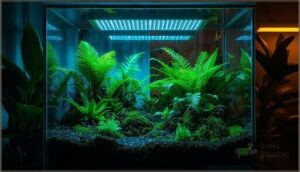
Too much heat from artificial lighting can scorch leaves faster than a desert sun, disrupting thermal balance in your terrarium. Prioritize LEDs for enhanced heat control over fluorescent bulbs—they run cool, enabling safe light management during 12-hour cycles without stress prevention worries.
Position them 10-15 cm above the lid for indirect light, ensuring even plant growth and terrarium cooling, far better than risky natural sunlight.
Using Timers and Tools for Consistent Lighting
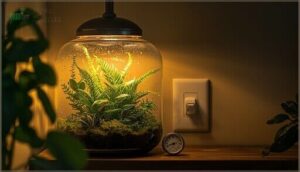
Keeping your terrarium’s light schedule consistent isn’t something you’ll want to manage by hand every day. Timers and simple monitoring tools make it easy to keep plants and animals on stable daily cycles without the guesswork.
Here’s how these tools can help you build a balanced routine for your setup.
Benefits of Automatic Timers
Ever leave your terrarium lights blazing overnight? Automatic timers fix that, delivering Lighting Consistency through Automated Scheduling for reptile health and Lighting for Plants. They boost Energy Efficiency by cutting power up to 50%, support Cycle Optimization with full-spectrum LED grow lights, and guarantee Plant Lighting mimics nature without stress.
- Maintain 12-hour day/night cycles for circadian rhythms and vitamin D synthesis.
- Prevent irregular exposure that stresses plants and animals in bioactive setups.
- Shut off after 10-14 hours, saving on bills with no forgotten lights.
- Offer manual overrides for feeding, plus dual outlets for day/night Grow Lights.
Setting Up Timers for Daily Cycles
You’ve already seen how automatic timers stop those “oops, I left it on” nights; now you’ll use them to lock in daily rhythms for Indoor Gardening and reptiles.
Start with Digital Timer Programming for a simple 24‑hour schedule: lights on for 12–14 hours a day, then off. Use Dual Outlet Use to split bright Fullspectrum LED grow lights for daytime Plant Lighting from a softer night source, and try Syncing Room Light with your own wake‑up time.
For species that respond to seasons, a Gradual Seasonal tweak of 10 to 15 minutes each week keeps Lighting for Plants and animals predictable without you babysitting the switch.
Monitoring Light and Temperature Balance
You’ve got the timer handling the photoperiod; now you need to watch what that schedule actually does to Light Intensity, Temperature Control, and Humidity Management.
Use at least one thermometer on the basking side and another on the cool end so Climate Regulation stays in a safe range while your Lighting Solutions (Natural Sunlight, Indirect Light, or Fullspectrum LED grow lights) still support Photosynthesis without drying the tank out.
Troubleshooting Common Terrarium Lighting Problems
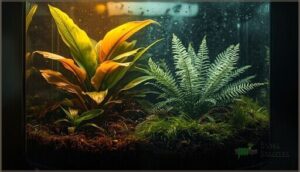
Even with the right setup, light problems can sneak up on you. Leaves may scorch, algae might spread, or your plants can start to fade without warning.
Here’s how to spot and fix the most common lighting issues before they throw your terrarium off balance.
Signs of Too Much or Too Little Light
Occasionally, your terrarium will “tell” you when Light Intensity is off. Watch for Color Changes and Leaf Damage: bleached tops under Fullspectrum LED grow lights, brown crispy edges, or pale, stretched Growth Patterns reaching past Indirect Light toward Natural Sunlight. These all signal Plant Stress, reduced Photosynthesis, and Lux levels that need correcting.
- Yellowing or bleaching near the lamp usually means too much light.
- Leggy, weak stems leaning toward a window point to too little light.
- Wilting in moist substrate under a hot lamp suggests heat and light stress.
Managing Algae, Mold, and Plant Health
You watched Light Intensity for leaf scorch; now observe how Humidity Balance and Artificial Illumination impact the glass and hardscape. Persistent fog, green film, or white fuzz indicate that Algae Prevention, Mold Control, and Plant Hygiene require attention, even if your Terrarium Plants appear “fine” under Fullspectrum LED grow lights and a generous Light Spectrum that subtly favors algae.
| Problem | What you’ll see | What to do |
|---|---|---|
| Algae bloom | Green film on bright, wet glass | Shorten light period, wipe glass, reduce intensity |
| Mold flare | White fuzz on wood or leaf litter | Vent daily, add springtails, remove decaying bits |
| Poor Plant Health | Yellow, soft, or rotting bases | Let substrate dry slightly, trim damaged tissue |
Handled early, these small signals allow you to correct the environment and safeguard long‑term Plant Health without dismantling the entire setup.
Adjusting Light Duration for Optimal Results
Deliberately tweaking your Daily Light Scheduling is the backbone of Light Cycle Management and Terrarium Lighting Optimization, not a one-time chore.
Start from 8–12 hours under Fluorescent Lights or Fullspectrum LED grow lights, then use Photoperiod Adjustment in 30-minute steps each week, watching for Plant Stress Prevention cues while keeping Lux and PPFD moderate so your Grow Lights support growth, not exhaustion.
Frequently Asked Questions (FAQs)
Do terrariums need light 24/7?
Not at all—think of your terrarium like it needs a nightly “lights out” to stay in rhythm. Terrarium plants rely on a balanced light cycle, not 24/7 exposure, to protect photosynthesis needs, reduce plant stress factors, stabilize terrarium microclimates, and support energy efficiency tips.
Most terrarium plants do best with a defined day–night pattern under grow lights, fluorescent lights, or fullspectrum LED grow lights, rather than nonstop direct sunlight or continuous artificial light.
Is 12 hours of light too much for plants?
Twelve hours of light isn’t automatically too much, but strong grow lights or direct sunlight can push photosynthesis rates too high, leading to light stress or plant burn.
Aim for consistent, full-spectrum LED exposure about 10–12 ideal growth hours daily.
Is 10 hours of aquarium light too much?
Ten hours of aquarium light usually hits the sweet spot for Lighting Balance. It maintains Aquarium Health and Plant Stress recovery, promotes growth under Full-spectrum LED grow lights, and keeps Algae Control steady with bright indirect light.
Can terrarium lights replace natural sunlight completely?
Terrarium lights can come impressively close to “bottling the sun,” but they don’t replace natural sunlight completely. Full-spectrum LED grow lights and other artificial light can meet most photosynthesis needs for plants, supporting photosynthesis and terrarium balance.
Yet, even excellent grow lights and so-called artificial sunlight fall short as a true UVB replacement for many reptiles because their light spectrum rarely matches outdoor sun perfectly. So, you treat them as carefully designed tools, not magic sky-in-a-box.
How does seasonal daylight change affect indoor terrariums?
Seasonal shifts in daylength variations slash winter daylight to 8 hours, dropping light intensity by 50-70% indoors. This causes your terrarium’s plants to slow photosynthesis and become leggy.
Reposition your terrarium for bright indirect light, or add full-spectrum LED grow lights to counter photoperiod effects and direct sunlight risks.
What light spectrum works best for moss and ferns?
For mosses and ferns, aim for a Full Spectrum light spectrum from a fullspectrum LED grow light or similar LED Options that covers 400–700 nm, with strong Blue Light, moderate Red Balance, and solid Green Wavelength output for dense, healthy carpets.
How can I reduce glare from terrarium lights?
Blinding as a stadium floodlight in a studio apartment, right? Angle your LED grow light slightly toward the back, add Light Diffusers or Glare Shields with Shade Hoods, and tweak Room Setup so you see bright indirect light, not bare artificial light or natural sunlight reflections from fullspectrum LED grow lights at harsh LED Angles.
Conclusion
Think of your terrarium’s light like a heartbeat, steady enough to sustain life but never racing out of control. Once you understand how long terrarium lights should stay on for your specific setup, daily care becomes far simpler.
Watch leaf color, growth rate, and animal behavior the way you’d check fundamental signs, then tweak duration in small, consistent steps. Over time, that steady rhythm turns guesswork into confidence and your enclosure into a reliable habitat.