This site is supported by our readers. We may earn a commission, at no cost to you, if you purchase through links.

A snake’s body runs on an internal clock, and light is what sets it. Without a reliable day-night cycle, that clock drifts—throwing off feeding responses, shedding cycles, and hormonal regulation in ways that aren’t always obvious until something goes wrong.
Most keepers focus on temperature gradients and humidity levels, but photoperiod quietly governs everything running beneath the surface.
Getting it right means understanding your specific species’ natural light environment, choosing equipment that delivers the right spectrum and intensity, and building a consistent schedule your snake’s physiology can actually follow.
Table Of Contents
- Key Takeaways
- Why Snakes Need a Day Night Cycle
- Understanding Your Snake’s Natural Light Needs
- Choosing The Right Lighting Equipment
- Setting Up a Day Night Lighting Schedule
- Balancing Light and Heat Sources
- Top 5 Products for Snake Day Night Cycles
- Creating Darkness for Nighttime Rest
- Nighttime Heating Without Disturbing Sleep
- Monitoring and Adjusting The Cycle
- Common Mistakes When Setting Light Cycles
- Frequently Asked Questions (FAQs)
- Do snakes need a day-night cycle?
- Do ball pythons need a heat lamp at night?
- What time should I turn my snakes light on?
- Can snakes get too much UV light exposure?
- Do snakes need light cycles during brumation?
- How does lighting affect snake feeding response?
- Should hatchlings have different cycles than adults?
- Can artificial light cycles impact snake breeding?
- Conclusion
Key Takeaways
- A consistent day-night light cycle isn’t optional for snakes — it directly controls melatonin, hormone balance, and feeding responses, and without it, health problems follow quickly.
- Your snake’s species and geographic origin determine its ideal photoperiod, so a ball python needs a steady 12-hour cycle year-round while a corn snake benefits from seasonal shifts between 11 and 13 hours.
- Automating your light schedule with a digital timer removes human error entirely, keeping your snake’s biological clock anchored even when your own routine changes.
- Nighttime darkness is a biological requirement, not just a preference — ambient room light, inappropriate red or blue night bulbs, and inconsistent shutoff times all disrupt your snake’s circadian rhythm in ways that show up as stress, poor sheds, and feeding refusal.
Why Snakes Need a Day Night Cycle
Think of your snake’s enclosure as a tiny replica of the wild — and light is one of the most important things to get right. Without a proper day/night cycle, snakes can’t sync their internal clock, which throws off feeding, shedding, and overall health.
A basic timer-controlled bulb is usually all it takes — you can see how simple setups work for an albino ball python lighting and care routine.
Here’s why that cycle matters so much.
Effects on Circadian Rhythms
Think of your snake’s body as a finely tuned clock — one that resets itself daily using light as its primary signal. Without a consistent day/night cycle, that clock drifts.
Three things break down fast:
- Melatonin Peaks flatten, blurring night from day
- Hormonal Cycles fall out of sync, disrupting metabolism
- Stress Hormone Levels rise, fragmenting natural sleep patterns
Photoperiod isn’t optional — it’s the environmental cue that keeps circadian rhythms running on schedule. Disruptions often stem from inappropriate lighting schedules that confuse the snake’s internal clock.
Impact on Snake Health and Behavior
When circadian rhythms fall apart, the physical consequences follow quickly. Disrupted melatonin suppresses immune function, leaving your snake vulnerable to respiratory infections and poor sheds.
Metabolic rate slows without a proper day/night cycle, stalling digestion and hormonal balance. Elevated stress hormones then trigger defensive behavioral rhythms — glass‑striking, refusing food, hiding constantly.
Behavioral enrichment becomes impossible when your snake’s biological foundation is compromised.
Proper lighting helps maintain natural rhythms, as light cycles influence activity in snakes.
Stress Reduction and Wellbeing Benefits
Beyond immune function, a consistent lighting schedule directly shapes how calm, hungry, and rested your snake feels daily. Proper photoperiod simulation stabilizes melatonin regulation, which quietly governs sleep quality, appetite stabilization, and calm behavior all at once.
Snakes receiving reliable environmental cues show measurably lower stress responses — less glass‑striking, more confident movement. Their circadian rhythms stay anchored, keeping every biological system running in steady, predictable harmony.
Understanding Your Snake’s Natural Light Needs

Not all snakes live by the same clock, and that difference matters more than most keepers realize.
Where your snake comes from — its native climate, latitude, and habitat — shapes exactly how much light it needs each day.
Once you understand those natural cues, building the right cycle in captivity becomes a lot more straightforward.
Diurnal, Nocturnal, and Crepuscular Species
Not all snakes live by the same clock. Your snake’s species determines whether it thrives under bright daylight, deep darkness, or the soft glow of twilight — and matching that photoperiod matters enormously for its health.
- Diurnal species like garter snakes use round pupils and active hunting strategies under full sunlight, with strong thermal preferences for warm, open habitats.
- Nocturnal species like ball pythons rely on vertical-slit pupil morphology and vision adaptations built for darkness, emerging only after dusk.
- Crepuscular species like corn snakes exploit dawn-and-dusk transitions, with habitat selection favoring low-light edges where prey is vulnerable.
- Each category demands a distinctly different day-night cycle in captivity — ignoring this is one of the fastest ways to stress your snake.
Geographic and Seasonal Light Patterns
Where your snake comes from shapes everything about its light needs.
Ball pythons thrive under a stable Equatorial Photoperiod — roughly 12 hours year‑round — while corn snakes require Temperate Seasonal Shifts, scaling from 13‑hour summer days down to 11‑hour winters.
Desert Daylength Extremes push 14‑hour summers, and Polar Midnight Sun creates near‑constant light.
Respecting these natural rhythms isn’t optional — it’s foundational.
Matching Wild Conditions in Captivity
Replicating wild habitats in your enclosure is simpler than it sounds — it’s really about layering the right details together. Geographic Photoperiod Replication, Habitat‑Specific Spectra, and Seasonal Light Shifts form the backbone of a convincing day‑night cycle.
Here’s what to match:
- Photoperiod: Mirror your species’ native daylight hours
- Twilight Intensity Mimicry: Dim lights gradually at dusk
- Natural Temperature Gradients: Separate heat from light sources
- Seasonal photoperiod simulation: Shift timing monthly, not overnight
Choosing The Right Lighting Equipment
Getting the lighting right starts with knowing what’s actually available — and there’s more to choose from than you might expect. The type of bulb, the fixture holding it, and how you automate the schedule all work together to shape your snake’s daily experience.
Here’s a look at the key equipment options worth considering.
Types of Bulbs for Reptiles
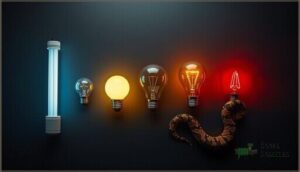
Not all bulbs are created equal — and choosing the wrong one can throw your snake’s entire cycle off.
Linear fluorescent tubes offer wide UVB Tube Longevity of 6–12 months, while Compact Coil Output suits smaller enclosures.
Mercury Vapor Sunlight replicates the full solar spectrum for diurnal species.
For basking, Halogen Basking Power outperforms standard incandescent bulbs.
At night, Red Moonlight from red night bulbs keeps things calm without disrupting sleep.
Fixture Options for Snake Enclosures
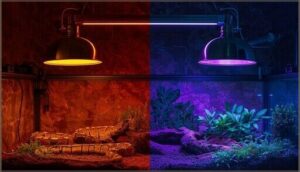
The fixture you choose is just as important as the bulb inside it. Dome Fixture Placement over a basking zone, paired with Ceramic Socket Safety ratings that handle high-wattage bulbs, gives you reliable heat delivery.
Bracket Height Adjustment lets you fine-tune temperatures without swapping bulbs.
Linear Hood Benefits shine for even UVB coverage, while IP65 Moisture Protection keeps humid setups safe from condensation damage.
Light Timers and Automation
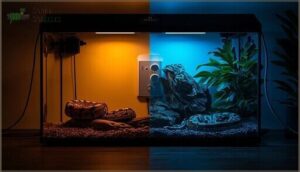
Think of a timer as your snake’s silent timekeeper — one that never forgets to flip the switch.
Digital Timer Programming lets you lock in precise on/off times to the minute, maintaining consistent light cycles without daily intervention.
Analog Timer Benefits include simplicity and affordability for basic setups.
Smart Plug Integration adds remote control and scheduling flexibility, though WiFi Reliability matters — always confirm automated systems resume correctly after power outages.
Setting Up a Day Night Lighting Schedule
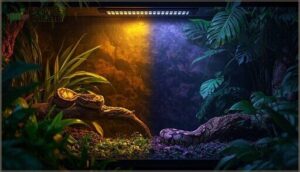
Getting your snake’s lighting schedule right comes down to a few simple decisions made consistently.
The good news is that once you understand the basics, setting it up takes almost no effort.
Here’s what you need to know to get it done right.
If your readings seem off, understanding why hygrometers give inaccurate humidity readings can help you spot whether a worn hair filament or faulty coil is to blame.
Recommended Light/dark Durations
Most snakes thrive on a 12-hour light/12-hour dark photoperiod — a Light/Dark Ratio that closely mirrors equatorial conditions and keeps circadian rhythms running smoothly.
Your Photoperiod Ratio Guidelines come down to three Species Light Duration baselines:
- Ball pythons — 12 hours on, 12 off year-round
- Corn snakes — 12 hours standard, adjustable seasonally
- Boa constrictors — 13 hours light, 11 hours dark
A Dawn/Dusk Ramp prevents abrupt on/off shocks during the day/night cycle.
Adjusting Cycles for Species and Seasons
A fixed 12-hour schedule works for many tropical species, but temperate snakes need more nuance.
Latitudinal Photoperiod Shifts and Seasonal Photoperiod Simulation are central to solid reptile husbandry — corn snakes, for instance, benefit from 13 hours in summer, dropping to 11 in winter.
High‑Latitude Day Length swings trigger brumation light reduction, Breeding Season Extensions, and Species-Specific Lighting Requirements that keep circadian rhythms properly calibrated year‑round.
Using Timers for Consistency
Once you’ve dialed in your seasonal light cycles, automation keeps them running without a second thought. A reliable timer removes the human variable entirely — no forgotten switches, no disrupted rhythms.
- Multi Channel Scheduling lets you stagger a soft ambient light before the main basking bulb activates.
- Timer Backup Power preserves your programmed day/night cycle through brief outages.
- Smart Plug Integration lets you monitor lighting cycles remotely via phone.
- Timer Maintenance Checks catch mechanical wear before your snake’s lighting cycle drifts off schedule.
Choose models with Overload Protection Features — non-negotiable for safe reptile husbandry.
Balancing Light and Heat Sources
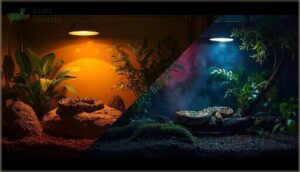
Light and heat are two sides of the same coin in your snake’s enclosure, and getting them to work together is where most setups either thrive or fall apart. Your daytime and nighttime needs are different, and so are the tools you’ll use to meet them.
Here’s what you need to know to keep temperatures balanced without disrupting your snake’s natural cycle.
Combining Lighting With Heating Needs
Getting UVB Heat Sync right means treating light and warmth as a single system, not two separate jobs.
A dual fixture lets you calibrate both outputs in one overhead unit, positioning your basking zone, tuning around a 90°F surface spot while a 6% T5 HO UVB tube runs 11–13 inches above the mesh — thermostat light integration keeps everything stable without manual guesswork.
Daytime Vs. Nighttime Heat Management
Once daytime gradient range is locked in — generally 75–90°F with a basking spot around 85–95°F — heat cycle automation makes the day/night cycle nearly simple.
After lights out, ceramic heat emitters and heat mats handle nighttime heating solutions without light, maintaining temperature differential control while letting the nighttime cool zone drop a comfortable 5–10°F, supporting your snake’s natural circadian rhythm.
Avoiding Overheating and Cold Spots
Think of your enclosure as a thermal map — every zone needs to serve a purpose. Place heat sources at one end to build a clear temperature gradient, keeping the warm side around 80–85°F and the cool zone at 70–75°F.
Dual thermometer placement catches hidden hot spots, while thermostat calibration practices and ventilation airflow optimization prevent dangerous spikes from ceramic heat emitters or heat mats, ruining your snake’s rest.
Top 5 Products for Snake Day Night Cycles
Finding the right gear takes the guesswork out of managing your snake’s light cycle. The products below cover everything from programmable controllers to dual-fixture setups, so you can build a reliable routine without overcomplicating things.
Here are five options worth considering.
1. Dual Reptile Light Fixture Switches
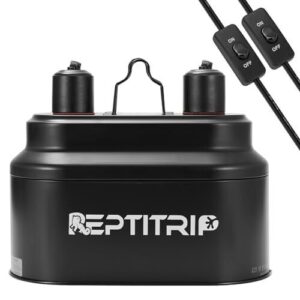
Independent control over each bulb is one of those small features that makes a genuine difference once you’re managing a strict photoperiod. dual reptile light fixture with separate on/off switches lets you run your daytime UVB or basking bulb while keeping the nighttime heat source completely off — no unplugging, no guessing. Route each switch cord to its own timer, and your snake’s cycle runs automatically.
Fewer outlets, less fuss, and your snake never gets an accidental burst of light at 2 a.m.
| Best For | Reptile owners who want hands-off control over their pet’s day/night lighting cycle without juggling multiple outlets or timers. |
|---|---|
| Brand | REPTITRIP |
| Reptile Compatible | Yes |
| Heat Support | Up to 160W |
| UVA Support | Yes |
| Day/Night Use | Daytime |
| Bulb Included | No |
| Additional Features |
|
- Two independent switches mean you can run your basking bulb and UVB light on totally separate schedules
- Handles up to 160W, so you’ve got plenty of room for serious heat bulbs
- Works with smart plugs and thermo controllers, making full automation easy
- Bulb not included, so factor that into your budget
- Shorter bulbs may sit too low in the fixture to light the tank effectively
- Mixing bulbs with different wattages can cause one to burn out faster than expected
2. Repti Zoo Dual Reptile Light Fixture
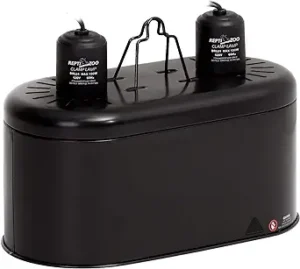
The REPTI ZOO Dual Reptile Light Fixture manages both UVB and heat in one compact, metal-built unit — no stacking multiple fixtures or crowding your enclosure lid. Each ceramic socket accommodates up to 150 watts, so you can pair a basking bulb with a UVB lamp without worrying about overload.
The ventilation holes and reflective interior keep heat dissipation efficient, extending bulb life.
It’s ETL certified, hangs easily over any screen top, and at just one pound, setup takes minutes.
| Best For | Reptile owners who want to simplify their setup by running both a basking bulb and UVB lamp from a single, no-fuss fixture. |
|---|---|
| Brand | REPTI ZOO |
| Reptile Compatible | Yes |
| Heat Support | Up to 150W per cap |
| UVA Support | Yes |
| Day/Night Use | Daytime |
| Bulb Included | No |
| Additional Features |
|
- Dual ceramic sockets handle up to 150W each, so you can run a heat bulb and UVB lamp at the same time without needing two separate fixtures
- Lightweight and easy to hang — at just one pound, it sits right on a screen top and takes minutes to set up
- ETL certified with built-in ventilation holes that help dissipate heat and keep your bulbs running longer
- Gets seriously hot during use, so you have to be careful when adjusting or handling it
- Some users have run into loose sockets or annoying buzzing sounds, which points to inconsistent build quality
- Durability is hit or miss — a few buyers reported malfunctions or damaged units not long after purchase
3. REPTITRIP LED UVB Light Controller
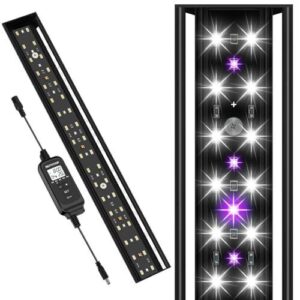
Automation is where the REPTITRIP LED UVB Light Controller genuinely earns its place in a snake keeper’s setup.
The built-in controller runs five programmable modes — M0 for manual control, and M1 through M4 mapped to Ferguson Zones 1–4 — so you can dial in exactly the right UV exposure for your species without guesswork.
It simulates smooth sunrise and sunset transitions, provides full darkness at night, and at just 14 watts, it won’t inflate your electricity bill while keeping your snake’s photoperiod perfectly on schedule.
| Best For | Reptile owners who want precise UV control for species like bearded dragons, geckos, and turtles without overspending on energy costs. |
|---|---|
| Brand | REPTITRIP |
| Reptile Compatible | Yes |
| Heat Support | Low heat only |
| UVA Support | Yes |
| Day/Night Use | Daytime |
| Bulb Included | Yes (LED) |
| Additional Features |
|
- Four UVI modes mapped to Ferguson Zones make dialing in the right UV exposure simple and species-specific
- Smooth sunrise and sunset transitions keep your reptile’s photoperiod natural and stress-free
- Lightweight aluminum build at just 14W keeps energy use low without sacrificing output
- No heat output, so you’ll still need a separate basking lamp to warm the enclosure
- No memory function means you have to reprogram settings after every power outage or unplug
- Manual reset requirement can be frustrating if your power supply is unreliable
4. REPTI ZOO Dual Reptile Heat Lamp
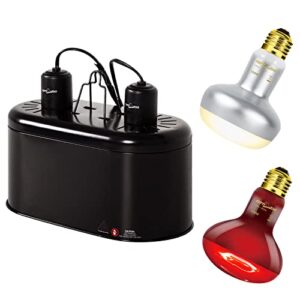
When you need heat and light handled in one compact unit, the REPTI ZOO Dual Reptile Heat Lamp (model DRL01ST3) delivers exactly that.
Each ceramic dome fits standard E26 bulbs up to 150 watts, and the two independent power switches let you run a daytime UVA bulb on one side while a ceramic heat emitter keeps temperatures stable through the night.
That clear separation between light and heat is what makes consistent day/night cycles genuinely easy to maintain for your snake.
| Best For | Reptile owners who want an all-in-one heat and light setup for species like bearded dragons or leopard geckos. |
|---|---|
| Brand | REPTI ZOO |
| Reptile Compatible | Yes |
| Heat Support | 100W |
| UVA Support | Yes |
| Day/Night Use | Daytime |
| Bulb Included | Yes |
| Additional Features |
|
- Two independent switches let you run daytime UVA light and nighttime infrared heat separately — no extra timer needed
- Ceramic build handles heat well, with ventilation holes that keep things from overheating
- Bulbs last up to 2,000–3,000 hours, so you’re not swapping them out constantly
- Bulbs can arrive cracked or broken due to fragile packaging
- The power cords run short, so you’ll likely need an extension cord nearby
- The lamp arm length is fixed — no way to adjust it if the fit isn’t quite right for your enclosure
5. Zoo Med Reptile Bulb Combo
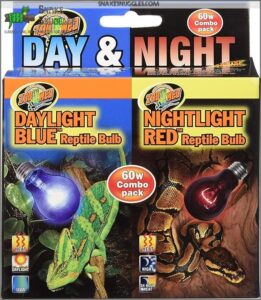
Sometimes the simplest solution is the right one. The Zoo Med Day and Night Reptile Bulb Combo (model DBC1) pairs a 60-watt Daylight Blue bulb with a 60-watt Nightlight Red bulb — giving you a complete photoperiod setup without overcomplicating your enclosure.
The blue bulb delivers UVA light and daytime heat, while the true red glass nightlight lets you monitor nocturnal activity without disrupting your snake’s rest. It’s a practical, budget-friendly starting point for ball pythons, corn snakes, and similar species in small to medium enclosures.
| Best For | Reptile owners who want a simple, affordable day-and-night lighting setup for ball pythons, corn snakes, or similar species in small to medium enclosures. |
|---|---|
| Brand | Zoo Med |
| Reptile Compatible | Yes |
| Heat Support | Incandescent heat |
| UVA Support | Yes |
| Day/Night Use | Day and Night |
| Bulb Included | Yes |
| Additional Features |
|
- Covers a full 24-hour cycle — the blue bulb handles daytime heat and UVA, while the red bulb lets you watch nocturnal activity without disturbing your reptile
- UVA light supports your reptile’s psychological well-being, not just physical health
- Comes as a ready-to-go combo pack, so no guesswork on pairing bulbs
- Bulb lifespan has been hit or miss — some users report burnouts way sooner than expected
- The blue light can be pretty intense, which might bother light-sensitive species or owners
- Not guaranteed to fit every fixture, so double-check compatibility before buying
Creating Darkness for Nighttime Rest
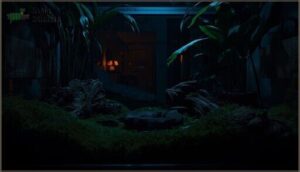
Darkness isn’t just a perk for your snake — it’s a biological necessity that signals rest, recovery, and the natural rhythm its body expects. Getting it right means more than just flipping a switch at the end of the day.
Here are three practical ways to make sure your snake’s enclosure stays genuinely dark when it needs to be.
Turning Off Daytime Lights
Think of daytime lights as a cue, not just a fixture — when they switch off, your snake’s biology takes the hint. A consistent shutoff time is the backbone of any healthy day/night cycle. Follow these Timer Programming Tips for Nighttime Light Safety:
- Set lights to switch off after 12 hours daily
- Target 6–8 p.m. for Ambient Light Control alignment
- Run nighttime heating solutions without light using ceramic emitters
- Apply Energy Saving Strategies through Heat Source Separation via separate thermostats
Covering Enclosures for Darkness
Even with timers doing the heavy lifting, ambient light sneaking through glass panels can still disrupt your snake’s day-night cycle. Draping a blackout fabric over the enclosure blocks up to 99% of light at night.
Prefer something more structured? A magnetic curtain system installs in minutes.
A partial front cover or Reflectix panel also works well — just always leave a ventilation gap to keep airflow moving.
Reducing Ambient Room Light at Night
Your enclosure cover manages what’s inside the tank, but the room itself still matters.
Blackout curtain installation along windows blocks 95–100% of outdoor glow that would otherwise bleed in and confuse your snake’s circadian rhythm.
Point task light direction away from the enclosure, use screen blue-light filtering on devices, and let furniture light shielding do passive work.
Motion-sensor night lights keep disruption minimal.
Nighttime Heating Without Disturbing Sleep
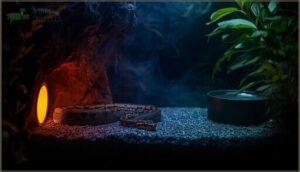
Keeping your snake warm at night doesn’t have to mean flooding the enclosure with disruptive light. right heating approach maintains safe temperatures while letting your snake rest undisturbed through the dark cycle.
Here’s what you need to know about nighttime heating options and how to use them correctly.
Ceramic Heat Emitters Vs. Heat Mats
Both options keep your day-night cycle intact since neither emits visible light — but how they heat is very different.
- Ceramic heat emitters warm the air through infrared radiation, supporting a wider thermal gradient, but increasing humidity impact.
- Heat mats deliver localized conduction heat, reducing burn risk when thermostat‑controlled.
- Installation safety matters: always use a ceramic guard and reliable thermostat for temperature regulation with both.
Safe Nighttime Temperature Ranges
Temperature is where species night temps really determine your thermostat settings.
Tropical snakes like ball pythons need 75–80°F after dark, while temperate colubrids like corn snakes tolerate 65–70°F — as long as heat gradient zones stay intact.
Follow a 5–10°F temperature drop guideline from daytime levels.
Room ambient impact matters too; cool homes can quietly drag your nighttime heating solutions without light below safe temperatures.
Monitoring Enclosure Temperatures
Think of your enclosure as a living system — one that needs constant feedback to stay balanced.
Place digital thermometers at both ends to map the full temperature gradient, positioning probes at the snake’s resting height for accurate ambient temperature readings.
Use infrared gun usage spot-checks on basking surfaces, and pair thermostat calibration with data logger alerts to catch overnight temperature cycling shifts before they stress your snake.
Monitoring and Adjusting The Cycle
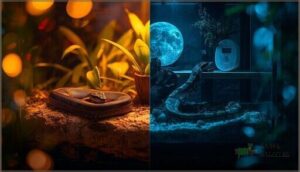
Even the best lighting setup needs occasional fine-tuning once your snake actually starts living in it. Watching how snake behaves day-to-day tells you far more than any timer or thermometer ever could.
Here’s what to look for — and how to adjust the cycle when something’s off.
Observing Snake Behavior for Stress
Your snake’s body is a behavioral diary — and knowing how to read it makes all the difference. When the day-night cycle is off, stress behaviors surface fast.
Your snake’s behavior is a diary — when the day-night cycle breaks, stress writes every entry
Watch for:
- Activity spikes or sudden lethargy outside normal hours
- Hiding frequency increasing even during active periods
- Feeding refusal across multiple consecutive attempts
- Escape attempts, nose rubbing, or rigid body posture
Monitoring snake behavior for light adjustments helps you catch circadian rhythm disruption in reptiles before it becomes a serious health issue.
Signs of Incorrect Light Cycles
Your snake doesn’t lie — its body broadcasts every lighting mistake loud and clear.
| Sign | Likely Cause | Impact |
|---|---|---|
| Irregular feeding or weight loss | Circadian disruption | Metabolic slowdown |
| Abnormal shedding cycles | Hormonal regulation failure | Incomplete skin release |
| Eye irritation and restlessness during day | Overexposure to bright light | Chronic stress behaviors |
Tweaking Schedules for Individual Needs
No two snakes run on the same internal clock, which is why an individualized photoperiod matters more than any generic schedule.
Fine-tune your day/night cycle with these steps:
- Track activity peak timing for 1–2 weeks before changing anything.
- Apply gradual light shifts of 15–30 minutes weekly.
- Use owner-snake sync by offsetting lights to match your availability.
- Apply seasonal adjustment strategies, shortening days in winter.
- Reassess species-specific lighting requirements alongside individual behavior.
Common Mistakes When Setting Light Cycles
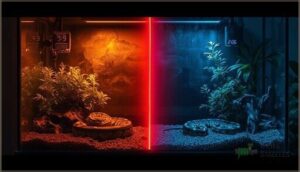
Even the most dedicated keepers slip up regarding lighting, and those small missteps can quietly throw off your snake’s entire biological rhythm. Most problems come down to just a few recurring patterns that are easy to fix once you know what to look for.
Here are the most common mistakes to avoid when setting light cycles for your snake.
Overexposure to Light or Darkness
Both extremes hurt your snake. Too much light suppresses melatonin, weakens the immune system, and triggers behavioral stereotypes like glass-surfing.
Eye strain risks rise sharply when high-intensity bulbs run too long.
Flip it the other way — no light at night matters less than no light during the day, which causes vitamin D deficiency and kills natural photoperiodism.
Balance light intensity carefully.
Inconsistent Schedules
Overexposure fixes mean nothing if your schedule changes every week. Photoperiod Drift — where light cycles shift gradually without intention — quietly unravels everything you’ve built.
- Feeding Schedule Instability leads to prey refusal and regurgitation
- Handling Routine Irregularity keeps arousal and defensive striking elevated
- Heat Timing Shifts prevent reliable basking and rest patterns
- Stress Behavior Patterns like hiding and freezing signal a broken day‑night cycle
Automation solves this instantly.
Using Inappropriate Bulbs or Fixtures
Automation manages timing but the wrong gear quietly undermines every cycle you’ve built.
Red Night Bulbs and Blue Night Bulbs maintain constant visible light, confusing your snake’s circadian clock regardless of color.
Plastic Covered Fixtures strip nearly all UVB before it reaches the basking zone.
Cheap Spotlights create harsh intensity imbalances, while Contact Heater Burns and Unshielded UVB round out the most damaging lighting mistakes in equipment selection.
Frequently Asked Questions (FAQs)
Do snakes need a day-night cycle?
Yes — snakes absolutely need day-night cycle.
Their reptile biology depends on consistent light cycles to regulate melatonin production, hormonal balance, and behavioral entrainment, keeping natural rhythms intact and stress biomarkers low.
Do ball pythons need a heat lamp at night?
Not always.
If your room stays above 75°F, ball pythons don’t need a heat lamp at night — ceramic heat emitters offer safer, lightless nighttime heating solutions without light without disrupting their cycle.
What time should I turn my snakes light on?
Turn your snake’s light on between 7 and 9 a.m. — a fixed start hour that mimics sunrise and delivers a reliable daily light cue your snake’s circadian rhythm depends on.
Can snakes get too much UV light exposure?
Snakes absolutely can get too much UV light exposure.
Excess UVB lighting causes UV eye damage, skin burns, cancer risk, and behavioral signs like lethargy — even though controlled UVB facilitates vitamin D3 synthesis and prevents metabolic bone disease.
Do snakes need light cycles during brumation?
During brumation, light cycles still matter — but less intensely.
Gradual light shortening sends hormonal light triggers that ease your snake into low light dormancy naturally, honoring its reptile physiology without abrupt disruption.
How does lighting affect snake feeding response?
Lighting directly shapes snake’s feeding response through light intensity, color spectrum, and hormonal rhythm.
Proper light cycles sync feeding time, improve visual cues, regulate hormone production, and support a healthy metabolic rate.
Should hatchlings have different cycles than adults?
Not drastically, but yes — hatchlings thrive on a steady 12-hour day/night cycle with softer light intensity preference, more hide availability, and no seasonal reductions until they’re established feeders.
Can artificial light cycles impact snake breeding?
Yes — artificial light cycles directly trigger breeding.
Photoperiod breeding triggers activate hormonal rhythm modulation through the pineal gland, while seasonal light simulation and UVB influence reproduction, supporting reproductive health, hormone production, and successful light-induced stress reduction across breeding cycles.
Conclusion
Every variable in your snake’s enclosure either aids or undermines the biological rhythm it inherited from millions of years of evolution—and light is the variable most keepers underestimate until the damage is already done.
Knowing how to create a day night cycle for snakes isn’t a luxury detail; it’s the foundation that everything else depends on. Nail the schedule, match the species, automate the consistency, and your snake’s physiology will quietly do exactly what it was designed to do.