This site is supported by our readers. We may earn a commission, at no cost to you, if you purchase through links.

stressed snake won’t eat, won’t shed cleanly, and spends most of its time trying to disappear into the corner of its enclosure.
That’s not a behavior problem—it’s a design problem.
Snakes are hardwired to feel exposed in open spaces, and a bare terrarium triggers the same alarm signals as sitting in the open with a hawk circling overhead.
The hide isn’t optional furniture.
It’s the foundation of the whole setup.
Get snake hides for naturalistic setups right, and everything else—feeding response, shed quality, temperament—usually follow.
Table Of Contents
- Key Takeaways
- Why Naturalistic Snake Hides Are Essential
- Key Features of Naturalistic Snake Hides
- Types of Snake Hides for Natural Setups
- Top 8 Snake Hides for Naturalistic Setups
- 1. Reptile Cave Hideout Decorative Rock
- 2. Exo Terra Snake Hide Cave Habitat
- 3. Grey Rock Cave Wall Decoration
- 4. Exo Terra Reptile Hide Cave
- 5. Zilla Reptile Bark Terrarium Decor
- 6. Hobbit House Aquarium Ornament Decoration
- 7. Exo Terra Primate Skull Terrarium Decor
- 8. Reptile Hide Box for Geckos and Snakes
- Choosing The Right Hide for Your Snake
- DIY Naturalistic Snake Hide Ideas
- Placement Strategies for Snake Hides
- Maintenance Tips for Healthy Snake Hides
- Enhancing Naturalistic Setups With Decor
- Frequently Asked Questions (FAQs)
- Conclusion
Key Takeaways
- A hide isn’t optional décor — it’s the foundation of your snake’s health, directly driving feeding response, shed quality, and temperament.
- Size your hide so your snake touches at least two walls when coiled; too much space kills the sense of security the hide is supposed to create.
- Always place two hides — one on the warm side (31–33°C) and one on the cool side (24–27°C) — so your snake can thermoregulate without ever feeling exposed.
- Match the hide style to your snake’s wild habitat: low rock caves for desert species, elevated vertical tubes for arboreal snakes, and damp moss hides for humid-forest dwellers.
Why Naturalistic Snake Hides Are Essential
good hide isn’t just decoration — it’s the difference between a snake that thrives and one that’s constantly stressed.
From snug cork rounds to stackable caves, the right boa constrictor hide type can make all the difference in how secure and settled your snake feels.
The right one facilitates natural behavior, helps with shedding, and gives your snake a genuine sense of security.
Here’s what makes a naturalistic hide worth adding to your setup.
Stress Reduction and Security
A snake that can’t hide is a snake that can’t relax. Enclosed hide design matters more than most keepers realize — low ceiling caves press against the snake’s back, dark interiors cut visual noise, and strategic placement away from foot traffic keeps alert responses from stacking up. Multiple secure hides complete the picture.
Prioritize these for effective reptile enrichment:
- Enclosed Hide Design — one or two small openings limit shadow triggers
- Low Ceiling Caves — back contact signals "no aerial threat"
- Dark Interior — opaque walls create a true refuge, not just décor
- Multiple Secure Hides — two minimum; one warm side, one cool
Support for Natural Behaviors
Beyond stress relief, the right reptile hide unlocks real snake behavior. Thermoregulation shuttling between warm and cool hides mirrors wild shuttling patterns.
Ambush hunting snakes naturally coil just inside a low entrance, watching for prey.
Environmental enrichment shapes everything — activity cycles, climbing and perching, burrowing interaction — inside naturalistic terrariums.
| Behavior | Hide Type |
|---|---|
| Ambush hunting | Low-entrance cave |
| Climbing perching | Vertical cork tube |
| Burrowing interaction | Half-log on loose substrate |
Encouraging Healthy Shedding
Hides also carry serious weight when shedding time comes. A moisture hide — packed with damp sphagnum moss and tucked into the thermal gradient — keeps local humidity between 65 and 80 percent, which is exactly where clean tube sheds happen.
Textured surfaces near the entrance give your snake something to snag the old skin on. Without that, retained eye caps become a real problem.
Key Features of Naturalistic Snake Hides
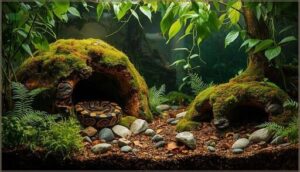
Not every hide is worth putting in your setup.
The best ones share a few traits that make them safer, easier to maintain, and more effective at keeping your snake calm.
Here’s what to look for before you buy.
Textured Surfaces and Camouflage
Texture isn’t just cosmetic — it’s functional. A good reptile hide uses color matching and pattern disruption to blend into naturalistic terrariums.
- Microhabitat integration — matte, earth-tone finishes disappear against coconut fiber or leaf litter.
- Camouflage — mottled, speckled patterns break up boxy outlines.
- Tactile grip — rough surfaces let snakes brace and reverse confidently.
- Shedding assistance — lightly abrasive interiors help loosen and peel old skin cleanly.
Appropriate Dimensions and Shape
Size is everything. The entrance width ratio should be just 5–10% wider than your snake’s mid-body girth — snug enough to feel like a burrow, not a doorway.
Keep the internal height profile low for terrestrial species; arboreal tube geometry works better for climbers. Single vs dual openings matter too — shy species settle faster with one exit.
Get the dimensions right, and your snake hides actually get used.
Safe, Non-Toxic Materials
Every material in your reptile hide sends a chemical signal into that enclosure.
Stick to these three non-negotiable choices:
- Aquarium-safe plastics like PP or HDPE — inert, odorless, proven safe
- Cork bark — naturally rot-resistant, low resin, ideal for naturalistic habitat design
- Food-grade resins sealed with non-toxic paints and silicone adhesives
For DIY snake hide builds, fully cure everything before your snake moves in.
Ease of Cleaning and Maintenance
Cleaning a hide shouldn’t mean dismantling your whole setup.
| Feature | Best Material | Why It Matters |
|---|---|---|
| Smooth Interior Surfaces | Non‑Porous Materials like resin | Wipes clean in seconds |
| Quick‑Dry Design | Molded plastic or sealed resin | Back in tank same day |
| Sink‑Friendly Sizing | Compact modular hide construction | Easy full soak and scrub |
| DIY Snake Hide sealing | Cork with reptile‑safe sealant | Slows stain absorption |
| Terrarium Maintenance and Safety | Unpainted interiors | Diluted bleach stays safe |
Prioritize snake hides built for reptile care and housing — not just looks.
Types of Snake Hides for Natural Setups
Not all hides are built the same, and that matters more than most keepers realize.
The right style depends on your snake’s species, behavior, and the kind of environment you’re trying to recreate.
Here are the four main types worth knowing before you pick one.
Rock Cave Hides
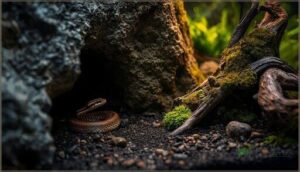
Rock cave hides are the paragon for terrarium design — and for good reason. Their thermal mass retention keeps interiors warm long after heat sources cycle off, and when paired with damp substrate, they create a reliable humidity microclimate perfect for clean sheds.
Here’s what makes them work:
- Entrance size optimization — A snug opening mimics a natural rock crack, triggering genuine security responses
- Light reduction interior — Dark, matte walls cut reflected light, making the space feel like a real crevice
- Weight stability — Heavy resin construction stays put when large snakes push against it
- DIY snake hide potential — Rock-textured molds let you customize a naturalistic habitat that commercial reptile hides rarely match
Bark and Wood Hides
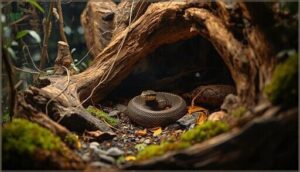
Wood and bark hides bring forest-floor realism to any naturalistic setup. The wood grain camouflage blends naturally into bioactive substrates, while bark texture benefits your snake’s skin between sheds.
Pair them with moss integration and strategic branch placement for genuine reptile enrichment.
Rotating these snake hides seasonally keeps the terrarium design fresh and your reptile hide options working harder year‑round.
Skull-Shaped and Decorative Hides
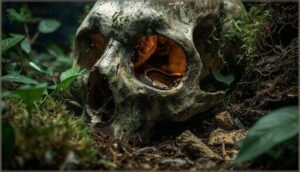
Skull-shaped and decorative hides do double duty — they’re aesthetic focal points that also deliver genuine environmental enrichment. They create thematic ambiance without sacrificing function.
- Works as predator mimicry, triggering natural hide-seeking instincts
- Pairs well with lighting accents and material contrast for visual depth
- Fits naturally into DIY snake hide builds for a cohesive naturalistic habitat
Vertical Hides for Arboreal Snakes
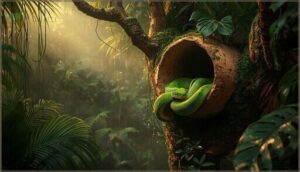
Arboreal snakes live differently — they don’t hide in the ground. Green tree pythons and emerald tree boas need vertical space utilization and branch height placement to feel secure. A well-anchored vertical hide with climbing grip surfaces provides arboreal thermoregulation naturally.
| Feature | Why It Matters |
|---|---|
| Stability anchoring methods | Prevents tipping during climbing |
| Elevated entry points | Matches wild roosting behavior |
Top 8 Snake Hides for Naturalistic Setups
Finding the right hide comes down to matching your snake’s needs with the right design, size, and material.
The options below cover a range of styles — from rocky caves to bark shelters — so there’s something for most common species and setups.
Here are eight solid picks worth considering.
1. Reptile Cave Hideout Decorative Rock
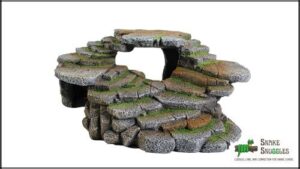
resin rock formation earns its place in a naturalistic setup.
At 11" x 8.25" x 4", it’s a solid fit for small to mid-sized snakes — big enough to feel like shelter, compact enough to maintain that snug, security-triggering fit.
Four entry points let your snake move naturally without feeling cornered.
It doubles as a basking platform, which helps with thermoregulation.
Rinse it thoroughly before use and check for rough edges.
A functional piece that doesn’t sacrifice aesthetics.
| Best For | Small reptile owners — especially snake, axolotl, or salamander keepers — who want a hide that looks good and actually does its job. |
|---|---|
| Material | Resin |
| Hide Function | Yes |
| Easy to Clean | Yes |
| Stress Reduction | Yes |
| Reptile Compatible | Yes |
| Naturalistic Design | Rock formation |
| Additional Features |
|
- Four entry and exit points give your pet freedom to move in and out naturally, which cuts down on stress
- Works as both a hide and a basking platform, so you get two functions in one piece
- Made from durable resin, so it holds up well in humid or wet setups
- Can have rough or sharp spots out of the box, so you’ll need to inspect and smooth it before putting it in the tank
- On the pricier side compared to simpler hide options
- Too small for larger reptiles, so it’s a pass if your snake or lizard has outgrown compact spaces
2. Exo Terra Snake Hide Cave Habitat
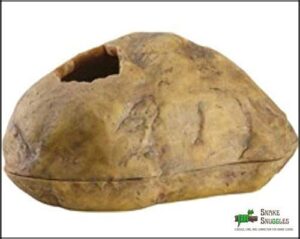
The Exo Terra Snake Hide Cave (PT2847) brings something most resin hides skip — ceramic construction. That matters. Ceramic holds humidity better, which helps during shed cycles.
At roughly 9.8" x 7.4" x 4.7", it fits ball pythons and corn snakes comfortably without feeling cavernous.
The removable top makes cleaning straightforward, and the included moss turns it into a functional humid hide.
One caveat: check the entrance opening against your snake’s girth before buying. Larger juveniles can outgrow it faster than you’d expect.
| Best For | Small to medium snakes and lizards — especially ball pythons, corn snakes, and leopard geckos — that need a cozy, humidity-friendly hide. |
|---|---|
| Material | Ceramic/Resin |
| Hide Function | Yes |
| Easy to Clean | Yes |
| Stress Reduction | Yes |
| Reptile Compatible | Yes |
| Naturalistic Design | Natural stone look |
| Additional Features |
|
- Ceramic construction holds moisture well, making it great for shed cycles
- Removable top makes cleaning quick and easy
- Comes with moss so it’s ready to use as a humid hide right out of the box
- Entrance hole may be too tight for thicker or larger snakes
- Can be on the heavier side, so it needs to be placed carefully to avoid tipping
- May be outgrown faster than expected by juvenile snakes that are still putting on size
3. Grey Rock Cave Wall Decoration
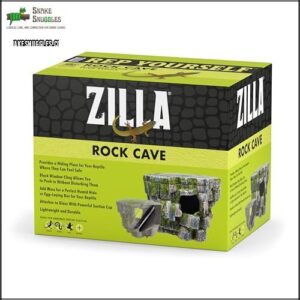
If your snake is arboreal or needs a perch point, the Zilla Grey Rock Cave Wall is worth a look. It mounts directly to the glass via suction cup, which keeps floor space free — a real advantage in tighter builds.
At 8.75" wide and 7.25" tall, it gives climbing species like tree boas a solid spot to anchor. The included black window cling helps reduce reflection stress.
Just check those suction cups regularly. Some users report weakening over time.
| Best For | Arboreal reptiles like tree boas, geckos, and tree frogs that need vertical space to climb, perch, and hide. |
|---|---|
| Material | Plastic |
| Hide Function | Yes |
| Easy to Clean | Yes |
| Stress Reduction | Yes |
| Reptile Compatible | Yes |
| Naturalistic Design | Branch/bark texture |
| Additional Features |
|
- Mounts to the glass with a suction cup, keeping valuable floor space open
- Realistic rock look adds a natural feel to the terrarium
- Comes with a black window cling to help cut down on reflection stress
- Suction cups can weaken over time and may need regular checking
- Some sharp edges have been reported, which could be a concern for smaller or more delicate pets
- At nearly 9" wide, it takes up a noticeable chunk of space inside the tank
4. Exo Terra Reptile Hide Cave
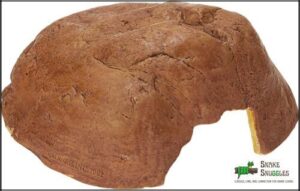
The Exo Terra Reptile Hide Cave (PT2853A1) is a solid all‑rounder for ground‑dwelling species.
At 9.5 x 12 x 3 inches, it fits comfortably into 10 and 20‑gallon builds without dominating the layout.
The food‑grade resin construction resists bacterial growth, and the smooth interior won’t snag scales during movement.
Ball pythons, leopard geckos, and bearded dragons all use it well.
One caveat: don’t place it over a heat mat.
It’s not rated for direct heat, and that matters.
| Best For | Ground-dwelling reptiles like ball pythons, leopard geckos, and bearded dragons housed in 10 or 20-gallon terrariums. |
|---|---|
| Material | Resin |
| Hide Function | Yes |
| Easy to Clean | Yes |
| Stress Reduction | Yes |
| Reptile Compatible | Yes |
| Naturalistic Design | Rock formation |
| Additional Features |
|
- Food-grade resin with a bacterial-resistant coating keeps things clean and safe for your reptile
- Natural brown look blends into desert or tropical setups without looking out of place
- Smooth interior won’t catch or irritate scales during normal use
- Not safe to place over a heat mat or in high-temperature spots
- Some owners have reported the interior material breaking down over time
- Edges can be sharp out of the box and may need a quick once-over before use
5. Zilla Reptile Bark Terrarium Decor
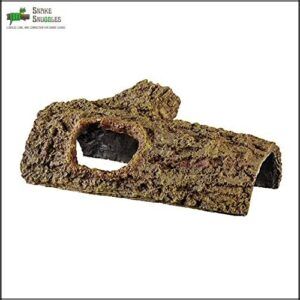
Zilla Reptile Bark Terrarium Decor does something most plastic hides — it actually looks like it belongs in a naturalistic setup.
At 10.75" long, 5" wide, and 5.5" high, it gives corn snakes and similar mid-sized species a snug, den-like space.
The non-porous exterior resists bacterial buildup, and the viewing window on top lets you check on your snake without disturbing it.
Just watch the edges — some units ship a little rough and may need light sanding before use.
| Best For | Reptile owners who want a hide that actually looks natural and makes it easy to keep an eye on their pet without a lot of fuss. |
|---|---|
| Material | Plastic |
| Hide Function | Yes |
| Easy to Clean | Yes |
| Stress Reduction | Yes |
| Reptile Compatible | Yes |
| Naturalistic Design | Wood bark |
| Additional Features |
|
- Looks like real wood bark, so it blends right into naturalistic tank setups
- Non-porous surface means bacteria doesn’t build up easily — simple to wipe down and keep clean
- The window on top lets you peek in on your reptile without having to move anything around
- Some units come with rough or sharp edges that need a quick sand before they’re safe to use
- The top opening can be too tight for larger reptiles, which is a real concern if they get stuck
- No mention of weather resistance, so it’s best kept indoors
6. Hobbit House Aquarium Ornament Decoration
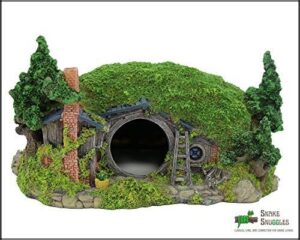
At 11.5 x 7.5 x 6.2 inches, the BobbyPet Hobbit House is one of the larger decorative hides you’ll find — which makes it a reasonable fit for small-to-medium aquatic setups or reptile tanks needing a statement piece.
The resin construction is non-toxic and easy to wipe down.
That said, inspect the interior openings before use. Sharp edges inside can catch scales or fins.
A quick sand and soak removes any chemical residue before your animal moves in.
| Best For | Fish keepers and reptile owners with medium to large tanks who want a standout centerpiece that doubles as a functional hide. |
|---|---|
| Material | Resin |
| Hide Function | Yes |
| Easy to Clean | Yes |
| Stress Reduction | Yes |
| Reptile Compatible | Yes |
| Naturalistic Design | Multi-color coral |
| Additional Features |
|
- Bigger than most tank ornaments, so it actually gives fish and reptiles room to move in and out comfortably
- Made from non-toxic resin — safe for fresh and saltwater setups alike
- Handcrafted with a vibrant, detailed design that makes it a real eye-catcher in any tank
- Too bulky for tanks under 10 gallons — it’ll eat up most of the space
- Sharp interior edges can snag fins or scales, so you may need to sand them down before use
- Can arrive with a chemical smell that requires soaking before it’s safe to drop in the tank
7. Exo Terra Primate Skull Terrarium Decor
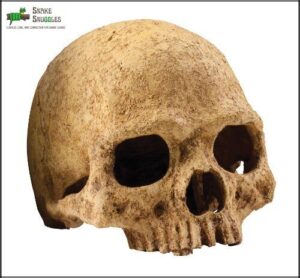
Not every hide needs to look like a rock. The Exo Terra Primate Skull adds a striking visual to desert or rainforest builds while still doing the job — multiple entrances, a secure interior, and resin construction that’s easy to clean.
At 6.3 x 6.3 x 5.7 inches, it fits small species like juvenile ball pythons and geckos well.
One caveat: check the interior before use. The skull detailing can leave sharp points that need light sanding before your snake moves in.
| Best For | Small reptile owners who want their terrarium to look like something out of a fantasy game without sacrificing function. |
|---|---|
| Material | Resin |
| Hide Function | Yes |
| Easy to Clean | Yes |
| Stress Reduction | Yes |
| Reptile Compatible | Yes |
| Naturalistic Design | Skull design |
| Additional Features |
|
- Multiple entry points make it easy for curious geckos and young ball pythons to explore and hide comfortably
- Resin build is simple to wipe down and holds up well in both desert and rainforest setups
- The skull design is genuinely eye-catching — it adds personality to a tank without looking cheap
- Sharp interior edges are a real concern — you’ll likely need to sand a few spots before it’s safe for your pet
- The openings are sized for small species only, so larger or full-grown reptiles won’t fit
- Softer-skinned animals could get scratched if you skip the edge check
8. Reptile Hide Box for Geckos and Snakes
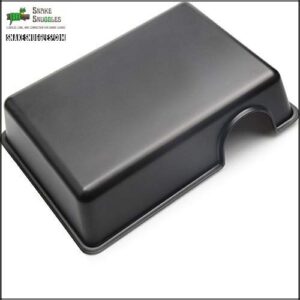
The Zipefy Reptile Hide Box keeps things simple — and sometimes that’s exactly what your setup needs.
At 9.5 x 6.7 x 2.2 inches, it fits geckos, juvenile ball pythons, and similarly sized species comfortably.
The textured interior actively aids molting, giving your reptile something to push against during shedding.
Resin construction cleans up fast with reptile-safe soap.
One thing to watch: it runs low-profile, so it won’t suit snakes that prefer a taller refuge.
Backed by a 12-month warranty.
| Best For | Small reptile owners keeping geckos, juvenile ball pythons, or similarly sized snakes who need a simple, easy-to-clean hide. |
|---|---|
| Material | Resin |
| Hide Function | Yes |
| Easy to Clean | Yes |
| Stress Reduction | Yes |
| Reptile Compatible | Yes |
| Naturalistic Design | Rock/cave style |
| Additional Features |
|
- Textured interior genuinely helps with molting — your reptile can rub against it during sheds
- Super easy to clean, just a quick scrub with reptile-safe soap and you’re done
- Comes with a 12-month warranty, which is a nice safety net for the price
- Too small for larger reptiles and the low profile rules out snakes that like a taller hide
- Resin construction raises some durability concerns — it may not hold up long-term
- A few buyers have reported receiving wrong quantities, so double-check your order when it arrives
Choosing The Right Hide for Your Snake
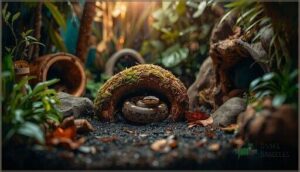
Not every hide works for every snake — species, size, and natural habitat all shape what your animal actually needs. Getting these three factors right makes a bigger difference than most keepers expect.
Here’s what to think about before you buy.
Species-Specific Preferences
Not all snake hides work for every species — your setup should mirror where that animal actually lives. Arboreal elevation matters for green tree pythons, which prefer hides 30–60 cm off the ground.
Desert-cooling ceramic hides suit sand boas. Semi-aquatic shoreline placement works best for garter snakes. Forest cover and burrowing hides serve corn snakes and hognose respectively.
That’s species-specific habitat design in action.
Sizing Guidelines for Juveniles and Adults
Size follows the animal — always. A secure hide lets your snake coil fully inside while touching at least two walls. For Hide Height Proportions, aim for 1.25–1.5 times body thickness. Growth Rate Scaling matters too: fast-growing juveniles often need upgrades every 6–12 months.
- Track Body Thickness Ratio as your snake grows
- Apply Seasonal Size Adjustments during brumation prep
- Use Species Size Benchmarks to anticipate upgrades early
Matching Hides to Natural Habitats
Once you’ve nailed sizing, habitat match is the next layer.
Desert Rock Caves suit arid species like Kenyan sand boas — low‑profile, warm‑side placement, rough exterior.
Tropical Moss Hides work for humid‑forest dwellers.
Temperate Burrow Design fits corn snakes naturally.
Arboreal Canopy Hides belong elevated on branches, while Semi‑Aquatic Riverbank Hides sit near the water dish.
Match the hide to the wild, and your Bioactive Terrarium starts working with the snake, not against it.
DIY Naturalistic Snake Hide Ideas
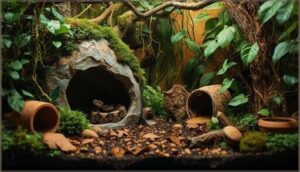
Store-bought hides work fine, but making your own gives you full control over size, shape, and materials. With the right supplies, you can build something that fits your snake perfectly — and your wallet will thank you.
Here are some practical DIY ideas to get you started.
Cost-Effective Materials and Tools
Most solid DIY snake hide ideas don’t require a big budget. A few materials go a long way:
- Corkboard Panels and Recycled PVC pipe cut to size
- Silicone Molds shaped into rock or cave forms
- Heat‑Resistant Glue to bond layers safely
Budget Lighting, basic tools, and these components make a functional DIY reptile hide achievable. Smart reptile habitat design starts with sourcing the right materials.
Customizing for Your Snake’s Needs
Once you’ve got your materials sorted, DIY hide is where a DIY hide earns its keep. Match the species‑specific shape to your snake — tight and low for ball pythons, taller for arboreal setups.
Build in an adjustable humidity chamber using removable moss inserts. A modular hide system lets you swap panels as your snake grows, keeping the terrarium design functional without starting from scratch.
Step-by-Step DIY Hide Projects
Building a DIY snake hide comes down to four stages: plan, assemble, seal, cure.
Start with material selection — extruded polystyrene foam cuts cleanly and shapes easily. Cut a cardboard template first; template testing saves wasted foam.
Bond panels with aquarium-safe silicone, then apply two or three grout coats for texture.
Finish with a water-based sealant — curing safety means airing it out 24–72 hours before your snake moves in.
Placement Strategies for Snake Hides
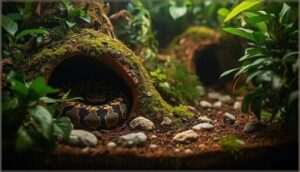
Where you put your snake’s hide matters just as much as which hide you choose. A well-placed hide can mean the difference between a snake that thrives and one that stays stressed.
Here’s how to get the placement right.
Creating Thermal Gradients
Think of your enclosure as a two-zone system.
Warm hide placement over your heat source should hit 31–33°C at floor level, while cool side design keeps the opposite end around 24–27°C.
Smart heat source selection — thermostat-controlled mats or ceramic emitters — locks in that thermal gradient precisely.
Vertical gradient layers enhance bioactive terrariums, letting your snake self‑regulate through your reptile habitat naturally.
Maintaining the optimal humidity range is essential for ball pythons.
Multiple Hides for Enrichment
Offering more than one reptile hide transforms your terrarium design into a living enrichment system. Behavioral choice alone reduces stress noticeably — snakes with options move more confidently and explore earlier each evening. For real environmental enrichment and stimulation, aim for:
Multiple hides don’t just reduce stress — they give snakes the freedom to choose, and that choice changes everything
- Humidity Zones — one moist moss hide, others dry
- Sensory Variety — mix cork bark, resin, and smooth plastic
- Visual Security — stagger hide rotation monthly for novelty
Secure and Stable Placement
A wobbly hide undoes everything else in your terrarium design.
For heat mat stability, set your reptile hide on tile or slate directly over the mat — it won’t shift when your snake pushes in.
Corner anchoring gives two-sided support, while burying the base 1–2 cm adds grip.
Good weight distribution and vibration dampening complete a terrarium setup that holds its shape.
Maintenance Tips for Healthy Snake Hides
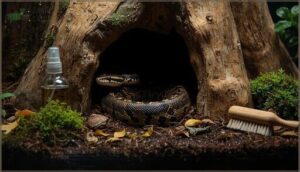
A clean hide is a safe hide — and that’s not something you want to leave to chance.
Over time, bacteria, mold, and shed skin debris can build up fast, especially in humid enclosures.
Here’s what you need to stay on top of it.
Regular Cleaning and Disinfection
Dirty hides are a fast track to sick snakes.
For routine terrarium maintenance, pull each hide every 2–4 weeks for a full wash, disinfect with chlorhexidine at 25–33 ml per liter, and follow contact time guidelines — at least 5–10 minutes. Always wear gloves, then rinse thoroughly and air-dry completely before returning hides to the snake enclosure.
Reptile wellness starts with consistency.
Monitoring for Mold and Bacteria
Mold rarely announces itself.
Start with visual checks every week — fuzzy white, green, or black patches grow over days, often hiding in back corners and undersides first.
Musty odor detection is your next cue; if lifting the hide releases a stale smell, something’s already growing.
Digital hygrometer helps with humidity spotting and microclimate control — hides staying above 70–80% without airflow are prime targets.
Behavior indicators too: a snake coiling on top of its hide instead of inside is telling you the interior feels wrong.
Replacing and Upgrading Hides
clean hides don’t last forever. Watch for hide replacement timing cues: cracked edges, peeling coatings, or persistent odor after cleaning. Size upgrade indicators are equally clear — once your snake can’t touch two or three walls while coiled inside, it’s time to move up.
DIY snake hide builds keep your naturalistic habitat and terrarium setup fresh without draining your wallet. Providing proper hides reduces stress and aids thermoregulation.
Enhancing Naturalistic Setups With Decor
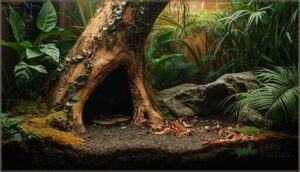
A hide alone won’t make your ** setup feel alive — the decor around it does a lot of that work.
Layering in plants, substrate, and moss turns a basic enclosure into something that actually resembles where your snake came from. Here’s how to pull it all together without sacrificing practicality.
Integrating Live or Artificial Plants
Plants do more than look good — they’re functional tools in a naturalistic habitat. Strategic Cover Plant Placement around your reptile hide creates a humidity pocket that helps with shedding and reduces stress.
Stick with safe plant species like pothos or philodendron for live plants, or inspect artificial plant maintenance regularly for frayed parts. Either way, thoughtful foliage path design keeps every hide accessible while maximizing environmental enrichment for animals.
Using Natural Substrates and Moss
Substrate layering works hand‑in‑hand with your plant choices. Getting humidity regulation right starts beneath the surface — literally. A good reptile habitat foundation includes:
- Coconut fiber or cypress mulch for moisture retention
- Damp sphagnum moss packed inside hides for localized humidity spikes
- 5–10 cm burrowing depth for smaller species
- Leaf litter on top for airflow and natural cover
Swap moss every 2–4 weeks for mold prevention.
Balancing Aesthetics and Functionality
Once your substrate and moss layers are set, the finishing challenge is making everything look intentional. Color harmony matters here — rock hides in warm browns, and grays anchor most desert or woodland themes without fighting your backdrop.
For environmental enrichment for reptiles, a modular design approach works best: two functional reptile hides, one warm side, one cool, matching style throughout. Clean lines, purposeful placement.
That’s a naturalistic habitat that works as hard as it looks.
Frequently Asked Questions (FAQs)
Can snakes share hides without causing stress?
Yes, but only under the right conditions. Species compatibility, hide dimensions, and temperature zoning all matter. Watch for behavioral cues — stress shows fast when the fit is wrong.
How does brumation affect hide usage patterns?
Brumation flips hide usage completely. Your snake abandons its usual rotation and locks onto one cool, dark retreat for weeks. That seasonal hide shift is instinct — don’t fight it.
Should hides differ for nocturnal versus diurnal snakes?
Absolutely. light blocking, snug entrance size, and humidity balance.
Diurnal snakes want open hides near basking zones.
Hide placement, enrichment paths, and thermal gradient needs differ completely between them.
Can hides double as egg-laying spots for breeding?
A standard hide can absolutely double as an egg-laying site. If it’s snug, dark, and humid, most oviparous species won’t need anything fancier.
Conclusion
A snake without a proper hide is like a soldier without cover—constantly alert, never truly at ease.
The right snake hides for naturalistic setups do not just complete the enclosure; they switch your animal from survival mode into settled, natural behavior.
Get the size right, place hides across both thermal zones, and clean them consistently.
Do that, and you’ll see better feeding, cleaner sheds, and a calmer animal.
That’s not luck—that’s good husbandry.