This site is supported by our readers. We may earn a commission, at no cost to you, if you purchase through links.
A bearded dragon without UVB isn’t basking—it’s slowly breaking down. Without the right light wavelengths, its body can’t produce vitamin D₃, calcium absorption stalls, and bones soften in a condition called metabolic bone disease. Vets see it constantly in pet reptiles kept under the wrong bulbs.
The fix isn’t complicated, but the choices are. T5 tubes, mercury vapor bulbs, compact coils, LED emitters—each works differently depending on your species and enclosure setup. Picking the wrong one doesn’t just waste money. It puts your animal at at risk.
The right reptile UVB light makes husbandry straightforward. This guide cuts through the options.
Table Of Contents
- Key Takeaways
- What is UVB Lighting and Why Reptiles Need It
- Do All Reptiles Need UVB Lights
- Types of UVB Bulbs for Beginner Reptile Keepers
- Choosing The Right UVB Strength and Setup
- Installing UVB Lights Safely and Effectively
- Top 10 UVB Lights for Beginner Reptile Keepers
- 1. REPTIDLDB T5 UVB Light Fixture
- 2. QZQ T5 UVB Reptile Light Fixture
- 3. Hygger Zoo T5 UVB Reptile Light
- 4. T5 UVB Terrarium Light Fixture
- 5. Hygger Dimmable LED UVB Reptile Lamp
- 6. GREENPAW T5 UVB Reptile Light
- 7. Haceryc T5 UVB Reptile Light
- 8. Homnebila T5 UVB Reptile Light
- 9. Hygger Zoo UVB Reptile Lamp
- 10. REPTIDLDB T5 UVB Reptile Light
- Common UVB Lighting Mistakes Beginners Should Avoid
- Frequently Asked Questions (FAQs)
- Can you get vitamin D from an UVB lamp?
- How to choose UVB bulb?
- How do I choose the best UVB lighting for my Pet Reptile?
- Do Reptiles need UV light?
- How do I choose the right type of lighting for my reptile?
- What UVB does my reptile need?
- Can a reptile get too much UVB?
- How big of an UVB light do I need?
- How often should UVB bulbs be replaced?
- Can UVB lights be used with mesh screens?
- Conclusion
Key Takeaways
- Without UVB light, your reptile can’t make vitamin D₃, which leads to soft bones and metabolic bone disease — it’s not optional; it’s survival.
- Match the bulb rating to your species: desert lizards, like bearded dragons, need 10.0% UVB, tropical species need 2.0–5.0%, and nocturnal snakes need barely any.
- UVB bulbs go silent before they go dark — replace them every 6–12 months regardless of whether they still light up, or your reptile pays the price.
- Placement matters as much as the bulb itself: keep it 12–18 inches above the basking spot, never behind glass, and move it closer if you’re using a mesh screen.
What is UVB Lighting and Why Reptiles Need It
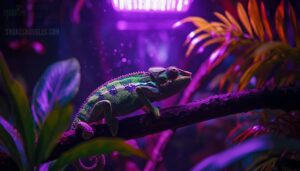
UVB lighting isn’t just a nice-to-have — for most reptiles, it’s as essential as food and water. Without it, their bodies can’t produce vitamin D₃, which means calcium absorption breaks down and health problems follow fast.
Beyond health, UVB also shapes natural behaviors like basking and activity cycles, so getting the setup right matters — beginner’s guide to UVB lighting systems for reptiles walks you through exactly what to look for.
For most reptiles, UVB lighting is as vital as food and water — without it, vitamin D₃ fails, and health follows
Here’s what you actually need to know before picking a light.
The Role of UVB in Vitamin D3 Synthesis
When UVB light hits your reptile’s skin, it triggers 7‑dehydrocholesterol absorption in epidermal cells — starting provitamin D3 formation. That molecule undergoes a thermal isomerization step, slowly converting into vitamin D3 over several hours.
The vitamin D3 peak arrives around 12 hours post-exposure. From there, hormone signaling activates calcium absorption in the gut, keeping bones dense and healthy.
The effective UVB spectrum range for vitamin D synthesis is 280‑320 nm.
How UVB Prevents Metabolic Bone Disease
Without enough vitamin D3, your reptile can’t absorb calcium properly — and that’s where metabolic bone disease starts. Bones weaken, bend, and break.
Consistent UVB lighting drives the Calcium Absorption Boost your reptile needs for real Bone Mineralization Support.
Think of UVB Dose Optimization as Skeletal Remodeling Control from the inside out.
Get it right, and bone health stays solid.
UVB Impact on Circadian Rhythms and Immune Health
Bone health isn’t the whole story. Your reptile’s body runs on a biological clock, and light drives it.
Consistent UVB exposure promotes Circadian Entrainment — keeping feeding, activity, and rest in sync through Chronobiology Timing. It also triggers Melatonin Suppression during daylight hours, shaping Immune Response Timing and Skin Immune Modulation. Stick to a steady 10–12 hour photoperiod, and immune function stays sharp.
Do All Reptiles Need UVB Lights
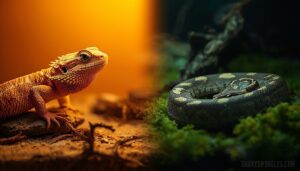
Not every reptile needs the same amount of UVB — and getting that wrong can affect their health more than you’d think. A bearded dragon’s needs look nothing like a ball python’s, and that difference matters when you’re picking a light.
Here’s a breakdown of which reptiles need high UVB, which do fine with less, and where the most popular pet species fall on that scale.
Species That Require High UVB Exposure
Some lizards are sun worshippers by nature. Bearded Dragon UVB needs are intense — they evolved under harsh Australian sun. The same goes for species with equally demanding species-specific UVB requirements:
- Green Iguana Calcium absorption fails without a strong UVB dosage daily.
- Uromastyx Shell Development depends on high UVB intensity and heat combined.
- Monitor Lizard Bone density drops fast without proper UVB lamp placement.
Pigment also fades without adequate UVB safety guidelines followed consistently.
Low-UVB and Crepuscular Species Like Ball Pythons
Not every reptile chases the sun. Ball pythons follow a Twilight Feeding Schedule, staying hidden during peak daylight hours. Their Temperature-Driven Activity means heat matters more than bright overhead light. A low-output tube with proper UVB lamp placement gives them a choice without forcing exposure.
| Feature | High-UVB Species | Ball Python |
|---|---|---|
| Activity Pattern | Diurnal | Crepuscular |
| Crepuscular Lighting Design | Not needed | Essential |
| Low-UVB Metering | Rarely used | Recommended |
| Shade Utilization | Minimal | High priority |
Use a handheld UV meter to confirm UVB 20 levels stay low. Species-specific UVB requirements vary — always match the lamp to your animal’s natural behavior, not just its species name.
Common Pet Reptiles and Their UVB Needs
Think of your pet’s natural habitat as a starting point for Species UVB Profiles. A bearded dragon basks under desert sun all day. A crested gecko hides in forest shade.
Here’s a quick Species-specific UVB requirements snapshot:
- Bearded dragons — 10.0% UVB
- Leopard geckos — 2.0–5.0% UVB
- Ball pythons — 2.0% or less UVB
Match the bulb to the animal, not the enclosure.
Types of UVB Bulbs for Beginner Reptile Keepers
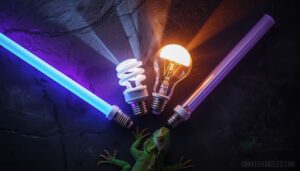
Not all UVB bulbs work the same way, and picking the wrong one can make a real difference for your reptile’s health. Each type has its own strengths, lifespan, and ideal use case.
Here are the four main options you’ll come across as a beginner.
T5 Vs. T8 Fluorescent UVB Tubes
T5 high output fluorescent tubes beat T8s in almost every category. T5s are slimmer, which improves size clearance inside tight enclosures and fixture compatibility with compact hoods.
Their output efficiency is higher per watt, and UVB strength stays consistent longer—roughly 12 months before replacement. That lifespan cost advantage adds up.
For desert species, T5s are the smarter starting point.
Compact and Coil UVB Bulbs
Compact and coil UVB bulbs screw into standard sockets — no ballast, no separate fixture. That’s Fixture Compatibility made easy.
They’re great for small setups where a tube won’t fit. Heat Generation is a bonus in cooler tanks.
Stick with 5.0–10.0 ratings and improve your Footprint Optimization by positioning the basking perch within 20 inches.
Follow a strict UVB replacement schedule every 6–12 months.
Mercury Vapor Bulbs: Heat and UVB Combined
Mercury vapor bulbs do two jobs at once — heat and UVB in a single unit. That Heat UVB Balance simplifies your setup. Pressure Arc Dynamics inside the bulb powers both outputs, but Bulb Warm-up Time takes a few minutes after switching on. Always use Fixture Heat Resistance-rated ceramic sockets.
- Delivers basking temps of 90–110°F
- Covers UVB wavelengths from 290–320 nm
- Watch the UVB Decline Curve — replace annually
- Follow UVB light installation and UVB safe handling guidelines
- Keep a UVB lighting checklist for hobbyists and track UVB light maintenance dates
LED UVB Emitters: Energy Efficiency and Lifespan
LED UVB emitters are the newest option worth knowing. They convert up to 40% of power into UVB radiation, making them genuinely energy-efficient.
Thermal Management and Heat Sink Design keep output stable over time. Driver Dimming lets you fine-tune intensity.
Lumen Maintenance stays strong — many LED UVB Models last 10,000–20,000 hours. That means less UVB light maintenance and better long-term UVB safety for your reptile.
Choosing The Right UVB Strength and Setup
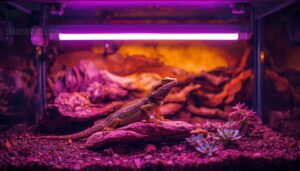
Not all UVB bulbs work the same way for every reptile — the strength, placement, and size all matter. Getting these details right makes a real difference in your animal’s health.
Here’s what you need to know before picking a setup.
Since enclosure needs shift as your snake grows, it’s worth checking this guide to recommended terrarium sizes for a ball python before settling on a permanent setup.
UVB Ratings Explained: 2.0, 5.0, and 10.0
UVB bulbs use a simple rating scale basics system: 2.0, 5.0, and 10.0 represent the percentage of UVB output each bulb emits.
A 2.0 suits low-light species.
A 5.0 fits tropical dwellers.
A 10.0 delivers desert-level UVB intensity measurement for heavy baskers.
Understanding UVB ratings and species needs matters because the metabolism impact is real — wrong UVB strength causes preventable health problems.
Matching UVB Intensity to Your Species
Once you know the rating, match it to your species.
Bearded dragons need a 10.0 — desert heat means high UVB strength.
Leopard geckos need just a 2.0 to 5.0 due to their crepuscular nature.
Species-specific UVI targets matter more than guesswork.
Use a UVI gradient design so your basking zone calibration peaks where your reptile basks and drops toward shade areas.
Optimal Bulb-to-Basking Distance Guidelines
Distance matters more than most beginners expect. Start with 12–18 inches for most setups, then adjust using real temperature correlation — if the basking spot hits your species-specific range, you’re close.
Factor in mesh reduction: screens can cut UVB substantially, so move the bulb 4–6 inches closer. Use measurement tools like a UV meter for accurate UVB light intensity readings rather than guessing.
Sizing UVB Bulbs to Fit Your Enclosure
Bulb size follows enclosure size — it’s that simple. Your tube should cover at least half the enclosure width for proper half-width coverage. A 36-inch tank fits a 34-inch tube well.
For tall builds, vertical enclosure fit matters: use T5 HO for deeper UVB output.
Mesh barrier compensation means moving the bulb 4–6 inches closer.
Big setups may need a multiple bulb layout.
Installing UVB Lights Safely and Effectively
Getting the bulb in the right spot matters more than most beginners expect.
A few small missteps — like placing the lamp behind glass or skipping a timer — can quietly undermine even the best UVB setup.
Here’s what you need to know before you flip that switch.
Avoiding Glass and Acrylic Barriers That Block UVB
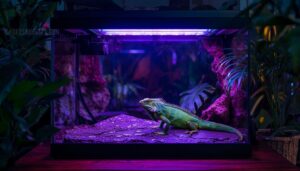
Glass blocks UVB almost completely — your lamp’s output means nothing if it can’t reach your reptile. Standard aquarium lids, acrylic panels, and plastic barriers all act as filters.
Use UVB-permeable enclosures or an open-top terrarium setup instead.
If you’re unsure whether your current material is blocking light, barrier transmission testing with a UVB meter confirms real intensity quickly.
Proper Fixture Placement Above The Basking Zone
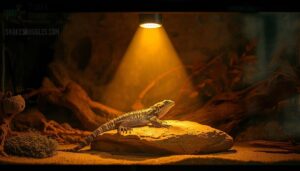
Your fixture placement shapes everything. Center the UVB light mount directly above the basking zone — no offsets, no obstructions blocking the path down.
- Use an adjustable height mount to fine-tune UVB light distance without rewiring.
- Keep UVB light hood aimed straight down for uniform UVB coverage.
- Check that no décor interrupts centering basking light over the platform.
Start at 12–18 inches and adjust from there.
Using Reflectors and Hooded Fixtures for Coverage
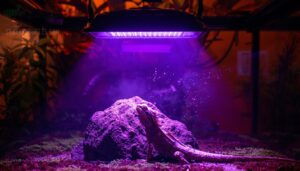
UVB light hood does two things: it seals light in and directs it down. Hooded fixture sealing cuts light spill reduction losses substantially.
reflector angle optimization to widen your coverage footprint, mapping across the basking zone.
Adjustable hood positioning lets you fine-tune your UVB light mount without moving the whole UVB light fixture.
Reflectors for UVB work best when aimed directly at the basking spot.
Setting Timers for a 10–12 Hour Photoperiod
Your reptile’s internal clock runs on light. Set timers for a 10–12 hour photoperiod and keep it consistent daily.
Digital timers beat mechanical ones — they allow precise dawn sync and gradual ramp-up transitions. Always choose a model with battery backup to prevent schedule gaps.
Match your UVB lighting schedule to your species’ natural habitat, and adjust seasonal timing only when biology demands it.
Top 10 UVB Lights for Beginner Reptile Keepers
Finding the right UVB light doesn’t have to feel overwhelming. These ten options are all beginner-friendly, widely available, and suited to the most common pet reptiles.
Let’s get into what each one offers.
1. REPTIDLDB T5 UVB Light Fixture
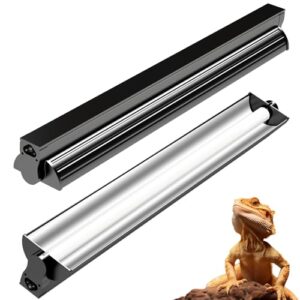
The REPTIDLDB T5 UVB Light Fixture is a solid first choice for beginners keeping desert species.
It runs at 8W with a 10.0 UVB rating, making it suitable for bearded dragons and tortoises in small to medium tanks. The built-in alloy reflector directs UVB straight into the basking zone, and the slim 12-inch design fits most standard enclosures.
Just remember — it puts out very little heat, so pair it with a separate basking lamp for proper temperature control.
| Best For | Beginners raising desert reptiles like bearded dragons or tortoises in small to medium enclosures. |
|---|---|
| UVB Rating | 10.0 |
| UVA Output | ~30% |
| Power Draw | 8W |
| Bulb Type | T5 HO tube |
| Mounting Options | Mesh/lid/external |
| Replaceable Bulb | Yes |
| Additional Features |
|
- Delivers a strong 10.0 UVB rating that supports vitamin D₃ synthesis and healthy bone development
- Slim 12-inch design fits easily into most tanks without eating up headspace
- Built-in alloy reflector focuses UVB right where your reptile basks, so less light goes to waste
- Produces almost no heat, so you’ll need a separate basking lamp to hit proper temps
- The reflective coating can peel or crack over time, which may reduce UV output
- Too underpowered for larger enclosures — you’d need a longer fixture to cover more ground
2. QZQ T5 UVB Reptile Light Fixture
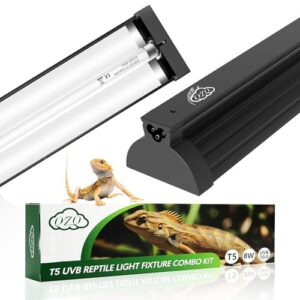
QZQ T5 UVB Reptile Light Fixture is a step up if you’re housing a bearded dragon or large desert lizard.
It delivers 10.0 UVB output through a polished curved reflector, which pushes light deeper into the basking zone instead of letting it scatter.
The aluminum build resists humidity, and mounting hardware fits both mesh lids and wooden enclosures.
Replace the bulb every 6–12 months — even if it still glows, the UVB fades long before the light does.
When you install a fresh bulb, double-check your setup against the recommended heat lamp distances for snake tanks — positioning matters just as much as bulb freshness.
Pair fresh UVB with natural snake terrarium enrichment ideas to keep the enclosure secure, stimulating, and comfortable.
Pair proper lighting with adequately sized boa constrictor rescue shelter enclosures to support calmer, healthier rehabilitation.
| Best For | Reptile owners keeping bearded dragons, tortoises, or other desert species that need strong, consistent UVB exposure. |
|---|---|
| UVB Rating | 10.0 |
| UVA Output | ~30% |
| Power Draw | 8W |
| Bulb Type | T5 fluorescent |
| Mounting Options | Mesh/wood vivarium |
| Replaceable Bulb | Yes |
| Additional Features |
|
- High 10% UVB output with a curved reflector that focuses light into the basking zone instead of wasting it
- Fits both mesh lids and wooden enclosures, so it works with most common setups
- Energy-efficient 8W design keeps running costs low without sacrificing UV performance
- Some users have reported early bulb failure or flickering, which is frustrating right out of the box
- Packaging can be misleading — you’re getting one lamp, not two, despite what product photos may suggest
- UVB output fades over time, so you’ll need to replace the bulb every 6–12 months even if it still looks bright
3. Hygger Zoo T5 UVB Reptile Light
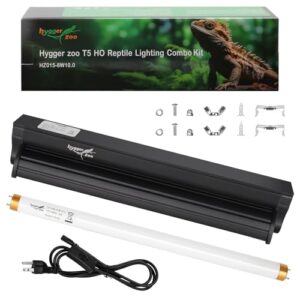
If you’re working with a slightly larger setup, the Hygger Zoo T5 UVB Reptile Light is worth a look. Its 21.6-inch fixture fits standard 22-inch enclosures, and the curved polished reflector pushes UVB straight down to the basking zone — not sideways where it’s wasted.
You get 10% UVB output, which covers desert species well.
The aluminum shell manages heat cleanly, and the 5.9-foot power cord gives you real flexibility in placement.
Replace the bulb on schedule regardless of visible brightness.
| Best For | Reptile owners with mid-to-large desert or tropical setups who need solid UVB coverage without spending a lot. |
|---|---|
| UVB Rating | 10.0 |
| UVA Output | ~30% |
| Power Draw | 8W |
| Bulb Type | T5 tube |
| Mounting Options | Mesh/inside/wood |
| Replaceable Bulb | Yes |
| Additional Features |
|
- 10% UVB output is strong enough for desert species like bearded dragons and turtles
- Curved reflector focuses light downward into the basking zone where it actually matters
- Aluminum hood with heat-dissipation design keeps things running cooler and more stable
- Some users report bulbs dying within weeks, so build reliability can be hit or miss
- Not built for high-humidity environments — the hood can degrade over time if exposed to moisture
- A few buyers have noted electrical interference with timers, which could disrupt your lighting schedule
4. T5 UVB Terrarium Light Fixture
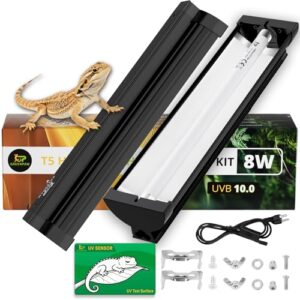
Need something more stripped-down? The T5 UVB Terrarium Light Fixture keeps things simple without cutting corners.
Its slim 16mm tube slots into compact enclosures where bulkier units won’t fit.
The built-in electronic ballast cuts flicker and extends bulb life — two things that matter more than most beginners realize.
A polished reflector pushes UVB straight down to your basking zone. Mount it directly above with clips or hang it overhead.
Just skip any glass or plastic barrier between the bulb and your reptile.
| Best For | Desert reptile owners — bearded dragons, tortoises, iguanas, and geckos — who want reliable UVB coverage with easy setup and built-in verification. |
|---|---|
| UVB Rating | 10.0 |
| UVA Output | ~30% |
| Power Draw | 8W |
| Bulb Type | T5 HO tube |
| Mounting Options | Mesh/lid/wood |
| Replaceable Bulb | Yes |
| Additional Features |
|
- The reflective aluminum hood nearly doubles UV intensity compared to standard fixtures, so your reptile actually gets the UVB it needs.
- Comes with a UV sensor card that lets you quickly check if the bulb is still working — no guesswork about silent output decay.
- Flexible mounting options (clips, screws, mesh brackets) mean it fits on lids, inside tanks, or on wooden vivariums without much fuss.
- The bulb needs replacing every 6–12 months since UVB output fades even when the light still looks bright.
- The sensor card only tells you UVB is present, not how strong it is — you’d need a separate meter for that.
- At 13 inches with a reflective hood, it’s not a great fit for small or low-clearance enclosures.
5. Hygger Dimmable LED UVB Reptile Lamp
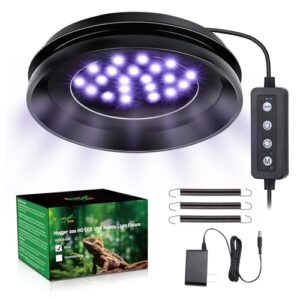
If you want something different from a traditional fluorescent tube, the Hygger Dimmable LED UVB Reptile Lamp is worth a look.
It runs on just 6 watts but delivers output close to a 90W incandescent bulb. Four UVB modes — 2.0, 5.0, 10.0, and 12.0 — let you match intensity to your specific species.
The built-in timer includes sunrise and sunset ramp cycles. It mounts on mesh, magnetic underside, or through wood. You’ll still need a separate heat source.
| Best For | Reptile owners who want precise, customizable UV lighting without the bulk or heat of traditional fluorescent setups. |
|---|---|
| UVB Rating | 2.0–12.0 (selectable) |
| UVA Output | Independent control |
| Power Draw | 6W |
| Bulb Type | LED array |
| Mounting Options | Mesh/magnetic/wood |
| Replaceable Bulb | No (LED) |
| Additional Features |
|
- Four UVB modes make it easy to dial in the right intensity for desert or tropical species
- Built-in timer with sunrise/sunset ramp cycles means one less thing to think about each day
- Three mounting options give you flexibility whether you’re working with mesh, glass, or wood tanks
- No heat output, so you’ll need a separate heat source on top of this
- Wooden tank installation requires drilling, which isn’t ideal for everyone
- UVB LEDs degrade over time and will need periodic replacement to stay effective
6. GREENPAW T5 UVB Reptile Light
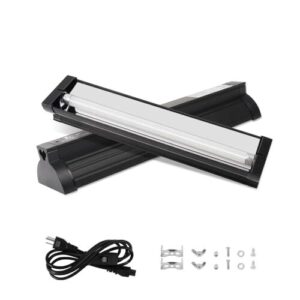
For a reliable, no-fuss option, the GREENPAW T5 UVB Reptile Light delivers solid performance. It puts out UVB in the 6–10% range, making it suitable for bearded dragons, tortoises, and geckos.
The polished reflector directs light downward into the basking zone, so your reptile actually gets the UVB it needs. The housing resists corrosion, which matters in humid setups. It fits most standard T5 canopies and mounts easily.
Replace the bulb every 6–12 months to keep output effective.
| Best For | Reptile and amphibian owners who want a compact, energy-efficient UVB light for small to mid-sized enclosures housing bearded dragons, tortoises, geckos, or frogs. |
|---|---|
| UVB Rating | 10.0 |
| UVA Output | ~30% |
| Power Draw | 8W |
| Bulb Type | T5 HO tube |
| Mounting Options | Mesh/tank-top/vivarium |
| Replaceable Bulb | Yes |
| Additional Features |
|
- Delivers both UVB and UVA, supporting vitamin D₃ synthesis and keeping natural behaviors like appetite and activity on track
- Polished curved reflector spreads light evenly across the basking zone without cranking up the heat
- Easy to install on mesh tops, tank lids, or inside vivariums — no complicated setup required
- At only 8W and 12 inches, it won’t cut it for large or deep terrariums without extra lighting support
- UVB output fades over time, so you’ll need to swap the bulb every 6–12 months even if it still looks bright
- Some users find it dimmer than competing fixtures with the same specs, which may affect how natural the enclosure looks
7. Haceryc T5 UVB Reptile Light
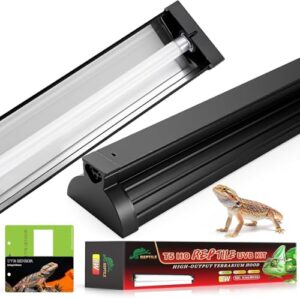
The Haceryc T5 UVB Reptile Light punches above its 8W rating. It delivers 10% UVB and 30% UVA through a curved, polished reflector that concentrates output directly onto your basking spot.
Available in 12-inch and 22-inch sizes, it fits smaller to mid-size enclosures well.
Mount it 15–30 cm above your reptile, never behind glass.
It won’t provide heat, so pair it with a ceramic emitter. Replace the bulb every 6–12 months to keep UVB levels effective.
Follow snake habitat lighting requirements to maintain a consistent day-night cycle without disrupting nighttime darkness.
| Best For | Reptile owners with small to mid-size enclosures who need a reliable UVB source for species like bearded dragons, turtles, or ball pythons. |
|---|---|
| UVB Rating | 10.0 |
| UVA Output | ~30% |
| Power Draw | 8W |
| Bulb Type | T5 linear fluorescent |
| Mounting Options | Multiple enclosure types |
| Replaceable Bulb | Yes |
| Additional Features |
|
- Strong UVB concentration thanks to the curved, polished reflector that directs light right where it matters.
- Comes in two sizes (12-inch and 22-inch), so it fits a range of tank setups without much fuss.
- Includes a UVB test card so you can actually verify the light is doing its job.
- 10% UVB may not cut it for species that need higher levels or for larger enclosures.
- No heat output at all, so you’ll need to budget for a separate heat source on top of this.
- No listed lifespan, which makes it harder to know exactly when to swap out the bulb.
8. Homnebila T5 UVB Reptile Light
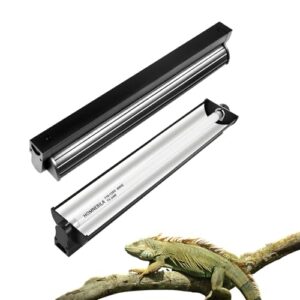
The Homnebila T5 UVB Reptile Light is a solid beginner pick. It runs at 24W and delivers 10.0 UVB output — enough for bearded dragons, tortoises, and most diurnal lizards.
The reflective interior pushes UVB coverage across your basking zone without wasted light. Mount it 20–30 cm above your reptile, never behind glass or acrylic.
It won’t produce heat, so add a ceramic emitter. Replace the tube every 9–12 months, and you’re set.
| Best For | Beginner reptile owners who want reliable UVB lighting for bearded dragons, tortoises, geckos, or other diurnal lizards without breaking the bank. |
|---|---|
| UVB Rating | 10.0 |
| UVA Output | ~30% |
| Power Draw | 24W |
| Bulb Type | T5 HO tube |
| Mounting Options | 3 universal styles |
| Replaceable Bulb | Yes |
| Additional Features |
|
- Strong 10.0 UVB output with a high-reflectivity coating that pushes more light into the basking zone — less waste, better coverage
- Three mounting options make it easy to fit most terrariums, and the 5.9 ft cord with an inline switch keeps things simple
- Flicker-free, quiet operation means less stress for your reptile (and you)
- Assembly can be fiddly — mounting alignment takes some patience to get right
- Build quality feels a bit lightweight; not the most durable fixture if it takes a knock
- No built-in timer, and the blue reflector film has to be removed properly or UVB output takes a hit
9. Hygger Zoo UVB Reptile Lamp
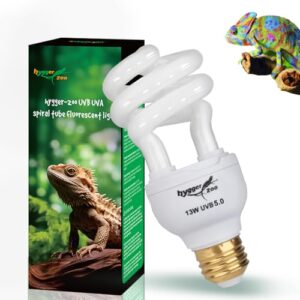
The Hygger Zoo UVB Reptile Lamp is a compact 13W option built for tropical species like chameleons, iguanas, and tree frogs. It delivers 5.0 UVB and 30% UVA output — enough to support vitamin D₃ synthesis without overwhelming shade-loving animals.
The quartz glass construction keeps output stable longer than cheaper bulbs.
That said, some units fail early, so keep a spare handy. UVB performance usually drops after 3–6 months. Replace it on schedule, and it’ll do its job.
| Best For | Tropical reptile owners keeping chameleons, iguanas, snakes, or tree frogs who need reliable UVB and UVA support without overspending. |
|---|---|
| UVB Rating | 5.0 |
| UVA Output | ~30% |
| Power Draw | 13W |
| Bulb Type | Fluorescent tube |
| Mounting Options | Fixture required |
| Replaceable Bulb | Yes |
| Additional Features |
|
- Solid 5.0 UVB and 30% UVA output — great match for tropical species that need strong D₃ synthesis
- Quartz glass construction keeps emission stable longer than most budget bulbs
- Energy-efficient 13W design costs less to run and replace than typical $25–$30 pet store options
- Some units fail within a month, so it’s smart to keep a backup on hand
- UVB output degrades around the 3–6 month mark — you’ll need to replace it on schedule even if it still lights up
- Requires a compatible fixture and correct placement distance to actually work as intended
10. REPTIDLDB T5 UVB Reptile Light
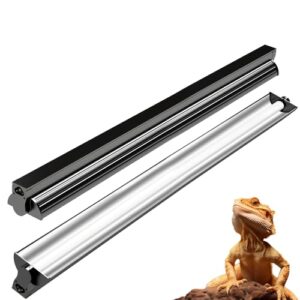
The REPTIDLDB T5 UVB Light is a solid last pick — but don’t let that fool you.
It delivers 10% UVB and 30% UVA through a T5 HO tube with a built-in ballast.
No external driver needed.
The alloy reflector pushes UVB straight toward your basking spot.
It comes in four sizes, from 12 to 46 inches, so it fits most enclosures.
Just remember: it runs cool, so pair it with a separate heat source.
Replace the bulb every 9–12 months.
| Best For | Desert reptile owners — bearded dragons, tortoises, and other sun-loving species — who need reliable UVB in a clean, easy-to-install setup. |
|---|---|
| UVB Rating | 10.0 |
| UVA Output | ~30% |
| Power Draw | 8–54W |
| Bulb Type | T5 HO tube |
| Mounting Options | Mesh/lid external |
| Replaceable Bulb | Yes |
| Additional Features |
|
- Built-in T5 HO ballast means no external driver to deal with — just plug it in and go
- Alloy reflector pushes UVB right where it counts, maximizing exposure at the basking spot
- Four sizes (12"–46") make it versatile enough for small starter tanks up to large 120-gallon builds
- Runs cool, so you’ll need a separate heat source for proper thermoregulation
- The internal reflective coating can peel or crinkle after a few months, especially in humid setups
- Bulbs need replacing every 9–12 months, which adds to the long-term cost of ownership
Common UVB Lighting Mistakes Beginners Should Avoid
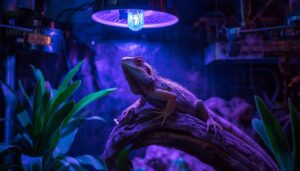
Even with the right bulb and the perfect setup, a few small mistakes can quietly undo all your hard work. Most beginners don’t realize these errors until their reptile starts showing symptoms.
Here are the most common UVB lighting mistakes worth knowing before they become a real problem.
Ignoring Bulb Replacement Schedules
Your bulb looks fine — but is it actually working? UVB output decay starts long before the light goes dark.
Bulb lifespan myths lead many beginners to skip maintenance schedule, neglect until real damage is done. Subclinical deficiency symptoms — soft bones, slow feeding, lethargy — build quietly. Calcium imbalance risk grows every month past the replacement schedule.
- UVB degradation over time happens invisibly
- UVB bulb lifespan ends at 6–12 months, not when it dims
- UVB bulb replacement can’t wait for visible signs
- Track installation dates to stay ahead of UVB decline
Overexposure and Underexposure Risks
Too much UVB is just as harmful as too little. Poor UVB dose control — a basking spot too close, no shade availability, or lamp intensity unchecked by meter calibration — causes skin and eye damage.
multi-reptile tanks worsens species dominance imbalance.
heat-UV balance and ignoring UVB exposure guidelines push animals toward harm from both ends of the spectrum.
Monitoring Your Reptile for Signs of UVB Deficiency
Watch your reptile closely — your setup tells part of the story, but your animal tells the rest.
UVB deficiency symptoms show up as bone swelling, jaw weakness, reduced appetite, muscle tremors, and abnormal posture. These are early warnings of Metabolic Bone Disease.
Monitoring reptile health for UVB deficiency means catching these signs fast, before vitamin D3 and calcium absorption break down completely. When in doubt, get reptile veterinary care.
Frequently Asked Questions (FAQs)
Can you get vitamin D from an UVB lamp?
Yes — but there’s a catch. Only UVB wavelengths between 280–315 nm drive vitamin D3 synthesis.
Dose timing, safety exposure limits, and UVB meter calibration matter. Too much risks burns. Too little means calcium absorption benefit.
How to choose UVB bulb?
Start with your species-specific UVB requirements.
Match the spectral output and UVB output to their needs, then factor in fixture compatibility, bulb durability, power efficiency, budget constraints, and a realistic UVB bulb replacement schedule.
How do I choose the best UVB lighting for my Pet Reptile?
Picking the right UVB light isn’t rocket science — it’s matchmaking. Match your species-specific UVB requirements to the correct UVB output rating, bulb type, and distance.
Your reptile’s health depends on that fit.
Do Reptiles need UV light?
Most reptiles need UVB lighting to produce vitamin D3 and absorb calcium. Without it, metabolic bone disease sets in fast.
Species-specific UVB requirements vary, so match the light to your animal.
How do I choose the right type of lighting for my reptile?
Match the light to your reptile’s natural habitat. Desert species need 0% UVB. Forest dwellers need 0–0%. Check species-specific UVB requirements before buying anything.
What UVB does my reptile need?
Your reptile’s UVB needs depend on its species. Desert lizards need 0%, rainforest species need 0–0%, and nocturnal snakes need minimal UVB. Always match UVB output to your animal’s natural habitat.
Can a reptile get too much UVB?
Yes.
Too much UVB causes eye damage risks, skin irritation signs, and calcium overload.
Watch for hiding, lethargy, and swollen eyes.
Match exposure duration to your species to stay within safe UVB safety limits.
How big of an UVB light do I need?
Your enclosure footprint drives everything.
A bulb should cover the full light coverage area — basking zone included. Match lamp wattage selection to tank size, then adjust distance between the UV lamp and the animal accordingly.
How often should UVB bulbs be replaced?
Replace most UVB bulbs every 6–12 months. Even bright bulbs lose UVB output silently. A UV meter confirms real output. Don’t guess — dead UVB means sick reptiles.
Can UVB lights be used with mesh screens?
Yes, but mesh screens reduce UVB light intensity. Fine screen mesh can cut transmission by a third or more. Move your UVB lamp closer or use a reflector to compensate.
Conclusion
ball’s in your court now.
You know which reptile UVB lights for beginners actually deliver, how to position them correctly, and when to replace them.
Your reptile can’t tell you when something’s wrong—but weak bones, dull eyes, and sluggish behavior will.
Get the right bulb, mount it properly, set your timer, and mark your replacement date.
Do those four things, and your animal gets what it needs every single day.