This site is supported by our readers. We may earn a commission, at no cost to you, if you purchase through links.
Most boa constrictors kept in captivity spend their entire lives vitamin D3 deficient—not because their owners don’t care, but because the connection between UVB exposure and metabolic function isn’t obvious when you’re looking at a snake that appears healthy.
Subclinical deficiency doesn’t announce itself until calcium metabolism has already been compromised, often months before any visible symptom surfaces.
The skin‑based photosynthesis pathway that converts 7‑dehydrocholesterol into previtamin D3 peaks at 294 nm—a wavelength range that standard household lighting never touches.
Choosing the right reptile UVB lights for boa constrictors means understanding output degradation, UVI gradients, and fixture placement before you ever plug anything in.
Table Of Contents
- Key Takeaways
- Why Boa Constrictors Need UVB Lighting
- Choosing The Right UVB Light Type
- Top 9 Reptile UVB Lights for Boa Constrictors
- 1. Kasa Smart Power Strip with USB
- 2. Hygger Zoo T5 UVB Reptile Light Fixture
- 3. QZQ T5 UVB Reptile Light Fixture
- 4. REPTI ZOO Dimmable UVB Reptile Light
- 5. QZQ 24W UVB LED Reptile Lamp
- 6. REPTI ZOO T5 HO UVB Lighting Kit
- 7. REPTIDLDB T5 8W UVB Light
- 8. LckyY UVB 10.0 Reptile Light
- 9. Hygger Zoo Adjustable UVB Reptile Light
- Setting Up UVB Lighting in Boa Enclosures
- UVB Maintenance and Photoperiod Best Practices
- Frequently Asked Questions (FAQs)
- What UVB do boa constrictors need?
- Do boas benefit from UVB?
- Do boas need a basking light?
- What is UVB lighting for snakes?
- Can boa constrictors get too much UVB exposure?
- How does UVB lighting affect boa constrictor behavior?
- Do juvenile boas need different UVB than adults?
- What happens if UVB lighting is suddenly removed?
- Are there UVB risks for albino or morph boas?
- Conclusion
Key Takeaways
- UVB lighting isn’t a nice-to-have for boa constrictors—it drives the skin-based D3 synthesis pathway that calcium metabolism depends on, and no oral supplement reliably replicates what the right wavelength exposure does naturally.
- Your boa falls into Ferguson Zone 2, meaning you’re targeting a basking UVI of 2.0–3.0 using a T5 HO fixture positioned 10–14 inches above the basking surface, with background zones dropping to around 0.7–1.0.
- Bulb output degrades silently long before the light goes dim—T8s need replacing every 6 months, T5 HOs every 12 months—so verify UVI monthly with a Solarmeter 6.5 rather than trusting visible glow.
- Photoperiod and gradient matter as much as the bulb itself: sync a 13:11 light cycle with gradual dawn transitions, build in proper shade zones, and use a smart power strip to automate the schedule so your boa can self-regulate D3 intake the way it would in the wild.
Why Boa Constrictors Need UVB Lighting
UVB lighting isn’t optional for boa constrictors—it drives vitamin D3 synthesis, aids calcium metabolism, and keeps their immune function running the way it should.
For a deeper look at choosing the right setup, UVB lighting systems for boa constrictors breaks down which bulbs and schedules actually support healthy D3 levels long-term.
Without the right exposure, you’re looking at metabolic bone disease and a host of preventable health problems.
Here’s what you need to know before choosing a fixture.
Importance of UVB for Vitamin D3 Synthesis
UVB lighting triggers a precise skin conversion pathway in your boa’s epidermis — UVB wavelength specificity matters here, with peak synthesis occurring at 294 nm. Those rays convert 7-dehydrocholesterol into previtamin D3, which body heat then finalizes into usable cholecalciferol.
What makes this self‑regulating synthesis notable is that your snake controls intake by adjusting basking duration, delivering a calcium absorption boost and immune system enhancement that no supplement reliably replicates.
Snakes self-regulate UVB intake by adjusting basking time, producing benefits no supplement can replicate
A 13:11 photoperiod schedule is recommended for ideal health.
Preventing Metabolic Bone Disease
When D3 synthesis fails, Metabolic Bone Disease follows — a progressive demineralization that deforms spines and weakens jaw tissue.
Calcium supplementation alone won’t compensate for inadequate UVB lighting for snakes; you need Vitamin D3 Synthesis running continuously. Maintain your 2:1 Calcium Metabolism ratio, pair it with proper Temperature Gradients and Humidity Control, and schedule annual blood panels for consistent Bone Health Monitoring.
adequate UVB lighting is essential to prevent metabolic bone disease.
Ferguson Zone 2 UVB Requirements
Boas fall squarely into Ferguson Zone 2 — partial sun baskers requiring a measured UVI Gradient across their enclosure. For proper Zone 2 Calibration, target:
- Basking Distance of 10–14 inches from T5 HO lamps
- Peak UVB Output at 2.0–3.0 UVI basking, dropping to 0.7 background
- Mesh Blockage compensation of 35%, factored into your Reptile Lighting Systems positioning
UVB Spectral Balance across UVB Lighting setups determines whether Boa Constrictor Care succeeds or stalls.
Benefits for Immune Function and Overall Health
Beyond calcium metabolism, UVB lighting drives meaningful systemic benefits.
Vitamin D3 Immunity support comes from calcitriol regulating over 200 immune‑related genes — directly strengthening Respiratory Defense and cutting infection rates.
Endorphin Mood improvements follow consistent UVB cycles, producing measurable Activity Boost and Appetite Enhancement.
Snakes with proper UVB feed 25% more reliably, move considerably more, and maintain stronger Immune Function overall.
Choosing The Right UVB Light Type
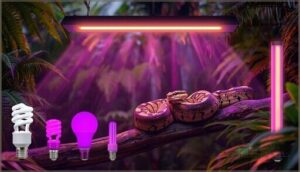
UVB lights are built the same, and picking the wrong one can quietly work against your boa’s health.
The type, intensity, and spectrum each matter more than most keepers realize.
Here’s what to weigh before committing to any fixture.
T5 Vs. T8 Fluorescent UVB Lights
T5 HO linear fixtures outperform T8 in nearly every metric that matters for boa constrictor care. Their 5/8‑inch diameter allows slimmer fixture size, while delivering UVI readings of 6–8 at a 12–13‑inch output distance—roughly double what T8 achieves.
T5 HO linear fixtures also last 12 months versus T8’s 6 months, making reptile lighting cost efficiency considerably stronger despite the higher upfront fixture investment.
Advantages of LED UVB Lights
LED lights are quietly changing how keepers approach reptile lighting—and for good reason.
Compared to fluorescent alternatives, LED UVB fixtures consume 60–80% less electricity, run cooler to support Ferguson Zone 2 gradients without thermal interference, and last 10,000–20,000 hours.
They’re mercury free, simplifying disposal, and clip directly onto mesh tops without ballasts—making boa constrictor health maintenance genuinely more practical.
Selecting Correct Intensity and Spectrum
Getting UVI Gradient Calibration right separates functional reptile lighting systems from genuinely effective ones. For boa constrictors, Bulb Percentile Selection matters: 5.0–6% UVB bulbs hit Ferguson Zone 2’s target range without overexposure risk. Spectrum Matching ensures the 290–320 nm band drives Vitamin D3 synthesis and calcium metabolism efficiently. Prioritize Heat‑UVB Balance to avoid thermal interference with UVB output.
- Target basking UVI of 2.0–3.0; background zones at 0.7–1.0
- Use Zoo Med ReptiSun 5.0 or Arcadia 6% for appropriate output
- Avoid 10.0 bulbs—those suit open‑sun baskers, not boas
- Verify readings monthly with a Solarmeter 6.5 at snake‑back height
- Mesh lids reduce UVB transmission by ~35%; factor that into placement
Adjusting UVB Output for Snake Age and Size
A hatchling boa constrictor isn’t just a small adult—its UVB output needs differ meaningfully by growth stage.
Position fixtures 8–10 inches above hatchlings to achieve UVI 2.0–3.0; juvenile height adjustments push that to 12–16 inches as they hit 24–48 inches.
Adult lamp length scales to 22–30 inches for enclosure scaling in 6x2x2 setups.
Measure monthly—growth gradients shift faster than you’d expect.
Top 9 Reptile UVB Lights for Boa Constrictors
With the right fixture, you’re giving your boa exactly what it needs to synthesize D3 and stay metabolically sound.
Each option below covers different enclosure sizes, output levels, and control features—so you can match the right light to your specific setup.
Here are nine UVB lights worth considering for boa constrictors in 2026.
1. Kasa Smart Power Strip with USB
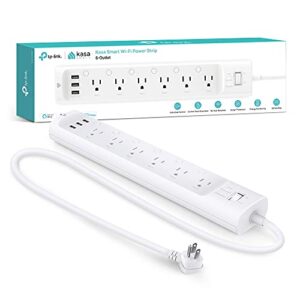
The Kasa Smart Power Strip (HS300) isn’t a UVB fixture—but it may be the most important piece of hardware in your boa’s lighting setup.
With 6 individually controlled outlets, you can automate precise 13:11 photoperiods for winter and 12:12 cycles for spring, synced to local sunrise and sunset via the Kasa app. ETL-certified surge protection shields sensitive UVB bulbs from voltage spikes, and energy monitoring helps you track consumption across all connected devices simultaneously.
| Best For | Anyone who wants to automate and monitor multiple smart home devices from one app—especially home office setups, indoor gardens, or small businesses. |
|---|---|
| Power | 1875W max |
| UVB Type | N/A |
| Material | Plastic |
| Weight | 1.55 lbs |
| Brand | Kasa |
| Reptile Suitability | Not reptile-specific |
| Additional Features |
|
- Six individually controlled outlets mean you can schedule each device on its own timer without any fuss.
- Built-in energy monitoring lets you see exactly what’s drawing power, so you can cut down on waste.
- Works with Alexa, Google Assistant, and Cortana, so it slots right into whatever smart home setup you already have.
- The cord runs a bit short, which can be a pain depending on where your outlets are.
- USB ports don’t support fast charging, so don’t expect your phone to top up quickly.
- The indicator LEDs stay on no matter what—you can’t turn them off through the app, which can be annoying in a dark room.
2. Hygger Zoo T5 UVB Reptile Light Fixture
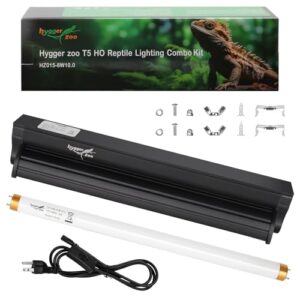
The Hygger Zoo T5 UVB Reptile Light Fixture (HZ015‑T5‑8W) punches above its weight for a compact 8W unit. Its polished curved reflector—enhanced with a special alloy layer—boosts UVB and UVA output by up to 30%, driving measurable vitamin D3 synthesis without adding excess heat to your enclosure.
You can mount it on mesh lids or install it internally, which gives you real flexibility.
Replace the T5 bulb every 6‑12 months; output degrades well before the visible glow fades.
| Best For | Desert reptile owners—especially those keeping bearded dragons or turtles—who want solid UVB coverage in a small to mid-sized enclosure without breaking the bank. |
|---|---|
| Power | 8W |
| UVB Type | UVB 10.0 |
| Material | Aluminum |
| Weight | 1.06 lbs |
| Brand | Hygger Zoo |
| Reptile Suitability | Desert reptiles |
| Additional Features |
|
- The polished curved reflector pushes UVB output up to 30% higher than a basic fixture, so your reptile actually gets the D3 boost it needs.
- Two mounting options (on top of a mesh lid or inside the tank) make it easy to fit into different setups.
- At 8W, it runs cool and efficient—good for your electricity bill and your animal’s environment.
- It’s not built for larger tanks—if you’re running a 120-gallon enclosure, this one won’t cut it.
- A handful of users have flagged durability concerns, so long-term reliability isn’t guaranteed.
- The fixture can shift around inside the tank and doesn’t always stay put where you place it.
3. QZQ T5 UVB Reptile Light Fixture
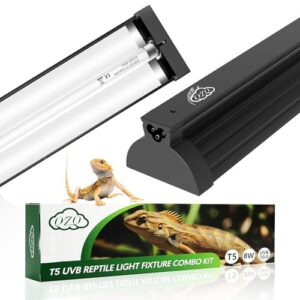
Another compact option worth considering is the QZQ T5 UVB Reptile Light Fixture. At 8W, it fits 12-inch enclosures comfortably—useful for juvenile boa setups—and its polished curved alloy reflector directs up to 95% of UVB rays downward, delivering consistent Ferguson Zone 2 exposure without hotspots. The 10% UVB, 30% UVA output facilitates calcitriol synthesis reliably.
Its detachable 5.9 ft cord and adjustable mounting brackets make installation straightforward. One caveat: some units show reflector coating delamination over time, so inspect it during your monthly maintenance checks.
| Best For | Reptile owners with smaller enclosures who want reliable UVB lighting for bearded dragons, tortoises, or lizards without spending a lot. |
|---|---|
| Power | 24W |
| UVB Type | UVB 10.0 |
| Material | Glass |
| Weight | 1.17 lbs |
| Brand | Hygger Zoo |
| Reptile Suitability | Desert/tropical |
| Additional Features |
|
- Strong 10% UVB and 30% UVA output helps prevent metabolic bone disease and supports natural behaviors
- Easy to set up with adjustable mounting brackets and a detachable 5.9 ft cord
- Energy-efficient at just 8W, so it won’t drive up your electricity bill
- Some users have reported the reflective coating peeling off over time, which can reduce effectiveness
- Bulb lifespan can be hit or miss—don’t count on it lasting much beyond six months
- Not ideal for all reptile types or larger enclosures, so double-check it fits your setup before buying
4. REPTI ZOO Dimmable UVB Reptile Light
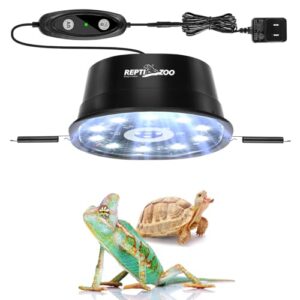
Where the QZQ suits juveniles with fixed output, the REPTI ZOO Dimmable UVB Reptile Light gives you active control—dimming from full tropical UVB 5.0 intensity down to near‑off via a rotary knob, so you can simulate dusk without disrupting calcitriol synthesis cycles.
At 6W, it pulls equivalent output to a 90W incandescent.
UVB delivery peaks at 303 µW/cm² at four inches—adequate for Ferguson Zone 2 compliance in boa enclosures.
Its hook‑mount design installs in minutes, though monitor output with a Solarmeter; some units degrade before the 6‑month mark.
| Best For | Reptile owners who want hands-on control over UVB intensity, especially those keeping tropical or desert species that need flexible lighting conditions. |
|---|---|
| Power | 8W |
| UVB Type | UVB 10.0 |
| Material | Plastic |
| Weight | 1.06 lbs |
| Brand | QZQ |
| Reptile Suitability | Desert reptiles |
| Additional Features |
|
- Dimmable design lets you dial in the right light level and even simulate a natural dusk cycle
- Energy efficient — only 6W but puts out what a 90W bulb would
- Works for a wide range of species, from geckos to turtles, with two distinct UVB modes
- Durability is hit or miss — some units start fading before the 6-month mark
- May not cut it for high-UVB reptiles like bearded dragons
- A bit pricey for something that might not last as long as you’d hope
5. QZQ 24W UVB LED Reptile Lamp
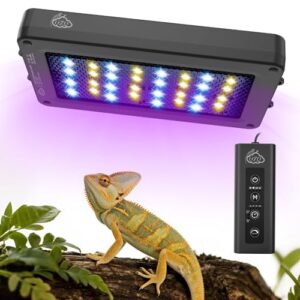
If QZQ 24W UVB LED Reptile Lamp covers the other—packing 16 RGB, 4 UVB, and 4 UVA LEDs into a compact 7.48‑inch fixture that draws just 24 W while producing 1900 lumens.
Its 24/7 smart timer cycles through gradual sunrise, daylight, sunset, and moonlight modes automatically, supporting consistent calcitriol synthesis without manual intervention.
One caveat: verify UVI readings with a Solarmeter, as LED UVB output can fall short of Ferguson Zone 2 thresholds in practice.
| Best For | Reptile owners who want an all-in-one lighting solution with smart timer automation for bearded dragons, geckos, turtles, and other UV-dependent reptiles. |
|---|---|
| Power | 6W |
| UVB Type | UVB 5.0/10.0 |
| Material | ABS/LED |
| Weight | 7.1 oz |
| Brand | REPTI ZOO |
| Reptile Suitability | Tropical/desert |
| Additional Features |
|
- The 24/7 smart timer handles sunrise, daylight, sunset, and moonlight automatically — no babysitting required.
- Packs RGB, UVA, UVB, and white LEDs into one compact fixture, so you’re not juggling multiple bulbs.
- At 24W and 1900 lumens, it’s energy-efficient without skimping on brightness.
- Some users found the UVB output underwhelming — worth checking with a Solarmeter before relying on it fully.
- The lamp can emit a high-pitched whine that bothers both people and pets nearby.
- Moonlight mode doesn’t dim down much, and the timer only supports one lighting schedule at a time.
6. REPTI ZOO T5 HO UVB Lighting Kit
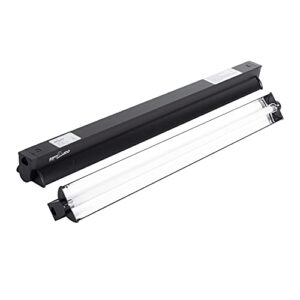
Where the QZQ leans on LED flexibility, the REPTI ZOO T5 HO UVB Lighting Kit takes a more traditional fluorescent approach—and delivers reliably.
Its highly polished curved reflector pushes UVB deeper into the enclosure, which matters when you’re trying to hit consistent 2.0–3.0 UVI readings at basking distance.
The included Desert 10.0 T5 lamp covers calcium metabolism and UVA-driven appetite stimulation.
Available in 24W, 39W, and 54W configurations, it scales cleanly to your enclosure size.
Replace the bulb annually regardless of visible output.
| Best For | Desert reptile owners who want a reliable, no-fuss UVB setup that delivers consistent light penetration for calcium metabolism and overall health. |
|---|---|
| Power | 24W |
| UVB Type | UVA/UVB LED |
| Material | Plastic |
| Weight | 1.28 lbs |
| Brand | Not specified |
| Reptile Suitability | Bearded dragons/lizards |
| Additional Features |
|
- The polished curved reflector pushes UVB deep into the enclosure, so your reptile actually gets the exposure it needs at basking distance
- Comes ready to go with a Desert 10.0 T5 lamp included — no scrambling for extras right out of the box
- Scales across multiple wattages (24W, 39W, 54W), so it fits enclosures of different sizes without a headache
- Bulbs tend to burn out faster than expected, and replacements aren’t cheap
- Some buyers have run into packaging and durability issues, which is frustrating for the price
- Not a great fit for all reptile types or enclosure setups, so it’s worth checking compatibility before buying
7. REPTIDLDB T5 8W UVB Light
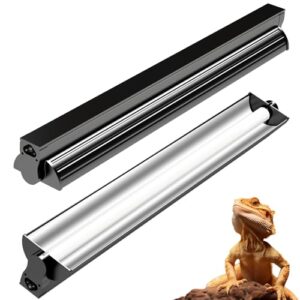
At just 8 watts and 12 inches long, the REPTIDLDB T5 fixture punches above its weight for smaller boa setups. Its alloy reflective layer maximizes the 10% UVB output—reaching up to 18 inches—while the built‑in electronic ballast keeps flicker out of the equation.
UVA sits at 30%, supporting appetite stimulation alongside D3 synthesis. The aluminum housing dissipates heat efficiently, so enclosure temperatures stay stable. Replace the bulb at 12 months, before output degradation compromises calcitriol production.
| Best For | Reptile owners with smaller desert setups—especially those keeping bearded dragons, turtles, or snakes—who need reliable UVB coverage without a bulky fixture. |
|---|---|
| Power | 24W |
| UVB Type | UVB 10.0 |
| Material | Aluminum/Plastic |
| Weight | 1.2 lbs |
| Brand | REPTI ZOO |
| Reptile Suitability | Desert reptiles |
| Additional Features |
|
- Solid UVB and UVA output (10% and 30%) that actually supports D3 synthesis and keeps appetite up
- Compact aluminum build dissipates heat well, so your enclosure temps stay steady
- Built-in electronic ballast means no annoying flicker, and the bulb is easy to swap when it’s time
- Some users have noticed the bulb holder peeling or crinkling over time, which is a bit concerning for longevity
- At 12 inches, it’s better suited for smaller enclosures—bigger setups will need something with more reach
- Bulbs need replacing around the 12-month mark, so factor in that ongoing cost
8. LckyY UVB 10.0 Reptile Light
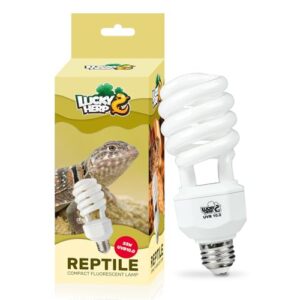
The compact fluorescent bulb—23W, E26 base—delivers 10% UVB and 30% UVA output without emitting UVC. At 7800K and a CRI of 90, it replicates desert‑intensity sunlight closely enough to support consistent calcitriol synthesis in your boa.
The self‑ballasted design fits standard US fixtures, eliminating compatibility concerns. Expect 8,000–10,000 hours of usable output, though you should verify UVI levels with a Solarmeter every 6–8 weeks and replace annually regardless of visible glow.
| Best For | Desert reptile owners—think bearded dragons, lizards, and snakes—who need reliable UVB and UVA light to keep their animals healthy and thriving. |
|---|---|
| Power | 8W |
| UVB Type | UVB 10.0 |
| Material | Aluminum |
| Weight | 9.6 oz |
| Brand | REPTIDLDB |
| Reptile Suitability | Desert/tropical |
| Additional Features |
|
- Puts out 10% UVB and 30% UVA, which gives your reptile what it needs to produce Vitamin D3 and absorb calcium properly
- High color rendering (CRI 90) means it mimics natural sunlight pretty closely, which can actually boost appetite, activity, and even reproduction
- Fits standard E26 bases right out of the box—no adapters or special fixtures needed
- Some users say it burned out way sooner than expected, so longevity can be hit or miss
- Occasional flickering has been reported, which isn’t ideal for your reptile or your sanity
- You’ll need to replace it every 6–12 months regardless of whether it still glows, since UVB output fades before the light actually dies
9. Hygger Zoo Adjustable UVB Reptile Light
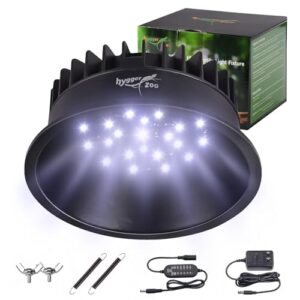
Four adjustable UVB modes—2.0, 5.0, 10.0, and 12.0—make this Hygger Zoo fixture genuinely adaptable for boas at different life stages. Set it to 5.0 for rainforest-appropriate output, and the curved reflector concentrates UVB delivery at 85 μW/cm² measured at 4.7 inchesin.
The built-in timer runs up to 12 hours, and the aluminum housing** handles heat dissipation effectively.
One caveat: some users report the timer occasionally fails to restart automatically, so verify operation weekly rather than assuming consistent photoperiod maintenance.
| Best For | Reptile owners who keep bearded dragons, geckos, turtles, or boas and want flexible UVB control across different life stages and environments. |
|---|---|
| Power | 23W |
| UVB Type | UVB 10.0 |
| Material | Glass |
| Weight | 4.7 oz |
| Brand | LUCKY HERP |
| Reptile Suitability | Desert reptiles |
| Additional Features |
|
- Four UVB modes (2.0, 5.0, 10.0, 12.0) let you dial in the right output for your specific reptile and setup
- Curved reflector concentrates UVB delivery, so your reptile actually gets the light it needs
- Aluminum build dissipates heat well and keeps the fixture durable over time
- The timer can fail to restart on its own, meaning your reptile’s light schedule might get interrupted without you noticing
- Requires hands-on testing and adjustment to get optimal performance—not a true plug-and-play setup
- At just over 14 ounces and a compact size, mounting options may be limited depending on your enclosure
Setting Up UVB Lighting in Boa Enclosures
UVB setup right isn’t just about screwing in a bulb and calling it done.
Placement, gradient, and heat integration all work together to keep your boa actually thriving rather than just surviving.
Here’s what you need to nail each part of the process.
Positioning UVB Fixtures for Even Exposure
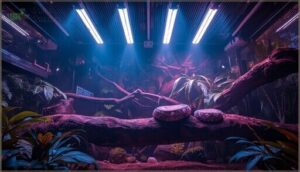
Mount your UVB lighting flush to the ceiling, centered over the warm side where basking behavior naturally concentrates.
For T5 HO tubes, target 30–60 cm from the basking surface; verify UVI measurement points with a Solarmeter rather than estimating.
Mesh transparency impact is real—dirty or fine-weave screens cut UVB output substantially.
In longer enclosures, multiple fixture spacing beats one central unit every time.
Creating a Safe and Effective Lighting Gradient
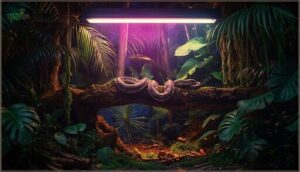
A well‑calibrated UVB gradient isn’t optional—it’s how boa constrictors self‑regulate calcitriol synthesis the way they would under dappled jungle canopy.
- Target UVI 2.0–3.0 at the basking perch, using Bulb Length Selection that spans half the enclosure
- UVB Gradient Measurement weekly with a Solarmeter 6.5
- Branch Height of 10–14 inches below the bulb for peak UVB Output
- Shade Placement via elevated foliage to reduce UVI 50% in retreat zones
- Lighting Gradient self‑regulation across the enclosure for complete Lighting heights
Preventing Excessive Heat Buildup
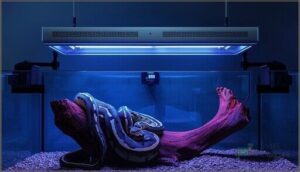
Heat buildup silently undermines your entire enclosure setup.
T5 HO linear fixtures 10–14 inches above mesh—distances that account for 35% screen blockage while keeping surface temperatures under 95°F.
Riser prop usage adds 2–4 inches when shallow enclosures compress that margin.
Aluminum-lined reflective fixture design with top-side ventilation optimization: 20% surface venting dissipates fixture heat efficiently.
Thermostatic cutoff at 120°F protects your temperature gradient without disrupting UVB distance calibration.
Integrating UVB With Heat Sources
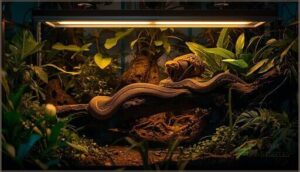
Halogen‑UVB pairing solves the heat gradient balancing problem directly—two 50–75W halogens on a dimming thermostat set to 88–90°F, positioned 10–12 inches from your T5 HO linear fixtures, keep UVB output in the 2.0–3.0 UVI range without overlap.
Radiant panel integration, mount 120W panels 12 inches clear of UVB. Smart power strip scheduling then synchronizes everything to your boa’s 13-hour photoperiod automatically.
UVB Maintenance and Photoperiod Best Practices
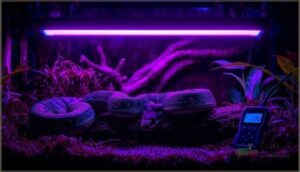
Getting UVB lighting right doesn’t stop at installation — ongoing maintenance and smart scheduling are what actually keep your boa healthy long-term. Bulb output degrades silently, and photoperiod timing matters more than most keepers realize.
Here’s what you need to stay on top of both.
Replacing Bulbs and Monitoring Output
Even if your UVB bulbs still glow, output drops silently — T8s degrade within 6 months, T5 HOs within 12 months. Don’t wait for visible dimming.
Bulb replacement timing matters: mark purchase dates and set calendar reminders.
For UVI calibration procedures, use a Solarmeter 6.5 weekly, holding it vertically at the basking spot to confirm 2.0–3.0 UVI.
Establishing Optimal Photoperiod Schedules
Photoperiods aren’t one-size-fits-all. For your boa constrictor, seasonal light cycles shift meaningfully across the year:
- Hatchlings: 12-hour cycles support juvenile light needs and early D3 synthesis
- Spring/Summer adults: 13–14 hours of UVB lighting daily
- Fall: Gradually reduce to 10–12 hours for breeding light adjustments
- Winter: Drop to 8–11 hours, triggering natural circadian rhythm management
- Post-breeding: Return to 13:11 to restore feeding response
Smart timer integration manages light intensity timing automatically.
Synchronizing Lighting With Natural Day/night Cycles
Beyond timer schedules, your boa’s circadian rhythm depends on how light transitions happen.
Gradual dawn simulation—30 to 60 minutes of ramping—triggers crepuscular activity far more effectively than abrupt switches.
Delay UVB output by 90 minutes after visible lights start.
Complete nighttime darkness, 11 to 13 hours, is non‑negotiable; boas detect red and blue wavelengths, so any glow disrupts nocturnal adaptation and elevates stress hormones.
Using Smart Power Strips for Automation
Automate your boa constrictor’s UVB lighting with the Kasa Smart Power Strip, which manages outlet scheduling across six independently controlled channels—setting reptile lighting on at 7 AM and off at 8 PM, without touching the enclosure.
Voice control via Alexa or Google Assistant adds hands‑free convenience, while remote alerts flag power failures instantly.
USB device integration charges hygrometers alongside lighting fixtures, and energy monitoring tracks daily kWh consumption.
Frequently Asked Questions (FAQs)
What UVB do boa constrictors need?
Boa constrictors fall under Ferguson Zone 2 UVI, requiring 0–0 UVI at the basking spot to drive Vitamin D3 Synthesis and Calcium Metabolism — without it, metabolic bone disease becomes a real risk.
Do boas benefit from UVB?
Yes—UVB lighting drives vitamin D3 synthesis, helps bone density, strengthens immune response, and encourages natural behavioral activity.
Without it, metabolic bone disease prevention becomes nearly impossible over a boa’s lifespan.
Do boas need a basking light?
Heat and UVB serve different roles. Your boa needs a basking spot reaching 86–90°F, but dedicated UVB output—not visible light—drives D3 synthesis. Nighttime darkness remains non-negotiable.
What is UVB lighting for snakes?
UVB lighting emits ultraviolet-B wavelengths that penetrate snake skin, triggering Vitamin D3 Synthesis through the Calcium Metabolism Pathway—
7-dehydrocholesterol into calcitriol, which drives calcium absorption and helps skeletal integrity without supplementation risk.
Can boa constrictors get too much UVB exposure?
Absolutely — too much UVB causes real harm. Overexposure triggers UVB burn symptoms, vitamin D toxicity, and kidney damage. Keep UVI between 0–0 using Solarmeter monitoring, mesh screens, and age-specific UVB limits.
How does UVB lighting affect boa constrictor behavior?
Proper UVB lighting drives measurable behavioral shifts in boa constrictors—activity increases, basking behavior emerges,
appetite boosts noticeably, stress reduction follows, and thermoregulation improvement becomes visible as snakes shuttle confidently between gradient zones.
Do juvenile boas need different UVB than adults?
Yes and no. Both juvenile and adult boas target Ferguson Zone 2, needing UVI 0–0, but juvenile UVB levels require closer bulb positioning and compact gradient design given their smaller enclosure size.
What happens if UVB lighting is suddenly removed?
Remove UVB lighting and vitamin D3 deficiency follows within weeks—calcium metabolism stalls, lethargy onset appears, immune function declines, and metabolic bone disease accelerates.
Weight loss symptoms and metabolic bone loss confirm the cascade.
Are there UVB risks for albino or morph boas?
Not all boas are created equal.
Albino and low-pigment morphs face real melanin deficiency risks—eye photokeratoconjunctivitis, skin burn risk, and behavioral warning signs like hiding.
Apply safe UVB mitigation immediately.
Conclusion
It’s no coincidence that the healthiest captive boas share one trait their owners rarely credit: properly dialed UVB environment built around measured output, not guesswork. The right reptile UVB lights for boa constrictors don’t just prevent deficiency—they sustain the photobiological processes that keep calcium metabolism, immune function, and long-term tissue integrity intact.
Get the fixture placement, UVI gradient, and replacement schedule right, and your boa’s health reflects exactly that precision.