This site is supported by our readers. We may earn a commission, at no cost to you, if you purchase through links.

Your new ball python sits on the cool side of the tank at 21°C, refuses dinner, and hides for a week. Nine times out of ten, the culprit is heat, not temperament.
Snakes can’t generate their own warmth. They borrow it from your setup, and a bulb that’s too weak, too strong, or wired without a thermostat can stall digestion or cause burns. Ball pythons want a 30–32°C basking zone, while corn snakes settle happily at 28–30°C.
Picking the right reptile heat lamps for first-time snake owners takes less guesswork than it seems. Here’s how to match bulb type, wattage, and controls to your enclosure.
Table Of Contents
- Key Takeaways
- Choose The Right Snake Heat Lamp
- Match Heat Lamp Wattage to Your Enclosure
- Establish Species-Specific Temperatures and Monitor Heat Gradients
- Install Thermostats and Maintain Heat Lamps Safely
- Set Daytime Lighting and Nighttime Heating Cycles
- Top 10 Heat Lamp Essentials for Beginners
- 1. Ceramic Reptile Heat Lamp 100W 2-Pack
- 2. Aiicioo 60W Ceramic Heat Emitter
- 3. Flukers 150W Reptile Basking Bulb
- 4. REPTI HOME 100W Reptile Heat Lamp
- 5. MCLANZOO 75W Infrared Heat Lamp Bulbs
- 6. Zoo Med Repticare 100W Ceramic Heat Emitter
- 7. REPTI HOME Infrared Heat Lamp Bulb
- 8. REPTI ZOO Dimming Reptile Light Fixture
- 9. DXOPHIEX Reptile Heat Lamp Thermostat
- 10. Reptitrip Dual UVB Heat Light Fixture
- Frequently Asked Questions (FAQs)
- What heat lamp does a snake need?
- Do snakes need a heat lamp 24-7?
- How long should a heat lamp be on for a snake?
- How long can snakes go without a heat lamp?
- What heat lamp do snakes need?
- How long should I keep a heat lamp on for a snake?
- How many watts should a snake heat lamp be?
- How many heat lamps does a snake need?
- Should I have my snakes heat lamp on all the time?
- Can snakes overheat from too much basking?
- Conclusion
Key Takeaways
- Your snake needs a temperature gradient with a warm end and a cool end (ball pythons 30–32°C and 24–27°C, corn snakes 28–30°C and 21–24°C), so check your exact species and measure the air at snake level on both sides.
- Run every heat lamp through a proportional thermostat with the probe at snake level in the basking zone, and calibrate it against a separate thermometer before your snake moves in.
- Match wattage to your enclosure size, use halogen by day and a light-free ceramic emitter at night, and skip heat rocks and colored bulbs, which cause burns and disrupt your snake’s dark period.
- Keep daytime lighting on a 12-hour on/off cycle with a gentle nighttime temperature drop, and remember a heat lamp doesn’t provide UVB, so that’s a separate bulb.
Choose The Right Snake Heat Lamp
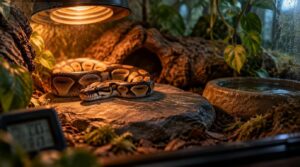
Your snake can’t tell you it’s too cold, so the heat lamp you pick matters more than you’d think. Below, we’ll walk through the main bulb types, how heat differs from UVA and UVB light, and which risky products you should skip. Read each one before you buy, and you’ll set up a safer, steadier tank.
Since an overheated or chilled tank can quietly cause stress and illness, it helps to understand the snake habitat and health concerns tied to temperature before settling on a bulb.
Halogen, Incandescent, Ceramic, and Deep Heat
Halogen bulbs give your snake the closest thing to sunlight. Picture each option:
- Halogen: deep-penetrating heat for a bright basking spot.
- Incandescent: cheaper, but weaker and shorter-lived.
- Ceramic heat emitter: no light, ideal at night.
- Deep heat projector: gentler infrared, no glare.
Pair any heat lamp with a thermostat, then check your thermal gradient daily, so nothing ever surprises you.
Halogen bulbs also produce more heat than incandescents at lower wattage and last longer if they aren’t moved or jostled often.
Heat Lamps Versus UVA and UVB
A heat lamp warms your snake. It doesn’t give it UVB. Those are separate jobs, so don’t assume one bulb covers both.
UVA helps your snake see and read its surroundings. UVB helps vitamin D3 and bone health, but it often adds almost no warmth. Glass blocks it too. Check labels, since "full spectrum" doesn’t guarantee real UVB output.
Heat Rocks and Colored Bulb Risks
Skip heat rocks. They cause thermal burns in reptiles, and your snake may not notice until it’s too late. Colored bulbs aren’t safer:
- Heat rocks create hot spots.
- Colored bulbs disrupt your snake’s dark period.
- A ceramic heat emitter heats without light.
- Verify every temperature gradient with an infrared thermometer.
Mount heat overhead and respect your heat lamp safety distance.
Match Heat Lamp Wattage to Your Enclosure
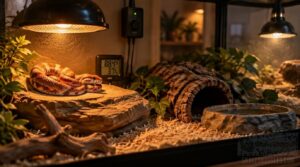
Once you’ve picked a bulb type, wattage is the next decision. Too little and your snake sits cold. Too much and you risk burns.
Start with enclosure size:
| Enclosure Size | Typical Wattage |
|---|---|
| 10–20 gallons | 25–50W |
| 20–40 gallons | 50–75W |
Larger tanks over 40 gallons usually need 75–150W.
Then adjust. A cool room, a screen top, or a glass tank all bleed heat, so you may need more wattage or a second bulb. Two lower-wattage lamps also spread warmth better than one strong one.
Don’t dim a high-wattage bulb to compensate; choose lower wattage instead. Verify everything with a thermometer at the basking spot. Always run your heat lamp through a thermostat, and make sure the fixture is rated for the bulb.
Establish Species-Specific Temperatures and Monitor Heat Gradients
Why does one number never tell the whole story? Because your snake needs a temperature gradient, a warm end and a cool end, so it can choose where to be.
Species-specific needs come first. Corn snakes want 28 to 30°C on the warm side and 21 to 24°C on the cool side. Ball pythons run warmer, 30 to 32°C warm and 24 to 27°C cool. Boas sit around 29 to 32°C warm and 24 to 26°C cool. Confirm the range for your exact species and life stage.
An infrared heater can help hold those warm-side temperatures steadily overnight without bright light, and this children’s python temperament and care guide covers how small pythons respond to heating setups.
Always measure air at snake level on both sides. An infrared gun reads surfaces, not air, so a hot basking temperature doesn’t prove the air is right. Wattage matters, and thermostat control helps.
Install Thermostats and Maintain Heat Lamps Safely
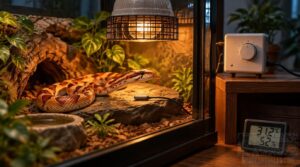
Plug your heat lamp into a proportional thermostat first, then plug the thermostat into the wall. That order matters. Without it, you’ve got no real temperature control, just a bulb burning on hope.
Probe placement is where most beginners slip. Set the probe at snake level in the basking zone, where your animal actually touches the surface. Keep it away from the bulb itself, or the readings will mislead you.
Run thermostat calibration before your snake moves in. Compare its reading against a separate thermometer for a full day.
For heat lamp safety, mount the fixture outside the enclosure, add a guard, and keep wood and plastic clear. Inspect cords weekly for discoloration, and check your readings every single day.
Set Daytime Lighting and Nighttime Heating Cycles
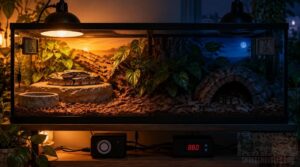
Your snake needs a sunrise, not a spotlight, and a cool night, not a freezer. Daytime lighting should run on a steady 12-hour on/off cycle, mimicking natural days. Aim a bulb at one end to build a temperature gradient, leaving the other side shaded for retreat.
Your snake needs a sunrise, not a spotlight, and a cool night, not a freezer
After lights-out, switch to nighttime heating that gives off warmth but no glow:
- Ceramic heat emitters for steady infrared warmth
- Deep heat projectors for larger enclosures
- A gentle 5-15°F nighttime drop from daytime highs
Plug everything into a timer and a thermostat. Reliable thermostat control prevents overnight spikes, and it keeps your snake safe while you sleep. Check readings with two thermometers every evening and morning. Never trust the dial alone, because sensors drift.
Top 10 Heat Lamp Essentials for Beginners
You’ve got the basics down, so now it’s time to shop. Below are ten beginner-friendly heat essentials, from bulbs and emitters to a thermostat and fixtures. Each one helps you build a safe, steady gradient your snake can actually use.
1. Ceramic Reptile Heat Lamp 100W 2-Pack
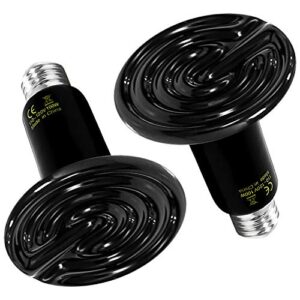
Snakes don’t need a nightlight, they need steady warmth. That’s where this 2-pack earns its spot on your shelf.
These 100W ceramic emitters give off no visible light, so your snake keeps a normal day/night rhythm. They screw into a standard E26 base and run on AC 110-120V. Rated for up to 10,000 hours, though some buyers report mixed durability.
Pair them with a thermostat. The surface runs hot, so keep it away from anything flammable, and let the bulb cool for an hour before touching it.
| Best For | Reptile and amphibian keepers, or poultry brooder owners, who need steady, light-free heat around the clock without disturbing their animals’ day and night cycles. |
|---|---|
| Power | 100W |
| Heat Type | Ceramic heat emitter |
| Light Output | No light |
| Socket Type | E26 |
| Lifespan | Up to 10,000 hours |
| Reliability Concerns | Mixed lifespan reports |
| Additional Features |
|
- Gives off no visible light, so pets keep a natural sleep rhythm
- Fits a standard E26 lamp base and runs on AC 110-120V, so setup is easy
- Rated for up to 10,000 hours of use
- The surface gets very hot, so it must be kept away from flammable materials
- It needs at least an hour to cool down after switching off before you touch it
- Some customers report inconsistent lifespan and light output
2. Aiicioo 60W Ceramic Heat Emitter
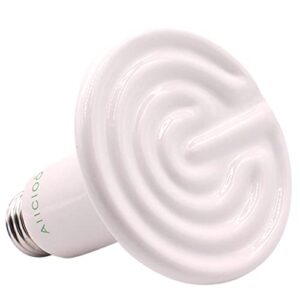
Snakes need warmth at night, but light wrecks their sleep. This emitter solves that.
The Aiicioo 60W puts out long wave infrared heat with zero light, so your snake keeps a natural day and night cycle. Its moisture-resistant ceramic holds up in humid enclosures, and it runs on standard 110-120V power.
Two catches. Let it cool an hour before touching it, and don’t flip it on and off. Some pull 75W instead of 60W, so pair it with a thermostat.
| Best For | Reptile keepers, especially snake owners, who need steady nighttime warmth in a humid enclosure without light disrupting their pet’s sleep. |
|---|---|
| Power | 60W |
| Heat Type | Ceramic infrared emitter |
| Light Output | No light |
| Socket Type | N/A |
| Lifespan | Weeks to 2 years |
| Reliability Concerns | Inconsistent wattage and lifespan |
| Additional Features |
|
- Gives off long wave infrared heat with no light, so animals keep a natural day and night cycle
- Moisture-resistant ceramic holds up well in humid enclosures
- Runs on standard 110-120V power and is compact at 2.95 x 3.94 x 2.95 inches
- Needs at least an hour to cool down before you can safely handle it
- Should not be switched on and off often, or turned back on right after shutdown
- Some units draw 75W instead of 60W, and lifespan can vary from weeks to two years
3. Flukers 150W Reptile Basking Bulb
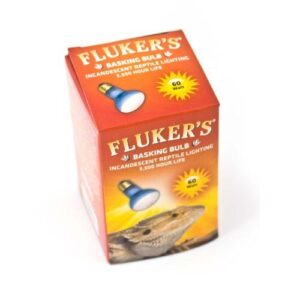
Want a bulb that hits one spot hard? The Flukers 150W Reptile Basking Bulb (model 22604) is an incandescent that sends infrared heat to a focused area, and it fits standard tank hoods.
It’s compact, at 3.5 x 3.5 x 7.25 inches and 2.89 ounces. Here’s the catch. Some owners report burnout within a month, a burning chemical smell when it overheats, and glass detaching from the base. Watch it, and pair it with a thermostat so it stays safe.
| Best For | Reptile owners with lizards or snakes who want a focused basking spot in a standard tank hood and are willing to monitor the bulb closely. |
|---|---|
| Power | 150W |
| Heat Type | Infrared basking bulb |
| Light Output | Emits light |
| Socket Type | N/A |
| Lifespan | N/A |
| Reliability Concerns | Burnout, glass detachment |
| Additional Features |
|
- Directs infrared heat and light to a specific area, giving reptiles a clear basking spot
- Helps regulate core body temperature and supports natural behaviors like appetite and digestion
- Compact at 3.5 x 3.5 x 7.25 inches and fits standard reptile tank hoods and fixtures
- Some owners report the bulb burning out within a month of use
- Some units give off a burning chemical smell when they overheat
- The glass has detached from the base in multiple reported cases
4. REPTI HOME 100W Reptile Heat Lamp
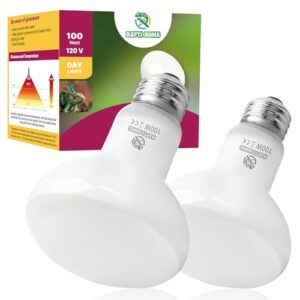
Prefer a bulb that doesn’t make you nervous? The REPTI HOME 100W Reptile Heat Lamp is a solid middle ground. It simulates natural sunlight, heats fast, and reaches your target temperature in minutes. It’s rated for 2,000 to 3,000 hours, and each pack includes two bulbs.
It fits standard lamp holders, so setup is easy.
Keep it at least 30 cm from your snake. Never run it through a dimmer, thermostat, or rheostat, and keep it away from water and unstable voltage.
| Best For | Reptile owners with bearded dragons, turtles, lizards, or snakes who want a fast-heating basking bulb that fits standard lamp holders and don’t need to dim or regulate it. |
|---|---|
| Power | 100W |
| Heat Type | Sunlight-simulating basking bulb |
| Light Output | Emits light |
| Socket Type | N/A |
| Lifespan | 2,000-3,000 hours |
| Reliability Concerns | Keep 30 cm away |
| Additional Features |
|
- Simulates natural sunlight and reaches the target temperature in minutes
- Fits standard lamp holders, and each pack includes two bulbs
- Rated for 2,000 to 3,000 hours and suits a range of reptiles and amphibians
- Must be kept at least 30 cm away from the animal
- Cannot be used with dimmers, thermostats, or rheostats
- Should be kept away from water and unstable voltage
5. MCLANZOO 75W Infrared Heat Lamp Bulbs
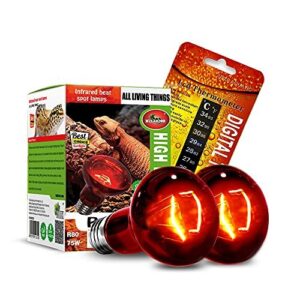
Want heat at night without a glowing bulb? The MCLANZOO 75W Infrared Heat Lamp Bulbs give off soft red light, so your snake’s sleep cycle stays intact.
It’s a 75 watt bulb rated for 3,000 hours, and it fits standard E26 sockets. Pair it with a daylight basking bulb for 24-hour heating cycles.
Know the downsides, though. Some buyers reported bulbs failing within 48 hours, and a few experts say not every reptile benefits from red light. Test yours early.
| Best For | Reptile and amphibian owners, such as those with bearded dragons, snakes, turtles, or leopard geckos, who want gentle nighttime heat that won’t disrupt their pet’s sleep cycle. |
|---|---|
| Power | 75W |
| Heat Type | Infrared heat bulb |
| Light Output | Soft red light |
| Socket Type | E26 |
| Lifespan | 3,000 hours |
| Reliability Concerns | Failures within 48 hours |
| Additional Features |
|
- Soft red light provides nighttime heating without disturbing pet activity
- Fits standard E26 sockets and can be paired with a daylight basking bulb for 24-hour heating cycles
- Rated for 3,000 hours of service life at 75 watts
- Some users reported bulbs failing within 48 hours of use
- One customer noted visible internal gaps and non-uniform construction
- Some experts say not all reptiles benefit from red light exposure
6. Zoo Med Repticare 100W Ceramic Heat Emitter
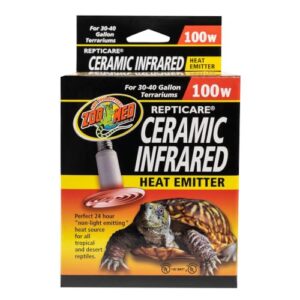
Prefer zero light at night? The Zoo Med Repticare 100W Ceramic Heat Emitter skips the glow. It puts out infrared heat with no visible light, so your snake sleeps undisturbed.
The flat-face design runs more efficiently than conical models, and it’s built for continuous 24-hour use. It lifts air temperature 10 to 20°F above ambient.
Here’s the catch. Some owners find 100W too weak for larger enclosures, and reported lifespan ranges from four months to five years. Buy a spare.
| Best For | Reptile and small mammal owners, such as hedgehog keepers, who want steady, light-free heat overnight in a humid, small to medium terrarium. |
|---|---|
| Power | 100W |
| Heat Type | Porcelain infrared emitter |
| Light Output | No visible light |
| Socket Type | Standard porcelain |
| Lifespan | 4 months to 5 years |
| Reliability Concerns | Mixed durability feedback |
| Additional Features |
|
- Emits infrared heat with no visible light, so nocturnal animals sleep undisturbed
- Flat-face design runs more efficiently than conical models and is built for continuous 24-hour use
- Raises terrarium air temperature by 10 to 20°F above ambient, and its porcelain build holds up in high humidity
- Some owners find the 100W output too weak for larger enclosures
- Reported lifespan varies widely, from four months to five years
- Feedback on durability and long-term reliability is mixed, so a spare is a smart purchase
7. REPTI HOME Infrared Heat Lamp Bulb
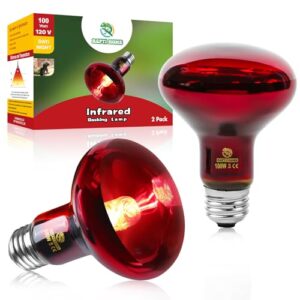
Want heat at night without the glow? The REPTI HOME Infrared Heat Lamp Bulb gives off infrared heat with no visible light, so your snake keeps its natural day and night rhythm.
It’s a 100W bulb for 120-volt setups and fits standard E26 sockets. A frosted coating cuts glare, and it creates a basking spot for thermoregulation.
Feedback is mixed. Some bulbs die within a week, and some users flag a potential fire hazard. Always pair it with a thermostat.
| Best For | Reptile, amphibian, or chicken keepers who want a night-time heat source that gives off no visible light, and who will pair it with a thermostat. |
|---|---|
| Power | 100W |
| Heat Type | Infrared heat bulb |
| Light Output | No visible light |
| Socket Type | E26 |
| Lifespan | 2,000-3,000 hours |
| Reliability Concerns | Breaks early, fire risk |
| Additional Features |
|
- Gives off infrared heat with no visible light, so animals keep their natural day and night rhythm
- Frosted coating cuts glare, and the bulb creates a basking spot for thermoregulation
- Fits standard E26 sockets and runs on 120 volts at 100W
- Customer feedback is mixed, and some bulbs break within a week
- Some users flag it as a potential fire hazard
- Rated lifespan is only 2000 to 3000 hours, and it is designed for just 4 to 6 hours of daily use
8. REPTI ZOO Dimming Reptile Light Fixture
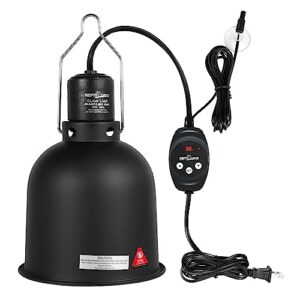
The REPTI ZOO Dimming Reptile Light Fixture is an ETL certified fixture pairing a dimming thermostat with an aluminum reflective shade. Its E26 ceramic lamp cap accommodates heat bulbs up to 100W, and you’ll need to buy the bulb separately.
Set temperatures anywhere from 20℃ to 50℃ (68°F to 122°F). The LED display shows both ambient and set readings, and you can switch between Celsius and Fahrenheit.
No power switch means unplugging to turn off. Some stop reaching set temperature.
| Best For | Reptile owners who want an affordable, all-in-one heat lamp fixture with a built-in dimming thermostat and a digital display to keep an enclosure at a steady temperature. |
|---|---|
| Power | Up to 100W bulbs |
| Heat Type | Thermostat fixture |
| Light Output | N/A |
| Socket Type | E26 ceramic |
| Lifespan | N/A |
| Reliability Concerns | Fails to reach temperature |
| Additional Features |
|
- Dimming thermostat holds a set temperature anywhere from 20℃ to 50℃ (68°F to 122°F)
- LED display shows both ambient and set temperatures, with a switch between Celsius and Fahrenheit
- ETL certified, with a ceramic E26 lamp cap that handles heat bulbs up to 100W
- No built-in power switch, so you have to unplug it to turn it off
- Some users report it stops reaching the set temperature over time
- The heat bulb is not included and must be purchased separately
9. DXOPHIEX Reptile Heat Lamp Thermostat
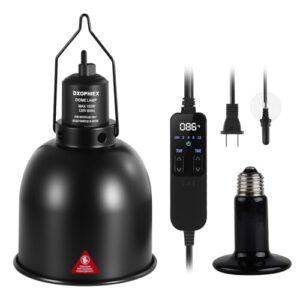
The DXOPHIEX thermostat fixture is a tidy all-in-one for snake heat. It pairs an E26 ceramic head, good for bulbs up to 100 watts, with a built-in thermostat covering 40°F to 131°F. The 100-watt ceramic heat emitter makes heat without light, so nights stay dark.
Setup is simple: place the sensor, install the lamp, plug in, and set your temperature. PID heating keeps temps steady and saves energy.
Caution: some owners report failure after one month, and reviews are mixed.
| Best For | Reptile keepers who want a simple, all-in-one heating setup with a built-in thermostat for snakes, leopard geckos, bearded dragons, and similar pets that don’t need light with their heat. |
|---|---|
| Power | 100W emitter |
| Heat Type | Ceramic heat emitter |
| Light Output | No light |
| Socket Type | E26 ceramic |
| Lifespan | N/A |
| Reliability Concerns | Stopped working after a month |
| Additional Features |
|
- Built-in thermostat covers 40°F to 131°F, with PID heating that keeps temperatures steady and saves energy
- Ceramic heat emitter produces heat without light, so nights stay dark
- Easy setup: place the sensor, install the lamp, plug in, and set your temperature
- Some owners report the unit stopped working after one month of use
- Reviews are mixed, with both positive and negative experiences
- Gives off no light, so it won’t suit pets that need a combined light and heat source
10. Reptitrip Dual UVB Heat Light Fixture
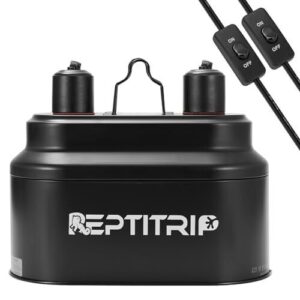
Think a dual fixture is overkill for one snake? Not really. The two sockets have independent switches, so you can run heat and UVB on separate schedules. Each socket helps up to 160W, and the polished dome reflects light well. The bulbs aren’t included, so budget for them.
Pair it with a thermostat or smart plug. Top vents help dissipate heat, and the label warns above 113°F, so mind the surface.
Some units shorted and lifespans vary, so inspect yours.
| Best For | Reptile keepers who want to run heat and UVB bulbs on separate schedules in one fixture, especially those using a thermostat or smart plug. |
|---|---|
| Power | Up to 160W per socket |
| Heat Type | Dual-socket fixture |
| Light Output | N/A |
| Socket Type | Dual sockets |
| Lifespan | N/A |
| Reliability Concerns | Shorting, early failures |
| Additional Features |
|
- Two sockets with independent switches let you control heat and UVB separately
- Each socket handles up to 160W, so it supports ceramic, UVB, and heat bulbs
- Works with smart plugs and temperature controllers, and its height keeps bulbs from touching the terrarium screen
- Some units have shorted because of internal contact issues
- The top and bottom sections are hard to separate once assembled
- Lifespan is inconsistent, with several reports of early failure
Frequently Asked Questions (FAQs)
What heat lamp does a snake need?
Your snake needs a halogen heat lamp for the basking spot, plus a ceramic heat emitter for nighttime warmth.
Run both on a thermostat, and you’ll keep a safe temperature gradient across the whole enclosure.
Do snakes need a heat lamp 24-7?
Picture a ball python owner who leaves a bright heat lamp on all night, then wonders why her snake hides and refuses food. No, your snake doesn’t need one 24/ Use thermostat-controlled nocturnal heating instead.
How long should a heat lamp be on for a snake?
Think of your snake’s day like a clock.
Run the basking spot lamp on a 12-hour on/off cycle, and let thermostat temperature control hold your basking temperature steady. Then switch it off for the night.
How long can snakes go without a heat lamp?
Wondering how long your snake can skip a heat lamp? Check the basking spot and thermal gradient; if temperature control holds your species’ safe range, reptile thermoregulation continues.
Watch actual enclosure temperatures, not the clock.
What heat lamp do snakes need?
Most snakes need a basking spot around 85-95°F. Use a halogen heat lamp by day and a ceramic heat emitter at night.
Add a thermostat for reliable temperature control, so nothing ever overheats or burns.
How long should I keep a heat lamp on for a snake?
Think of your heat lamp as a sunrise you control. Run it on a 12-hour on/off cycle and switch it off at night. Use thermostat control and temperature monitoring tools to hold your basking temperature.
How many watts should a snake heat lamp be?
Most 20-gallon tanks run fine on 50 to 75W. Match wattage to enclosure size, then check your thermal gradient. Your basking temperature should hit 85 to 92°F, and thermostat control keeps it steady.
How many heat lamps does a snake need?
Think one lamp sounds too simple? It usually isn’t. Most snakes need just one heat lamp at one end, creating a thermal gradient. Add a second only if your enclosure size demands it, and always use a thermostat.
Should I have my snakes heat lamp on all the time?
No, don’t leave your heat lamp on all the time. Run a 12-hour on/off cycle, keep the basking spot warm by day, use a thermostat, and let the temperature gradient cool a bit at night.
Can snakes overheat from too much basking?
Yes, they can. Basking surfaces under a lamp run far hotter than the air, so heat stress prevention starts with thermal gradient maintenance, smart heat lamp placement strategy, and enclosure temperature monitoring. Watch basking behavior.
Conclusion
A heat lamp is the sun you build for an animal that can’t build its own. Get it right, and your snake eats, digests, and sheds like clockwork.
The best reptile heat lamps for first time snake owners share three traits: the right wattage, a reliable thermostat, and a gradient you’ve verified with a thermometer. Skip colored bulbs and heat rocks. Check your basking zone temperatures every week.
Nail the heat and the rest follows.