This site is supported by our readers. We may earn a commission, at no cost to you, if you purchase through links.

temperature drop of just 5°F can send a reptile into stress within hours—and on the road, you won’t always know it’s happening.
Travel disrupts everything: tub setups, hotel rooms, car trunks, reptile expos.
The enclosure changes, but your animal’s thermal needs don’t.
Keeping tabs on heat and humidity in temporary setups isn’t optional; it’s the difference between a smooth trip and a vet visit.
right reptile thermometers for travel and temporary enclosures are small enough to toss in a bag, accurate enough to trust, and tough enough to survive the chaos of being on the move.
Table Of Contents
- Key Takeaways
- Top 5 Reptile Thermometers for Travel and Temporary Enclosures
- Key Features to Look for in Travel Reptile Thermometers
- Best Thermometer Types for Temporary Snake Enclosures
- Durability, Value, and What to Avoid When Traveling
- Frequently Asked Questions (FAQs)
- What’s the best thermometer for reptiles?
- How far away can a temp gun read?
- Which thermometer is no longer recommended for use?
- How often should I calibrate my travel thermometer?
- Can reptile thermometers work in extreme outdoor temperatures?
- Do wireless thermometers exist for reptile enclosures?
- How do I clean probes between different reptiles?
- Are thermometers safe near reptile UVB lighting?
- Conclusion
Key Takeaways
- A 5°F temperature drop can stress your reptile within hours, so a compact, accurate thermometer isn’t optional gear—it’s a travel essential.
- The best travel thermometers combine both temperature and humidity readings, update every 10 seconds, and run on long-life batteries so you’re never caught guessing mid-trip.
- Features like waterproof probes, magnetic mounts, and multi-pack formats make it easier to monitor multiple zones or wet substrates without rigging up a complicated setup.
- Mercury thermometers are out—skip them entirely—and budget digital units need a recalibration check every few months since sensor drift can quietly push readings 2–3 degrees off.
Top 5 Reptile Thermometers for Travel and Temporary Enclosures
Traveling with reptiles means you can’t afford a thermometer that fogs up, dies mid-trip, or reads five degrees off.
A reliable digital thermometer is non-negotiable, especially when you’re building out reptile habitat setups that depend on precision temperature zones.
five options below all pack small, hold up in transit, and give you the accuracy your animal needs.
Here’s what made the cut.
1. ATuMan Mini Indoor Hygrometer Thermometer
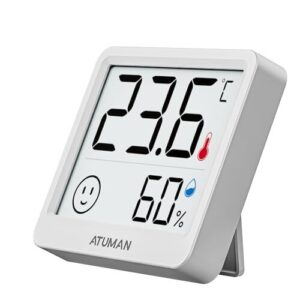
The ATuMan Mini Indoor Hygrometer is a smart pick when space is tight and accuracy matters. At just 36 mm by 60 mm, it slips into any travel kit without a second thought.
You get temperature readings from -9.9°C to 60°C and humidity from 10% to 99% RH — solid coverage for most reptile needs.
The CR2032 battery lasts months between changes, and the large LCD digits stay readable even in dim light.
It’s compact, reliable, and won’t let you down mid-trip.
| Best For | Anyone who needs a quick, reliable read on temperature and humidity in small spaces — think reptile keepers, plant lovers, or anyone monitoring a wine cellar, guitar case, or RV. |
|---|---|
| Temp Range | 14°F–140°F |
| Humidity Range | 10%–99% RH |
| Temp Accuracy | ±0.1°F |
| Humidity Accuracy | ±1% RH |
| Update Interval | 10 seconds |
| Display Type | LCD |
| Additional Features |
|
- Surprisingly accurate for its size — ±0.1°F/°C and ±1% RH means you’re getting real numbers, not ballpark guesses
- Battery lasts up to 12 months, so you’re not constantly swapping cells
- The comfort indicator face icon gives you an instant visual cue without squinting at numbers
- The unit-toggle button is recessed, so switching between Fahrenheit and Celsius can be a bit fiddly
- Humidity digits are smaller than the temperature display, which can make quick glances less convenient
- The temperature range tops out at 60°C, so it won’t cut it for extreme environments or precise scientific use
2. JEDEW Mini Digital Hygrometer Thermometer
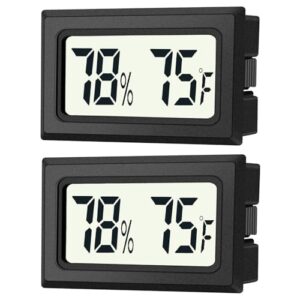
Another solid option worth keeping in your kit is the JEDEW Mini Digital Hygrometer. It reads humidity from 10% to 99% RH and temperature from -58°F to 158°F — plenty of range for most snakes and lizards.
The compact 44 mm square body fits easily inside a hide or tight corner of a travel tub. It ships ready to use with LR44 batteries included, displays both readings at once, and updates every 10 seconds. The 2-pack format makes monitoring two zones simple.
| Best For | Reptile keepers who need an affordable, no-fuss way to monitor humidity and temperature in two separate enclosures at once. |
|---|---|
| Temp Range | -58°F–158°F |
| Humidity Range | 10%–99% RH |
| Temp Accuracy | ±2°F |
| Humidity Accuracy | ±3% RH |
| Update Interval | 10 seconds |
| Display Type | LCD |
| Additional Features |
|
- Comes as a 2-pack, so you can watch two zones — like a warm side and cool side — without buying extra units.
- Tiny footprint fits inside hides, travel tubs, or tight corners without getting in the way.
- Updates every 10 seconds and shows both temp and humidity on one screen at a glance.
- No mounting hardware included, so you’ll need tape or another solution to keep it in place.
- Humidity readings can take a few days to stabilize after you first set it up.
- No wireless connectivity or data logging — you have to physically check the screen to see readings.
3. KJCOOSWI Mini Digital Hygrometer Thermometer
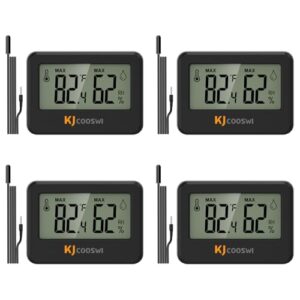
The KJCOOSWI MC30 is a step up if you want a separate waterproof probe. That probe drops directly into a water bowl or damp substrate while the main unit stays dry on the wall.
If you’re still comparing options, this humidity gauge guide for snake enclosures breaks down how the MC30’s 2.3" LCD and waterproof probe stack up against other monitors worth considering.
Temperature accuracy sits at ±1°C, humidity at ±5% RH, with readings updating every 10 seconds. The magnetic back keeps it flush against metal shelving.
For new keepers still learning what “good humidity” looks like in practice, choosing the right reptile humidity gauge as a first-time owner can make those 10-second updates genuinely meaningful rather than just numbers on a screen.
One CR2032 battery generally lasts 12–18 months — less fussing on the road.
| Best For | Reptile keepers, plant growers, or anyone who needs to monitor temps in a wet or tight spot without dunking the whole unit. |
|---|---|
| Temp Range | -58°F–158°F (probe) |
| Humidity Range | 10%–99% RH |
| Temp Accuracy | ±1.8°F |
| Humidity Accuracy | ±5% RH |
| Update Interval | 10 seconds |
| Display Type | LCD |
| Additional Features |
|
- Waterproof probe lets you stick it right in a water bowl or damp substrate while the display stays safe and dry
- Reads every 10 seconds, so you catch temperature swings fast
- One CR2032 battery lasts over a year — barely any upkeep
- Humidity readings can be hit or miss; don’t rely on it for anything that needs precision
- The magnetic mount is a bit weak — the probe cord can pull the unit off-angle
- No reset button, and the battery compartment can be a pain to open
4. Mini Digital Hygrometer Thermometer
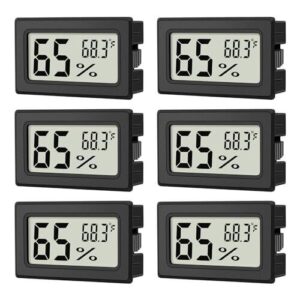
If you’re monitoring several enclosures at once, the ANFBYOH 6-pack solves that problem in one purchase. Each compact unit — just 1.12 inches wide — clips directly onto a tank wall, jar lid, or probe holder without extra hardware.
You get temperature coverage from -58°F to 158°F and humidity from 10% to 99% RH, accurate to ±2°F and ±5% RH.
Pre-installed batteries mean they’re ready straight out of the box. Ideal for staging multiple temporary setups fast.
| Best For | Anyone managing multiple enclosures, terrariums, or storage spaces who needs a quick, affordable way to track temperature and humidity across several spots at once. |
|---|---|
| Temp Range | -58°F–158°F |
| Humidity Range | 10%–99% RH |
| Temp Accuracy | ±2°F |
| Humidity Accuracy | ±5% RH |
| Update Interval | 10 seconds |
| Display Type | LCD |
| Additional Features |
|
- Six units in one pack makes it easy to monitor multiple spaces without buying sensors separately
- Tiny clip-on design fits just about anywhere — jars, tanks, instrument cases, you name it
- Comes with batteries already installed, so you’re up and running right out of the box
- No calibration option, so readings can drift over time with no way to correct them
- Battery life isn’t specified and units arrive pre-activated, meaning you might need a replacement sooner than expected
- Can’t read humidity below 10% RH, which could be a problem in very dry environments
5. JEDEW Digital Hygrometer and Thermometer
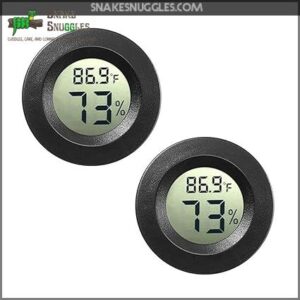
The JEDEW Digital Hygrometer and Thermometer keeps things simple when you need reliable, fast readings.
It covers 32°F to 158°F and 10% to 99% RH, updating every 10 seconds so you catch temperature swings before they become a problem.
Accuracy holds at ±1°F and ±3% RH — solid for basking and hide zone checks.
The compact LCD is easy to read at a glance, and the 2-pack gives you two zones covered without doubling your budget.
| Best For | Reptile keepers and hobbyists who need affordable, at-a-glance humidity and temperature monitoring across multiple enclosures or small storage spaces. |
|---|---|
| Temp Range | 32°F–158°F |
| Humidity Range | 10%–99% RH |
| Temp Accuracy | ±1°F |
| Humidity Accuracy | ±3% RH |
| Update Interval | 10 seconds |
| Display Type | LCD |
| Additional Features |
|
- Updates every 10 seconds, so you catch changes fast before they affect your animals or stored items
- Comes as a 2-pack, making it easy to monitor two zones without spending much
- Compact and lightweight — fits neatly inside tanks, cases, or containers without getting in the way
- Units can read differently when placed side by side, which makes direct comparisons tricky
- Not built for sub-zero monitoring, so it won’t work for freezer or cold-storage setups
- Batteries may arrive dead and only last around 10 months with no rechargeable option
Key Features to Look for in Travel Reptile Thermometers
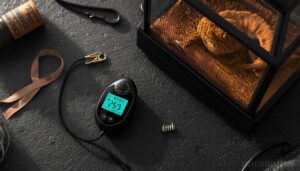
Not every thermometer is built for life on the road. When you’re traveling with a reptile, a few key features can make or break your ability to keep temps and humidity dialed in.
Here’s what to look for before you buy.
Sensor Accuracy for Basking and Hide Zones
Accuracy starts with placement. Put your sensor within 2 cm of the basking surface for a true Surface‑Air Comparison—air temps nearby often read lower due to radiant heat.
For Gradient Mapping, place a second sensor at floor level inside the hide.
Humidity Effect can skew readings, so recalibrate every 2–3 months.
Smart Sensor Placement and consistent Calibration Frequency keep your data trustworthy.
The device’s IP65 rating ensures durability against splashes and high humidity.
Battery Life and Portability for On-the-Go Use
When you’re packing for a trip, every gram counts. Look for units under 40 grams with a Compact Form Factor—slim enough for a shirt pocket.
Battery Chemistry Choices matter too: lithium polymer cells outlast NiMH in small housings. Fast Charging Compatibility via USB-C means a quick top-up between stops. Power Saving Modes and smart Weight Optimization keep your thermometer running the whole journey.
Display Visibility in Low-Light Travel Settings
Dim hotel rooms and overnight drives can make reading your thermometer a real challenge. That’s why display quality matters as much as sensor accuracy.
Look for three things:
- A Backlight Brightness of at least 300 nits with a Contrast Ratio of 1000:1 or higher
- Warm Color Temperature backlight to protect your night vision
- An Anti-Glare Coating paired with an Ambient Light Sensor for automatic adjustments
Mounting Options for Temporary Enclosures
Mounting a thermometer in a temporary setup shouldn’t feel like a puzzle. Adhesive backings work fast on glass, but humidity loosens their grip. Magnetic base pads are cleaner — tool-less, residue-free, and easy to reposition.
Surface bracket angles let you align sensors away from vents for truer readings. wall back plate designs spread load evenly, while enclosure plate materials like aluminum resist corrosion.
pole mast stability options unless you’re running mobile setups outdoors.
Best Thermometer Types for Temporary Snake Enclosures
Not every thermometer pulls its weight when you’re working with a temporary snake setup. The right type depends on what your snake actually needs — quick surface checks, full gradient data, or both.
Here are the best options to have on hand.
Digital Combo Hygrometer-Thermometer Units
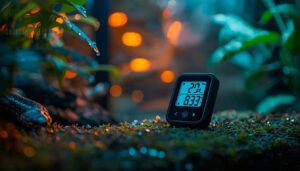
A digital combo unit is the most reliable all-in-one tool you can carry. It tracks both temperature and humidity simultaneously, updating readings every few seconds so you’re never guessing.
Look for models with Power-Saving Modes and Data Logging to extend battery life and monitor trends over time. Firmware Updates can even improve accuracy without buying new hardware.
Key reasons to choose a combo unit:
- Temperature accuracy within ±1°C across typical enclosure ranges
- Humidity readings with ±3–5% RH precision
- Built-in Calibration Procedures reduce sensor drift over months
- Data Logging stores min/max records for daily trend checks
- Power-Saving Modes stretch battery life up to 24 months
Infrared Temp Guns for Quick Surface Readings

Combo units cover ambient conditions well, but they won’t tell you what a basking rock actually feels like underfoot. That’s where an infrared temp gun earns its spot.
Point it, pull the trigger, and you’ve got a surface reading in seconds. Use the Laser Aiming Aid to target small zones precisely, and adjust Emissivity Calibration for darker or reflective surfaces.
A 12:1 Spot Size Ratio keeps measurements tight at close range, while Ambient Interference from drafts stays manageable indoors.
They’re also handy for quick Safety Checks around heating elements.
Dual-Probe Models for Temperature Gradient Monitoring
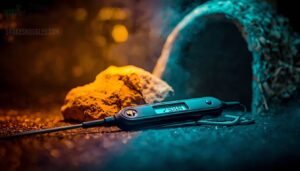
temp gun shows you the surface. Dual-probe models show you the whole story.
Place one probe near the basking spot and one in the hide. Probe Synchronization captures both readings at once, so you’re comparing real-time temps, not guesses.
- Gradient Calibration aligns sensors using Software Offsets
- Data Logging tracks diurnal swings automatically
- Real-Time Alerts flag unsafe drops instantly
- Accuracy holds within 0.5–1°C per probe
How Far Away Can a Temp Gun Read?
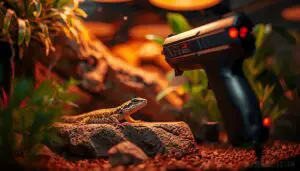
Your temp gun’s range depends on its Spot Ratio. A 12:1 ratio reads a one-inch target accurately from 12 inches away.
Push past that, and Target Size starts working against you — the sensor averages surrounding surfaces into the reading.
Adjust Emissivity Settings for substrate or rock materials. Watch for Environmental Interference, like humidity or steam.
Laser Alignment helps you aim, not measure.
Durability, Value, and What to Avoid When Traveling
Traveling with reptiles puts your gear to the test in ways a static setup never does. Not every thermometer holds up to bumps, condensation, or repeated use across different enclosures.
what actually matters when you’re on the road — and what to skip.
Impact Resistance and Moisture Protection Ratings
Travel breaks things. That’s just reality.
Look for IP54 or higher ratings — these pass water ingress testing and dust tightness standards that matter when bags get tossed around. IP rating levels above IPX5 handle accidental splashes without flinching.
Sealing gasket materials keep moisture out during humid transit. IK impact grades add another layer if you’re rough on gear.
Multi-Pack Options for Monitoring Multiple Enclosures
If you’re moving more than one reptile, multi-packs earn their place fast. A single Central Display Interface tracks every enclosure without battery sprawl. Flexible Probe Placement lets you hit basking spots and hides simultaneously, while Shared Power Sources cut down on charging chaos.
- Interchangeable Sensor Modules let you swap faulty units without replacing the whole kit.
- Expandable Data Storage holds up to 90 days of interval logs across enclosures.
- Cable extensions reach distant zones without repositioning your display.
Which Thermometer is No Longer Recommended for Use?
Mercury thermometers are off the table — full stop. Mercury toxicity makes a broken unit genuinely dangerous, and regulatory bans have pulled them from shelves in many regions for good reason.
Mercury thermometers are off the table — toxicity, fragility, and hazardous disposal make them indefensible
They’re fragile, slow, and create a hazardous waste headache if cracked near your reptile’s enclosure. Safe disposal isn’t simple either, so the environmental impact alone makes switching a no-brainer.
| Feature | Mercury Thermometer | Digital Thermometer |
|---|---|---|
| Safety | Toxic if broken | Non-toxic |
| Disposal | Hazardous waste | Standard recycling |
| Accuracy | ±1–2°C | ±1°C |
Long-Term Drift and Reliability in Budget Units
Budget units drift — and they drift faster than most people expect. Calibration Frequency matters here: cross‑check against a trusted thermometer every two to four weeks.
Sensor Aging kicks in after just months, especially when Battery Voltage Impact from dying coin cells skews your ADC readings.
Moisture Ingress through loose seals and Housing Degradation from heat warp compound the problem, quietly pushing readings two to three degrees off.
Frequently Asked Questions (FAQs)
What’s the best thermometer for reptiles?
The right thermometer depends on your setup.
Look for one with a solid temperature range, memory capacity for trend tracking, calibration alerts, wireless sync, and emissivity adjustment for accurate surface reads.
How far away can a temp gun read?
That depends on the Distance Spot Ratio. At 8:1, you’re accurate from 8 inches away on a 1-inch target.
Emissivity Adjustments, Angle Perpendicularity, and Laser Guide Aiming all affect reliability.
Target Size Impact matters too.
Which thermometer is no longer recommended for use?
Skip the mercury thermometer. Mercury toxicity, spill hazards, regulatory bans, and disposal challenges make it a liability. Safer alternative safety options like digital or infrared units exist. Don’t risk it.
How often should I calibrate my travel thermometer?
Calibrate every 3–6 months, or monthly with heavy use.
Run Ice Point Checks and Boiling Point Verification after battery changes.
Keep a Calibration Log and use a Field Reference to catch Battery Influence on readings.
Can reptile thermometers work in extreme outdoor temperatures?
Most reptile thermometers work best between 0–50°C.
Outside that range, Battery Performance, Cold conditions cause shutdowns, Condensation Effects degrade sensors, and Temperature Compensation Limits reduce reliability.
UV Degradation weakens housings over time.
Always cross-check with a second device outdoors.
Do wireless thermometers exist for reptile enclosures?
Yes, wireless options exist.
Many multi-channel units sync readings to a receiver or app, but Signal Interference, Wireless Range Limits, and Calibration Procedures matter.
Multi-Channel Sync and App Integration keep monitoring simple across zones.
How do I clean probes between different reptiles?
Use color-coded wipes and dedicated cleaning cloths for each animal — no sharing. Wipe probe tips with 70% isopropyl alcohol, then air-dry completely.
Cross-species sanitation prevents pathogen spread. Safe disinfectant use matters every single session.
Are thermometers safe near reptile UVB lighting?
Most thermometers handle UVB radiation effects fine, but plastic degradation is real over time. Watch your probe placement — heat drift kicks in near basking lamps.
Replace any cracked casing immediately; electrical shielding won’t protect compromised hardware.
Conclusion
Funny how reptiles survived millions of years without us—yet a weekend road trip without the right reptile thermometers for travel and temporary enclosures can undo everything you’ve built in captivity.
Your animal doesn’t care about the hotel room or the expo hall. It only cares about heat and humidity being exactly right.
A small, accurate monitor isn’t just gear you pack—it’s the one thing standing between a smooth trip and a crisis.