This site is supported by our readers. We may earn a commission, at no cost to you, if you purchase through links.
Most snake health problems trace back to one overlooked variable—not temperature, not diet, but humidity.
A ball python sitting in air that’s too dry develops stuck shed around its eyes. A corn snake in an overly damp enclosure starts showing early signs of scale rot within weeks.
These aren’t edge cases; they’re the most common mistakes reptile keepers make. Maintaining moisture in a snake enclosure isn’t about hitting a single magic number—it’s about matching conditions to your specific animal’s biology, then holding that range steady through seasonal swings, shed cycles, and daily temperature shifts.
Table Of Contents
- Key Takeaways
- Set The Right Humidity Range
- Measure Humidity Accurately
- Raise Moisture Safely
- Control Excess Humidity
- Maintain Stable Humidity Long Term
- Frequently Asked Questions (FAQs)
- How much humidity does a snake enclosure need?
- How do you keep snakes moist?
- How do I make my snake enclosure humid?
- What happens if a snake enclosure humidity drops too low?
- How to maintain humidity in a snake enclosure?
- Is 40% humidity too low for sleeping?
- What are signs of too much humidity for pythons?
- Can tap water cause fogger nozzle clogs?
- Do humidity needs change during brumation?
- How does enclosure size affect humidity stability?
- Conclusion
Key Takeaways
- Humidity is the single biggest factor in snake health — not diet or temperature — and getting it wrong causes stuck sheds, scale rot, and respiratory infections faster than most keepers realize.
- Every snake needs a different moisture range: desert species do fine at 20–40%, temperate snakes need 50–70%, and tropical species require 80–90%, so knowing your animal’s native climate is non‑negotiable.
- During shedding, bump humidity 10–15% above your baseline, the moment you see dull eyes or milky skin, and add a humid hide packed with damp sphagnum moss to prevent incomplete sheds before they start.
- Long‑term stability comes down to two digital hygrometers (one per enclosure zone), a moisture‑retaining substrate like coconut fiber, and seasonal adjustments — more misting in winter, more ventilation in humid months.
Set The Right Humidity Range

Getting humidity right starts with knowing what your specific snake actually needs. Not every species plays by the same rules, and age matters just as much as species.
A solid starting point is this DIY humidity control setup guide for snake enclosures, which walks you through tailoring conditions by species and life stage.
Here’s what to think about before you dial in those numbers.
Species-specific Humidity Needs
No two snakes want the same air. Getting species-specific humidity requirements right is the foundation of everything else.
Here’s a quick reference by type:
- Neonatal Hatchling RH – 60–70% to support hydration and clean sheds
- Juvenile snakes – 50–65% for steady growth
- Adult Scale Health – 40–60% maintains skin integrity
- Gravid Egg Humidity – 65–75% facilitates soft-shell development
- Arboreal Rainforest Moisture / Subterranean Snake RH – 70–90% vs. 35–50%, respectively
A reliable digital hygrometer removes the guesswork from humidity monitoring entirely.
Consult the ideal humidity range guide for detailed species-specific targets.
Desert, Temperate, and Tropical Snakes
Think of it as three climate zones in one hobby.
Desert snakes — like sand boas — stay healthy at 20%–40% humidity, mimicking arid burrow conditions shaped by seasonal activity patterns. Temperate species like corn snakes need 50%–70%. Tropical snakes, including green tree pythons, demand 80%–90%.
Match your substrate choice, misting techniques, and humidifier settings to your snake’s native habitat, not your best guess.
Hatchlings, Juveniles, and Adults
Age changes everything regarding species-specific humidity requirements.
Hatchlings need 70%–80% RH — they desiccate fast and can’t regulate moisture like adults. Juveniles do well at 60%–70%, supporting growth tracking and immune support during rapid development. Adults settle into their standard range.
- Hatchlings: 70%–80% RH, moisture-retaining substrate, gentle misting techniques
- Juveniles: 60%–70% RH, humidity gradients across the tank
- Adults: species baseline, stable ventilation and airflow
- All stages: consistent temperature gradients, behavioral enrichment, feeding schedule alignment
Adjusting Humidity During Shedding
Shedding flips the script on your normal humidity routine. When you spot dull eyes or milky skin — that’s your cue to trigger a Pre-shed Spike, bumping RH 10%–15% above baseline. This Shedding Cycle Timing matters because dysecdysis (incomplete shedding) starts with low moisture, not bad luck.
Dull eyes and milky skin mean one thing: raise humidity now or risk an incomplete shed
| Shedding Stage | Action |
|---|---|
| Dull/blue eyes appear | Raise RH 10%–15% |
| Skin looks milky | Add humid hide with damp moss |
| Active shed begins | Maintain Moisture Gradient warm-to-cool |
| Post-shed check | Return to baseline humidity |
| Retained shed spotted | Warm soak immediately |
Use Humidity Alert Systems to catch drops early, and keep Temperature-Humidity Sync tight — warmer air needs more moisture to compensate. Adjusting humidity during shedding cycles prevents shedding problems before they start.
For more on navigating these challenges, scaleless snake husbandry tips and care guides walk through the moisture and stress sensitivities that make these animals uniquely rewarding to keep.
If shedding issues do slip through, safe techniques for removing stuck shed can help you handle retained skin without stressing your snake.
Measure Humidity Accurately
Knowing your snake’s humidity range is only half the job — actually measuring it accurately is where most keepers fall short. The tools you use and where you place them make a bigger difference than you’d think.
Here’s what you need to get it right.
Choosing a Digital Hygrometer

Not all humidity gauges are created equal — a cheap analog dial can fool you by 10–15%. Go digital.
A good digital hygrometer with a ±2% accuracy rating and a capacitive sensor technology gives you readings you can actually trust. Look for wireless connectivity, data logging, and flexible power options like AA or coin-cell batteries. That’s real humidity monitoring, not guesswork.
Best Sensor Placement in The Tank
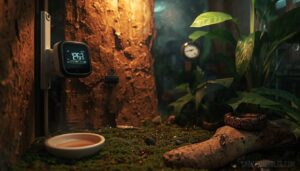
Where you mount your humidity sensor matters as much as which one you buy. Fix it at the tank’s midline wall mount, using an accessible calibration bracket — at least 3 inches above the substrate surface clearance zone, away from misting nozzles and humid hides.
Near water feature areas need their own dedicated humidity gauge.
Bad placement turns accurate digital hygrometer readings into meaningless numbers.
Checking Multiple Enclosure Zones

One sensor won’t cut it when your enclosure has distinct humidity gradients across zones. Zone-specific control means running separate digital hygrometers in each microclimate area for independent humidity monitoring.
- Label each zone clearly for cross zone airflow tracking
- Set alert threshold settings per zone, not globally
- Use data logging practices over a 30-day rolling window
- Calibrate each zone sensor independently for accurate readings
Calibrating With a Salt Test

Your digital hygrometer is only as trustworthy as its last calibration.
For salt solution prep, dissolve table salt in distilled water until saturated, then place it in a small jar — that’s your calibration container setup. Leave your sensor inside for 6–8 hours. Use the offset calculation method to log any deviation.
Good calibration log practices, including temperature compensation strategy, keep your humidity monitoring dependable long-term.
Raise Moisture Safely

Getting humidity up doesn’t have to mean flooding your enclosure or guessing at what works.
There are a few simple, reliable methods that give you real control without overdoing it. Here’s what actually moves the needle.
Using Water Bowls to Boost Humidity
A simple water bowl is one of the most underrated tools for humidity control in your snake enclosure.
Get these three things right:
- Bowl Size — wider bowls increase evaporation rate more effectively than deep ones
- Bowl Placement — position on the cool side to slow evaporation and avoid hotspots
- Water Quality — fresh daily water prevents mineral buildup that disrupts moisture management
One bowl often isn’t enough — adjust your bowl count based on your hygrometer readings.
Light Misting Schedules
Misting works best as a rhythm, not a reflex. Morning mist timing gives surfaces time to dry before nighttime temperatures slow evaporation.
burst duration control short — a few seconds per zone, then wait and check your hygrometer. Sensor-based misting removes the guesswork. Adjust frequency adjustments seasonally; winter air indoors runs drier, so your seasonal mist cadence shifts naturally alongside it.
Humid Hides With Damp Sphagnum
A humid hide takes localized humidity control to another level. Pack a small hollow with damp sphagnum moss — wrung out just until it stops dripping — and you’ve built a humidity pocket that sits near 80% RH for days without soaking your whole enclosure.
- Hide Placement Optimization: Position it on the warm side to increase moisture activity
- Microclimate Buffering Effect: The moss dampens swings from fans or ceramic heaters nearby
- Humidity Pocket Benefits: Snakes actively seek it during pre-shed when skin needs the most support
- Moss Rehydration Techniques: Soak, wring, and replace every 1–2 weeks
- Moss Longevity Tips: Toss any moss showing sliminess or discoloration immediately
Moisture-retaining Substrates
Your substrate choice does most of the heavy lifting between misting sessions.
Coconut fiber (Eco Earth) and cypress mulch excel at Coconut Coir Retention — staying damp for hours after a light spray. Mix in sphagnum moss for Sphagnum Buffering that smooths out humidity spikes. Expanded Wood Fibers release moisture slowly over days.
For Air Porosity Management, avoid compaction — a 2–4 inch depth keeps things breathable, never waterlogged.
Live Plants and Water Features
Live plants pull double duty — they look great and quietly release moisture through transpiration, nudging ambient humidity up 2–4%.
Aquatic Plant Selection, hornwort and Java moss handle low light well and support Moss Moisture Retention on driftwood.
Water Feature Design spreads humidity evenly across the enclosure, creating natural microclimate zones your snake will actually use.
Control Excess Humidity

Too much humidity is just as problematic as too little. When moisture builds up past your snake’s ideal range, it opens the door to scale rot, mold, and respiratory infections.
Here’s how to bring it back under control.
Improving Ventilation and Airflow
Good ventilation is your first defense against humidity that creeps too high.
Proper air circulation works on a simple principle: intake placement low draws in cool, dense air, while exhaust height up top removes warm, moisture-heavy air through passive buoyancy vent design.
Variable speed fans let you fine-tune the air turnover rate, and smart ventilation design keeps airflow steady without blasting your snake directly.
Adding or Enlarging Mesh Vents
If your humidity keeps climbing, adding or enlarging mesh vents is often the fastest fix. A solid Vent Placement Strategy puts openings on opposite sides for Cross Ventilation Design — this pushes stale, moisture‑heavy air out efficiently.
For Mesh Material Selection, corrosion-resistant stainless steel screen mesh holds up long term.
Your Vent Size Calculation should target at least 40% open ventilation area, and stick to a monthly Vent Maintenance Schedule to keep airflow clear.
Using Ceramic Heat Emitters
Dropping in a ceramic heat emitter is one of the smartest moves for dialing back excess moisture. Unlike bulbs, these deliver UV-Free Warmth through Infrared Heat Benefits — pure, steady heat that quietly evaporates surface dampness without stressing your snake.
- Pair with a thermostat for precise Thermostat Integration
- Follow Mounting Safety Guidelines — keep emitters 12+ inches from substrate
- Choose wattage wisely for Energy Consumption Efficiency (60W–150W range)
- Works alongside your misting system without interference
- Helps balance ventilation airflow without drying the enclosure completely
Preventing Condensation and Mold
Condensation usually tells you there’s a cool spot meeting humid air — and that combo is mold’s welcome mat.
Seal gaps with Sealant Application along lid edges, add Glass Insulation panels to prevent cold-wall drips, and use Humidity Buffer Materials like cork bark to absorb excess moisture.
Watch for Mold Detection Indicators: musty odors, gray fuzz, or slick surfaces.
| Problem | Cause | Fix |
|---|---|---|
| Glass condensation | Cool Spot Elimination needed | Insulate side panels |
| Corner mold | Poor ventilation airflow | Open or add mesh vents |
| Hide dampness | Humidity gradients too flat | Reposition humidifier output |
Avoiding Soggy Substrate
Soggy substrate sneaks up on you — one extra misting session, and suddenly you’ve got scale rot risk and mold prevention problems stacking up fast.
A Layered Substrate Design fixes this: drier top layer, damp base, with a Drainage Base Structure underneath to manage Water Flow Paths through Capillary Action.
Match your Particle Size Mix to your moisture-retaining substrate, keep proper air circulation going, and humidity gradients stay balanced without the swamp.
Maintain Stable Humidity Long Term

Getting humidity right once is a win — keeping it right is the real goal. Long-term stability comes down to a few consistent habits and knowing what warning signs to watch for.
Here’s what to focus on.
Daily and Weekly Humidity Checks
Think of your humidity log as a snapshot of your snake’s environment over time. Check readings morning, afternoon, and evening — that’s your log timing baseline.
Monitoring humidity with digital hygrometers makes this easy, but watch for sensor drift; regular calibration of humidity sensors keeps data honest. Track weekly trends for pattern recognition, set alert thresholds around 10% deviation, and back up your data monthly.
Seasonal Humidity Adjustments
Your snake’s world shifts with the seasons — and your setup should too. A Seasonal Baseline Review every month keeps your humidity range dialed in as outdoor conditions change.
- Winter Dry Strategies: Ramp up misting and humidification when indoor heating strips moisture.
- Monsoon Season Adjustments: Boost ventilation and airflow strategies to shed excess moisture buildup.
- Seasonal Sensor Calibration: Recalibrate hygrometers each season to keep humidity monitoring trustworthy.
Seasonal Ventilation Tuning and consistent moisture balance protect your snake year-round.
Preventing Respiratory and Skin Problems
Seasonal adjustments keep humidity stable, but prevention goes deeper than numbers.
Respiratory infections and skin infections often trace back to overlooked basics: a dirty, clean water bowl, wet low‑ammonia bedding sitting too long, or residue‑free cleaning done halfway.
Spot cleaning routine up, run your humidifier on a schedule, add air filtration if airflow feels stagnant, and mold prevention practically manages itself.
Spotting Scale Rot and Fungal Growth
Even with a solid prevention routine, problems can still sneak up on you. Scale rot usually announces itself through belly scale discoloration — look for brownish or reddish edges along the underside where your snake contacts the substrate. From there, swelling blisters and ulcers can develop quickly.
Watch for these warning signs:
- Raised or fluid-filled scales along the belly contact zone
- Fuzzy matting spreading across décor or substrate surfaces
- Persistent condensation that returns quickly after wiping the glass
- Moldy substrate with a musty, anaerobic odor
Monitoring humidity with digital hygrometers catches imbalances before fungal growth or scale rot takes hold — preventing bacterial and fungal growth is far easier than treating it.
Keeping Moisture Levels Consistent
Catching problems early is half the battle — fixing them consistently is the other half. Combine sensor redundancy strategies (two digital hygrometers at different zones) with data logging trends to spot drift before it becomes a crisis.
Automated humidity controllers take the guesswork out daily.
Microclimate mapping, humidity buffer materials like coco coir, and smart misting techniques keep your moisture-retaining substrate working reliably long-term.
Frequently Asked Questions (FAQs)
How much humidity does a snake enclosure need?
Not every snake needs the same amount of moisture.
Species-specific humidity requirements vary widely — desert species thrive at 20–40%, temperate snakes need 50–70%, and tropical species require 80–90% for proper thermoregulation balance and immune health.
How do you keep snakes moist?
Keep a water bowl on the warm side, mist lightly once or twice daily, and use a moisture-retaining substrate like coconut fiber.
A humid hide gives your snake a damp retreat whenever it needs one.
How do I make my snake enclosure humid?
right environment doesn’t happen by accident — it’s built."
Start with a moisture-retaining substrate, add a humid hide, and use a digital hygrometer to confirm levels are where they need to be.
What happens if a snake enclosure humidity drops too low?
Drop the humidity too low, and you’re inviting real trouble — dysecdysis risk climbs fast, respiratory infections follow, and dehydration effects hit harder than most keepers expect.
Behavioral stress and feeding decline aren’t far behind.
How to maintain humidity in a snake enclosure?
Too much moisture rots scales. Too little cracks sheds.
Nail humidity control by pairing a misting system with substrate moisture retention, solid enclosure seal integrity, and smart ventilation — your snake stays healthy either way.
Is 40% humidity too low for sleeping?
For humans, 40% humidity sits right at the lower comfort boundary. Below that, dry throat irritation and skin dehydration creep in, quietly disrupting sleep quality.
Staying near 40–60% promotes respiratory comfort overnight.
What are signs of too much humidity for pythons?
Watch for pink belly, scale rot, glass fogging, musty smell, persistent dampness, mold growth, or open mouth breathing. These signal bacterial growth, respiratory infections, and shedding problems fast.
Can tap water cause fogger nozzle clogs?
Yes — tap water is basically a slow-acting saboteur. Mineral scaling and sediment blockage gradually choke fogger nozzles.
Filter strainer maintenance helps, but switching to distilled water eliminates mineral buildup entirely and keeps output consistent.
Do humidity needs change during brumation?
During brumation, humidity needs do shift. Brumation RH Trends lean moderate — usually 40–60% — balancing hydration buffering against mold risk.
Temperature‑humidity coupling matters here: cooler temps naturally raise moisture, so monitor daily.
How does enclosure size affect humidity stability?
A larger enclosure behaves like an open warehouse — harder to humidity-control evenly.
Volume Driven air mass slows RH shifts, while Stratification Effects and Air Exchange Scaling create humidity fluctuations that demand Microclimate Zoning across your enclosure design.
Conclusion
Maintaining moisture in a snake enclosure sounds complicated until you realize it’s just a few consistent habits. You don’t need expensive equipment or perfect conditions every single day—you need a reliable hygrometer, the right substrate, and a routine you’ll actually stick to.
Your snake’s body tells you when something’s off. Stuck shed, dull scales, labored breathing—these are the signals.
Get the humidity right, and most of those problems quietly disappear.
- https://pubs.acs.org/doi/10.1021/acs.analchem.4c02871
- https://petsqtr.com/blogs/news/dealing-with-shedding-season-in-qatar-brushes-shampoos-and-solutions-from-petsqtr
- https://linkinghub.elsevier.com/retrieve/pii/S0169433217325163
- https://extension.umaine.edu/ipm/ipddl/publications/5103e/
- https://www.petmojo.com/scale-rot-in-reptiles-how-to-identify-and-treat-it/