This site is supported by our readers. We may earn a commission, at no cost to you, if you purchase through links.

Most snake health problems trace back to one invisible culprit: the wrong humidity. ball python stuck in a bad shed, scales that look dull and lifeless, respiratory infections that seem to come out of nowhere—humidity is almost always hiding somewhere in the story.
Snake terrarium moisture levels aren’t complicated to manage, but they do require a system.
Get it right, and your snake thrives with clean sheds, strong feeding responses, and noticeably better energy.
This guide walks you through species-specific targets, accurate measurement, and practical tools to keep moisture dialed in through every season.
Table Of Contents
- Key Takeaways
- Ideal Moisture Levels by Species
- Measure Humidity Accurately
- Increase Moisture Safely
- Reduce Excess Humidity
- Maintain Stable Tank Moisture
- Frequently Asked Questions (FAQs)
- How much humidity should be in a snake enclosure?
- How much condensation is too much in a terrarium?
- Is 40 humidity too low for ball python?
- Can tap water cause mineral buildup in foggers?
- Does tank size affect how humidity stabilizes?
- How does feeding frequency impact moisture needs?
- Should humidity differ between day and night cycles?
- Conclusion
Key Takeaways
- Each snake species needs a different humidity range — ball pythons thrive at 60–80%, corn snakes at 40–60%, and desert species stay healthiest between 20–40%.
- A calibrated digital hygrometer placed at mid-wall height gives you reliable readings; without accurate data, even a perfect setup can quietly fail your snake.
- Coconut coir, cypress mulch, and sphagnum moss hold moisture far better than standard substrates, making them your best tools for hitting and holding your target humidity.
- Humidity swings of more than 15% in a single day stress your snake before symptoms appear — humidistats, sealed enclosure gaps, and seasonal misting adjustments keep levels stable year‑round.
A blended substrate like coconut fiber, cypress mulch, and sphagnum moss helps maintain these ranges more steadily, and this guide to fixing snake tank humidity swings breaks down why levels dip and spike in the first place.
Ideal Moisture Levels by Species

Not every snake needs the same air around it — moisture levels vary quite a bit from species to species. Getting that range right is honestly one of the most important things you can do for your snake’s health.
A good starting point is checking a snake humidity and environment guide to match your specific species to the conditions it actually needs.
Here’s a breakdown of what each type actually needs.
Ball Python Humidity Range
Ball pythons are surprisingly forgiving — until humidity slips out of range. Keep your baseline between 60–65% for healthy adults. Bump it to 70–80% during shedding cycles.
Here’s your stage-specific RH cheat sheet:
- Hatchlings — 60–65% baseline, humid hide essential
- Juveniles — 65–75% for skin elasticity
- Adults — steady 60%, microclimate zoning helps
- Shedding — 70–80%, substrate moisture retention is key
- Post-shed — return to baseline within 48 hours
The care sheet advises an ambient humidity range of 40–60% for healthy ball pythons.
Corn Snake Humidity Range
Corn snakes are a bit more laid-back than ball pythons regarding moisture. Their sweet spot sits at 40–60% humidity — think of it as the Goldilocks zone for health indicators like clean sheds and clear eyes.
digital hygrometer helps you track that temperature-humidity balance daily. Microclimate zones, substrate moisture retention, and light misting system uses keep things stable without overshooting.
Desert Snake Humidity Needs
Desert snakes flip the script entirely. Rosy boas and sand boas need low humidity — around 20–40% — so dry zone creation is your priority, not moisture-adding.
Skip the automated fogger use here; it’ll cause more harm than good.
Watch for low RH signs like rough sheds, then offer a small humidity pocket placement inside a hide for that brief desert shedding cycle only.
Hatchling and Shedding Adjustments
Hatchlings are a different story — think of them as humidity-sensitive newcomers.
First Shed Timing generally lands 7–14 days after hatching, so keep ambient RH at 65–70% from day one. Shedding Frequency runs every 1–3 weeks during rapid growth.
Watch Eye Cap Observation closely.
For Retained Skin Management, skip pulling — Gentle Soaking works better.
A humid hide and substrate that retains moisture does the heavy lifting.
For more on keeping shedding smooth and skin intact, scaleless snake care tips and husbandry guidance covers the finer details that make a real difference.
Measure Humidity Accurately
Knowing your snake’s ideal humidity range is only half the battle — you also need to know if you’re actually hitting it. Bad reading can throw off everything, even if your setup looks fine.
Here’s what you need to get accurate, reliable humidity data in your enclosure.
Choosing a Digital Hygrometer
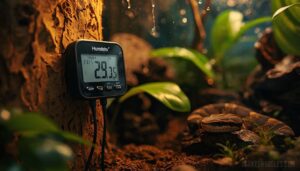
Not all hygrometers are created equal — and your snake’s health depends on picking a solid one.
Look for digital hygrometer models with capacitive sensors; they offer sensor accuracy within ±2% RH.
Good display readability matters too, especially in dim corners.
Consider power options like USB or battery, plus connectivity features for app-based humidity monitoring.
A solid durability rating seals the deal.
Best Sensor Placement

Even the best digital hygrometer gives bad data if it’s in the wrong spot. For accurate humidity monitoring, follow these sensor placement rules:
- Mount at mid-wall height, in the central airflow zone — never near corners.
- Use a vertical gradient pair: one sensor warm-side, one cool-side.
- Practice hide proximity avoidance, and use an easy access mount for quick checks.
Calibrating With a Salt Test

Once your sensors are in position, you’ll want to trust what they’re telling you — and that’s where the salt test method earns its keep.
| Step | Action | Detail |
|---|---|---|
| 1 | Saturated solution preparation | Mix table salt and distilled water in a small dish. |
| 2 | Container sealing technique | Seal hygrometer inside airtight container. |
| 3 | Equilibrium time guidelines | Wait 6–12 hours for stable 75% RH reading. |
Temperature impact matters — keep it room temp. Calculate your calibration offset by subtracting your digital hygrometer’s reading from 75%. Apply that offset to all future humidity monitoring.
Tracking Readings Daily

Think of your humidity log as a weather journal for your snake’s little world. Check readings in morning and evening — that’s your Log Timing Consistency in action.
Use Dual Sensor Verification by cross-checking two digital hygrometers placed in different zones. Run a Rolling Average Calculation over seven days, set Alert Threshold Settings for dips below 40%, and keep a Cloud Backup Routine so your data logging never disappears.
Increase Moisture Safely

Boosting moisture in your snake’s enclosure doesn’t have to mean guesswork. There are a handful of reliable methods that actually work together, so you’re not just throwing water at the problem.
Here’s what to use and how to set it up right.
Moisture-retaining Substrate Choices
Your substrate is basically the foundation of your humidity game.
Coconut Coir (coconut fiber) holds 8–10 times its weight in water — that’s serious staying power.
Cypress mulch and a Peat Moss Mix also work great as moisture-retaining substrates.
Tuck in some Sphagnum Moss inside hides for a cozy 80% RH microclimate.
Forest Mulch and Bioactive Retainers round out your options beautifully.
Substrate Depth for Humidity
Depth matters more than most keepers realize. Think of it like a sponge — a thicker layer means more moisture retention between sessions. The Depth Gradient Impact is real: deeper substrate keeps humidity stable longer.
- Start at 5 cm for hatchlings, increase to 6–7 cm for adults
- Coconut fiber and coir excel at substrate moisture storage — but fluff regularly for Compaction Prevention
- Burrowing Species Needs call for deeper layers to maintain consistent humidity as they tunnel
- Use Layered Substrate Design with a Moisture Barrier Use on top — drier surface, damp bottom — for balanced humidity control
Misting Schedules That Work
Once your substrate depth is sorted, misting becomes your daily fine-tuning tool. A solid misting schedule uses Morning Mist Timing — before lights kick on — so moisture lingers longer. Two short 10-second bursts daily work well for most setups.
| Schedule Element | Recommendation |
|---|---|
| Daily mist cycles | 2–3 times |
| Mist duration | 10 seconds each |
| Seasonal Frequency Adjustments | Increase in dry winter months |
| Mist Volume Calibration | 0.2–0.5 ml per sq cm |
Pair your misting system with Humidity Sensor Triggers and a digital hygrometer for hands‑free humidity control. Zone-specific Mist Delivery keeps moisture where it counts — hide and basking areas — without soaking everything. Your humidity monitoring devices will confirm you’re hitting that sweet spot every time.
Humid Hide Setup
Misting covers the whole tank, but a humid hide gives your snake its own personal spa. Pack it with sphagnum moss or coconut fiber — both are excellent Replaceable Substrate options that stay damp for days.
Keep the Entry Hole Size just big enough for your snake to squeeze through; that limits moisture escape naturally.
Position it for Temperature Gradient Balance, and line it with Anti-Mold Liners.
Your best Humidity Indicator? Your snake actually using it.
Water Bowl Placement Tips
Your water bowl does double duty — hydration station and passive humidity booster. Placement matters more than you’d think.
- Corner vs Center: corners keep spillage away from traffic zones.
- Height Alignment with the substrate keeps access easy and stress‑free.
- Non‑slip Base plus Material Weight (ceramic wins) prevents tipping.
large, shallow bowl covering 10–15% of floor space quietly raises ambient humidity without needing your mist system running constantly.
Reduce Excess Humidity

Too much moisture in your snake’s enclosure is just as problematic as too little.
The good news is that few targeted fixes can bring those levels back down quickly. Here’s actually works.
Improve Enclosure Ventilation
Good ventilation is basically your tank’s built-in humidity exhaust system. Place low intake vents opposite high exhaust openings — that’s your Cross Ventilation Layout working with natural convection.
Low Noise Fans keep airflow steady without stress.
Adjustable Vent Grills let you fine-tune airflow dynamics on the fly.
Positive Pressure Flow pushes stale, moist air out before it builds up.
| Fan Placement Strategies | Effect |
|---|---|
| Low intake, high exhaust | Drives convection naturally |
| Opposite-wall vent pairs | Maximizes cross ventilation |
| Adjustable vent grills | Fine-tunes airflow dynamics |
| Push-pull fan setup | Boosts ventilation design efficiency |
| Low noise fans near hides | Reduces stress, maintains flow |
Control Condensation on Glass
Condensation buildup on glass tells you moisture has nowhere to go. Three fixes cut it fast:
- Seal frame gaps with silicone sealant — Glass Edge Sealing blocks moisture migration through cracks.
- Apply a Hydrophobic Surface Treatment so water beads and rolls off instead of filming.
- Airflow Balance using ventilation strategies for ideal airflow to keep Dew Point Monitoring accurate.
Use Dry Heat Sources
Heat is one of your best tools for pulling moisture out of the air. Ceramic heat emitters are a great starting point — ceramic heater placement on the warm side creates natural temperature gradients that drive evaporation without adding moisture.
Infrared zone control lets you target specific areas, while following coil safety guidelines keeps everything running safely.
Smart heat source integration and power usage optimization mean your heat lamp works smarter, not harder.
Spotting Mold and Musty Odors
Your nose is your first alarm system. A musty odor detection moment — that earthy, damp smell — often means mold growth is already happening somewhere hidden.
Check porous material testing zones, like wood decor and substrate corners first. Look for dark or light fuzzy patches as mold visual cues.
Run airflow odor mapping by sniffing near vents and cool glass edges, where vapor barrier checks matter most.
Maintain Stable Tank Moisture

Getting humidity right once is great — keeping it right is the real win. Consistency is what separates a thriving snake from one that’s always one shed away from trouble.
Hitting the right humidity once is easy — keeping it there is what truly makes a snake thrive
Here’s what actually works for long-term moisture control.
Seasonal Humidity Adjustments
Your snake’s enclosure doesn’t live in a bubble — seasons shift everything. Winter Moisture Management means bumping misting frequency, as indoor heating dries the air. Summer Humidity Boost calls for extra ventilation. Track it all through Seasonal Humidity Logging, so patterns become obvious fast.
Nail your seasonal adjustments with these steps:
- Raise misting in winter to counter dry heating air
- Increase airflow during humid summer months
- Support the Spring Shedding Cycle with a brief humidity spike to 60%
- Begin the Fall Humidity Reduction by scaling back water bowl exposure
- Log daily readings to spot seasonal drift before it causes problems
Using Humidistats and Timers
Think of a humidistat as enclosure’s autopilot. It senses moisture and triggers your misting system automation before levels drift.
Pair it with a timer — just confirm the Timer Power Ratings match your gear. Nail your Hysteresis Settings to prevent constant cycling.
| Feature | Humidistat | Timer |
|---|---|---|
| Trigger | Humidity level | Schedule |
| Hysteresis | Yes | No |
| Best For | Precision control | Routine misting |
Smart Home Integration and automated humidity alert systems take it further — your phone gets pinged instantly.
Preventing Humidity Swings
Humidity swings — when levels shift more than 15% in a single day — quietly stress your snake before you even notice. That’s why Temperature Humidity Sync matters: keeping nighttime temps within 2–4°C of daytime values prevents dew point surprises.
Seal Enclosure Gaps to block outdoor air infiltration, build in Balanced Airflow Design for steady ventilation, and set Automated Alerts so humidity fluctuations never catch you off guard.
Cleaning Routines for Long-term Control
Stable humidity starts with a clean tank — full stop. Grime, old substrate, and biofilm throw your readings off quickly.
- Weekly Bowl Sanitization keeps bacterial growth and algae from spiking moisture unpredictably
- Surface Wipe Protocol removes condensation daily before mold gets a foothold
- Substrate Rotation Schedule: full swap every 4–6 weeks prevents compacted, moisture-trapping waste
- Equipment Disinfection Cycle covers probes, hides, and heaters every two weeks
- Mold Inspection Checklist: check for musty smells or visible spots after every misting session
Common Humidity Mistakes
Even with a spotless tank, small habits can quietly wreck your humidity game. Here are the common mistakes in snake humidity control to watch for:
| Mistake | Why It Hurts |
|---|---|
| Over‑Misting Frequency | Waterlogged air triggers respiratory issues |
| Saturated Substrate Mistake | Soggy bedding breeds bacteria fast |
| Unventilated Humid Hide | Traps excess moisture against skin |
| Inaccurate Sensor Readings | Bad data leads to wrong fixes |
| Ignoring Microclimate Zones | One reading misses the full picture |
Frequently Asked Questions (FAQs)
How much humidity should be in a snake enclosure?
Like Goldilocks, your snake needs it just right.
Ball pons want 60–80% relative humidity. Corn snakes** prefer 40–60%. Desert species stay healthy at 20–40%.
Get this wrong, and shedding indicators and respiratory risks appear fast.
How much condensation is too much in a terrarium?
A little condensation is fine — think light morning dew. But if your glass stays fogged all day, that’s your mold development warning.
Persistent surface moisture indicators mean ventilation strategies and substrate moisture balance need immediate attention.
Is 40 humidity too low for ball python?
Yes, 40% humidity is too low for a ball python. It raises the risk of dehydration symptoms, eye cap retention, and skin shedding failure.
Target 60–80% to avoid respiratory problems and scale rot.
Can tap water cause mineral buildup in foggers?
Tap water is basically liquid sandpaper for fogger nozzles. Minerals like calcium and magnesium build up fast, causing Fogger Nozzle Clogging and uneven mist.
Use distilled water to avoid mineral buildup in misting heads entirely.
Does tank size affect how humidity stabilizes?
Absolutely — tank size shapes how humidity stabilizes through the Volume Buffering Effect.
Larger enclosures support Microclimate Zoning and varied Surface Evaporation Rates, while Air Circulation Patterns and Heat Source Interaction determine the humidity gradient across tank zones.
How does feeding frequency impact moisture needs?
Feeding frequency quietly shapes humidity levels. Each meal releases prey water content and metabolic heat, spiking moisture briefly.
More frequent feedings mean more humidity spikes, so watch substrate moisture and adjust your feeding schedule accordingly.
Should humidity differ between day and night cycles?
A slight day-night RH gradient is completely normal. Cooler nights naturally push humidity up by 5–10%.
For most species, that Circadian Humidity Cycle works in your favor — no extra misting needed after dark.
Conclusion
Like Goldilocks searching for just right, your snake needs that same precision—not too wet, not too dry. Mastering snake terrarium moisture levels is the difference between a thriving animal and a sick one.
You now have the tools: accurate readings, smart substrates, seasonal adjustments, and a cleaning rhythm that holds everything together. Trust the system you’ve built.
When humidity stays dialed in, your snake does exactly what it’s supposed to—live well.
- https://developers.cloudflare.com/support/troubleshooting/http-status-codes/cloudflare-5xx-errors/error-522/
- https://www.cloudflare.com/5xx-error-landing?utm_source=errorcode_522&utm_campaign=pet-health-advisor.com
- https://www.airpf.com/mold-infestation-signs-what-does-mold-in-the-house-smell-like/
- https://en.air-q.com/blog/muffiger-geruch-in-der-wohnung-ohne-sichtbaren-schimmel-das-sollten-sie-jetzt-tun
- https://www.epa.gov/mold/mold-course-chapter-3