This site is supported by our readers. We may earn a commission, at no cost to you, if you purchase through links.

A snake that can’t find the right moisture level will tell you—through stuck shed, cloudy eyes, or scales that look a little too tight.
Most keepers chase a single humidity number, dialing in 60% or 70% and calling it done.
But that’s not how a wild environment works, and it’s not what your snake actually needs.
A humidity gradient in a terrarium creates two distinct zones—one damp, one dry—so your snake can move between them on its own terms.
Understanding how to build and maintain that gradient changes everything about how you manage your enclosure.
Table Of Contents
- Key Takeaways
- What a Humidity Gradient Means
- Why Snakes Need Humidity Zones
- How to Build The Gradient
- How to Measure and Adjust It
- Problems Caused by Poor Gradients
- Frequently Asked Questions (FAQs)
- Is 40 humidity too low for ball python?
- How to make a moisture gradient for isopods?
- Is 70% humidity too high for plants?
- Can plants and snakes share the same terrarium?
- How does terrarium size affect gradient consistency?
- Which substrate materials work best for moisture retention?
- Does ambient room humidity impact the internal gradient?
- How do seasonal temperature changes affect humidity zones?
- Conclusion
Key Takeaways
- A humidity gradient—not a single fixed percentage—gives your snake distinct wet and dry zones to move between, which is what actually supports healthy shedding and hydration.
- Place your water bowl on the humid side, layer coco coir and peat 2–4 inches deep, and pack a humid hide with sphagnum moss to anchor the moist zone without soaking the whole enclosure.
- Two hygrometers beat one every time—place them at opposite ends to catch gradient drift, false readings near heat sources, and humidity spikes before they stress your animal.
- A flat gradient usually traces back to a centered water dish, uniform substrate, or over-ventilating both sides equally—fix one of those first before overhauling the whole setup.
What a Humidity Gradient Means

A humidity gradient isn’t just a fancy term — it’s the difference between a terrarium that works and one that stresses your animals.
Getting this right matters more than most keepers realize — here’s a practical guide to setting up the perfect snake enclosure humidity gradient that keeps your animal comfortable year-round.
Instead of one flat humidity level throughout the enclosure, a gradient gives you distinct wet and dry zones that serve different purposes.
Here’s what actually means and why it matters.
Definition of a Humidity Gradient
humidity gradient is a deliberate moisture range built into your terrarium — wet on one side, drier on the other. It’s not guesswork; it’s controlled spatial vapor distribution that mirrors what snakes experience in nature. Implementing a humidity set point control can improve energy savings potential.
- Humidity differential metric: the measurable gap between your wet and dry zones
- Microclimate creation through substrate, décor, and airflow placement
- Gradient stability factors include enclosure size and ventilation balance
- Moisture gradient concept facilitates self-regulation and healthy shedding
Difference Between Overall Humidity and Localized Moisture
Your hygrometer gives you one number — but that’s ambient humidity, the average across the entire air space. Localized moisture is different. It’s what’s actually happening near your water bowl, inside a hide, or under moist sphagnum.
Spatial variation means those zones can swing 20–30% apart. Temp‑humidity coupling sharpens that gap further, since warmer spots evaporate faster and push dew point thresholds earlier.
| Factor | Ambient Humidity | Localized Moisture |
|---|---|---|
| Measurement | Single average reading | Zone-specific reading |
| Source Impact | Whole enclosure | Water bowl, moss, hides |
| Spatial Variation | Low | High |
How Wet and Dry Zones Form Inside a Terrarium
Wet and dry zones don’t appear by accident — they’re driven by where you place moisture sources and how air moves through the space.
Capillary action pulls water upward through substrate, while light-induced evaporation and thermal gradient effects accelerate drying near warm spots.
Enclosure geometry, ventilation design, and humidity buffer materials like sphagnum all shape where microclimates settle, giving your substrate moisture retention real staying power across distinct humidity zones.
Why Gradients Are More Useful Than Uniform Humidity
A fixed humidity level forces every inch of your enclosure to serve one purpose. A moisture gradient does something smarter — it gives your snake options.
- Microclimate diversity lets snakes self-regulate hydration without intervention
- Species coexistence becomes possible when humidity zones suit different needs
- Mold prevention improves because ventilation design keeps drier areas from stagnating
- Behavioral thermoregulation stays natural when snakes move freely across the microclimate
Why Snakes Need Humidity Zones
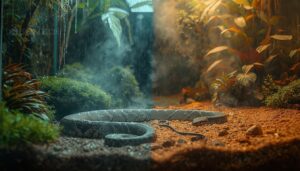
Snakes don’t just tolerate humidity — they depend on it in ways that go deeper than most keepers expect. Getting it right means understanding a few key reasons why zones matter, not just for comfort, but for their actual health and survival.
Here’s what drives that need.
Supporting Hydration and Healthy Shedding
Snakes absorb moisture through damp surfaces and wet substrates — and humidity zones make that possible without keeping the whole enclosure soggy. Proper microclimate control helps mucous membrane care, hydration, and shedding frequency monitoring.
Tracking water bowl conditions alongside humidity readings ties directly into ball python water bowl size and hygiene best practices, since bowl placement and capacity affect both substrate moisture and contamination risk.
A mist schedule and water quality management keep the humid side effective.
Skin moisture supplements and soil moisture monitoring fill the gaps, giving your snake exactly what it needs to shed cleanly.
Helping Snakes Self-regulate by Moving Between Zones
Unlike passive systems, a well-built moisture gradient lets your snake make decisions. Through behavioral thermoregulation and microhabitat exploration, they self-select exactly what they need:
- Pre-shed hydration runs toward wet-dry zones
- Zone preference testing after feeding to aid digestion
- Stress reduction strategies through enrichment via movement
- Microclimate control via daily position shifts
- Humidity control techniques through instinct-driven exploration
Benefits for Respiratory Comfort and Skin Health
A well-managed humidity gradient does more than help shedding — it actively promotes airway moisture and skin barrier hydration on a daily basis. When your snake rests in a microclimate with steady humidity, mucous membrane protection stays consistent, reducing respiratory irritation-prevention challenges from dry air spikes.
Better air circulation and ventilation also lower reduced shedding friction, keeping skin supple between cycles.
Why Species and Life Stage Affect Humidity Needs
Not every snake lives by the same rulebook. A hatchling moisture environment demands 75–90% humidity to support rapid shedding cycles, while adults prioritize stable mid-range conditions for healthy adult respiration. Reproductive females need periodic humidity increases for reproductive incubation success.
- Tropical arboreal species rely on arboreal microclimate pockets near canopy-level branches
- Desert juveniles thrive with 20–40% seasonal shedding humidity
- Ground dwellers need moist substrate without saturating sleeping areas
Role of Humid Hides Within The Gradient
Think of a humid hide as your terrarium’s moisture reservoir — a dedicated zone that holds humidity steady while the rest of the enclosure stays drier. Placed on the humid side, packed with sphagnum moss, it provides gradient stabilization and gives snakes a clear behavioral moisture cue.
That self-regulation shapes natural hydration cycles without misting the entire space.
How to Build The Gradient
Building a humidity gradient isn’t complicated, but every choice you make inside the enclosure works together. The placement of water, substrate, décor, and ventilation all pull in the same direction.
Here’s how to set each piece up so your gradient holds.
Placing The Water Bowl on The Humid Side
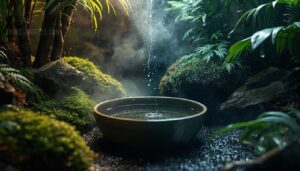
Your water bowl does more than hydrate your snake — it actively shapes the humidity gradient. Place it on the humid side to increase evaporation rate and support a stable microclimate.
Keep it away from direct heat sources to avoid humidity spikes, and maintain bowl stability on a firm substrate.
This single choice anchors your humidity zones and drives consistent condensation patterns where you need them most.
Using Substrate Depth to Hold Moisture
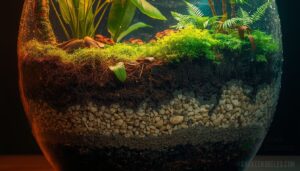
Substrate depth is your humidity gradient’s hidden engine. Porosity layering — coarse LECA at the bottom, fine coco coir and peat on top — creates a vertical moisture gradient that feeds the humid zone steadily.
- Target 2–4 inches for the humid layer
- Mixed substrate ratios of 60% coco coir, 40% peat boost water retention in substrate
- Capillary depth effects pull moisture upward during dry spells
- Reservoir thickness optimization prevents waterlogging while sustaining soil moisture retention
Adding Moss, Leaf Litter, and Humid Hides
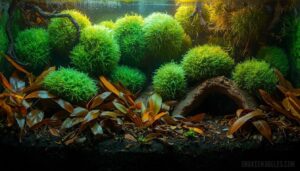
Once your substrate layers are set, moss and leaf litter do the finishing work. Sphagnum moss is the go-to for Moss Species Selection — it holds up to 20 times its weight in water, making Humid Hide Placement and microclimate creation reliable.
Layer 2–4 cm of leaf litter over damp moss for Litter Microbial Benefits and steady moisture gradient reinforcement across your humidity zones.
Managing Ventilation to Keep One Side Drier
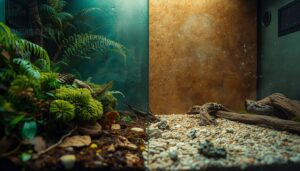
Moss and leaf litter build moisture on the humid side — now ventilation keeps the dry side actually dry. Position a small vent or intake on the dry side and exhaust openings on the humid side.
airflow timing and vent sizing setup moves moisture away before it equalizes.
quiet fan aids air circulation without drafts, locking in your moisture gradient.
Using Enclosure Layout, Décor, and Airflow Direction
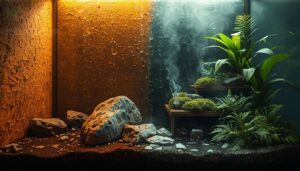
Layout does more than organize — it shapes your moisture gradient. Use Airflow Channeling Shelves to create micro-corridors that guide air from humid to dry zones.
Tiered Hide Arrangement concentrates humidity near lower hides while keeping upper shelves drier.
Texture-Based Condensation Control with rough bark versus smooth rock influences where moisture lingers.
Zoned Light Positioning and Modular Partition Panels sharpen microclimate creation within enclosed containers naturally.
Matching Terrarium Size and Design to Gradient Stability
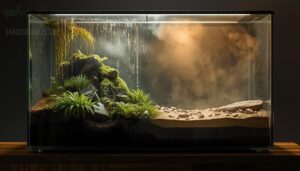
Tank size is the foundation most keepers overlook. A wider footprint ratio and a low aspect ratio give moist and dry air room to separate naturally — no fighting the physics. Pair that with smart vent placement and a barrier design that slows lateral moisture drift, and your layered substrate does the rest.
- Wider tanks allow gradual moisture diffusion, making humidity zones within terrariums far more stable
- Low-profile designs promote even airflow, reinforcing your moisture gradient without mechanical intervention
- Strategic vent placement at opposite ends sharpens microclimate creation within enclosed containers
How to Measure and Adjust It

Building the gradient is only half the job — keeping it dialed in is where consistency really matters. You’ll need the right tools in the right spots and a simple routine for making adjustments when things drift.
Here’s what to focus on.
Best Hygrometer Placement for Wet and Dry Zones
Place your digital hygrometer in the wet zone within 10–20 cm of the water source, mounted at mid-height on a vertical surface.
For the dry zone, corner mounting near entry points works well — just maintain substrate distance and avoid vent proximity to keep readings honest.
A shielded probe helps each sensor capture its true microclimate without picking up interference from neighboring zones.
Why Two Sensors Improve Accuracy
One sensor tells you a number. Two sensors tell you a story.
One sensor gives you a reading; two sensors give you the truth
Running dual digital hygrometers across your moisture gradient gives you redundant data validation, faster transient response after misting, and drift detection synergy when one unit starts reading off. Spatial microclimate mapping becomes genuinely reliable, and adaptive control weighting lets automated climate sensors make smarter decisions.
Here’s what dual humidity sensor calibration actually delivers:
- Cross-validation catches outlier readings before they trigger unnecessary misting
- Drift detection flags when one hygrometer diverges from its baseline
- Gradient mapping reveals microclimates a single sensor completely misses
- Faster response detects humidity spikes the moment they happen
- Control reliability reduces both under- and over-misting risk
How Often to Check Humidity Readings
Check your hygrometer at least once daily — that rhythm catches most humidity fluctuations before they stress your snake. Bump that to twice daily during seasonal changes, and every 4–6 hours for the first 48 hours after a substrate change.
| Situation | Check Frequency | Data Logging Interval |
|---|---|---|
| Stable setup | Once daily | Every 24 hours |
| Seasonal change | Twice daily | Every 12 hours |
| New substrate/gradient | Every 4–6 hours | Every 4–6 hours |
Maintain your sensor rotation cadence — shift placements every 1–2 weeks. Follow calibration frequency guidelines every 6 months to catch drift early.
When to Mist, Rewet Substrate, or Increase Airflow
Each adjustment has its own trigger. Morning mist timing works best right before peak evaporation — mist frequency schedule should stay at 1–2 sessions daily for new setups.
Watch for the substrate dryness cue: when soil moisture fades to a faint sheen, rewet the edges, not the center. Hit your airflow threshold level when the dry zone gets too humid.
Preventing False Readings Near Heat or Water Sources
Your hygrometer lies when it’s too close to heat or water. Keep a 15 cm distance buffer between sensors and any thermostat-controlled heat source, using thermal spacers to decouple housings from warm walls. Moisture barriers behind sensors block direct spray drift.
Dual validation — two sensors cross-checked within 5% — catches humidity spikes before they mislead you. Shielding techniques and smart placement make temperature and humidity interaction readings reliable.
Tracking Seasonal Changes Inside The Enclosure
Seasonal humidity trends don’t stay predictable — winter heating dries indoor air, while summer raises ambient moisture. Track these seasonal temperature shifts by logging daily readings from your digital monitoring devices over several weeks.
Substrate moisture variability follows these cycles too, so photoperiod adjustments and data logging practices help you spot drift early.
Consistent records make seasonal humidity management in terrariums genuinely straightforward.
Problems Caused by Poor Gradients
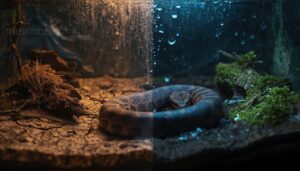
When the humidity gradient breaks down, your snake pays the price before you even notice something’s wrong. A setup that’s too dry and one that’s too wet cause completely different problems, but both are avoidable once you know what to look for.
Here are the most common signs and mistakes that throw the balance off.
Signs The Terrarium is Too Dry
Low humidity doesn’t whisper — it shouts. Dry substrate crumble is your first clue: soil that turns pale, powdery, and breaks apart at a touch has lost its moisture retention.
Wilting leaf tips, leaf browning, and moss discoloration follow fast.
With snakes, watch for mouth gaping and dull, scaly skin.
No glass condensation after misting? That confirms it — conditions are critically dry.
Signs The Terrarium is Too Damp
Too much moisture is just as dangerous as too little. Foggy glass that won’t clear hours after misting, moldy substrate with a musty smell, swollen wood warping along the edges — these aren’t minor quirks. They signal excessive humidity running unchecked.
Getting the balance right matters more than most keepers realize, and corn snake humidity requirements at home break down exactly which ranges protect your snake without tipping into the danger zone.
If your enclosure is also showing these warning signs alongside respiratory symptoms, the snake wheezing causes and treatment guide walks through the humidity-linked steps you should take right away.
Before making any adjustments, it helps to understand the full picture — a solid guide to raising and balancing enclosure humidity levels can help you recognize where things went wrong before they spiral.
Watch for:
- Waterlogged substrate that stays dark and soggy
- Stunted plant growth with yellowing, translucent leaves
- Respiratory distress in your snake — wheezing or open-mouth breathing at rest
Stuck Shed, Dehydration, and Scale Issues
Poor gradients hit hardest during pre-shed hydration, when your snake needs consistent skin moisture balance to loosen old layers. Heat-induced dryness on the basking side can sabotage that process even when water intake monitoring looks fine.
A dehydrated snake simply can’t generate enough internal fluid to shed cleanly. Uneven humidity zones also raise scale rot risk by trapping wet contact against skin without relief.
Condensation, Mold, and Stale Air
Condensation hotspot mapping reveals exactly where your gradient is breaking down. When warm, moist air hits cooler glass near your water bowl or heat source, temperature-driven condensation pools fast — and that damp surface becomes prime real estate for mold growth.
Without proper air circulation through ventilation holes, stale air detection becomes nearly impossible. Creating humidity zones within terrariums only works when routine surface sanitization and mold prevention strategies keep conditions reset.
Common Setup Mistakes That Flatten The Gradient
Most gradient problems trace back to a handful of predictable setup errors.
- A central water dish spreads evaporation evenly, erasing microclimates before they form.
- A uniform substrate layer eliminates the moisture pockets that anchor your humid side.
- Overventilation across sides strips both zones equally, balancing condensation and airflow in the wrong direction.
- Airflow obstruction décor and misaligned humidity hide, flattening the differential you worked to build.
Quick Fixes for Restoring Balance
When balance slips, small targeted changes fix it faster than a full redesign. Start on the humid side, then work outward.
| Problem | Quick Fix |
|---|---|
| Too dry overall | Add pebble tray or humidity tray beneath humid side |
| Too wet overall | Adjust fan timing to peak daytime hours |
| Flat gradient | Seal gaps on humid side, open dry-side vents |
| Mold forming | Reduce misting frequency, improve ventilation |
| Uneven moisture | Switch to targeted watering with a mist sprayer |
Frequently Asked Questions (FAQs)
Is 40 humidity too low for ball python?
Yes, 40% humidity is too low for a ball python. The ideal humidity range guidelines sit at 55–70%, and dropping below that raises shedding complications, dehydration risk, and respiratory risk fast.
How to make a moisture gradient for isopods?
Soak one side of the substrate thoroughly, leave the other lightly dry. Add moss on the wet end, leaf litter on the dry. That’s your gradient — simple and effective.
Is 70% humidity too high for plants?
At 70% humidity, most tropical plants thrive, but disease risk climbs fast without airflow. Stomatal conductance drops, slowing growth rate.
Susceptible species face mould, root rot, and leaf scorch if moisture stagnates.
Can plants and snakes share the same terrarium?
Absolutely — plants and snakes can share a terrarium. Stick to non-toxic species like pothos or sansevieria, quarantine new plants first, and anchor them securely so your snake can’t uproot them.
How does terrarium size affect gradient consistency?
Bigger tanks slow the Gradient Decay Speed, letting humidity zones within terrariums stay distinct longer.
Volume Humidity Ratio, Substrate Depth Scaling, and Airflow Path Length all determine how well microclimates hold against air circulation and ventilation pressure.
Which substrate materials work best for moisture retention?
Coco coir capacity wins here — it holds six to eight times its weight in water.
Pair it with a sphagnum moss layer, peat moss retention, and Seramis clay absorption for steady moisture balance.
Does ambient room humidity impact the internal gradient?
Yes, ambient humidity directly affects your internal gradient. Higher room moisture accelerates evaporation, expanding the humid zone, while dry air shrinks it.
Seasonal ambient shifts and airflow infiltration impact microclimate stability, so adjust ventilation and substrate moisture accordingly.
How do seasonal temperature changes affect humidity zones?
Seasons act like a dial turning up or down on evaporation rate shifts — warmer months pull more moisture from substrates, while cooler periods slow that release, tightening your condensation cycle variations and shifting zone boundaries.
Conclusion
The less you control snake’s environment, the more control it actually has over its own health—and that’s exactly the point.
A well-built humidity gradient in a terrarium doesn’t just hit a number; it builds a living range your snake can navigate on its own terms. Get the wet side moist, keep the dry side breathable, and place two sensors to confirm both.
Your snake will show you it’s working every time it sheds clean.
- https://www.awin1.com/cread.php?awinmid=10781&awinaffid=953569&platform=dl&ued=https%3A%2F%2Fwww.etsy.com%2Fau%2Fsearch%3Fq%3Dsphagnum%2Bmoss%2Bterrarium
- https://storageshedsoutlet.com/blog/keep-your-shed-dry-simple-solutions-that-actually-work/
- https://www.aquacareprogram.com/are-water-descalers-effective/