This site is supported by our readers. We may earn a commission, at no cost to you, if you purchase through links.
A reticulated python stretching past 15 feet can generate enough constriction force to fracture ribs—yet many keepers still reach into enclosures with hooks designed for garden snakes. The difference between a controlled interaction and a defensive strike often comes down to inches of hook length and the material carrying the load. Large constrictors aren’t inherently dangerous to handle, but they’re unforgiving of poor equipment choices.
Selecting and using the right snake handling hooks for large constrictors requires matching tool specifications to the snake’s actual size, weight, and behavioral state—then executing a deliberate, methodical approach every time.
Table Of Contents
- Key Takeaways
- Choose Proper Hook Size
- Check Strength and Materials
- Use Hooks Safely
- Step 1: Assess The Snake’s Posture First
- Step 2: Open The Enclosure Slowly
- Step 3: Use The Hook for Gentle Redirection
- Step 4: Support The Body With Hands or Help
- Step 5: Avoid Lifting Coiled Heavy Snakes
- Step 6: Keep Handling Sessions Short
- Never Hook a Snake Immediately After Feeding
- Use Gloves, Long Sleeves, and Eye Protection
- Top 6 Products to Compare
- Reduce Handling Stress
- Use Two Handlers for Large Constrictor Relocation
- Support Separate Body Sections During Movement
- Design Enclosures for Minimal Direct Handling
- Use Removable Hides During Routine Maintenance
- Train Voluntary Movement With Positive Reinforcement
- Use Transport Tubs, Trays, or Shift Boxes
- Clean and Inspect Hooks After Every Use
- Record Handling Events for Health Monitoring
- Frequently Asked Questions (FAQs)
- Conclusion
Key Takeaways
- Hook length isn’t a preference—it’s your standoff distance, and for any constrictor over 10 feet, a 50-inch minimum keeps you outside realistic strike range while giving you the control margin you actually need.
- Material matters more than most keepers realize: rigid aluminum or stainless steel won’t flex under a heavy body’s shifting load, but plastic and light telescopic hooks can fail silently, often without warning.
- Reading the snake before you reach in—watching for the S-curve, tight body tension, and rapid tongue-flicking—is the step that separates controlled interactions from defensive strikes.
- Enclosure design, transport tubs, and positive reinforcement training reduce how often you need a hook at all, which is ultimately the safest handling protocol.
Choose Proper Hook Size

Hook size isn’t just a preference — it’s a safety decision. Get it wrong, and you’re working too close to a snake that can covers ground faster than you’d expect.
A quick look at the snake hook size guide for safe handling can help you match your equipment to the snake’s size before you ever reach for it.
Here’s what to look for before you pick one up.
Match Hook Length to The Snake’s Strike Range
Hook length isn’t just a measurement — it’s your standoff distance from a potential strike. A large constrictor can lunge up to one-third of its body length in an instant, so your reach safety margin must account for that.
Match hook length to the snake’s strike range, factoring in enclosure size scaling and your own operator arm ergonomics. This ensures safe, controlled agile hook positioning.
The reaction time advantage of a correctly sized hook provides extra milliseconds before a bite, enhancing safety during handling.
Use 46–55 Inch Hooks for Large Pythons
For adult reticulated pythons in the 8–10 foot range, a 46–55 inch hook provides roughly 1.4 meters of working distance, enabling controlled lever mechanics without crowding the animal. This length simplifies hook angle adjustment and significantly reduces user fatigue, as handlers avoid bending into the enclosure.
The extended reach also enhances visibility during use. These combined benefits—easier adjustments, fatigue mitigation, and improved visibility—make longer hooks a practical choice for managing large pythons safely and efficiently.
Choose 50 Inch+ Hooks for Snakes Over 10 Feet
Once your snake exceeds 10 feet, a 50-inch minimum isn’t just a recommendation—it’s basic risk management. Extended reach keeps you outside realistic strike range while improving angle optimization during repositioning.
Short hook risks are real: crowding a large constrictor causes awkward weight distribution and limits reaction time.
For field applications, hooks meeting large snake handling standards, with weight capacity and shaft flexibility guidelines suited to heavy-bodied snakes, give you the control you need.
Select Wider Hook Openings for Heavy Bodies
Reach matters, but so does the opening. For large-bodied snakes like reticulated pythons, a body-friendly gap of 5.5 inches provides proper pressure distribution across the girth, protecting scales during contact. This design ensures critical scale protection and minimizes discomfort.
Wider openings also improve hook angle optimization when placing restraints under a moving animal. Snout clearance and scale protection work together to reduce the friction that triggers defensive responses in large constrictors, enhancing safety during handling.
Avoid Narrow Hooks for Adult Boas and Pythons
Narrow hooks, usually those with openings of 3 to 3.5 inches, simply can’t provide adequate jaw span for adult boas and pythons. Without proper force distribution across the body, you risk hook pinch, scale protection failures, and reduced operator visibility as the snake shifts unpredictably.
For large snakes, undersized snake hooks pose a real safety consideration — don’t underestimate that limitation.
Balance Reach With Enclosure Maneuverability
A longer hook isn’t always better — enclosure layout planning matters just as much as raw reach. Inside a tight enclosure, a 55-inch hook can limit your hook swing arc and block corner access angles. Factor in obstacle clearance zones and the reach-to-width ratio of your setup.
Ergonomic design features and reach and extendability benefits only pay off when balancing hook length and maneuverability actually works in your space.
Check Strength and Materials
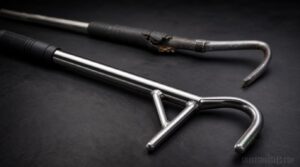
Not all hooks are built the same, and with a large constrictor, that difference really matters.
The material and strength of your hook can be the deciding factor between a smooth, controlled interaction and a dangerous situation.
Here’s what to look for before you ever bring a hook near your snake.
Prioritize Rigid Aluminum or Stainless Steel Construction
Regarding material considerations for reptile handling tools, your two reliable choices are heavy-duty aluminum and stainless steel. Both materials, when manufactured to tight tolerances, give you the rigid control large snakes demand.
Aluminum alloy delivers an excellent weight-to-strength ratio, keeping fatigue life high without burdening your grip.
Stainless steel’s durability shines where corrosion resistance and temperature stability matter most—think outdoor fieldwork or humid enclosures.
Avoid Flimsy Plastic or Light Telescopic Hooks
Plastic hooks are a liability you can’t afford with large constrictors. UV exposure degrades material brittleness over time, while thin wall failure and joint weakness accelerate under real handling stress. Fatigue cracking follows repeated flexion — often without warning.
Light telescopic hooks lack the weight capacities demanded here. Heavy duty aluminum and stainless steel durability aren’t optional upgrades; they’re baseline safety considerations for handling large snakes.
Check Load Capacity Before Lifting or Guiding
Every hook has a rated limit — ignore it, and you’re one wrong move away from equipment failure. Before you lift or guide any large snake, verify the manufacturer ratings match the animal’s estimated weight.
This matters most because:
- Active load testing reveals real-world flex under live animal movement
- Weight verification prevents silent overloading during guiding sessions
- Load documentation bolsters safety considerations for handling large snakes across your team
Heavy-duty rigidity isn’t a luxury — it’s handler safety, built in.
Watch for Shaft Flex Under Heavy Body Weight
Shaft flex is a silent failure you won’t notice until control is already lost. When a large constrictor shifts its weight, the bending moment increases along the lever arm, causing tip deflection that throws off your guidance angle. Material strength determines how much load distribution the shaft withstands before geometric drift occurs.
Shaft flex is a silent failure — by the time you feel it, control is already gone
| Shaft Material | Bending Moment Resistance | Tip Deflection Risk |
|---|---|---|
| Aircraft Aluminum | High | Low |
| Stainless Steel | Very High | Minimal |
| Plastic/Composite | Low | High |
Inspect for visible warp after every heavy session.
Choose Smooth, Coated, or Rounded Hook Tips
The hook tip is where all your control actually makes contact—so tip surface finish matters more than most handlers realize. For large constrictors, a rough or bare metal tip can snag scales, trigger defensive responses, or cause abrasion injuries.
Prioritize these four tip qualities:
- Smooth or powder-coated finishes for abrasion prevention during lateral repositioning
- Rounded geometry to distribute pressure evenly and reduce bite reflex triggers
- Protective coatings for corrosion resistance in humid enclosures
- Silicone-based oil treatment during tip maintenance to preserve grip consistency between sessions
Inspect Welds, Joints, Locks, and Handles
Before you trust any hook with a large constrictor, run a quick structural check.
Inspect weld bead inspection points along the shaft junction, looking for uniform bead profiles without porosity or cracks.
Perform a joint integrity check to confirm no looseness under lateral stress.
Test the locking mechanism for full engagement, verify handle attachment security, and complete a corrosion protection audit on moisture-exposed surfaces.
| Inspection Point | What to Check | Red Flag |
|---|---|---|
| Weld Bead | Uniform profile, no cracks or porosity | Spatter, inclusions, or undercut |
| Joint Integrity | No wobble or play under load | Step changes or visible gaps |
| Lock Engagement | Smooth, full latch without binding | Excessive play or sticking |
| Handle Attachment | Flush bolts, no fatigue cracks | Hairline fractures near base |
| Corrosion Protection | Intact anodized or coated surfaces | Peeling, pitting, or rust spots |
Use Hooks Safely
Using a hook correctly is about more than just technique — it’s about reading the situation before you ever open the enclosure.
Large constrictors respond to how you approach them, and even a well-built hook can become a liability if you skip the right steps.
Here’s how to handle each stage of the process safely.
Step 1: Assess The Snake’s Posture First
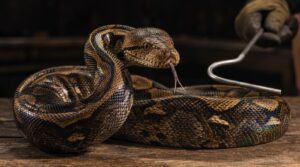
Before reaching for the hook, observe the snake’s raised head forming an S-curve, tight body tension, and tail coiling toward the midsection—classic defensive behavior signals you can’t afford to miss.
Check head orientation: Is it tracking you directly? Stress indicators like rapid tongue-flicking or sudden positional shifts tell you this large-bodied snake is not ready for handling.
Step 2: Open The Enclosure Slowly

Once you’ve read the snake’s posture, your next move sets the tone for everything that follows. A Slow Door Pivot—opening the enclosure panel gradually—combined with Reduced Ambient Noise and Light Dimming Adjustment signals calm, not threat.
Synchronize Handler Movement with the enclosure design to minimize abrupt changes. This involves:
- Pause after the latch clicks
- Watch for Observe the Snake’s Response before continuing
- Hold position if stress and agitation escalate
Step 3: Use The Hook for Gentle Redirection

With the enclosure open and the snake calm, slide the hook under the anterior third of the body using a low Hook Angle Adjustment—think of it as a gentle lift, not a lever. Cue-Based Steering works best when Smooth Motion Timing guides the snake forward rather than forcing direction.
| Technique | Purpose |
|---|---|
| Minimal Contact Point | Reduces stress response |
| Coordinated Handler Movements | Maintains snake coil control |
Step 4: Support The Body With Hands or Help
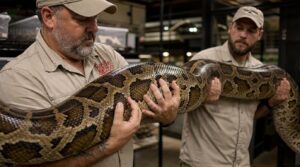
Once the hook has redirected the snake’s anterior third, your hands become the primary support system. Midline Pressure Distribution is key—cradle the midsection, not the tail or head.
- Apply Hand Grip Technique firmly but gently under the mid-body
- Use Ergonomic Stance: feet shoulder-width, neutral spine, legs doing the lifting
- Employ Partner Assistance and multiple handlers for snakes exceeding 8 feet
- Coordinate Release Timing between handlers to maintain snake coil control
Step 5: Avoid Lifting Coiled Heavy Snakes
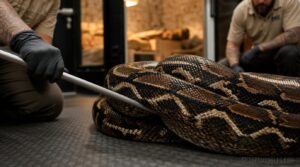
A coiled heavy constrictor is not ready to move—and neither should you be. Attempting to lift a tight coil invites both injury and loss of control. Instead, use your hook to initiate progressive uncoiling from the midsection, establishing core support points as each section relaxes.
Controlled coil release requires team communication signals and ground anchor usage throughout. Coiled snake management demands patience over force with large-bodied snakes.
Step 6: Keep Handling Sessions Short

Five minutes is your ceiling. Stress hormone spikes in large constrictors begin quickly, and prolonged contact compounds recovery time substantially. Use a timer—brief handling sessions aren’t just good practice; they’re animal welfare fundamentals.
Your observation checklist should flag these stress indicators before and after each session:
- Rapid, labored breathing
- Defensive coiling or musking
- Continuous tongue-flicking with lateral body tension
- Erratic, unpredictable locomotion
- Flushed or mottled skin coloration
Recovery intervals matter.
Never Hook a Snake Immediately After Feeding
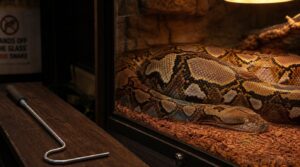
Post-meal handling is one of the fastest ways to undo good husbandry. A large-bodied snake in active digestion faces a serious Regurgitation Risk if disturbed — and that single event can set back weight gain for weeks. Respect the No-Contact Window strictly.
| Phase | Safe Action |
|---|---|
| 0–48 hrs post-meal | Post-Meal Observation only |
| 48–72 hrs | Monitor snake behavior, check Digestion Recovery signs |
Stress Hormones spike fast under handling pressure, so stay hands-off.
Use Gloves, Long Sleeves, and Eye Protection
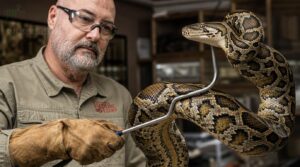
PPE isn’t optional — it’s the last line of defense between you and a defensive strike. Follow the Proper Donning Sequence: eye protection meeting standards like ANSI Z87.1 goes on first, then long sleeves, then animal handling gloves with solid Glove Dexterity Balance for precise hook control.
Your PPE Inspection Routine before every session — checking Material Compatibility and integrity — is non-negotiable in safe handling techniques.
Top 6 Products to Compare
Picking the right hook makes a real difference when you’re working with large constrictors.
The six options below cover a range of sizes, materials, and price points, so there’s something useful here whether you’re a weekend keeper or a seasoned professional.
Here’s what’s worth considering.
1. MidWest Blue Aluminum Snake Tongs
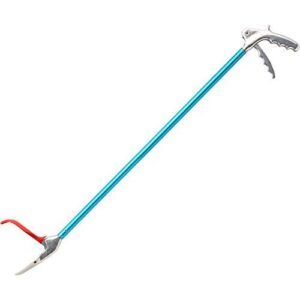
The MidWest Blue Aluminum Snake Tongs (model MI-40) are a reliable choice for handlers working with small-to-mid-sized snakes in tight spaces. At 40 inches long with a 1-inch jaw opening, these tongs provide controlled, gentle contact without crowding the animal.
Constructed from aircraft-grade aluminum, the tongs remain lightweight yet durable. The concealed stainless-steel cable ensures smooth operation, while the triple rubber-coated top jaw prevents slipping and minimizes tissue stress. These features combine to reduce strain on both handler and animal.
Priced at $94.95, the MI-40 is a professional-grade tool ideal for precision work. However, for large constrictors, a heavier-duty alternative is recommended.
| Best For | Handlers who regularly work with small to mid-sized or venomous snakes and need a reliable tool for tight spaces without putting their hands at risk. |
|---|---|
| Primary Material | Aluminum & Stainless Steel |
| Portability | Fixed length |
| Target Snake Size | Small snakes |
| Handle Type | Aluminum grip |
| Price Range | $94.95 |
| Venomous Snake Use | Yes |
| Additional Features |
|
- The triple rubber-coated jaw grips gently, so you’re not stressing the snake or risking a slip
- At 40 inches, you get solid reach without getting too close — great for venomous species
- Aircraft-grade aluminum keeps it light enough to use comfortably for extended handling sessions
- The 1-inch jaw opening just isn’t built for larger snakes — you’ll need something beefier for big constrictors
- Aluminum can get slippery, especially if your hands are wet or you’re working fast
- 40 inches might not cut it if you’re working with deep enclosures or tall setups
2. Zoo Med Collapsible Snake Hook
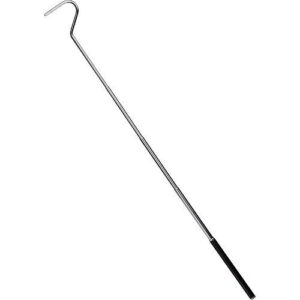
If portability matters more than raw power, the Zoo Med Collapsible Snake Hook (model TA-25) is worth keeping in your kit. It extends from 7.25 inches to 26 inches, collapses to fit in a pocket, and weighs just 0.06 kg.
The rounded hook tip and rubber handle make it genuinely safe for small or juvenile snakes during feeding swaps or enclosure cleaning.
However, don’t rely on it for anything heavy—the collapsible mechanism won’t hold up under large-constrictor loads.
| Best For | Hobbyists and field collectors who need a lightweight, pocketable hook for handling small or juvenile snakes safely. |
|---|---|
| Primary Material | Rubber & Metal |
| Portability | Pocket collapsible |
| Target Snake Size | Small/juvenile snakes |
| Handle Type | Easy-grip rubber |
| Price Range | Budget |
| Venomous Snake Use | Yes |
| Additional Features |
|
- Collapses down to fit in a pocket, so it’s easy to take anywhere
- Rounded hook tip and rubber grip keep handling low-stress for nervous or nippy snakes
- Adjustable length (7.25–26 in) gives you flexibility in tight spaces
- Not built for large or heavy snakes — the collapsible joint can bend or break under load
- Some units arrive damaged out of the box, which is a frustrating quality-control miss
- Limited reach compared to full-length hooks when you actually need the extra distance
3. Tomahawk Super XL Snake Hook
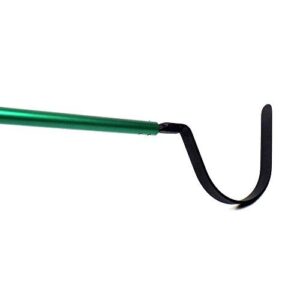
When you’re working with truly massive constrictors—reticulated pythons pushing 12 feet or beyond—you need a hook built for that reality. The Tomahawk Super XL delivers. Its mid-40-inch shaft keeps you at a safe distance, while the reinforced steel head withstands heavy loads without flexing.
The tool’s wider hook opening cradles thick body girth without pinching or repositioning, ensuring secure handling. A smooth, coated tip protects scales during redirection, maintaining both safety and animal welfare.
This is a professional-grade tool, and it performs exactly like one.
| Best For | Reptile keepers and wildlife handlers who regularly work with large constrictors like reticulated pythons or Burmese pythons and need a safe, sturdy hook with real reach. |
|---|---|
| Primary Material | Steel & Aluminum |
| Portability | Fixed length |
| Target Snake Size | Very large constrictors |
| Handle Type | Comfort-grip ergonomic |
| Price Range | Mid-range |
| Venomous Snake Use | Yes |
| Additional Features |
|
- The 44-inch length keeps you at a comfortable distance from large, powerful snakes
- Powder-coated steel hook holds up well in humid environments without rusting out
- Aluminum pole keeps the overall weight down, so your arm isn’t dead after a long handling session
- Too bulky for small enclosures—you’ll be banging it off the walls in a tight space
- Overkill for smaller or more delicate snakes, where it could actually cause harm
- No listed weight rating, so you’re left guessing whether it’s rated for your specific animal
4. Repti Zoo Collapsible Snake Hook
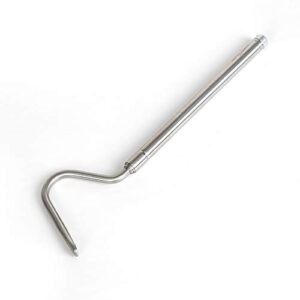
Not every situation calls for a heavy-duty professional hook. When managing smaller non-venomous snakes or needing genuine portability, the Repti Zoo Collapsible Snake Hook earns its place.
It collapses to just 7.8 inches and extends to 23.6 inches, fitting cleanly in a pocket or tool bag.
The stainless steel shaft resists corrosion, and the smooth, rounded tip won’t abrade delicate scales during redirection.
Rated for lighter specimens only, so don’t push it past its limits.
| Best For | Hobbyists who keep small, non-venomous snakes and want a compact, everyday hook they can toss in a pocket. |
|---|---|
| Primary Material | Stainless Steel |
| Portability | Pocket collapsible |
| Target Snake Size | Small non-venomous snakes |
| Handle Type | Standard grip |
| Price Range | Budget |
| Venomous Snake Use | Not recommended |
| Additional Features |
|
- Folds down to 7.8 inches, so it’s genuinely pocketable — easy to grab when you need it fast
- Adjustable up to 23.6 inches, which covers most standard terrarium depths without any fuss
- Stainless steel build with a rounded tip keeps handling safe and corrosion-free over time
- Not built for venomous or heavier snakes — the hook can lose rigidity under real downward force
- The attachment point for a wrist strap is tiny and a bit of a DIY situation
- More of a light-duty tool, so serious herpers or those with larger collections will likely outgrow it fast
5. MasterClass Annual Subscription Gift Card

The MasterClass Annual Subscription Gift Card isn’t a hook — it’s a knowledge investment. At $120, it unlocks a full year of access to 200+ instructors across categories including animal care, science communication, and hands-on skill development.
You can stream across any device, work through content at your own pace, and revisit lessons as your experience grows. For handlers serious about deepening their expertise beyond equipment, it’s a resource worth considering.
| Best For | Anyone who loves learning and wants a gift that keeps giving — whether they’re into cooking, music, writing, or just picking up something new. |
|---|---|
| Primary Material | Digital/None |
| Portability | Digital delivery |
| Target Snake Size | N/A |
| Handle Type | N/A |
| Price Range | $120.00 |
| Venomous Snake Use | N/A |
| Additional Features |
|
- Massive variety — 200 instructors across 10 categories means there’s genuinely something for everyone
- Super flexible — stream on your phone, TV, tablet, or desktop whenever it fits your schedule
- Great last-minute gift — delivered instantly by email or SMS, no wrapping required
- No live interaction — it’s all pre-recorded, so don’t expect feedback or Q&A with the instructors
- Needs a solid internet connection — not great if you’re somewhere with spotty Wi-Fi
- One year and it’s gone — any unused time just expires when the subscription ends
6. Gzlozak Retractable Heavy Duty Snake Hook
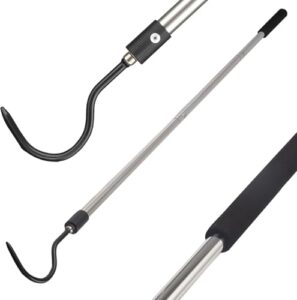
The Gzlozak Retractable Heavy Duty Snake Hook earns its place through sheer versatility. It extends from 35 to 66 inches, providing genuine standoff distance for snakes over 10 feet, then disassembles compactly for field transport.
Its stainless steel shaft resists flex under load, while the gel-coated tip protects scales during redirection.
One caveat: the screw-together sections slow setup compared to true telescopics, and the 8 lb load limit rules it out for large adult pythons.
| Best For | Hobbyist handlers and field herpers who need a lightweight, packable hook for relocating small-to-mid-sized snakes safely from a distance. |
|---|---|
| Primary Material | Stainless Steel |
| Portability | Disassembles for transport |
| Target Snake Size | Small to large snakes |
| Handle Type | Non-slip foam |
| Price Range | Mid-range |
| Venomous Snake Use | Yes |
| Additional Features |
|
- Extends up to 66 inches, giving you solid standoff distance from larger or more defensive snakes
- Gel-coated tip is genuinely gentle on scales, so you’re not stressing out the animal during a redirect
- Breaks down into compact sections, making it easy to toss in a bag for camping or field work
- Screw-together assembly takes longer than a true telescoping pole—not ideal if you need it fast
- The 8 lb load cap means it’s a no-go for big adult pythons or heavy constrictors
- The plastic riveted coupling is a weak spot that could fail under sudden or heavy pressure
Reduce Handling Stress

Handling stress is as real for the snake as it is for you, and managing it well separates good keepers from great ones.
Most of this comes down to smart habits—before, during, and after every interaction.
Here’s what actually counts.
Use Two Handlers for Large Constrictor Relocation
Relocating a large constrictor alone isn’t just difficult — it’s genuinely dangerous. For any snake exceeding eight feet, using multiple handlers is standard large constrictor management practice.
Handler positioning, signal timing, and cross-hand coordination must be agreed upon before opening the enclosure. This pre-move planning ensures controlled execution.
Safety briefings take thirty seconds and are critical to preventing injuries. They establish clear roles and emergency responses.
Good weight distribution across handlers keeps the animal calm, reducing stress and aggression during relocation.
Support Separate Body Sections During Movement
Think of a large-bodied snake as a bridge — it needs support at both ends, not just the middle. Dual-point support and sectional weight distribution is what keeps the animal calm during movement.
Assigning one handler to midsection lever control while another controls the head using an extendable snake hook ensures multi-hand coordination and segmented body guidance. This approach reduces defensive striking by naturally distributing load across both body sections.
Design Enclosures for Minimal Direct Handling
Enclosure design is your first line of defense against unnecessary stress. When building or selecting housing for a large-bodied snake, prioritize modular access panels, slide-out trays, and ventilation seals that maintain airflow without requiring internal access. Impact-resistant materials and thoughtful cable management ensure long-term durability and functionality.
Key design priorities:
- Install slide-out transport trays for hands-free relocation
- Use modular access panels for routine cleaning
- Position ventilation seals away from primary access points
- Choose impact-resistant materials for structural integrity
- Enhance heat dissipation with aluminum-framed enclosure walls
Use Removable Hides During Routine Maintenance
Removable hides are one of the most practical tools in your enclosure maintenance routine. With the right hide placement and material selection, you can complete cleaning protocols without ever reaching for your snake hooks. Secure attachment keeps hides stable during use, while a sensible rotation frequency ensures thorough access.
For large-bodied snake housing, this single design choice dramatically reduces unnecessary contact during routine maintenance.
Train Voluntary Movement With Positive Reinforcement
Beyond passive enclosure design, positive reinforcement training gives you genuine behavioral influence over a large-bodied snake. Through progressive shaping, cue timing, and reward scheduling, you can encourage voluntary movement toward a feeding station — reducing hook dependence substantially. Use marker language to reinforce each successful response, and keep session monitoring consistent.
- Pair a distinct cue before each target movement
- Deliver rewards immediately after correct responses
- Advance gradually from simple to complex behaviors
- Pause sessions at the first sign of stress
Use Transport Tubs, Trays, or Shift Boxes
Sealed Lid Systems on rigid transport tubs, Nestable Tray Design options, and Gasketed Shift Boxes enable relocation of large-bodied snakes with minimal contact. These methods prioritize safety by eliminating direct handling whenever possible.
Stackable Storage Solutions further support safe handling techniques and animal welfare by reducing stress triggers. Their design ensures efficient, secure transport while maintaining snake well-being.
Material Sanitization between uses guarantees hygienic, repeatable relocation processes. This critical step upholds consistent cleanliness standards for every operation.
Clean and Inspect Hooks After Every Use
Post-use sanitizing starts with warm water and a mild metal-safe sanitizer, followed by thorough drying for Rust Prevention. This foundational step eliminates biological contaminants like bodily fluids, shed cells, and bacteria.
Next, conduct a meticulous Inspection Checklist: examine welds, joints, and tips for burrs, cracks, or structural weaknesses. Address any issues immediately to ensure safety and functionality.
Apply Lubrication Application using silicone oil to maintain mobility and prevent corrosion. Finally, adhere to Storage Protocol by keeping hooks in a dry, ventilated, and accessible location.
Consistent adherence to these practices guarantees the longevity and reliability of your snake hooks.
Record Handling Events for Health Monitoring
Keeping a log does more than satisfy record-keeping—it gives you a reliable baseline for spotting health trends before they become problems. Document each session with timestamp logging, and note what you observed before contact.
- Posture documentation: alert, coiled, or defensive?
- Respiratory notes: labored or normal breathing?
- Injury tracking: abrasions or swelling post-handling?
- PPE verification: gloves and eye protection confirmed?
Frequently Asked Questions (FAQs)
How do snake hooks differ from snake tongs?
Both tools keep you safe, yet they work in opposite ways. Snake hooks guide through gentle redirection—a Guidance Technique prioritizing welfare—while snake tongs grip using a Restraint Mechanism for firm control.
At what age should juvenile pythons be hook-trained?
Start hook training after your juvenile python’s first shed, usually around 4–6 months. Factor in temperament assessment and feeding schedule stability before beginning.
Consistent training frequency and watching for stress indicators ensures safe, effective conditioning.
How should hooks be stored to prevent warping or damage?
A good tool deserves good care.
Store hooks in Climate-Controlled Storage using Individual Compartment Cases.
Apply Moisture Absorption Systems.
Schedule Quarterly Maintenance Checks to prevent warping, corrosion, and shaft misalignment over time.
Are snake hooks legal to own without a permit?
Snake hooks do not require a permit — legal classification targets the animal, not the tool.
Jurisdictional variations mean ownership documentation and enforcement nuances depend entirely on your snake species and local authority.
Conclusion
The safest handler is often the one who moves slowest. Mastering snake handling hooks for large constrictors isn’t about controlling the animal—it’s about removing the conditions that make control necessary.
Match your hook’s length and load rating to the snake’s actual size, support the body fully, and treat every session as a protocol, not a routine.
Do that consistently, and the hook in your hand becomes less a defensive tool and more a language both of you understand.