This site is supported by our readers. We may earn a commission, at no cost to you, if you purchase through links.
A rescue boa arriving at your home carries more than its past—it carries cortisol. Studies on captive reptiles show that chronically stressed snakes maintain elevated glucocorticoid levels for weeks after rehoming, suppressing immune function and killing the feeding response. The hide you place in that enclosure on day one isn’t an accessory—it’s the first signal this animal gets that danger isn’t constant anymore.
Rescue boas often arrive with no behavioral baseline: defensive coiling, refusal to eat, erratic thermoregulation. A properly sized, correctly placed hide interrupts this cycle by giving the snake control over its own visibility. This single variable shifts everything: digestion improves, shedding normalizes, and trust builds.
Choosing the right boa constrictor hides for rescue owners hinges on material, fit, placement, and maintenance—each factor carries a measurable impact on recovery.
Table Of Contents
- Key Takeaways
- Why Rescue Boas Need Secure Hides
- Best Hide Types for Boa Constrictors
- Choosing The Right Hide Size
- Placing Hides in The Enclosure
- Cleaning and Maintaining Boa Hides
- Frequently Asked Questions (FAQs)
- Do boa constrictors need hides?
- Do boa constrictors know their owners?
- How cold is too cold for a boa?
- Do boas need light at night?
- How often should rescue boa hides be replaced?
- Can multiple boas safely share the same hide?
- Should hides be covered during the quarantine period?
- How do hides differ for albino or sensitive boas?
- Conclusion
Key Takeaways
- A snug hide — sized to match your boa’s thickest body point — is the single fastest way to lower stress hormones and restart normal feeding after rehoming.
- Place one hide on the warm side (86–90°F) for digestion, one on the cool side (72–78°F) for thermoregulation, and a third damp hide lined with sphagnum moss whenever your boa begins shedding.
- Nonporous plastic is the easiest to clean for quarantine setups, cork bark buffers humidity naturally, and wood is only safe if it’s kiln-dried hardwood — never cedar.
- Spot-clean daily, inspect for cracks weekly, and upsize the hide the moment your boa can’t complete a full coil inside — don’t wait for behavioral refusal.
Why Rescue Boas Need Secure Hides
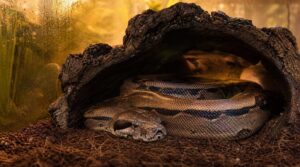
A rescue boa carries stress long before it reaches your home — and a secure hide is often the first thing that starts to change that. Without one, stress hormones stay elevated, which chips away at immune function, feeding response, and overall recovery.
Knowing which boa constrictor hide styles actually work can make the difference between a snake that settles in within days and one that stays on edge for months.
Here’s what every rescue owner needs to understand about why hides matter so much.
How Hides Reduce Stress in Newly Rehomed Boas
When a rescue boa first enters your home, everything is unfamiliar—the smells, the layout, even the light. A snug hide gives it visual privacy and genuine control over when it’s seen. That simple shift triggers a measurable stress hormone decline, supporting hormonal balance and faster acclimation speed. It’s one of the most important things you can do for boa health from day one.
A snug hide gives a rescue boa control over when it’s seen, triggering measurable stress relief from day one
Providing an optimal temperature range in the enclosure helps the rescue boa feel secure and reduces excessive hiding.
Why Rescue Boas May Be More Defensive Without Cover
Without cover, a boa can’t run a basic risk assessment — it just reacts. Visibility stress keeps it locked in defensive coiling, head elevated, body braced. The escape cost of crossing open substrate is simply too high, triggering the same stress hormones as direct threat exposure.
Watch for these behavioral signs:
- Tight, sustained coiling with head raised
- Prolonged staring toward disturbance sources
- Refusal to relax posture between keeper interactions
- Striking without direct contact provocation
- Remaining motionless rather than retreating
How Hiding Supports Feeding, Digestion, and Recovery
A secure feeding cue starts with cover. Boas with a nearby hide eat more consistently — they don’t feel exposed when prey is offered. After feeding, the hide becomes a digestive rest zone where your boa can settle undisturbed, supporting metabolic heat buffering and normal digestion.
| Phase | Hide Role | What You’ll Notice |
|---|---|---|
| Feeding | Secure feeding cue | More reliable food acceptance |
| Digestion | Digestive rest zone | Calm, sustained resting posture |
| Recovery | Recovery hide routine | Faster behavioral normalization |
The recovery hide routine further aids in post-feeding stabilization. A stress-free enclosure isn’t optional — it’s the foundation.
The Link Between Stress, Immunity, and Illness Risk
Stress does real damage behind the scenes. Chronic cortisol suppression kicks off a chain reaction—lymphocyte decline follows, leaving a boa’s adaptive immunity weakened. Inflammatory pathways activate, SIgA reduction compounds the problem, and immune imbalance sets in.
The impact of chronic stress on snake immune function is measurable. Providing hides is one of the most direct stress reduction techniques for captive reptiles you can use.
Why Oversized Open Spaces Can Delay Adjustment
A sprawling enclosure may seem generous, but for a rescue boa, it becomes overwhelming. Long escape routes force the snake to cross more exposed ground, triggering hesitation rather than comfort. Thermal gradient instability increases when the boa lingers in open zones instead of settling.
Consider the hidden costs of open space:
- Feeding exposure risk rises with every uncovered foot.
- Routine formation delay stretches the adjustment window considerably.
- Distraction competition from sightlines, airflow, and movement spikes defensive behavior.
Proper fitting of reptile hide boxes—not oversized ones—forms the foundation of stress reduction for reptiles. Strategic hide placement directly shapes behavior, fostering security and stability.
Best Hide Types for Boa Constrictors
Not all hides are created equal, and for a rescue boa, the right choice can make a real difference in how quickly they settle in. The material, structure, and purpose of a hide all factor into what works best for your snake’s specific needs.
Here are the main types worth knowing about.
Non-porous Plastic Hides for Easy Disinfection
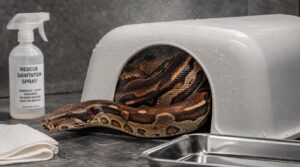
Plastic hides are the workhorse of any rescue setup. Their nonporous surface won’t absorb bacteria or odors — making cleaning and sanitation of reptile accessories genuinely straightforward. Look for gapless joint design, chemical resistance, and UV durability to get the most out of each unit.
Pairing plastic hides with a front-opening enclosure rounds out a low-stress setup — explore the full picture of boa constrictor habitat accessories for rescue and care to see how each piece works together.
| Feature | Why It Matters |
|---|---|
| Dishwasher Compatibility | Thorough sanitation between quarantine cycles |
| Surface Abrasion Resistance | Stays smooth through repeated scrubbing |
| Nonporous Resin Construction | Resists moisture, pathogens, and odor absorption |
| Gapless Joint Design | Nowhere for bacteria to hide |
Maintenance of nonporous plastic hides is simple — disinfect, rinse, dry fully, and reuse.
Cork Bark Hides for Naturalistic Enclosures

Cork bark hides give rescue boas something plastic can’t — a surface that feels like home.
The rough texture offers Cork Texture Enrichment during exploration, while Natural Camouflage blends naturally into forest-style substrates.
Moisture Buffering creates gentle humidity pockets without soaking the enclosure.
It’s durable, lightweight, and its Aging Patina Aesthetics stay non-toxic through years of use.
Wooden Hides Made From Safe Reptile Woods
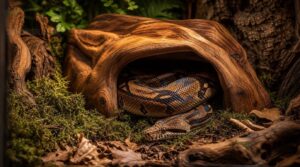
Not every wood is safe — and that distinction matters more than you’d think. Wood Species Selection is the first checkpoint. Safe wooden and cork bark hides use kiln-dried mopani, beech, or natural wood branches — never cedar, which leaches toxic resins. Look for:
- Non-Toxic Finishes verified through material toxicity testing
- Kiln Drying to reduce mold risk
- Moisture Resistance for long-term structural durability
- Natural wood antiseptic properties that slow bacterial growth
Humid Hides for Shedding Support
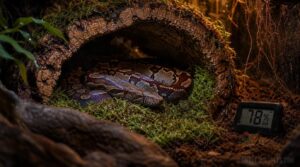
Shedding is where humid hides earn their place. Line one with sphagnum moss — it stays pliable, resists mold, and acts as a moisture substrate your boa can press against during pre-shedding hydration.
Position it on the warm side, away from direct airflow. An air-gap design around the entrance slows condensation.
Use humidity monitoring tools inside to keep levels at 75–80% for reliable shedding cycle management.
DIY Hide Boxes for Low-cost Rescue Setups
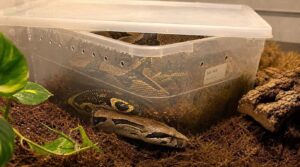
Food-grade plastic storage boxes offer a cost-effective DIY hide solution for boas. A snap-lid adaptation ensures juveniles remain secure, while drilling 5–8 mm ventilation holes on multiple sides maintains airflow. Adding a moisture-proof lining inside completes the setup, delivering budget-friendly functionality without compromise.
Prioritize recycled material selection, but avoid pine or cedar, as these can harm reptiles. Proper construction supports every boa’s health equally, proving that cost-effective hides need not sacrifice quality or safety when built thoughtfully.
Heavy-duty Hides for Large Adult Boas
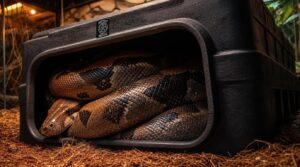
Large adult boas — especially rescues with unknown histories — require hides that withstand a 50-pound body without cracking. Prioritize reinforced plastic or thick-wall construction with proven load-bearing capacity to ensure longevity under daily use.
Opt for extra-large or jumbo hide boxes crafted from heavy 18mm-thick plastic. These designs offer durable, anti-slip exteriors and material resilience, addressing the unique demands of reptile enclosures.
Such robust construction directly enables proper selection of appropriate hide box sizes, ensuring both safety and comfort for the animal over time.
Choosing The Right Hide Size
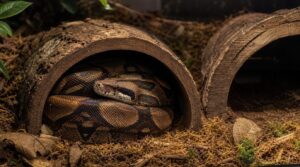
Getting the hide size right is one of the most common mistakes rescue owners make, and it’s usually an easy fix once you know what to look for. A hide that’s too big can stress your boa out just as much as having no hide at all.
Here’s what you need to know to size things correctly.
Measuring Your Boa’s Thickest Body Point
Grab a soft measuring tape and wrap it around your boa’s midsection — that widest point just behind the ribs. Proper tape placement matters: ensure it’s snug but never compressing. Take three readings and average them for accuracy.
Track these girth measurements on growth charts over time. Timing is crucial: measure when your boa is calm, not right after feeding.
Why Snug Hides Feel Safer Than Oversized Hides
Once you have that girth measurement, size matters more than you’d think. A snug fit reduces stress by delivering limited visual cues and minimal air draft — both of which trigger a calm, instinctual retreat response. Enhanced tactile enclosure from wall contact lowers perceived predation risk and maintains a consistent microclimate.
Oversized hides simply don’t provide that security.
Juvenile Boa Hide Size Guidelines
For hatchling boas and juveniles under 5 feet, interior floor space of 3–6 inches by 5–7 inches usually works well. Your hide box selection and placement should account for substrate depth — the boa should be able to partially settle into the substrate while still contacting the walls.
Key juvenile dimension chart guidelines:
- Interior floor: roughly 12 × 8 × 4 inches
- Minimum coil clearance: body contact on at least two sides
- Entry hole: 1.5–2 inches in diameter for a snug retreat
Adult Boa Hide Size Guidelines
Adult boas require precise sizing for optimal comfort. A 6–8 ft boa needs interior dimensions of roughly 15 × 15 × 7 inches to ensure adequate Coil Space and Girth Accommodation. Jumbo-size reptile hide boxes and extra-large options cater to larger boas and pythons effectively.
Use the following table for Standard Dimensions and Growth Projections when selecting appropriate hide sizes and materials:
| Boa Length | Standard Dimensions | Volume Guidelines |
|---|---|---|
| 4–5 ft | 12 × 10 × 5 in | Snug coil fit |
| 5–6 ft | 14 × 12 × 6 in | Moderate clearance |
| 6–7 ft | 15 × 15 × 7 in | Full coil room |
| 7–8 ft | 18 × 15 × 7 in | Jumbo capacity |
| 8+ ft | 20 × 13.5 × 6 in | Extra large hide boxes |
Product sizing varies by brand—always verify interior measurements before buying.
Entrance Size and Security Considerations
The entrance matters more than most owners expect. Aim for an aperture ratio where the opening is no wider than 1.5 times your boa’s thickest point — snug enough to feel secure, not tight enough to cause stress.
Chamfered openings and smooth edges prevent scale damage. Add tunnel depth and sidewall clearance to keep your boa fully concealed, reducing defensive behavior greatly.
When to Upsize Hides After Growth Checks
Growth doesn’t announce itself — it just happens. Schedule a quarterly size review, and add a pre-shed assessment and post-feeding checks, since rapid growth spikes often follow consistent meals. Watch for these clear upsize signals:
- Body no longer curls fully inside
- Behavioral refusal cues replace regular entry
- Scale rubbing appears near the opening
- The boa can’t complete a full turn
- Hide fit feels forced, not snug
Upgrade before refusal, not after.
Placing Hides in The Enclosure

Where you place each hide matters just as much as which hide you choose. Your boa depends on having the right temperatures and humidity available at all times.
That only happens when hides are placed in the right spots. Here’s what you need to know about setting up each one correctly.
Warm-side Hide Placement for Digestion
Position your warm-side hide directly over the under-tank heater — this is the digestion zone placement that makes everything else work. Thermally optimized hide access lets your boa rest at 86–90 °F after eating without exposing itself. Warm-side accessibility removes a real conflict: warmth versus security. Heat-linked hide positioning ties into the temperature gradient so digestion stays predictable.
| Hide Position | Target Temp | Primary Function |
|---|---|---|
| Over heat source | 86–90 °F | Post-meal digestion support |
| Warm-mid enclosure | 82–85 °F | Gradual temperature shift zone |
| Away from heat | Below 80 °F | Not a digestion zone |
Skipping proper heat lamp usage and thermal gradient alignment here means your boa has to choose between feeling safe and staying warm — and stress always wins that battle.
Cool-side Hide Placement for Thermoregulation
Your cool-side hide belongs at the far end of the enclosure — maximum heater distance from the primary heat source. Don’t guess: gradient mapping with a probe thermometer inside the hide confirms you’re hitting 72–78 °F at substrate level.
Airflow influence and the cool hide buffer effect mean interior temperatures often run slightly lower than ambient.
This is your dual-hide strategy for ideal thermoregulation working exactly as intended.
Using a Third Humid Hide During Shed Cycles
A third hide isn’t optional during shed cycles — it’s your localized humidity control tool. Position it toward the cool side, lined with damp sphagnum moss.
Monitor for signs like dull eyes or blue-tinted scales, then start your shed support schedule.
Microclimate timing matters: moisture level checks every 1 to 3 days keep humidity levels right without turning the hide into a swamp.
Checking Temperatures Inside Each Hide
Humidity affects thermal readings too — a damp humid hide often reads cooler than a dry one. That’s why probe placement matters: set your probe at the level your boa actually rests, never touching walls or the thermostat-controlled heat source.
For gradient verification across the temperature gradient, check each hide during both the active and resting phases of the thermostat cycle.
Preventing Hides From Blocking Movement Paths
Once your temperatures check out, turn your attention to hide placement itself. A poorly placed hide can box your boa into a dead-end.
Leave a clear travel lane around each hide — rubber matting underneath improves anchor stability and prevents shifting. Keep doorway orientation facing open substrate, not walls.
Zone spacing between hides preserves wall clearance and gives your boa actual room to move.
Arranging Hides for Shy or Defensive Rescue Boas
Shy rescue boas notice everything — including whether their hide feels like a trap or a safe room.
- Face the entrance toward open substrate, never a wall — entrance orientation matters
- Choose opaque concealment so your boa can’t be seen while resting
- Anchor each hide with a stable base it can’t shift
- Place a backup refuge nearby for hesitant boas
- Keep consistent positioning — don’t rearrange hides between checks
Cleaning and Maintaining Boa Hides
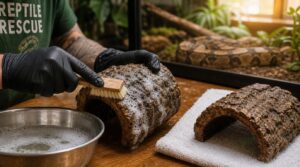
Keeping hides clean isn’t glamorous work, but it’s one of the most important things you can do for a rescue boa’s health. A dirty hide can undo all the progress you’ve made helping your snake feel safe and settled.
Here’s what you need to stay on top of it.
Our guide to choosing the right substrate and bedding for hatchlings breaks down exactly what to look for, so you can set up a healthier enclosure from the start.
Daily Spot-cleaning for Rescue Quarantine Setups
Spot-clean daily — no exceptions during quarantine. Remove droppings, spilled water, and uneaten food immediately upon spotting them. This prevents buildup and maintains hygiene.
Residue removal done in place preserves familiar scents, keeping your boa calmer and stress levels stable. Avoid disrupting the enclosure’s environment unnecessarily.
Use dedicated tools for quarantine to prevent cross-contamination between enclosures. Segregate supplies to eliminate risks.
Apply focused disinfection only to soiled areas, not the entire interior. Targeted cleaning reduces chemical exposure and preserves the habitat’s balance.
Consistent cleaning frequency directly supports recovery. Regular upkeep minimizes health hazards and fosters a stable environment.
Safe Disinfectants for Plastic Reptile Hides
Not every disinfectant is safe for plastic surfaces — the wrong one can warp surfaces or leave harmful residue. Stick to these four proven options:
- Hydrogen Peroxide (3%) — spray, let it dwell briefly, wipe clean
- Bleach Dilution — 1:10 ratio, rinse thoroughly after contact
- Chlorhexidine Rinse — gentle, low-odor, safe for routine sanitation
- Quaternary Contact disinfectants — verify plastic compatibility before use
Drying Hides Fully Before Reuse
After disinfecting, don’t rush reuse—a damp hide creates exactly the conditions mold and bacteria need to take hold. Prioritize airflow positioning: prop hides upright so air reaches all sides. Avoid direct sunlight; while it speeds drying, it warps cork and wood.
Verify dryness thoroughly: check under edges and inside seams, as surface-dryness isn’t sufficient. Refer to the material-specific guidelines below:
| Material | Estimated Dry Time | Key Check |
|---|---|---|
| ABS Plastic | 2–4 hours | No cool or clammy feel |
| Cork Bark | 12–24 hours | Seams fully dry, no musty odor |
| Mopani Wood | 24–48 hours | Interior crevices feel dry to touch |
Material-Specific Dry Times vary significantly—porous woods require the longest periods. For Storage Humidity Control, always place cleaned hides on an open rack. Never seal them in a tub until confirmed fully dry.
Consistent cleaning routines are critical: perform daily spot-cleans and weekly deep drying checks. Use mold-resistant materials wherever possible to maintain sanitation standards and protect your boa.
Replacing Damaged Plastic, Cork, or Wood Hides
Replace hides within 24 hours if cracks, flaking, or rough seams appear. Conduct weekly inspections for seams and cracks to ensure safety.
Plastic hides last 12–18 months, while wood hides endure around 24 months. Always perform disinfection verification on new hides before introducing them to the enclosure.
Ensure compatibility by matching replacement size exactly to the original. For cork hides, applying sealant at the first sign of surface wear significantly extends durability.
Preventing Mold in Humid Hides
Mold doesn’t need much of an invitation — just moisture and stagnant air. Keep humid hides clean with these four steps:
- Moisture Monitoring: Check hide interiors daily using a calibrated humidity sensor.
- Airflow Management: Use screen tops or side vents for airflow-mist balance.
- Dehumidifier Use: Run a room dehumidifier during shedding cycles.
- Routine Inspection: Remove any hide showing fuzzy growth immediately — mold-resistant materials like ABS plastic make humidity control for successful shedding far easier.
Coordinating Hide Cleaning With Substrate Changes
Think of it as a single hygiene reset, not two separate tasks. Clean hides and swap substrate together — that’s your substrate hide sync.
Remove soiled substrate first, keep hides in a clean container as your contamination barrier protocol, then reinstall fully dried hides only after humidity stabilizes.
Spot clean daily between resets.
Log each date — hygiene log alignment keeps your maintenance and cleaning routines for reptile hides consistent.
Frequently Asked Questions (FAQs)
Do boa constrictors need hides?
Yes — absolutely. A boa constrictor without a hide is like a person without walls. It’s a Behavioral Need Indicator you can’t ignore.
Hides aren’t optional; they’re core to Enclosure Enrichment and long-term health.
Do boa constrictors know their owners?
Not exactly — but they do recognize you. Your boa uses vomeronasal cues and scent recognition to associate your presence with safe, predictable handling.
This association reduces their defensive response over time through habituation.
How cold is too cold for a boa?
Below 75°F for extended periods triggers cold-induced lethargy and appetite loss.
Your boa’s minimum safe temperature sits around 75°F, though brief nighttime drops to 68°F are tolerable with a proper thermal gradient maintained.
Do boas need light at night?
Boas don’t need light at night. Darkness protects their circadian rhythm and reduces nighttime stress. A consistent photoperiod schedule—roughly 13 hours on, 11 off—keeps them settled.
Use light-free heating and infrared monitoring only to maintain their environment without disrupting their natural cycles.
How often should rescue boa hides be replaced?
Replace hides based on a monthly assessment cycle, not a fixed calendar.
Spot-clean daily, upsize quarterly, and swap immediately after illness, failed sheds, or visible damage.
Material durability for reptile hides determines the rest.
Can multiple boas safely share the same hide?
Sharing one hide sounds harmless — until one boa claims it entirely. Resource competition, disease transmission, and behavioral hierarchy pose a significant welfare risk.
Providing each snake its own secure hiding place ensures safety and reduces stress.
Should hides be covered during the quarantine period?
Yes. During quarantine, keep hides covered. Visual privacy buffers human disturbance and reduces defensive responses. A covered hide promotes stress reduction in snakes, which directly helps immune function recovery.
How do hides differ for albino or sensitive boas?
Albino and sensitive boas need darkened visual cover, smooth interior surfaces, and odor‑free materials. Use plastic and resin hides with nonreflective surfaces and shadowed enclosure placement to reduce stress.
Conclusion
A hide is a door—and every rescue boa constrictor needs one that fits. The right boa constrictor hides for rescue owners aren’t just furniture; they’re the first honest signal that this animal’s environment is finally working for it, not against it.
Get the size snug, place it in warm and cool areas, and keep it clean. These steps ensure the hide meets the snake’s needs effectively.
Over weeks, watch the defensive posture soften. That shift isn’t luck—it’s what safety feels like to a snake.