This site is supported by our readers. We may earn a commission, at no cost to you, if you purchase through links.
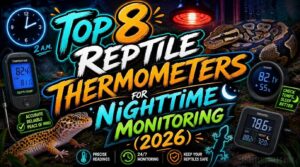
Most reptile deaths tied to temperature don’t happen under the basking lamp—they occur at 2 a.m., when the heat drops and nobody’s watching. A ball python in a 68°F enclosure overnight isn’t merely uncomfortable; it’s immunocompromised, digestively stalled, and one cold snap away from respiratory infection.
Reptile thermometers for nighttime monitoring address a gap daytime checks can’t: the hours you sleep are the hours your animal is most vulnerable. The right sensor catches failing equipment—like a broken ceramic heater or tripped breaker—before your pet suffers the consequences.
Table Of Contents
- Key Takeaways
- Top 8 Reptile Thermometers for Night Monitoring
- 1. Govee WiFi Temperature Sensor
- 2. Govee WiFi Thermometer Hygrometer
- 3. SensorPush Smart Temperature and Humidity Sensor
- 4. Inkbird Wireless Temperature Humidity Sensor
- 5. UbiBot WS1 WiFi Environmental Sensor
- 6. ThermoPro TP357 Digital Indoor Hygrometer
- 7. AcuRite Wireless Temperature Humidity Sensor
- 8. Zoo Med Terrarium Digital Thermometer
- Key Features for Overnight Accuracy
- 1°F or Tighter Accuracy for Safe Nighttime Readings
- High and Low Temperature Alerts for Overnight Drops
- Min/max Memory for Morning Temperature Review
- Backlit Displays for Quick Nighttime Checks
- Long Probes for Hides, Substrate, and Basking Surfaces
- Temperature and Humidity Tracking for Tropical Terrariums
- Wi-Fi Vs Bluetooth Night Monitoring
- Probe Placement for Night Readings
- Species Night Temperature Targets
- Backup Alerts and Power Planning
- Frequently Asked Questions (FAQs)
- What is the best thermometer for reptiles?
- Can reptile thermometers detect humidity spikes overnight?
- How often should nighttime temperature logs be reviewed?
- Do wireless sensors work inside glass terrariums?
- Which reptiles need the strictest nighttime temperature control?
- Can one app monitor both temperature and lighting schedules?
- Conclusion
Key Takeaways
- Most reptile deaths from temperature-related failures happen overnight, not during the day, making a dedicated nighttime sensor with real-time alerts non-negotiable for any serious keeper.
- Wi-Fi thermometers like the Govee H5179 or UbiBot WS1 beat Bluetooth-only options for overnight safety because they push alerts to your phone even when you’re away from the enclosure.
- Probe placement is just as critical as sensor accuracy—a misplaced probe on enclosure mesh instead of inside a hide or at substrate depth gives false confidence while the animal sits in a danger zone.
- Species like ball pythons, iguanas, and tropical reptiles have the narrowest thermal tolerance, meaning a drop below 68–70°F overnight isn’t just discomfort—it actively suppresses their immune system and stalls digestion.
Top 8 Reptile Thermometers for Night Monitoring
Temperature drops sneak up on you, and the wrong thermometer won’t even warn you until morning.
A reliable reptile thermometer for humidity and temperature control catches those dangerous dips before your animal ever feels them.
These eight models cover the full range—from cloud-connected Wi-Fi sensors to simple Bluetooth units—so you can match the right tool to your setup. Here’s what each one brings to the table.
1. Govee WiFi Temperature Sensor
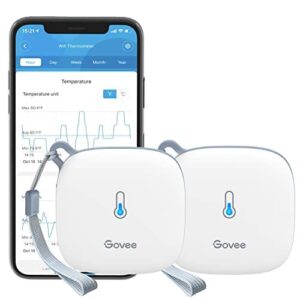
The Govee WiFi Temperature Sensor is a solid starting point for overnight reptile monitoring. Its Swiss-made sensor achieves ±0.54°F accuracy, updating every two seconds — fast enough to detect sudden temperature drops before your ball python is affected.
You’ll receive push alerts straight to your phone when thresholds are crossed, ensuring immediate awareness of critical changes. Additionally, two years of exportable data allows you to track trends rather than merely reacting to incidents.
One important consideration: the device is 2.4 GHz only, so verify your router compatibility before setup.
| Best For | Reptile owners, plant growers, and hobbyists who need reliable, real-time remote monitoring of temperature-sensitive environments from their smartphone. |
|---|---|
| Connectivity | Wi-Fi 2.4GHz + Bluetooth |
| Temp Accuracy | ±0.54°F |
| Power Source | 3× AA batteries |
| Data Logging | 20 days online, 2 years export |
| Alert Support | Push notifications |
| Humidity Sensing | ±3% RH |
| Additional Features |
|
- Swiss-made sensor hits ±0.54°F accuracy and refreshes every two seconds, so you catch temperature swings fast
- Push notifications alert you the moment conditions go out of range — no need to constantly check the app
- Stores up to two years of exportable data, making it easy to spot long-term trends and patterns
- Only works on 2.4 GHz Wi-Fi, so it won’t play nice with 5 GHz-only routers
- Alert thresholds can only be configured via Bluetooth, meaning you have to be physically near the sensor to change them
- Some users run into intermittent Wi-Fi dropouts that may need a Bluetooth reset to fix, which isn’t ideal for unattended monitoring
2. Govee WiFi Thermometer Hygrometer
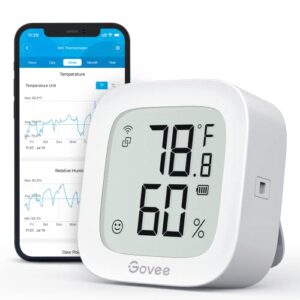
The H5179 enhances basic temperature monitoring by adding humidity tracking, a critical feature for tropical species like crested geckos and ball pythons. This dual functionality ensures precise environmental control for sensitive habitats.
Its Swiss-engineered sensor delivers exceptional accuracy—±0.54°F for temperature and ±3% RH for humidity—and refreshes readings every two seconds, eliminating delays that could lead to outdated measurements during critical checks.
Threshold alerts notify users directly via smartphone, while two years of exportable data history allows for trend analysis, helping identify gradual humidity shifts before they impact animal health.
Powered by a single AA battery lasting approximately six months, the device minimizes maintenance demands, ensuring uninterrupted overnight monitoring without frequent replacements.
It also provides Wi‑Fi remote data access through its dedicated mobile app, enabling real-time insights and historical reviews from any location.
| Best For | Reptile owners, greenhouse hobbyists, and anyone who needs reliable, remote environmental monitoring for humidity-sensitive spaces. |
|---|---|
| Connectivity | Wi-Fi 2.4GHz + Bluetooth |
| Temp Accuracy | ±0.54°F |
| Power Source | 1× AA battery |
| Data Logging | 13 days online, 2 years export |
| Alert Support | Push notifications |
| Humidity Sensing | ±3% RH |
| Additional Features |
|
- Tracks both temperature and humidity with solid accuracy, refreshing every 2 seconds so you’re always seeing current conditions
- Sends smartphone alerts when readings cross your set thresholds, so you can catch problems fast without constantly checking the app
- Stores up to 2 years of exportable data, making it easy to spot trends or meet any compliance requirements
- Only works on 2.4 GHz Wi-Fi, so if your router runs 5 GHz only, you’ll have a problem
- No AC power option means you’re swapping batteries every 6 months or so, and some users have reported spotty connectivity
- All cloud features depend on the Govee app and an internet connection—no app, no remote access
3. SensorPush Smart Temperature and Humidity Sensor
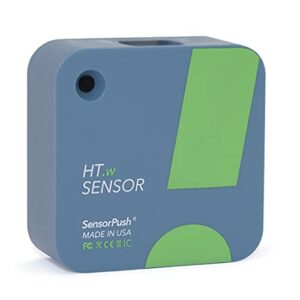
The SensorPush HT1 steps up with industrial-grade precision, offering ±0.5°C temperature accuracy and ±2% RH humidity tolerance that make it one of the tightest-spec sensors in this price range.
Its on-board memory stores 45 days of readings locally, so overnight data never disappears during a Bluetooth gap.
Add the optional G1 Wi-Fi Gateway and you get remote push alerts with unlimited cloud storage—a real advantage when you’re away from your collection overnight.
| Best For | Anyone who needs reliable, set-it-and-forget-it monitoring for wine cellars, freezers, greenhouses, or other spaces where temperature and humidity actually matter. |
|---|---|
| Connectivity | Bluetooth LE |
| Temp Accuracy | Not specified |
| Power Source | Coin cell |
| Data Logging | 45 days on-device, unlimited in app |
| Alert Support | Push/email via gateway |
| Humidity Sensing | Yes, plus VPD & dew point |
| Additional Features |
|
- One-tap Bluetooth pairing gets you up and running fast, and the app stores your full history so nothing gets lost.
- Tracks more than just temp and humidity—heat index, dew point, and VPD are built right in, which is a big deal for growers and fermenters.
- Add the G1 Gateway and you get remote alerts from anywhere, so you’re never caught off guard by a failing fridge or a hot greenhouse.
- The G1 Wi-Fi Gateway costs extra—remote access isn’t included out of the box, which stings at this price point.
- At $69.99, it’s a tough sell if you just need basic readings and don’t care about the advanced metrics.
- The battery is a non-standard coin cell, so when it dies, finding a replacement takes a bit more effort than grabbing AAs at a corner store.
4. Inkbird Wireless Temperature Humidity Sensor
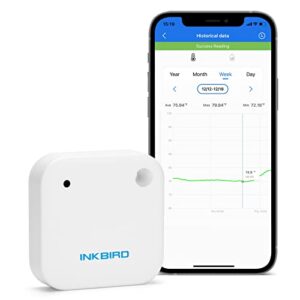
Where the SensorPush leans on precision, the Inkbird IBS-TH2 leans on flexibility.
Its IPX4 waterproof housing withstands humid tropical setups without complaint, and the 98-foot Bluetooth range covers most reptile rooms comfortably.
On-board memory holds up to 30,000 readings—plenty for tracking overnight dips across multiple enclosures.
You’ll need the IBS-M1 or M2 gateway for remote alerts, but once that’s in place, the Inkbird app delivers real-time graphs and configurable high/low alarms straight to your phone.
| Best For | Budget-conscious reptile keepers who want flexible, waterproof monitoring across multiple enclosures and don’t mind a little extra setup. |
|---|---|
| Connectivity | Bluetooth LE |
| Temp Accuracy | Not specified |
| Power Source | 2× AAA batteries |
| Data Logging | 30,000 readings |
| Alert Support | App-based alarms |
| Humidity Sensing | 0–99% RH |
| Additional Features |
|
- IPX4 waterproof housing handles humid tropical setups without breaking a sweat
- Stores up to 30,000 readings on-board, so overnight data never gets lost
- 98-foot Bluetooth range covers most reptile rooms with room to spare
- Bluetooth-only alerts mean you’re out of the loop the moment your phone leaves range
- Pairing can get flaky after a few days, which is frustrating for continuous monitoring
- The app feels clunky—no widget support, slow syncing, and a graph UI that leaves a lot to be desired
5. UbiBot WS1 WiFi Environmental Sensor
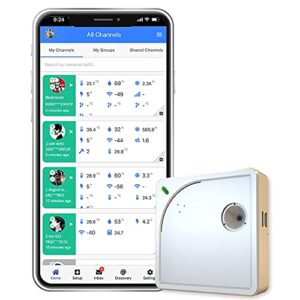
The UbiBot WS1 is built for keepers who need professional-grade overnight logging without babysitting their setup. It tracks temperature, humidity, and ambient light simultaneously, and its internal memory holds up to 300,000 readings—so even a Wi-Fi outage won’t cost you data.
Connect an external DS18B20 probe to monitor substrate or hide temperatures directly. Alerts reach you via push, email, SMS, or voice call, ensuring critical notifications never fail.
For off-grid rooms or secondary collections, that redundancy is hard to beat.
| Best For | Serious keepers or hobbyists who need reliable, hands-off environmental monitoring across multiple locations or enclosures. |
|---|---|
| Connectivity | Wi-Fi 2.4GHz |
| Temp Accuracy | Not specified |
| Power Source | 2× AA or USB-C |
| Data Logging | ~300,000 points + 2yr cloud |
| Alert Support | Email, push, SMS, voice |
| Humidity Sensing | 10–90% RH |
| Additional Features |
|
- Tracks temperature, humidity, and light all at once — no need for separate sensors
- Stores up to 300,000 readings locally, so a Wi-Fi drop won’t leave you with gaps in your data
- Flexible alerts (push, email, SMS, voice) mean you’ll actually know when something goes wrong
- The external temperature probe costs extra and isn’t included out of the box
- Only works on 2.4 GHz Wi-Fi, which can be a headache if your router runs 5 GHz only
- The mobile app feels cluttered and setup can be finicky — some users have to manually skip steps to get connected
6. ThermoPro TP357 Digital Indoor Hygrometer
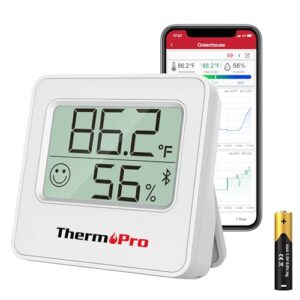
The ThermoPro TP357 is the no-fuss option when your enclosures are close and your budget is tight. Bluetooth reaches up to 260 feet in open space, making it ideal for nearby setups.
The ThermoPro app stores a full year of temperature and humidity history, complete with trend graphs designed for practical use. This ensures comprehensive data tracking without unnecessary complexity.
Accuracy holds at ±1°F, meeting the minimum threshold for safe reptile monitoring. This precision is critical for maintaining a healthy environment.
No Wi-Fi is required, and there are no subscriptions. AAA batteries last for months, ensuring long-term reliability. For a single nearby enclosure, it covers the essentials without overcomplicating things.
| Best For | Anyone who needs simple, app-connected temperature and humidity tracking for a single nearby space without spending a lot or dealing with subscriptions. |
|---|---|
| Connectivity | Bluetooth LE |
| Temp Accuracy | ±1°F |
| Power Source | 1× AAA rechargeable |
| Data Logging | 1 year on-device |
| Alert Support | App alerts |
| Humidity Sensing | ±2% RH |
| Additional Features |
|
- Stores a full year of data with trend graphs, so you can actually spot patterns over time
- Long battery life — AAA batteries last months, and you’re not stuck hunting for proprietary cells
- Clean, accurate readings (±1°F/±2% RH) delivered straight to your phone via Bluetooth
- Bluetooth range drops fast through walls, so it’s really only reliable for nearby rooms
- The Android app has no data export feature, which makes it hard to save or share your records
- Humidity readings below 20% RH lose granularity, rounding to the nearest 10%
7. AcuRite Wireless Temperature Humidity Sensor
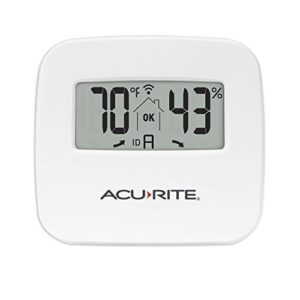
The AcuRite Wireless Temperature Humidity Sensor earns its spot through simplicity and solid range.
With a 330-foot range, it reliably covers most reptile rooms without signal issues. Updates every 16 seconds ensure rapid detection of overnight temperature dips, preventing potential problems. Its ±1°F accuracy meets the needs of most species.
However, the LCD lacks backlighting, making nighttime checks difficult.
Pair it with an AcuRite smartHUB for remote alerts; otherwise, monitoring remains local-only.
| Best For | Budget-conscious smart home tinkerers who want to monitor multiple rooms without spending a lot. |
|---|---|
| Connectivity | 433 MHz Wireless |
| Temp Accuracy | ±1°F |
| Power Source | 2× AAA batteries |
| Data Logging | Real-time display only |
| Alert Support | None (display only) |
| Humidity Sensing | ±1–2% RH |
| Additional Features |
|
- At $19.79, it’s easy to grab a few and cover your whole home without breaking the bank.
- Updates every 16 seconds, so you catch temperature or humidity shifts pretty quickly.
- Works with a ton of existing AcuRite gear, so no need to replace everything you already own.
- No backlight on the LCD, so reading it in a dark room is a pain.
- You’ll need an AcuRite hub or base station if you want remote monitoring — the sensor alone won’t cut it.
- Display only shows whole numbers, so don’t expect precision if you need decimal readings.
8. Zoo Med Terrarium Digital Thermometer
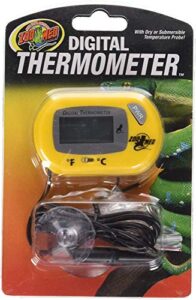
The Zoo Med Terrarium Digital Thermometer (TH-24) serves as a no-frills backup for monitoring reptile habitats when Wi-Fi sensors feel excessive. Its submersible external probe easily reaches substrate, water features, and hide boxes, offering reliable measurements across a range of -10°F to 140°F—ideal for typical reptile environments.
The device provides real-time LCD readouts in Fahrenheit or Celsius, while its humidity-resistant construction ensures durability in tropical setups.
Priced under $10, it’s not designed to replace advanced wireless logging systems. However, as a secondary check for a single enclosure, it proves practical and space-efficient.
| Best For | Reptile and hermit crab owners who want a simple, affordable thermometer to keep an eye on temps without overcomplicating their setup. |
|---|---|
| Connectivity | Wired Probe |
| Temp Accuracy | Not specified |
| Power Source | Not specified |
| Data Logging | None |
| Alert Support | None |
| Humidity Sensing | No |
| Additional Features |
|
- Submersible probe means you can check water features, substrate, or hide spots—not just ambient air
- Switches between Fahrenheit and Celsius, so it works however your brain thinks about temperature
- At under $10, it’s an easy add-on for a secondary enclosure or backup check
- Accuracy can slip at higher temps, which is a real concern for desert reptile setups
- Build quality is basic—don’t expect it to last years of heavy use
- One probe only, so larger or multi-zone enclosures will need more than one unit
Key Features for Overnight Accuracy
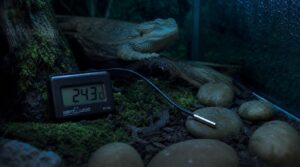
Not every thermometer built for daytime use holds up when the lights go off and temperatures start shifting. The features that matter most overnight are different from what you’d prioritize for a basking check at noon.
Here’s what to look for before you buy.
1°F or Tighter Accuracy for Safe Nighttime Readings
A single degree off sounds minor until you’re keeping iguanas that can’t drop below 75°F. Precision sensor types—thermistors and RTDs—deliver 1°F accuracy or better across typical terrarium ranges. Sensor drift management through regular calibration protocols keeps readings honest over time.
- Verify 0.5°F accuracy specs before purchasing
- Run reference thermometer comparisons monthly
- Perform tolerance standards review after battery changes
- Document sensor calibration results for trend tracking
High and Low Temperature Alerts for Overnight Drops
A silent drop to 68°F at 2 a.m. won’t wake you—but a properly configured alert will. Set high/low temperature alerts with threshold calibration matched to your species’ floor, ensuring precise monitoring tailored to specific needs.
Use time-window scheduling to activate alerts exclusively overnight, minimizing disruptions during the day while prioritizing critical hours.
Multi-zone alerts enable simultaneous coverage of both warm and cool areas, providing comprehensive environmental oversight across diverse spaces.
Alert escalation through SMS redundancy guarantees remote notifications reach you reliably, even if primary push notifications fail, ensuring uninterrupted awareness.
Min/max Memory for Morning Temperature Review
Once alerts have done their job overnight, the min/max memory function provides a comprehensive overview by morning. Each probe independently timestamps its extreme values, precisely capturing events like a nighttime temperature drop.
Check these readings before clearing them—memory reset timing is critical for maintaining accurate trend logging practices.
Consistent data logging, influenced by multiple probe tracking and battery impact on memory retention, remains your most effective diagnostic tool.
Backlit Displays for Quick Nighttime Checks
Min/max memory tells you what happened—a backlit display tells you what’s happening right now. When nighttime temperature drops occur, you don’t want to fumble for your phone. A quality digital thermometer with Glare-Free Visibility and Uniform Backlighting provides instant, readable data without disturbing your animals.
- Adjustable Brightness prevents terrarium glass glare
- Warm Light Spectrum minimizes circadian disruption for nocturnal reptiles
- LED Power Efficiency extends battery life during overnight monitoring
- Backlit display makes your reptile thermometer readable at a glance
Long Probes for Hides, Substrate, and Basking Surfaces
A backlit readout shows the moment’s notice—but only if your probe is where the animal actually is. Probe length selection matters because a short sensor clipped to enclosure mesh misses hide-box floors entirely.
Flexible tip design lets you press against curved basking surfaces for accurate temperature readings. This ensures precise measurements on uneven areas.
For substrate probes, target 1–3 cm depth to monitor conditions where animals burrow or rest. Regular calibration procedures, maintenance, and cleaning are essential to prevent issues like undetected nighttime temperature drops.
Temperature and Humidity Tracking for Tropical Terrariums
Probe placement manages temperature, but tropical terrariums add humidity into the equation. Microclimate Zoning ensures warm and cool sides maintain distinct relative humidity (RH) levels, while real-time RH alerts detect overnight swings to prevent mold.
Dew Point Management eliminates condensation risks, forming the foundation of robust humidity control. Practical implementation involves:
- Track RH between 60–90% with Real-time RH Alerts
- Use Automated Mist Scheduling to maintain overnight consistency
- Monitor dew point for Mold Prevention
- Apply temperature monitoring and real-time monitoring across both zones
- Set remote alerts for humidity spikes during lights-out hours
Wi-Fi Vs Bluetooth Night Monitoring
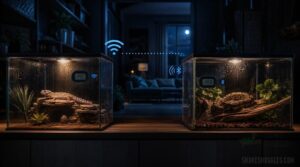
The connection type your thermometer uses shapes everything about how you monitor overnight temperatures. Wi-Fi and Bluetooth each have real strengths depending on how close you are to your enclosures when things go wrong at 2 AM.
Here’s how they stack up across the scenarios that matter most to reptile keepers.
Wi-Fi Thermometers for Remote Overnight Alerts
Wi-Fi connectivity transforms your phone into a 24/7 enclosure watchdog. The Govee WiFi Thermometer H5179 delivers push alerts instantly when temperatures exceed your predefined thresholds, with alert latency under 30 seconds.
| Feature | Benefit |
|---|---|
| Multi-User Access | Share alerts with caretakers |
| Redundant Gateways | Maintain remote monitoring during Wi-Fi outages |
Firmware OTA updates and data encryption ensure the system remains reliable and secure overnight, safeguarding your monitoring setup.
Bluetooth Sensors for Nearby Enclosure Monitoring
Bluetooth works well when your collection is close — same room, same rack system. With proximity sampling intervals as short as one minute, a Bluetooth Thermometer like the Inkbird IBS-TH2 or SensorPush HT.w captures granular overnight data without a router.
| Feature | Inkbird IBS-TH2 | SensorPush HT.w |
|---|---|---|
| Accuracy | ±0.5°F | ±0.5°F |
| Mounting Options | Magnetic, clip | Magnetic, adhesive |
| Alert Customization | Push, email | Push, SMS |
| Gateway Integration | Optional | Yes |
| Calibration Routines | Manual | App-guided |
Low battery alerts and a reliable alert system ensure uninterrupted overnight monitoring, eliminating Wi-Fi dependency.
Cloud Logging for Long-term Nighttime Trends
Over months of nighttime data, patterns you’d never catch in real time start to emerge. A cloudlogging platform built with retention policies and log query automation transforms raw readings into temperature trends analysis you can actually use.
| Feature | Govee Wi‑Fi H5179 | UbiBot WS1 |
|---|---|---|
| Retention | Up to 2 years | Extended cloud storage |
| Anomaly Detection | Push alerts | Email, SMS, voice |
| Dashboard Visualization | App-based historical graphs | Cross-source correlation |
Remote monitoring with temperature logging provides the full overnight picture.
App Dashboards for Multiple Reptile Enclosures
Managing eight enclosures at once isn’t overwhelming when your mobile app dashboard centralizes everything. Customizable Layouts let you prioritize high-risk reptiles, while Live Data Refresh updates every 60 seconds. Multi-Unit Alerts fire per enclosure, and User Role Management keeps vet access clean. Data Export Options push CSVs for trend analysis.
| Feature | Single Enclosure | Multihabitat Setup |
|---|---|---|
| Realtime Monitoring | One feed | Unified dashboard |
| Alarm Notifications | Basic threshold | Per-enclosure rules |
| Remote Monitoring | Standard access | Role-restricted sharing |
Signal Range Limitations in Reptile Rooms
Metal enclosures act as RF interference generators, reflecting and absorbing wireless signals. This reduces a Bluetooth thermometer’s effective range by nearly 50% and creates dead zones for Wi-Fi. Employing Smart Antenna Positioning—mounting the gateway high on the opposite wall—counters these metal shielding effects.
High humidity above 80% significantly impacts performance, increasing packet loss overnight and causing Wi-Fi signal instability.
Signal Repeaters and sophisticated alert logic are essential solutions to mitigate these issues and ensure reliable connectivity.
| Factor | Bluetooth Impact | Wi-Fi Impact |
|---|---|---|
| Metal Enclosures | Range drops ~50% | Dead zones form |
| Humidity Above 80% | Packet loss increases | Signal instability |
| Remote Monitoring Range | 5–10m open space | Degrades under 15m indoors |
Best Choice for Travel, Work, and Mobile Homes
Your monitoring solution should adapt to your mobile lifestyle. Compact power options with battery efficiency up to a year ensure reliable off-grid energy for tiny homes and travel trailers. Extended-range Wi-Fi and rugged housing designs handle compact spaces and remote monitoring in demanding environments. Portable mounting kits and travel-ready dashboards maintain visibility and control, even overnight.
| Scenario | Best Feature | Top Pick |
|---|---|---|
| Travel trailer | Rugged housing design | UbiBot WS1 |
| Mobile office | Travel-ready dashboards | Govee Wi-Fi H5179 |
| Tiny homes | Compact power options | ThermoPro TP357 |
Probe Placement for Night Readings
Where you place your probes matters just as much as which thermometer you buy. A misplaced sensor can give you a false sense of security while your reptile sits in a danger zone overnight.
Here’s exactly where each probe needs to go for accurate night readings.
Warm-side Probe Placement After Lights Turn Off
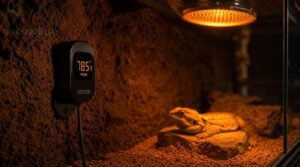
Once lighting cycles end, your warm-side probe’s position determines everything. Basking surface temperature spikes vanish fast, and ambient air temperature becomes your real target. Wall mounting the probe 2–4 inches below the heat source, away from direct radiant shielding interference, captures honest overnight data.
- Set Probe Height at 2–4 inches below the heat source
- Use wall mounting away from direct beam paths
- Apply radiant shielding barriers to block skewed readings
- Account for airflow influence from vents or fans
- Establish a monthly calibration routine against a reference thermometer
Cool-side Probe Placement for Thermal Gradient Checks
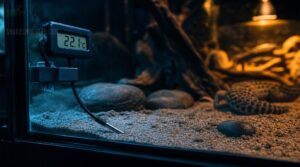
Your warm-side data means nothing without a reliable cool-side temperature reference to measure against. Substrate moisture impact can skew readings if the probe tip sits in damp substrate, so position it at substrate level near the enclosure wall. Multi-probe synchronization lets you confirm gradient stability verification across both zones simultaneously.
| Placement Factor | Recommendation | Why It Matters |
|---|---|---|
| Probe anchoring methods | Non-adhesive clips at wall base | Prevents reptile dislodgement overnight |
| Substrate depth | Surface contact, not buried | Avoids moisture-driven reading errors |
| Calibration routine timing | Before each nighttime session | Maintains ±0.5°F accuracy threshold |
| Distance from vents | Minimum 4 inches away | Eliminates draft interference on readings |
| Probe placement position | Cool-side wall, mid-enclosure depth | Captures true thermal gradient endpoint |
Continuous monitoring across both ends locks in the complete overnight temperature picture.
Hide-box Monitoring for Snakes and Nocturnal Reptiles
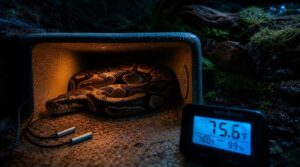
Once your gradient endpoints are locked in, the hide’s interior becomes the next critical measurement zone. Thermal Mass Effects inside ceramic hides stabilize Hide Surface Temperature far longer than plastic options—usually 15–30 minutes after heat shuts off.
For nocturnal reptiles and Ball Pythons specifically, position your temperature sensor placement using a dual-probe thermometer:
- Rest the tip directly on the hide floor
- Enable Nighttime Hide Alerts at your species’ low threshold
- Activate Hide Data Logging for overnight trend review
- Confirm Material Safety Monitoring by checking for toxic finishes before probe contact
A temperature alarm system catches drops before they become dangerous.
Substrate Probe Depth for Burrowing Species

Burrow Microclimate accuracy demands precise probe placement: push the probe 2–3 inches into the substrate. This depth captures the thermal conditions burrowing species actually experience.
Substrate composition—coconut fiber, aspen, or sand—directly influences Tunnel Stability and Temperature Buffering. Consequently, the Depth Moisture Gradient varies significantly depending on the material used.
For substrate temperature monitoring that reflects what your animal actually experiences, probe placement inside the burrow zone is non-negotiable.
Avoiding Glass, Vents, and Direct Heat Sources
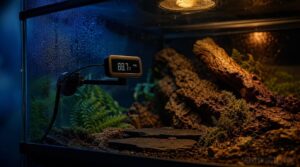
Glass conducts and stores heat, skewing external probe readings overnight. Vents create ambient temperature fluctuations that distort true enclosure conditions. Keep probes away from both, and apply Heat Plume Shielding near any heat source.
Best practices for probe placement demand Non-reflective Materials, Enclosure Airflow Management, and Radiant Heat Mitigation, alongside disciplined heat source placement. These measures ensure reliable Surface Temperature Checks.
Using Infrared Thermometers for Surface Verification
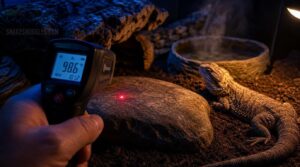
An infrared thermometer provides instant surface reads on hides and basking rocks after lights drop — no contact needed.
Emissivity Calibration is critical: set it first, as matte surfaces require values near 0.95, while shiny coatings demand 0.85–0.90.
Maintain Distance Consistency and Spot Size Management to avoid measuring unintended areas.
Ensure surface cleanliness for accuracy, and validate readings against a Reference Target Usage standard.
Following these steps guarantees 1°F accuracy every time.
Species Night Temperature Targets
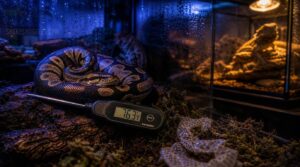
Every reptile runs on its own internal clock, and that clock is set by temperature. Getting the numbers wrong at night isn’t just uncomfortable for your animal — it can quietly derail digestion, immunity, and long-term health.
A reptile’s internal clock runs on temperature, and getting the numbers wrong at night can silently wreck digestion, immunity, and long-term health
Here’s what each species actually needs after the lights go out.
Ball Python Nighttime Temperature Monitoring
Ball pythons are nocturnal reptiles with zero tolerance for sloppy temperature management. Night drop prevention starts with keeping ambient temps between 78–82°F and the cool side no lower than 76°F.
Gradient drift analysis through a digital thermometer with a reliable alert system reveals shedding correlation and feeding timing impacts before problems compound. Thermostat calibration keeps everything locked in overnight.
Boa Constrictor Overnight Enclosure Checks
Boas demand tighter overnight discipline than most keepers expect. Run a 4-hour temperature sweep to catch gradient drift before it stresses the animal. Your dual-probe thermometer should confirm:
- Warm side holding 86–90°F, cool side at 75–80°F
- Humidity condensation checked for substrate cleaning routine needs
- Lid security verified; restlessness monitoring logged
Thermal stability depends on your alert system — don’t let battery life be the weak link.
Corn Snake Night Temperature Safety
Corn snakes are forgiving — until they’re not. Maintain a cool side temperature of 75–82°F and a warm side of 88–92°F. Gradient calibration matters here; a miscalibrated probe can mask nighttime stress indicators like restlessness or refusal to eat.
| Zone | Target Range |
|---|---|
| Warm Side | 88–92°F |
| Cool Side | 75–82°F |
| Danger Floor | Below 70°F |
Choosing the right reptile thermometer with species-specific temperature range alerts and solid battery life keeps your setup airtight.
Tropical Reptile Humidity and Temperature Balance
Tropical species live at the intersection of heat and moisture — get one wrong, and the other unravels. Green tree pythons and crested geckos need 72–80°F nights paired with 70–85% humidity.
Microclimate integration, airflow humidity balance, and substrate moisture management keep those numbers stable.
A digital thermometer with real-time data streaming, thermal gradient management, and understanding probe placement for reliable measurements lets you catch condensation prevention strategies and misting schedule optimization failures before they cost you.
Desert Reptile Nighttime Temperature Drops
Desert species face 10–20°F nighttime drops driven by desert night winds and microhabitat cooling. Substrate heat retention creates a thermal buffer effect, keeping ground temperatures 5–15°F warmer than ambient air.
Your cool side temperature and thermal gradient still need to be monitored—the ThermoPro TP357’s real-time data streaming captures these swings rapidly.
Nighttime metabolic impact and temperature accuracy importance make consistent overnight tracking essential for desert keepers.
When Low Night Temperatures Become Dangerous
Nighttime temperature drops that cause enclosure temperatures to fall below 65°F trigger cold stress signs fast—such as slowed movement, refusal to feed, and immune suppression. When temperatures drop below 60°F, hypothermia risk becomes real.
Your high/low temperature alerts and temperature sensor accuracy are critical safeguards, distinguishing between a recoverable dip and a medical emergency.
Ensure an emergency heat plan is prepared and ready to activate before nighttime temperatures drop dangerously.
Backup Alerts and Power Planning
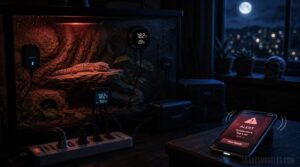
A thermometer that can’t reach you at 2 a.m. is only half a tool. Knowing your alert options and power backup strategy is what separates a close call from a real loss.
Here’s what every nighttime monitoring setup needs to stay reliable when things go wrong.
Push Notifications, Email, SMS, and Audible Alarms
Don’t leave nighttime temperature excursions to chance. Setting up failsafe alerts for temperature excursions means layering channels intentionally—what’s called Redundant Channel Design:
- Push notifications with Critical Alert Override cut through Do Not Disturb instantly.
- Email delivers detailed data logging and remote alerts for reptile husbandry review.
- SMS reaches you when Wi-Fi fails entirely.
Preference Customization lets you assign high/low temperature alerts per enclosure, so refined alert logic only wakes you when it counts.
Battery Life Checks for Bluetooth Thermometers
The Inkbird IBS-TH2 Bluetooth Thermometer with Probe ensures reliability through proactive battery management. While its app low-battery alerts activate before voltage drops to critical levels, these notifications should not be your sole safeguard. Scheduled battery replacement every 6–12 months is critical to prevent silent monitoring gaps. Cold weather significantly accelerates battery drain, requiring more frequent replacements during such conditions. Additionally, monthly battery contact cleaning—achieved by reseating the batteries—stabilizes sensor readings and maintains consistent performance.
| Check | Action |
|---|---|
| Battery Voltage Monitoring | Review app weekly |
| Cold-Weather Impact | Replace batteries sooner |
| Scheduled Battery Replacement | Every 6–12 months |
| Battery Contact Cleaning | Reseat monthly |
| App Low-Battery Alerts | Enable immediately |
Power Outage Preparation for Heated Enclosures
Size your generator capacity to cover all critical heaters, maintain a fuel rotation schedule of every 6–12 months, and house the unit in a weatherproof shelter.
Always have a manual heat backup ready. Follow a slow power restoration protocol when power returns.
Keep a non-digital backup thermometer inside every enclosure as a failsafe.
Redundant Sensors for Critical Reptile Habitats
One failing sensor at 2 a.m. can cost you an animal. That’s why redundant sensors aren’t optional for critical habitats — they’re your safety net. Build your system around these four principles:
- Sensor Fusion — cross-validate readings from two independent zones using Cross-Validation Alerts to catch drift before it becomes dangerous.
- Dual Zone Power — run warm-side and cool-side sensors on separate battery banks for true fault-tolerant logging.
- Multi-Sensor Calibration — compare readings weekly to identify placement bias or aging sensors before failure.
- Non-digital backup thermometer — keep one inside every enclosure as your last line of redundancy planning.
Together, these redundancy and backup strategies for habitat monitoring give you reliable failsafe alerts for temperature excursions, even off-grid.
Thermostat Integration for Nighttime Heat Control
Your thermometer doesn’t just report temperatures — it should drive decisions. Thermostat integration closes that loop by linking your digital thermometer readings to Adaptive Setpoints that automatically adjust heat mat output overnight.
Multi-Zone Control lets you manage warm and cool sides simultaneously through Smart Hub Integration.
Heating Source Scheduling and Energy Efficiency come built-in, ensuring optimized performance.
This makes temperature monitoring best practices nearly automatic across every enclosure.
Ceramic Heat Emitters and Safe Night Heating Setups
Ceramic heat emitters are your most reliable night heat source — no light, no circadian disruption, just steady infrared warmth. Pair them with your thermometer’s high/low temperature alerts, and you’ve built a closed-loop safety net.
- Wattage Selection — Match emitter output to enclosure size; 50–100W covers most setups.
- Reflector Mounting and Heat Guard Installation — Directs output downward and blocks animal contact.
- Electrical Safety Codes and Ceramic Lifespan Management — Use UL-rated fixtures; expect 5–10 years with thermostat control.
Setting up failsafe alerts for temperature excursions against defined thresholds completes temperature monitoring best practices.
Frequently Asked Questions (FAQs)
What is the best thermometer for reptiles?
The best reptile thermometer balances accuracy, smart home integration, durability, and waterproofing.
For budget considerations, a digital probe thermometer with high/low temperature alerts and a clean user interface covers most keepers’ needs reliably.
Can reptile thermometers detect humidity spikes overnight?
Yes — many temperature and humidity sensors do detect overnight spikes. Models with real-time data streaming and species-specific thresholds push instant alerts when humidity climbs past safe limits while you sleep.
How often should nighttime temperature logs be reviewed?
Every morning counts. Review nighttime logs within the first hour after lights come on. High-risk enclosures warrant pre-dawn checks too.
Run a weekly threshold audit and build monthly trend charts for staff accountability.
Do wireless sensors work inside glass terrariums?
Wireless sensors do work inside glass terrariums, though glass thickness impact and RF attenuation can weaken signals. Positioning near vents or using an external antenna keeps connectivity solid.
Which reptiles need the strictest nighttime temperature control?
Iguanas, ball pythons, and tropical species face the highest risk. Their narrow thermal tolerance and high metabolic demand make temperature drift dangerously fast — species-specific temperature ranges must be maintained tightly through every night.
Can one app monitor both temperature and lighting schedules?
Some apps do offer unified control, combining dual sensor sync with schedule overlay for temperature and lighting in one dashboard. Cloud synchronization and cross-platform alerts keep everything connected seamlessly.
Conclusion
A thermostat controls the heat, but reptile thermometers for nighttime monitoring are your eyes when the lights go out. Equipment fails quietly—a tripped breaker, a dead ceramic emitter—and by morning, the damage is done. The sensors you choose tonight determine whether you catch that drop at 2 a.m. or discover it too late.
Pick a device with alerts, accurate readings, and reliable connectivity. Your animal’s overnight safety depends on what you set up before you sleep.
- https://ennologic.com/pet-owners-find-temperature-gun-helps-maintain-a-healthy-reptile-enclosure/?srsltid=AfmBOor7RnY_finG2Td0hC-F5f11sefKb30RuCZR0EUAf5lLZeoWK2F9
- https://www.thebiodude.com/collections/reptile-thermostats-thermometers?srsltid=AfmBOoowBU3zjej0OLFGtfSOPT0iyg9pdJnfTgaEbqTdxryeLo7lREi6
- https://www.pangeareptile.com/collections/thermometers-and-hygrometers-1?srsltid=AfmBOormt_NBOPUHV7Wwg88tWF8Nomk80WJ-EMtYLOGur70L4eWHuJ1Y