This site is supported by our readers. We may earn a commission, at no cost to you, if you purchase through links.

Ball pythons don’t need a mansion. A healthy, thriving snake fits comfortably in a setup that won’t eat your entire bedroom floor—and that surprises a lot of first-time keepers who assume bigger always means better.
The truth is space efficiency matters more than square footage. A well-configured 36 x 18 x 18 inch enclosure with proper thermal gradients, secure locks, and the right substrate outperforms a sprawling tank that’s poorly managed every time.
Finding the best ball python kits for small spaces comes down to three things: correct dimensions for your snake’s life stage, reliable temperature control, and features that make weekly maintenance painless. These five kits deliver all of it without demanding a dedicated reptile room.
Table Of Contents
- Key Takeaways
- Top 5 Small-Space Ball Python Kits
- Choosing The Right Compact Enclosure
- Essential Small-Space Kit Features
- Space-Saving Ball Python Setup Tips
- Frequently Asked Questions (FAQs)
- Do ball pythons like small spaces?
- What kind of decor do ball pythons like?
- Can ball pythons live with other reptiles safely?
- How often do ball pythons need veterinary checkups?
- What live plants are safe for ball python enclosures?
- How long do ball pythons typically live in captivity?
- Do ball pythons require UVB lighting in their habitat?
- Conclusion
Key Takeaways
- A compact, well-configured enclosure with proper thermal gradients and secure locks outperforms a larger, poorly managed tank every time.
- Enclosure size must match your ball python’s life stage: hatchlings need 12–16 inches square, juveniles require a 24×18×12 inch minimum, and adults need at least a 36×18×18 inch footprint.
- Temperature control, escape-proof latches, snug hides, humidity-friendly ventilation, and front-opening doors are the five non-negotiable features any compact ball python kit must have.
- Vertical enrichment, corner hides, and humidity shields let you maximize a small footprint without sacrificing the thermal gradient or security your snake depends on.
Top 5 Small-Space Ball Python Kits
Finding the right enclosure when space is tight doesn’t mean settling for less. Each of the five options below was chosen with compact living in mind — no wasted floor space, no oversized footprint. Here’s what made the cut.
Getting the temperature gradient right is just as important as the enclosure itself — check out this guide on ideal temperature gradients for ball pythons to make sure your compact setup still meets every thermal need.
1. Exo Terra Mini Wide Glass Terrarium Kit
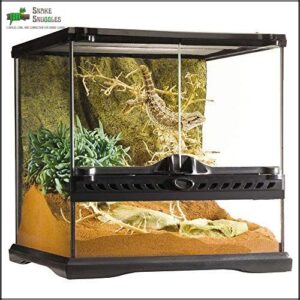
The Exo Terra Mini Wide Glass Terrarium Kit is a solid starting point for hatchling ball pythons in tight spaces. Its 12 x 12 x 12 inch footprint fits most shelves or desks without a fight. Front-opening dual doors make feeding and spot-cleaning easy — no awkward top-down reach required.
If you’re budgeting for a setup like this, it helps to understand the full cost of owning a pet snake before your hatchling outgrows its first home.
The raised bottom frame fits a substrate heater underneath, and five closable inlet ports keep your cords organized. Just know the glass construction tips the scale at 13.23 pounds once filled.
| Best For | Reptile and amphibian owners looking for a compact, beginner-friendly enclosure for small species like geckos, frogs, or hatchling snakes. |
|---|---|
| Primary Material | Glass and plastic |
| Weight | 13.23 lbs |
| Ventilation Type | Front window and mesh top |
| Access Style | Dual front doors |
| Bottom Design | Raised bottom frame |
| Intended Species | Geckos, frogs, snails |
| Additional Features |
|
- Front-opening dual doors make feeding and daily maintenance easy without stressing your pet
- Raised bottom frame accommodates a substrate heater, and five closable inlet ports keep cords tidy
- Waterproof bottom and removable screen top make it flexible for both desert and rainforest setups
- At 13.23 pounds empty, the glass construction gets heavy and awkward to move once filled with substrate and decor
- The Styrofoam background can degrade or discolor over time with regular cleaning
- The small 12 x 12 x 12 inch size may limit your lighting options and won’t suit species that need more room to roam
2. Carolina Custom Cages Extra Long Deep Terrarium
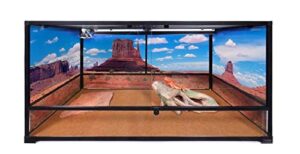
If you’re housing an adult ball python, the Exo Terra’s 12-inch footprint won’t cut it for long. The Carolina Custom Cages Extra Long Deep Terrarium steps up with a 48x24x24 inch all-glass build — well above the 36x18x18 inch adult minimum.
At 73 pounds, it needs two people to move. The 6.3-inch waterproof base tray accommodates deep bioactive substrate without leaking, and the key-lock sliding doors keep escapes off the table entirely.
| Best For | Reptile owners housing adult ball pythons, bearded dragons, or blue tongue skinks who need a spacious, secure, bioactive-ready enclosure. |
|---|---|
| Primary Material | Tempered glass and steel |
| Weight | 73 lbs |
| Ventilation Type | Full steel mesh top |
| Access Style | Sliding front doors |
| Bottom Design | 6.3-inch deep waterproof base |
| Intended Species | Bearded dragons, skinks, snakes |
| Additional Features |
|
- Generous 48x24x24 inch footprint well exceeds adult reptile space requirements
- 6.3-inch waterproof base tray supports deep bioactive substrate without leaks
- Key-lock sliding doors and full steel mesh top keep escapes and escapes firmly in check
- At 73 pounds, assembling or repositioning requires two people
- Plastic feet can slide on smooth floors without added grip pads
- High-humidity species may need partial mesh coverage to maintain proper moisture levels
3. Exo Terra Glass Natural Terrarium Kit
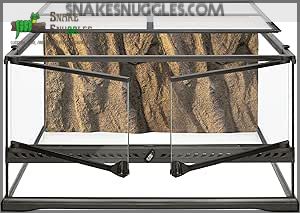
Not every setup calls for a 73-pound giant. The Exo Terra Glass Natural Terrarium measures 24x18x12 inches — the right fit for young adult ball pythons — and weighs just over 30 pounds.
Front-opening dual doors with integrated locks make feeding and cleaning straightforward without disturbing the animal. The raised bottom frame holds under-tank heating pads, and the removable mesh top gives you control over ventilation. One trade-off: the foam background shaves about 2 inches of interior depth.
| Best For | Reptile and amphibian owners looking for a mid-sized, easy-access enclosure that supports naturalistic setups for young adult animals like ball pythons. |
|---|---|
| Primary Material | Glass and foam |
| Weight | 30.12 lbs |
| Ventilation Type | Steel mesh screen top |
| Access Style | Front-opening doors |
| Bottom Design | Raised bottom frame |
| Intended Species | Reptiles and amphibians |
| Additional Features |
|
- Front-opening doors with integrated locks make feeding and spot-cleaning simple without stressing your pet
- Raised bottom frame fits under-tank heating pads, and the removable mesh top gives you real control over airflow and humidity
- Clear glass panels and a naturalistic foam background make it easy to build a visually appealing habitat with live plants and substrate
- The foam background eats up about 2 inches of interior depth, which reduces usable space
- Glass construction makes it vulnerable to damage during shipping and requires careful handling during setup
- Small gaps between the background and screen can let feeder insects escape
4. Tetra Aquatic Turtle Deluxe Aquarium Kit
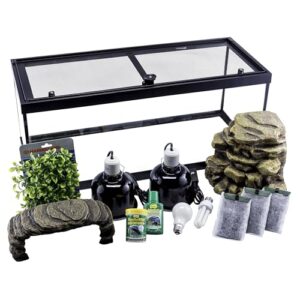
The Tetra Aquatic Turtle Deluxe Kit is built for aquatic turtles — not ball pythons. Its 30x12x12 inch glass tank is too narrow for an adult python, and the ReptoFilter’s waterfall setup eats into usable floor space.
For a species-appropriate alternative, top-rated ball python enclosures offer the floor space and humidity control that pythons actually need.
The 20-gallon glass body also tops 41 pounds, which goes against the purpose of a compact build. If you’re hunting small-space efficiency, this kit’s limitations stack up fast. Skip it; better reptile-specific options exist.
| Best For | Beginner turtle owners looking for an all-in-one setup that covers the basics right out of the box. |
|---|---|
| Primary Material | Glass |
| Weight | 41.44 lbs |
| Ventilation Type | Screen top with locking clips |
| Access Style | Removable screen top |
| Bottom Design | Standard glass base |
| Intended Species | Aquatic turtles, frogs, geckos |
| Additional Features |
|
- Comes with nearly everything you need to get started — filter, dual dome lamps, basking platform, and food samples included
- The 3-stage ReptoFilter with waterfall effect keeps water clean while adding a nice visual touch
- Works for more than just turtles — frogs, newts, and small geckos can call it home too
- No water heater included, so you’ll need to buy one separately
- The rock-style filter takes up a noticeable chunk of tank space and has specific water level requirements
- At 41 pounds with a narrow 30x12x12 footprint, it’s bulky for what you get
5. Repti Zoo 67 Gallon Reptile Glass Terrarium
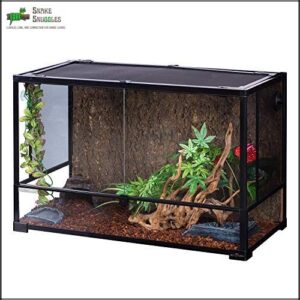
At 35.98 x 17.99 x 17.99 inches, the Repti Zoo 67-gallon clears the adult minimum — barely. Front-opening double doors reduce escape risk during feeding, and the raised bottom frame fits substrate heaters cleanly beneath the floor.
Glass construction means it lands at 52 pounds, so forget carrying it alone. The corner gaps in the mesh top also warrant close attention if you’re housing a juvenile. Seal those before the snake finds them first.
| Best For | Hobbyists and enthusiasts keeping medium-to-large reptiles like bearded dragons, pythons, or tortoises who want a versatile enclosure that works for both arid and humid setups. |
|---|---|
| Primary Material | Glass and mesh |
| Weight | 52 lbs |
| Ventilation Type | Mesh top and side windows |
| Access Style | Double hinge front doors |
| Bottom Design | Raised bottom frame |
| Intended Species | Pythons, bearded dragons, tortoises |
| Additional Features |
|
- Double-hinged front doors make feeding and daily care straightforward while minimizing the chance of escapes
- The raised bottom frame is a thoughtful touch — substrate heaters slide right underneath without any awkward modifications
- High-clarity glass panels give you a clean, unobstructed view of your animal from nearly any angle
- At 52 pounds, moving or repositioning this tank is a two-person job
- Small gaps at the mesh top corners can be a real escape risk for juvenile or smaller snakes — you’ll want to seal them before setup
- The side mesh panels can make it tricky to sustain the high humidity levels some tropical species need
Choosing The Right Compact Enclosure
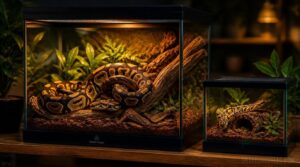
Picking the right enclosure size isn’t guesswork — it depends on where your ball python is in its life cycle. Get this wrong and you’re either stressing a hatchling with too much open space or cramping a full-grown adult. Here’s what to know before committing to a setup.
Humidity matters just as much as space — pair the right enclosure size with a solid ball python humidity setup guide to keep conditions consistent at every life stage.
Hatchling Enclosure Dimensions
A hatchling ball python is tiny, but that doesn’t mean any box will do. Your ball python starter kit needs a floor area of at least 12 to 16 inches square — enough for the snake to move, turn, and feed without stress. Aim for 8 to 12 inches of vertical clearance to support hides and stable microclimates. Anything smaller risks escape and temperature control issues.
As they grow, remember that adult ball pythons require a minimum 4x2x2 foot footprint.
Juvenile Space Requirements
Once your ball python outgrows its starter habitat kit, space requirements jump fast. A juvenile ball python needs at least a 20-gallon enclosure — or a 24x18x12 inch footprint minimum. Crowding at this stage causes chronic stress and feeding refusal.
Don’t wait until it looks cramped. Plan your ball python enclosure upgrade early. Make the move around 150–200 grams body weight.
Adult Minimum Habitat Size
Adults need space — at minimum a 40-gallon enclosure with a 36x18x18 inch footprint. For proper ball python care, the habitat must cover 6 to 8 square feet.
Three essential adult ball python snake habitat requirements:
- Girth-to-space ratio — 2–3x body girth in linear space
- Thermal zone placement — 88–92°F warm side, 75–80°F cool end
- Stretching requirements — full body extension without wall contact
Horizontal Floor Space
Floor shape matters as much as total volume. A rectangular footprint gives your ball python diagonal movement freedom — adults need 2.5 to 4 square feet of usable horizontal space. Narrow enclosures under 18 inches deep cut that range fast.
Keep 6 inches of floor clearance around hides for thermal gradient access and easy ball python care maintenance.
Stackable Enclosure Options
Stackable enclosures turn a single footprint into a modular and expandable system. Most use interlocking lips and alignment pins to lock units squarely, eliminating wobble under load. Rubberized feet dampen vibration on uneven floors.
Stacked PVC units share heat more efficiently than standalone tanks. That’s why a ball python starter kit in a dorm benefits most — maximum snake space, minimum floor sacrifice.
Essential Small-Space Kit Features
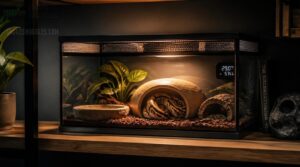
Not every kit is built with small spaces in mind, so knowing what to look for saves you from a costly mistake.
A good compact setup covers five non-negotiables: security, temperature control, proper hides, ventilation, and easy access for cleaning. Here’s what each of those features should actually look like in practice.
Secure Locking Doors
A ball python starter kit without escape-proof latches is a liability waiting to happen.
Your secure enclosure should include:
- Deadbolt security extending fully into the frame
- Anti-pry mechanisms along door edges
- Tamper detection sensors that alert you immediately
- Keyless entry options like PIN pads for quick access
Escape prevention isn’t optional — it’s the baseline.
Digital Thermostat Control
Latches keep your snake in. A digital thermostat keeps conditions safe.
Forget guessing — these units hold ±0.5 to ±1.0°C accuracy using thermistor or RTD sensors. Set your warm side to 88–92°F and the cool side to 75–80°F, then let the thermostat handle it. Automated daily scheduling and remote temperature alerts mean you’re always in control, even when you’re not in the room.
Warm and Cool Hides
Once temperatures are locked in, hides give your snake somewhere to use that gradient.
Every ball python enclosure needs two: a warm hide sitting at 88–92°F and a cool hide at 72–80°F. Both must offer a snug fit — body contact on multiple walls. Resin and ceramic materials retain heat well and sanitize easily. Compact corner designs keep your thermal gradient intact without crowding the floor.
Humidity-friendly Ventilation
Hides solve thermal needs — ventilation solves moisture balance.
Your ball python starter kit needs vents placed on the sides or rear, never directly overhead. That positioning keeps airflow gentle while humidity retention stays consistent. Target 50–80% relative humidity using a digital hygrometer inside the enclosure. When levels creep too high, mold follows fast. A variable speed fan corrects that without crashing your microclimate.
Easy Cleaning Access
Cleaning a ball python enclosure gets messy fast — substrate, waste, shed skin.
Your ball python starter kit should feature front-opening doors that swing wide and expose the full interior without repositioning the tank. Look for non-porous interior panels you can wipe down in seconds, sloped base drainage to redirect spills, and tool-free panel removal so terrarium maintenance never turns into a project.
Space-Saving Ball Python Setup Tips
A good setup does more with less — and ball pythons actually thrive when their space is tight, secure, and well-organized.
Ball pythons thrive when their space is tight, secure, and well-organized
These five tips cover everything from where to put hides to keeping things clean in a dorm room. Work through each one and your snake’s enclosure will run smoothly no matter how little room you’re working with.
Compact Hide Placement
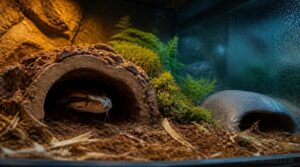
Place your warm and cool hides directly on the substrate — one near the heat source, one on the cool end. That thermal gradient gives your ball python a real choice.
Keep both hides snug against the front wall of the ball python enclosure so you can check on your snake without dismantling the whole setup.
Vertical Enrichment Ideas
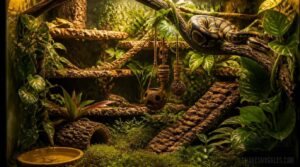
Floor space is limited — so go up.
Stackable climbing platforms (12 inches high, 14 inches wide) fit neatly inside compact terrariums without crowding the substrate. Pair them with a multi-level vine system to connect vertical hide towers into continuous exploration routes.
Try these habitat enrichment additions:
- Textured ramps on each platform level
- Adjustable vines anchored with non-toxic clips
- Hanging nutrition toys sized for juveniles
- Cork-bark vertical hides with ramped entries
- Lighter, drier upper substrate layers to encourage climbing
Humidity Shield Use
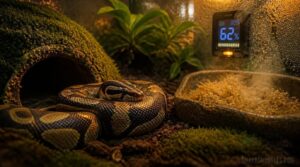
Compact enclosures lose humidity fast — every door opening drops moisture levels instantly. A humidity shield placed on the warm side near hides creates a stable microclimate, keeping relative humidity between 60–70% without soaking the whole tank.
Use hygroscopic materials or a shallow damp sphagnum tray as your moisture reservoir. Refill every 3–7 days. Check your digital hygrometer daily — target ±5% variation to support clean shedding cycles.
Safe Substrate Choices
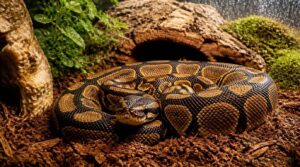
The wrong substrate can quietly harm your snake. Cedar and pine release terpenes that irritate the respiratory tract — skip both entirely.
Coconut fiber or cypress mulch are your safest loose options; they retain moisture, resist mold, and won’t compact badly. Replace substrate every 6–12 months, or immediately if mold appears. For a ball python starter kit, paper towels work fine short-term.
Dorm-friendly Maintenance Routine
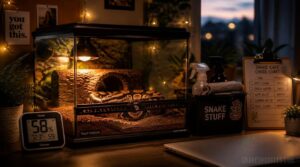
Dorm life runs on routines. A weekly 15-minute cleaning block keeps your ball python starter kit fresh and your roommates unbothered.
- Spot-clean waste daily; swap damp substrate every 3–4 days
- Store wipes and disinfectant in a labeled corner bin
- Log cleanings on a shared roommate chore chart
Track dorm humidity with a hygrometer — aim for 40–60% to prevent glass condensation.
Frequently Asked Questions (FAQs)
Do ball pythons like small spaces?
Like a mouse in a mansion, ball pythons actually prefer snug, secure spaces. They’re not thrill-seekers — they crave tight hides and defined territory. A cramped enclosure still stresses them, though. Adequate space matters for thermoregulation and natural movement.
What kind of decor do ball pythons like?
Ball pythons gravitate toward naturalistic burrowing elements — cork bark hides, hollow half-logs, and coconut husk burrows with snug, dark interiors. A secure hide should fit the snake’s body closely.
Non-toxic plants like pothos reduce stress.
Can ball pythons live with other reptiles safely?
Safely? Sharing space spells stress. Ball pythons are solitary by nature — they don’t share territory, warmth, or hides without competing aggressively. Disease spreads fast. Keep your snake housed alone, always.
How often do ball pythons need veterinary checkups?
Aim for at least one annual checkup. New snakes need a baseline wellness visit first. Watch for wheezing, stuck shed, or appetite changes — those symptoms mean you don’t wait for the next scheduled appointment.
What live plants are safe for ball python enclosures?
Pothos, spider plants, and snake plants are all safe choices. They’re non-toxic to ball pythons and boost humidity naturally. Inspect any new plant for pesticides and quarantine it for two weeks before adding it to the enclosure.
How long do ball pythons typically live in captivity?
20 to 30 years is the typical captive lifespan, though some lucky ones have exceeded Consistent husbandry, a clean enclosure, and annual vet checks make the biggest difference.
Do ball pythons require UVB lighting in their habitat?
No, ball pythons don’t require UVB lighting to thrive. A proper diet with adequate calcium and vitamin D3 covers their needs. UVB is optional — useful only if supplementation is lacking.
Conclusion
A badly chosen enclosure can undo months of careful husbandry overnight. Space isn’t the enemy—poor configuration is. The best ball python kits for small spaces prove that a compact, well-managed setup beats an oversized tank with inconsistent heat every time.
Nail your thermal gradient. Lock down humidity. Keep hides properly placed. Your snake doesn’t need more room—it needs the right room. Get that part correct, and everything else follows naturally.