This site is supported by our readers. We may earn a commission, at no cost to you, if you purchase through links.

Flip on the lights an hour after dusk, and your ball python that slept all day suddenly turns into a different animal—alert, curious, ready to explore. That shift catches plenty of owners off guard. Your snake isn’t being difficult; it’s simply following millions of years of nocturnal wiring.
Handle that moment wrong, and you’ll spook an animal that was calm minutes earlier. Handle it right, and nighttime becomes your best window for building real trust. Get the pace, the lighting, and the timing right, and even a defensive snake starts settling into your hands instead of away from them.
Table Of Contents
Key Takeaways
- Approach and handle your snake slowly using a low, side-scoop grip that supports its full body, since overhead reaches and jerky movements trigger defensive strikes.
- Prepare the room first by escape-proofing gaps, removing hazards, using dim red lighting (620–700nm), and keeping ambient temperature between 60–83°F to match your snake’s comfort zone.
- Watch for stress signals like hissing, rapid breathing, tight coiling, or fast tongue-flicking, and end the session immediately if you spot them.
- Build trust gradually with two short weekly sessions, starting at five minutes, avoiding handling after feeding or during shedding, and always ending on calm behavior.
If your snake stays calm, this guide to training snakes without causing stress shows how far station work and target following can realistically go.
Handle Nocturnal Snakes Calmly and Safely

Nighttime handling isn’t about speed or confidence—it’s about reading your snake’s rhythm and working with it. Your nocturnal snake is more alert, more reactive, and more likely to strike if you rush the process in the dark. Here’s exactly how to approach, lift, and hold your snake so both of you stay calm.
Even careful handlers get caught off guard sometimes, so it helps to know what a ball python bite actually feels like before you attempt any nighttime interaction.
Move Slowly After Lights-out
Once the lights dim, your snake’s world sharpens. Rod-dominant retinas and heat-sensing pits pick up your every move, so match your pace to your breathing—slow, steady, deliberate.
Keep steady footing, avoid sudden vibrations, and let shadows fall gently, not sharply across the enclosure. Quick jabs or jerky reaches read as threats. Calm tempo now sets the tone for everything that follows.
Support The Full Body
Once you’ve made contact, one hand cradles the mid-body while the other trails behind, giving full support from chest to tail. Never let the head or tail bear weight alone.
- Keep palm contact smooth and continuous
- Maintain body alignment with natural curves
- Distribute weight evenly to protect ribs and spine
Good weight distribution prevents twisting—key to secure handling and snake temperament.
Avoid Sudden Overhead Grabs
Reaching down from above mimics a predator strike—snakes read it as a threat, not a greeting.
Approach from the side instead, sliding your hands in at a low to mid height scoop. Keep the snake near chest level on a stable plane.
This midline grip holds the body without blocking its view. Slide in gradually as it moves; pause and redirect if you sense tension building.
Keep Sessions Short
Once you’ve settled into that midline hold, resist the urge to linger. Cap sessions at 5–10 minutes, tapering to 2–4 as your snake grows accustomed.
Short windows mean:
- calmer breathing
- fewer defensive coils
- quicker stress recovery
- less risk of accidental drops
- cleaner data for tracking temperament trends
Brief handling builds trust without triggering fatigue—precision beats endurance here.
Return Before Stress Escalates
Once your snake’s tongue-flicks quicken or it coils defensively, that’s your cue to stop—not push through.
Pairing these behavioral cues with steady handling habits from this beginner’s guide to snake training helps you build trust without overwhelming your snake.
End the session immediately at the first stress signal, then log it for your progress records.
| Stress Sign | Action |
|---|---|
| Rapid breathing | Return now |
| Tight coiling | Return now |
| Fast flicking | Pause, observe |
| Hissing | End session |
| Calm posture | Continue briefly |
Rest a full night before your next attempt.
Prepare a Safe Night Handling Area
Before you ever touch your snake at night, the room itself needs work. A few small setup steps make the difference between a calm handling session and a chaotic one. Here’s what to check first.
Escape-proof The Room

Gaps under an inch wide are all a corn snake needs to vanish. Before you dim the lights, check door sweeps, mesh vents, and any ventilation mesh security around ducts—loose screens invite escape.
Secure electrical cable management and clear clutter so nothing hides a slipped-out snake. If your enclosure uses magnetic lock safety features, test them; power loss should never mean an open door.
Remove Hazards and Pets
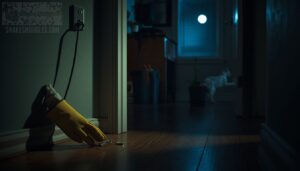
Clearing the room matters as much as locking the door. Sweep floors for small object hazards like coins or rubber bands, and tuck away cords—chewed wiring risks shock. Relocate toxic houseplants such as lilies or pothos.
- Lock cleaning agents in cabinets
- Cover exposed outlets
- Remove loose decorations
- Secure trash bins
- Keep other pets out entirely
Use Dim Red Lighting

Ditch the white light—switch to a red or infrared heat lamp instead. Wavelengths between 620–700nm won’t disrupt circadian rhythms or trigger pupil dilation, letting you observe low-light vision behavior safely.
Choose LED over incandescent for stable color and less heat drift. Angle the light low, outside the enclosure, avoiding glare off scales. Test brightness first—startled snakes remember bright lights.
Check Room Temperature

Cold rooms fool handlers into thinking a snake’s fine when it’s actually shutting down thermal regulation. Check ambient temperature with a calibrated digital thermometer at 1–1.5 meters up, away from drafts or heat sources.
Aim for 60–83°F, matching each species’ comfort zone. Watch for temperature fluctuations near windows or vents—drafts sabotage the gradient your snake relies on for stable thermal control.
Wash Hands Before Handling
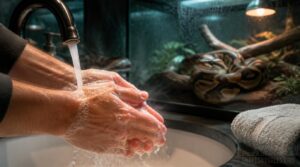
Your snake can’t wash its hands, so yours have to count double. Lather with soap and water for a full 20 seconds, covering fingers and thumbs where germs hide.
This step prevents cross-contamination between animals and stops bacteria transfer during handling. Dry completely with a clean towel before contact—damp hands spread germs faster than dry ones.
Match Handling to Snake Activity
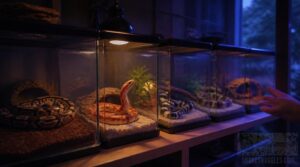
Not every snake keeps the same clock, and that matters more than most handlers realize. Your ball python and your friend’s corn snake might be active at completely different hours, even side by side in the same room. Here’s what to expect from five common species, so you can time every session right.
Ball Python Night Habits
Once the lights go out, your ball python wakes up. Expect slow, deliberate exploring rather than quick bursts—this is your cue to handle.
Keep a thermal gradient ready (mid-to-upper 70s°F) and check for burrowing in the substrate first.
Wait until early activity peaks, roughly an hour or two post-dusk, before lifting it out. Remember to limit nighttime handling to avoid stressing your snake.
Corn Snake Evening Activity
Corn snakes lean crepuscular, with twilight foraging peaks driving most of their energy right after dusk. Warm evenings often stretch this into full nocturnal activity, especially with seasonal extensions in summer.
Watch for post-dusk humidity shifts—rising moisture signals prime handling time. In suburban rooms, dim lighting mimics natural cycles well. Handle once respiration slows into steady overnight patterns, keeping temperatures between 24–30°C throughout.
Boa and Rosy Boa Timing
Rosy boas shift with the seasons—expect crepuscular to nocturnal foraging drives in warm months, with dawn and dusk marking peak movement.
Cooler nights push them toward daytime activity instead. Keep enclosures between 22–26°C for steady metabolism, and handle shortly after dusk when temperament stays calmest. Winter brumation slows things further, so ease off handling frequency until foraging drives return naturally.
Crepuscular Rat Snake Handling
Rat snakes run on a different clock than boas—true twilight activity peaks at dawn and dusk, not deep night. Approach within 30 minutes of first light shift for exploratory behavior.
Keep sessions to 5-8 minutes, watching tongue-flicking or coiling. They lean on sensory cue reliance when light fades, so move slowly and observe calmness afterward.
Diurnal Species Exceptions
Even daytime species sometimes break their own rules. When food runs scarce or temperatures dip, diurnal snakes may forage after dark instead of waiting for sunrise.
Watch for these shifts:
- Coastal habitats cooling faster after sunset
- Urban light extending activity past dusk
- Barometric pressure drops before storms
- Scarcity-induced activity pushing snakes to hunt late
Adjust your handling techniques accordingly, and stay alert to temperament changes signaling stress.
Watch for Stress and Timing Risks

Even a well-timed handling session can go sideways if you miss the warning signs. Your snake talks to you through body language, not words, so learning its signals matters as much as picking the right hour. Here’s what to watch for, and when to simply leave it be.
Hissing or Defensive Coiling
A hiss is your snake’s clearest "back off" warning—listen to it. Defensive coiling tightens muscle tension, tucking the head inward to shield essential organs while priming a faster strike if needed. This isn’t aggression; it’s stress signaling.
A hiss isn’t aggression—it’s your snake’s clearest warning to back off and give it space
When you spot coiling or hear hissing, stop handling immediately. Give your snake space, and let its temperament settle before trying again.
Rapid Breathing Signs
Watch your snake’s breathing rate as closely as its body language. Tachypnea—breathing faster than normal—shows up as visible chest movement or accessory muscle use around the ribs.
Labored, rapid breaths paired with gaping or lethargy signal real respiratory distress, not just handling stress. If breathing looks strained or irregular, stop the session, return your snake to its enclosure, and monitor behavior before your next attempt.
Increased Tongue Flicking
That flicking tongue tells you more than any body posture ever will. Rapid, oscillatory flicks—repeated bending and straightening rather than one simple protrusion—signal heightened vigilance, not curiosity. Your snake’s vomeronasal organ is working overtime, sampling airborne cues to assess threat level.
Elevated flick rate during handling usually means stress, not interest. Slow your movements, then monitor behavior closely before continuing the session.
Avoid After Feeding
A full belly turns your snake’s priorities upside down—digestion now outranks everything else. Wait at least 24 hours post-meal before handling; ball pythons and boas need the fuller window. Watch for:
- Gaping or labored breathing
- Tight defensive coiling
- Reduced responsiveness
- Reluctance to leave its hide
Keep enclosure temps stable within species range. Rushing this risks regurgitation and lasting stress.
Avoid During Shedding
A milky, opaque skin and cloudy blue eyes mean shedding’s near—hands off until it’s done. Avoid handling during shedding; the thin, tender skin tears easily, and vision loss makes snakes strike defensively. Watch for dulled behavior and slower movement.
Once shed, check eye caps came off fully. Humidity helps smooth sheds. Resume regular handling gradually as normal behavior returns.
Build Trust Through Gentle Routine
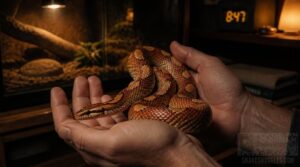
Trust doesn’t happen in one session—it builds through repetition your snake can predict. A steady routine tells its nervous system that handling means calm, not danger. Here’s how to structure that routine step by step.
Handle Two Weekly Sessions
Two sessions a week, spaced apart, works best for building trust without wearing your snake down. Pick fixed days—say, Tuesday and Friday—so the routine stays predictable.
Consistent scheduling helps you track behavior changes over time and gives your snake real recovery days between handling. Skip consecutive days; that recovery window matters more than enthusiasm does.
Start With Five Minutes
Even on scheduled days, hesitation creeps in—so commit to just five minutes. Open the enclosure, let your snake settle into your grip, and stop there.
That tiny window lowers task anxiety and builds momentum naturally. Most sessions stretch longer once your snake relaxes, but five minutes remains your honest starting cue—never a countdown to more.
Use Enrichment Before Handling
Give your snake something to explore before you ever reach for it. Cork bark hides, a scent cue from prey, or a rearranged branch invite investigation instead of defense.
Offer enrichment 30 minutes before handling—this timing lowers arousal and softens defensive postures. Match stimuli to your snake’s temperament: some prefer burrowing substrate, others favor climbing structures. Small choices like these build a genuinely safe and enriching experience.
Track Behavior Changes
Keep a simple activity log after each session: date, duration, posture, tongue-flick rate, breathing. Watch for stress signals like coiling or rapid breathing versus calm exploration.
- Note reactivity trends to touch or sound
- Correlate lighting and temperature with mood
- Track weekly milestones in calm behavior
- Assess temperament shifts over time
This data reveals real progress, not guesswork.
End on Calm Behavior
How you end a session teaches your snake what to expect next time. Watch for loosely coiled posture, slow tongue flicks, and steady respiration rates—these are your relaxation cues.
Withdraw slowly, then leave the enclosure undisturbed in its stress‑free hide. Standardizing session endings this way builds predictable, calm associations, turning nocturnal handling into a routine your snake actually tolerates well.
Frequently Asked Questions (FAQs)
What equipment do I need for night handling?
Grab a red-light headlamp, calibrated snake hook, and handling tongs. Add an infrared thermometer, snake gaiters, and a secure emergency container. These essentials keep your hands safe and your snake calm during dim, low-stress sessions.
What should I do if my snake bites me?
Stay calm, keep the limb still, and remove jewelry immediately. Call emergency services, note the bite time, and get to a hospital fast. Never cut, suck venom, ice, or apply a tourniquet.
Does moonlight affect how active my snake is?
Yes—your snake isn’t a vampire, but full moons still matter.
Moonlight suppresses activity in species like desert nightsnakes, shifting circadian rhythm and prey availability. Rat snakes ignore it entirely.
Species-specific responses mean checking your snake’s own nocturnal behavior patterns.
Can I handle my snake outdoors at night?
Only if you supervise constantly and use a secure, escape-proof space—outdoor conditions bring predator risks, temperature swings, humidity shifts, and pests that trigger stress or sudden escapes. Indoors stays safer for consistent nocturnal handling and dependable environmental control.
What protective gear guards against venomous snake bites?
Does gear really stop fangs?
Testing shows puncture-proof boot shanks and dense gaiters resist bites well.
Layered suits and bite-resistant gloves trade dexterity for safety—when a bite occurs, gear buys precious seconds before emergency treatment.
Conclusion
Darkness isn’t a warning sign—it’s an invitation. Once you master how to handle nocturnal snakes, that hour after dusk stops feeling unpredictable and starts feeling familiar.
Your snake reads your steadiness before it reads anything else. Move slowly, watch the tongue flick, respect the shed cycle, and stop before stress builds.
Do this consistently, and trust becomes routine. That calm, alert snake in your hands? That’s the payoff for patience done right.