This site is supported by our readers. We may earn a commission, at no cost to you, if you purchase through links.

A ball python in the wild spends most of its life tucked into a burrow or termite mound, hidden from anything that might eat it. Pull that snake into an open tank with glass on every side, and you’ve built its worst nightmare. That constant exposure raises stress hormones, kills appetite, and can even weaken the immune system over time.
Here’s the good news: security isn’t complicated. It comes down to a handful of habits, checked and repeated.
Knowing how to make a snake feel secure starts with seeing the world through its eyes, small, dark, and predictable. Get the enclosure, hides, and handling routine right, and you’ll watch a nervous snake settle into a calm, confident one.
Table Of Contents
- Key Takeaways
- Create a Secure, Properly Sized Enclosure
- Add Snug Hides Across Temperature Zones
- Stabilize Heat, Humidity, and Lighting
- Build Trust Through Gentle Handling
- Respond Quickly to Stress Signals
- Frequently Asked Questions (FAQs)
- How do you get a snake to trust you?
- What material can snakes not bite through?
- How to calm down a stressed snake?
- Do snakes like being held?
- How long until a new snake feels secure?
- Can too much enrichment overwhelm a snake?
- Is glass or PVC better for security?
- Should snakes be housed alone or together?
- Does enclosure location in the room matter?
- Conclusion
Key Takeaways
- Give your snake’s enclosure three covered sides, a properly sized space, and safe burrowable substrate, since an open, exposed tank keeps a snake stressed and off its food.
- Offer both a warm and cool hide (plus a humid one for shedding), each snug and opaque, so your snake can retreat and self-regulate on its own terms.
- Keep temperature, humidity, and light cycles stable and checked daily, because unpredictable conditions undo the security your hides and enclosure setup work to build.
- Handle your snake gently and briefly, watching for stress signs like hissing or tight coiling, and stop immediately if you see them to keep trust intact.
Create a Secure, Properly Sized Enclosure

Think of your snake’s enclosure as its whole world, so getting it right matters more than you might expect. A secure setup isn’t about luck, it comes down to a few key choices you make early on. Let’s walk through exactly what your snake needs to feel safe at home.
Start by sizing the enclosure to your snake’s length and species needs, since a space that’s too small or too open can leave it stressed and exposed—this guide on designing a stimulating snake environment breaks down dimensions and layout choices that actually support natural behavior.
Match Space to Adult Size
Size matters more than most owners think. Your snake’s home should fit its adult length, not the size it is today.
- Floor space: 3-5 body lengths for movement
- Height: room to stretch fully
- Length: 36-40 inches for adult ball pythons
- Substrate: 2-4 inches for burrowing
- Growth: upgrade housing as juveniles mature
Cramped tanks raise stress. Give your snake room to breathe, literally. Just as clear communication requires writing for naive readers, thoughtful housing design requires anticipating your snake’s needs before problems arise.
Cover Three Enclosure Walls
Once space is sorted, think about walls. Cover three sides with opaque, non-absorbent panels like sealed plywood, leaving one open for feeding and viewing.
| Wall | Material | Purpose |
|---|---|---|
| Back | Sealed plywood | Visual stress reduction |
| Sides | BPA-free plastic | Thermal gradient support |
| Front | None | Feeding access |
Light-colored, smooth panels resist warping and keep your secure enclosure easy to sanitize.
Secure Lids and Ventilation
With walls covered, check the lid next. A locking lid with a metal hasp and gasket stops escapes and seals air leaks.
Add a screened vent panel for proper ventilation, placed off center to avoid direct drafts. Corrosion-resistant frames keep that seal tight through regular cleaning, supporting real escape prevention.
Choose Safe, Burrowable Substrate
With ventilation sorted, look down at what’s underfoot. Your snake’s floor deserves the same care as its walls.
Pick dust-free substrate like coconut coir or aspen, never cedar or pine. Give burrowers 6-12 inches of depth for stable tunnels.
- Coconut coir holds shape and moisture
- Aspen shavings stay breathable
- Playsand mixed with soil builds sturdy burrows
- Avoid pine and cedar oils
- Check depth weekly for burrow stability
Keep The Habitat Clean
Odor builds trust faster than you’d think, since a clean space feels safer to your snake. Stick to a daily spot cleaning routine and swap water bowls every day.
Pair that daily habit with a deeper weekly sanitation session to knock out lingering bacteria—this complete snake cage cleaning guide walks you through both routines step by step.
Disinfect surfaces and decorations weekly with reptile-safe cleaner, rinsing well. Schedule a full enclosure cleaning monthly. This keeps proper ventilation working and helps lasting environmental stability.
Add Snug Hides Across Temperature Zones
Once your enclosure is set up right, hides become your snake’s next best friend. Think of them as safe rooms, not just decorations, spread across the warm and cool ends. Here’s what to look for when choosing and placing them.
Provide Warm and Cool Hides

One hide isn’t enough. Your snake needs two: a warm hide near the heat source and a cool one away from it.
Budget for both hides from the start—see the full corn snake setup cost breakdown so you’re not caught off guard at the register.
- Warm hide: 88–95°F
- Cool hide: 70–78°F
- Both: snug, away from drafts
This gradient lets your snake choose comfort on its own terms, easing stress and supporting natural thermoregulation without guesswork.
Choose Opaque, Close-Fitting Hides

Not just any box will do. Your snake’s hide needs a snug fit, matched to its girth, so it feels squeezed in a good way.
Skip clear plastic. Choose opaque hides with matte, smooth walls that block light and resist bites. Snug, sturdy, and shadowed, these hides trigger real security.
Add a Humid Hide

Shedding shouldn’t feel like a fight. A humid hide, tucked in the cool zone away from heat, gives your snake a moist retreat when skin starts loosening.
Fill it with damp sphagnum moss, rehydrated whenever it dries out. Aim for 70-90% humidity inside, checked with a small hygrometer.
Swap the moss weekly, sooner if it smells musty, to keep mold from creeping in.
Use Naturalistic Clutter and Cover

Bare enclosures feel like open fields to a snake, exposed and unsafe. Add leaf litter, bark, and driftwood to create real microhabitat creation.
Rock retreat routes and fallen branches give your snake paths to explore. Moss texture comfort and bark surface interaction add tactile richness, breaking sightlines and easing that exposed, hunted feeling snakes naturally avoid.
Keep Retreats Easily Accessible
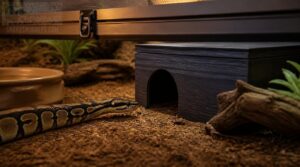
A hide your snake can’t reach fast isn’t really a hide at all. Keep pathways unobstructed and place hides 6-12 inches from the front for fast retreat access.
Check lids weekly, latches should open with one gentle push. Keep substrate depth consistent near entrances, so your snake never hesitates at the door.
Stabilize Heat, Humidity, and Lighting

Hides give your snake a place to hide, but comfort doesn’t stop there. Temperature, humidity, and light all shape how safe your snake feels day to day. Here’s what you need to get those conditions right.
Create a Safe Temperature Gradient
Snakes can’t shiver or sweat, so thermal regulation depends entirely on you. Set up a gradient from 88-95°F warm to 70-78°F cool, using thermostat-controlled heating like a heat mat or ceramic emitter. Place sensors at both ends for temperature monitoring. Verify readings daily.
Your snake should move freely between zones, no drafts, no obstacles, just proper temperature choices within reach.
Match Humidity to Species
Temperature isn’t the only gradient that matters, humidity needs one too. Desert species like ball pythons want 50-60% humidity, while rainforest pythons need 70-85%. Corn snakes stay healthy at 40-60%.
Build zonation into your enclosure: a moist hide near damp substrate, drier air elsewhere. Watch for swings past 20% RH hourly, that’s when shedding problems start.
Use Thermostats and Digital Gauges
Guessing temperatures wastes effort. Use a thermostat-controlled heating system to hold your warm side steady, then verify with digital gauges at snake eye level on both ends. This confirms your temperature gradient actually works.
Calibrate gauges yearly against a known reference. Check readings daily, since drift happens quietly and undermines enclosure security before you notice.
Prevent Dangerous Temperature Spikes
Once your gauges confirm accuracy, guard against spikes actively. Place your probe near the basking area, not the air, so your thermostat controlled heating reacts fast. Add ambient monitoring as backup, and consider a brief cooling period overnight.
Keep backup power ready too. Power outages shouldn’t wreck your hard-won temperature gradient.
Maintain Predictable Day-Night Cycles
Beyond heat, your snake’s inner clock craves rhythm. Run a fixed 12-hour light and dark cycle, syncing thermal cycle alignment with those changes. Dim evening lighting, brighten mornings.
Keep feeding schedule consistency too, always daytime. This day-night change precision stabilizes mood and appetite. Track sunrise shifts weekly. A steady rhythm builds real security, not just comfort.
Build Trust Through Gentle Handling

Trust with a snake isn’t given, it’s earned, one calm session at a time. Your hands can either signal safety or send that snake straight into defense mode. Here’s how to handle yours the right way, step by step.
Understanding how environment shapes behavior is key, and reticulated python temperament traits show exactly how husbandry and handling work together to build a calmer, more trusting snake.
Trust isn’t given by a snake, it’s earned one calm, gentle session at a time
Let New Snakes Settle
Patience pays off here. Give your new snake an initial acclimation period of 24 to 72 hours before touching it, letting it settle into its secure enclosure undisturbed.
- Keep the room quiet
- Skip handling entirely
- Check hiding spots stay stocked
Quiet observation time builds trust. A peaceful, stress-free setup now means calmer handling later.
Wash Hands Before Handling
Before you prepare your snake before handling, scrub up like you mean it. Wet hands, lather well, then wash hands thoroughly for a full 20 seconds, covering nails and wrists.
Rinse under running water and dry completely. No water available? Use a 60%+ alcohol sanitizer instead.
This simple hand washing hygiene step guards against salmonella risk for safe handling.
Approach Slowly From The Side
Ever notice how a snake tenses up when something looms straight over its head? That’s why you approach from the side, at a shallow angle, using smooth deliberate movements.
- Keep your body low
- Watch for widening or tightening
- Avoid blocking escape routes
- Stay calm and quiet
Read its body language before any contact begins.
Support The Snake’s Mid-Body
Think of the mid-body as the snake’s center, support it well and everything else follows. Cradle it with both hands, palms flat, weight spread evenly from behind the head to the vent.
| Hand Position | Purpose | Watch For |
|---|---|---|
| Under mid-body | Full support | Sagging |
| Curved palms | Even pressure | Tight coiling |
| Slow lift | Smooth movement | Muscle tensing |
Keep Handling Brief and Predictable
Short and predictable beats long and random, every time.
- Start with 5–10 minute sessions, 2–3 times weekly
- Keep grip and pace consistent throughout
- Watch for stress cues, coiling, hissing, retreating
- Release gently within seconds, ending on a calm note
Predictable timing builds trust faster than marathon sessions ever will.
Respond Quickly to Stress Signals

Even with gentle handling, your snake will sometimes tell you it’s had enough. Learning to catch those signals early keeps trust intact and stress low. Here’s what to watch for, and what to do about it.
If your snake seems extra irritable during a shed, check that its enclosure hits the ideal humidity levels for smooth shedding before assuming it’s a behavior issue.
Watch Hissing and Tight Coiling
Listen for a sharp hiss and watch for tight coiling, both are warning signs, not random quirks. Hissing means your snake wants distance. Tight coils protect its head and organs when it feels cornered.
Learning this snake body language helps you recognize stress triggers early and respond before defensive behavior escalates into something worse.
Notice Repeated Escape Attempts
Body language isn’t the only clue. A snake that keeps pushing at lid seams or lock points is telling you something too.
Try this escape frequency analysis:
- Log each attempt’s time and location
- Rate the snake’s temperament that day
- Check retreat availability near the exit point
Missing hides near escape spots usually signal unresolved threat perception, not stubbornness.
End Stressful Handling Sessions
Once escape attempts turn frantic, or hissing and tight coiling show up, stop the session right there. This is a red zone signal, your snake fears for its life.
Support your snake with both hands, lift gently, and return it home with smooth, slow movements. No sudden drops.
Give it 24-48 hours to recover before trying again.
Recheck Enclosure Conditions
After a stressful session, your snake’s stress often points back to its home setup. Recheck enclosure conditions before the next attempt.
- Monitor ambient temperature and check humidity stability
- Inspect substrate condition and verify hide placement
- Assess enclosure integrity, including secure locks
A shaky temperature gradient or damp substrate can turn any handling session sour, no matter how gentle you are.
Seek Veterinary Help When Needed
Some stress signs go beyond behavior. Bleeding, coughing, trouble breathing, or straining to pass waste are emergency signs needing immediate care.
Keep medical records and medication doses ready. Choose a clinic ahead of time, know its emergency hours, and call first for wait times.
Routine annual vet visits catch problems early, so don’t wait for a crisis to start monitoring your snake’s health.
Frequently Asked Questions (FAQs)
How do you get a snake to trust you?
Trust grows through consistent routine interaction, gentle voice association, and calm handling. Keep sessions short, predictable, and distraction-free. Use positive reinforcement feeding and confident body language. Respect boundaries, and your snake learns you’re safe, not a threat.
What material can snakes not bite through?
Granite countertops, glazed ceramic tile, stainless steel, tempered glass, and reinforced polymers resist bites best. For secure enclosures, choose puncture-proof materials like these over plastic or wood when building your snake’s habitat.
How to calm down a stressed snake?
Ever wonder why your snake won’t settle? Watch for stress signals like hissing or tight coils, then end handling, return it to a calm distraction-free environment, and recheck hides and heat for quick recovery.
Do snakes like being held?
Not really, most snakes tolerate handling rather than enjoy it. Keep sessions short and calm, support your snake’s body fully, and watch its body language. Respecting these boundaries builds trust gradually, session by session.
For a deeper look at reading body language and timing your sessions well, safe and stress-free snake handling techniques covers everything from post-feeding windows to recognizing the early signs of a defensive mood.
How long until a new snake feels secure?
Like a new tenant settling into an unfamiliar house, your snake needs time. Expect a full Settlement Timeline of about two weeks, with steady behavioral adjustment as enclosure acclimation, hides, and gradient stability build trust.
Can too much enrichment overwhelm a snake?
Yes, it can. Too many objects crowd pathways and block thermal gradients, causing stress instead of comfort. Snakes often prefer simple, stable setups with clear access to hides over cluttered, constantly changing habitats.
Is glass or PVC better for security?
Both work well when built right. PVC frame durability resists corrosion and warping, while tempered or laminated glass offers strong impact resistance. For a secure enclosure, prioritize snug seals and sturdy locks over material alone.
Should snakes be housed alone or together?
Picture two roommates fighting over one blanket. That’s cohabitation stress. Most snakes need solitary housing, since sharing suppresses feeding and raises disease risk. Give each snake its own space, hides, and gradient. Comfort beats company here.
Does enclosure location in the room matter?
It matters more than you’d think. Pick a low-traffic, interior wall spot away from windows and vents, this keeps temperature stability, airflow quality, and noise vibration in check for a calmer snake.
Conclusion
The safest snake is the one you almost never see, and that paradox lies at the center of good care. Real security isn’t about affection, it’s about predictability. Same hides, same schedule, same gentle hands, every single time. Master how to make a snake feel secure, and you’ll watch defensive strikes fade into curious tongue-flicks. That calm animal, tucked deep in its hide, thrives precisely because you gave it a place to disappear.