This site is supported by our readers. We may earn a commission, at no cost to you, if you purchase through links.

A dry zone in a large enclosure isn’t just an inconvenience, it’s a stress point that disrupts thermoregulation, shedding, and long-term health. Reptiles with access to consistent, well-distributed humidity show measurably better hydration and fewer respiratory issues. The problem is that most misters are built for compact setups, and scaling up to enclosures that need six nozzles, 20+ psi of pump pressure, and multi-schedule timers narrows your options fast.
Reptile misting systems for large enclosures demand more than a bigger tank. This breakdown covers four systems that actually deliver on pressure, coverage, and runtime without requiring daily babysitting.
Table Of Contents
- Key Takeaways
- Top 4 Reptile Misters for Large Enclosures
- How We Selected and Compared Systems
- Choosing The Right Capacity and Pressure
- Optimizing Nozzle Placement and Mist Coverage
- Are Automatic Reptile Misters Worth It?
- Installation, Maintenance, and DIY Alternatives
- Frequently Asked Questions (FAQs)
- What is the best misting system for reptiles?
- Are automatic reptile misters worth it?
- Is there an automatic mister system for terrariums?
- How do I make a DIY reptile misting system?
- What water type works best in misting systems?
- Can over-misting harm reptiles or their habitat?
- How does misting affect enclosure temperature levels?
- What humidity levels do different reptile species need?
- How do misters differ from ultrasonic foggers?
- Conclusion
Key Takeaways
- Reptiles kept in consistently humid enclosures shed up to 40% more successfully, making reliable humidity control a direct health factor, not just a comfort upgrade.
- For large enclosures, you need at least 20–40 PSI of pump pressure to eliminate dry zones — most compact misters simply can’t deliver that coverage.
- Matching your reservoir capacity to your daily misting volume (not just enclosure size) determines whether your system runs between refills or leaves animals in a dry enclosure mid-cycle.
- Automated systems with programmable timers are worth the upfront cost for any enclosure exceeding four feet, since manual misting can’t maintain the humidity consistency that large habitats demand.
Top 4 Reptile Misters for Large Enclosures
Each system below was chosen for performance in large enclosures, so you’re not comparing budget foggers meant for desktop terrariums. They vary in reservoir size, nozzle count, pump strength, and timer capability. Pick the one that fits your enclosure dimensions and your species’ specific humidity demands.
For smaller setups that still need reliable humidity control, a well-chosen snake humidifier for small enclosures can make all the difference between consistent results and constant manual intervention.
1. REPTIZOO Tree Trunk Reptile Humidifier
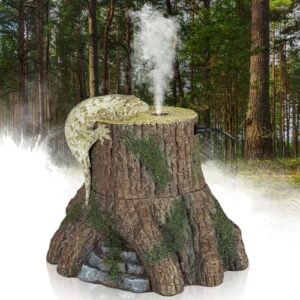
For enclosures where aesthetics matter as much as function, this unit blends into naturalistic setups with its resin tree trunk design. The stump shape also gives reptiles a surface to climb or rest on.
The 1,000ml detachable reservoir fills from the bottom and connects via USB, making daily setup simple. It runs on 10-minute mist cycles with 50-minute rest intervals, so you don’t need a separate timer.
Rinse the filter head weekly. Some units show intermittent mist failure within the first month.
| Best For | Reptile keepers who want a humidifier that doubles as a naturalistic decor piece in medium to large terrariums. |
|---|---|
| Water Tank Capacity | 1000ml |
| Adjustable Mist Output | Fixed cycle |
| Automatic Shutoff | Not specified |
| Hose Connection | Top outlet |
| Quiet Operation | Standard |
| Terrarium Compatibility | Small to medium |
| Additional Features |
|
- The tree trunk resin design blends seamlessly into naturalistic enclosures and gives reptiles a surface to climb or rest on.
- The 1,000ml bottom-fill reservoir and USB power make daily setup and refilling straightforward.
- Built-in 10-minute mist cycles with 50-minute rest intervals remove the need for a separate timer.
- Some units develop intermittent mist failure or stop working entirely within the first month.
- The stump-shaped design may be too bulky for smaller terrarium setups.
- The filter head requires weekly rinsing to maintain consistent performance, adding to routine maintenance.
2. Repti Zoo 4L Reptile Humidifier TF03M
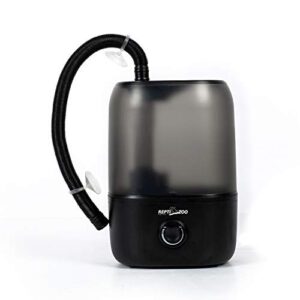
If you need serious runtime, the TF03M steps up with a 4L top-fill reservoir and up to 12 hours at max output (300ml/hour). The stepless knob adjustment pairs with a hygrostat for hands-off humidity control, and automatic shut-off protects the pump when water runs out.
That said, some users report leaking tank seals and a lightweight hose that kinks or dislodges easily. Secure the tubing with clips and check connections weekly to stay ahead of those issues.
| Best For | Reptile and amphibian keepers who need extended runtime and hands-off humidity control via hygrostat integration. |
|---|---|
| Water Tank Capacity | 4L |
| Adjustable Mist Output | Stepless knob |
| Automatic Shutoff | Yes |
| Hose Connection | Flexible tube |
| Quiet Operation | Quiet |
| Terrarium Compatibility | Vivariums |
| Additional Features |
|
- Large 4L top-fill reservoir delivers up to 12 hours of runtime, reducing how often you need to refill
- Stepless knob adjustment works seamlessly with a hygrostat for fully automated humidity management
- Automatic shut-off protects the pump when the water runs out, adding a layer of reliability
- Some users report leaking tank seals that can cause water damage around the enclosure
- The lightweight hose kinks and dislodges easily, leading to fog backup or unexpected leaks
- Mixed durability feedback, with some units failing within the first couple of months of use
3. Coospider 3.8L Reptile Fogger Mister
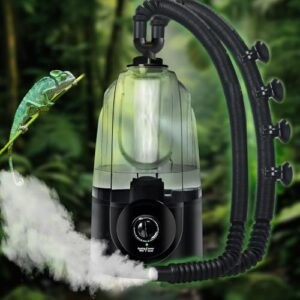
The Coospider offers a slightly smaller 3.8L tank with up to 380ml/hour output and a rotary control knob for dialing in your preferred mist density. It’s quiet at under 35dB and includes dry-run auto shutoff to protect the pump.
For reptile keepers who rely on consistent ambient humidity, pairing this humidifier with a solid care routine — like the moisture guidance in this milk snake morph and habitat care guide — can make maintaining the ideal enclosure environment far more effortless.
The tradeoffs are real, though. Refilling means disassembling the top-fill design, which risks spills. Users also report base leakage and hose connection issues, so check seals regularly and keep connections snug.
| Best For | Reptile and amphibian keepers who want quiet, adjustable misting in small to mid-sized terrariums (10–40 gallons) and don’t mind using an external timer. |
|---|---|
| Water Tank Capacity | 3.8L |
| Adjustable Mist Output | Rotary knob |
| Automatic Shutoff | Yes |
| Hose Connection | Dual hose |
| Quiet Operation | Under 35dB |
| Terrarium Compatibility | 10-40 gallon |
| Additional Features |
|
- Large 3.8L tank supports extended operation between refills
- Quiet under 35dB with a simple rotary knob for easy mist adjustment
- Dry-run auto shutoff protects the pump when water runs low
- Top-fill design requires disassembly to refill, increasing spill risk
- Reported leakage from the base and hose connections
- No built-in timer, and max output may fall short for larger enclosures
4. LANUEVA Reptile Misting System 6 Nozzles
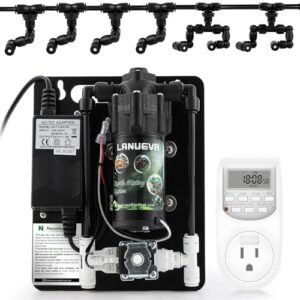
If bigger coverage is the priority, the LANUEVA’s six adjustable nozzles are worth considering. Three single and one dual-nozzle head let you position mist where your animals need it, and 360° rotation on each makes fine-tuning easy.
The silent diaphragm pump runs 5 to 70 PSI, and a return valve cuts water flow at shutdown so you’re not dealing with drips. You get a programmable timer with up to 20 schedules. Assembly is required, but the included accessories cover it.
| Best For | Reptile and amphibian owners who need broad habitat coverage and flexible misting schedules across larger terrariums. |
|---|---|
| Water Tank Capacity | External reservoir |
| Adjustable Mist Output | PSI adjustable |
| Automatic Shutoff | Return valve |
| Hose Connection | 5m pipe |
| Quiet Operation | Silent pump |
| Terrarium Compatibility | Large enclosures |
| Additional Features |
|
- Six adjustable nozzles with 360° rotation make it easy to direct mist precisely where it’s needed
- Up to 20 programmable timer schedules give you fine control over humidity without manual intervention
- The return valve prevents dripping after shutdown, keeping the enclosure from getting oversaturated
- Requires assembly before use, which adds setup time out of the box
- Limited to 20 timing programs, which may not be enough for complex multi-zone schedules
- Designed exclusively for reptile and amphibian enclosures, so it won’t suit other use cases
How We Selected and Compared Systems
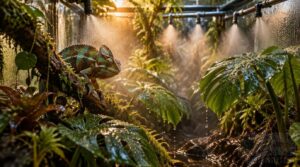
A structured scoring method guided every comparison here. Each system was tested against measurable performance benchmarks you’d care about: mist output rate normalized to enclosure volume, average droplet size, and habitat hydration uniformity across 30 to 60 minute spray cycles.
If you’re working with limited space, our guide to reptile humidifiers for apartments covers quieter, more compact options that suit smaller enclosures just as well.
Three factors carried the most weight in the final rankings:
- Large tank capacity relative to projected runtime and enclosure size
- Programmable timer accuracy and repeatability across 24 to 48 hour stress tests
- Expandable nozzle system flexibility for multinozzle coverage in complex layouts
Practical deployment details shaped the scores too. Pump vibration, low-water shutoff reliability, nozzle clog frequency, and ease of disassembly all factored in. Any system that scored inconsistently on a key metric was deprioritized, whatever the spec sheet claimed.
Choosing The Right Capacity and Pressure
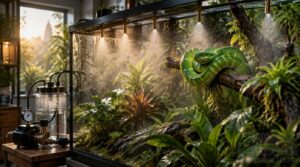
Picking the right misting system comes down to a few measurable factors, not brand names or price points. You’ll want to work through capacity, runtime, pressure, and nozzle count before committing to any unit. The points below give you a practical framework for making that call.
Match Reservoir Capacity
Your reservoir’s capacity is your system’s real ceiling.
A 38L tank controls multiple nozzles through extended daily cycles without constant refilling, while a smaller unit on a programmable timer may run dry mid-session.
Match capacity to daily misting volume, not enclosure size alone.
For most large setups, you’ll want enough to comfortably cover two to three full cycles between refills.
Estimate Required Runtime
Picture your enclosure at midday, nozzles running dry before your timer cycles off.
Divide your reservoir capacity by flow rate to find runtime. A 4L tank at 0.5 L/hr gives roughly eight hours continuous.
Set your nozzles to 15 minutes on and 15 off, and you’ll effectively double that window.
Match runtime to your humidity schedule before buying.
Choose Adequate Pressure
Mist that barely reaches the far corner tells you everything about pump pressure. For large enclosures, you’ll need 20-40 psi minimum. A 45 BAR pump controls high pressure misting reliably; a 25 BAR pump works for smaller builds.
- Weak pressure leaves dry zones
- Overpressure quickly soaks surfaces
- Pressure resistant tubing prevents leaks
Always pair your pump rating to enclosure size.
Consider Nozzle Count
More nozzles don’t automatically mean better coverage. In large enclosures, 6-nozzle systems cut dry zones by roughly 40% compared to 4-nozzle setups.
If your enclosure might grow, look for nozzle expansion support; some systems offer multinozzle expansion and support up to 20 nozzles.
4 rotating nozzles with 360-degree adjustable heads give you precise zone control without re-plumbing.
Balance Output And Coverage
More nozzles doesn’t mean better coverage. What matters is balanced output across your habitat coverage zones. Follow these five steps:
- Set a fixed flow rate per nozzle.
- Count nozzles by zone size, not enclosure size.
- Stagger timing so adjacent nozzles don’t fire together.
- Use adjustable spray output for corners.
- Verify overlap with a test grid.
Optimizing Nozzle Placement and Mist Coverage
Once you’ve sized your system, placement determines whether that output actually reaches your animal. Position nozzles 20–40 cm below the enclosure top and tilt them 15–30 degrees off vertical so mist spreads laterally instead of pooling on one surface.
Divide the enclosure into near-wall, mid-field, and center zones. You want 2–3 nozzles feeding each zone, with 60–80% runtime overlap between neighbors to eliminate dry seams. Add extra density at basking and feeding spots where heat strips moisture fastest.
Good nozzle adjustability lets you correct gaps after testing. Run a 24–72 hour trial with moisture sensors, then re-aim any nozzle that leaves a dry pocket. If you need more reach later, systems expandable to 10 nozzles save you from buying a second unit.
Are Automatic Reptile Misters Worth It?
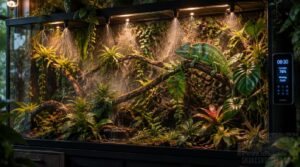
Once your nozzles are dialed in, you’re basically running a precision system. That’s where automatic misting systems prove their value: you set the schedule and walk away.
For large enclosures, the payoff is clearest. A programmable timer controls cycles you’d otherwise track manually, keeping enclosure hydration consistent overnight or when you’re away. Timer-controlled misting also removes the guesswork from humidity swings caused by ambient temperature shifts or ventilation changes.
The tradeoff is upfront cost and periodic maintenance. But if your enclosure exceeds 4 feet in any dimension, manual misting rarely delivers the habitat coverage an automated unit achieves reliably. For smaller setups, the cost-benefit is tighter, and a manual spray bottle may be enough.
For large enclosures, automated misting reliably delivers what a spray bottle simply cannot
Installation, Maintenance, and DIY Alternatives

Once you commit to an automated reptile misting system, setup quality determines long-term performance. For large enclosures, follow these installation steps:
- Mount a sealed 4L+ reservoir and route tubing with 90-degree elbows to prevent kinks.
- Install a GFCI-protected junction box, keeping electrical components 12 inches from misted surfaces.
- Prime the pump first, then calibrate each nozzle to 0.5 to 1.5 ml per minute.
Maintenance doesn’t take much time. Soak nozzles in a 50/50 vinegar-water solution weekly, swap inline filters every three to six months, and rinse the reservoir monthly with distilled water.
For DIY alternatives, a gravity-fed solenoid valve cuts costs considerably. You can also retrofit an existing humidifier with reptile-safe ultrasonic transducers, keeping mist particles between one and five microns.
Frequently Asked Questions (FAQs)
What is the best misting system for reptiles?
The best misting system for reptiles depends on enclosure size. For large setups, you’ll want an external reservoir, a programmable timer, and high-pressure misting to keep humidity consistent without constantly refilling or adjusting the unit.
Are automatic reptile misters worth it?
For large enclosures, yes. An automatic reptile mister with timer eliminates manual spraying and keeps humidity steady without constant intervention. If you’re managing a multizone habitat, the labor savings alone easily justify the upfront cost.
Is there an automatic mister system for terrariums?
Yes, an automatic mister system for terrariums exists. These use a reservoir, pump, and automatic reptile mister with timer to run hands-free, with auto shutoff safety and stepless mist control built in.
How do I make a DIY reptile misting system?
Connect a self-priming pump to an external reservoir, run tubing through leakproof connectors to your nozzles, and control runtime with a programmable timer plug. You’ll want an inline filter and distilled water to prevent clogging.
What water type works best in misting systems?
Distilled or reverse osmosis water works best. Both minimize hard water buildup in nozzles and reservoirs. If your tap supply is soft, filtered water’s fine, but RO water keeps your water reservoir maintenance simpler long-term.
Can over-misting harm reptiles or their habitat?
Over-misting absolutely can damage both. Excess humidity promotes mold, breaks down substrate, and stresses arid species. Keep misting intervals short, make sure enclosure ventilation between cycles, and watch for condensation as an early over-misting harm indicator.
How does misting affect enclosure temperature levels?
Water acts as a silent thermostat inside your setup. Highpressure misting commonly drops air temps by 2-6°C, but rising ambient humidity reduces that cooling effect. Use enclosure ventilation with temperature monitoring to keep levels steady.
What humidity levels do different reptile species need?
Tropical species need 70–90% RH, while desert reptiles sit comfortably around 20–40%. Montane species require a vertical humidity gradient, from 75–85% at substrate level down to 60–70% near the canopy. Semiarid species tolerate 30–60% RH.
How do misters differ from ultrasonic foggers?
How do misters differ from ultrasonic foggers? Picture heavy raindrops sliding down glass versus a soft haze drifting through leaves. Misters produce larger droplets that deposit on surfaces; an ultrasonic fogger creates submicron droplets that permeate air evenly, though you risk condensation.
Pair either with a programmable timer to control misting frequency, and match droplet size to your reservoir size.
Conclusion
Studies show reptiles kept in humidity-optimized enclosures shed up to 40% more successfully than those living in consistently drier setups. That gap closes faster than most keepers expect, once the right system is consistently running.
Choosing reptile misting systems for large enclosures isn’t about the biggest tank or the most nozzles; it’s about matching pressure, coverage, and scheduling to your animal’s specific daily needs. Get those variables right, and your enclosure will largely run itself.