This site is supported by our readers. We may earn a commission, at no cost to you, if you purchase through links.

A chameleon that can’t drink from standing water, a dart frog that needs 95% humidity by dawn, a crested gecko that dehydrates if you miss a single evening mist. The margin for error in tropical reptile keeping is razor-thin, and a leaky pump or miscalibrated timer can undo months of careful husbandry.
Reptile misting systems for terrariums have come a long way from plastic spray bottles. Today’s best units run 8 to 12 hours on a single fill, hit specific humidity windows to the second, and do it quietly enough for a bedroom shelf.
These six systems earned their place on this list.
Table Of Contents
- Key Takeaways
- Best Reptile Misting Systems Compared
- Our Terrarium Misting Selection Process
- Foggers Versus Misters for Terrariums
- Reptile Misting System Buyer’s Guide
- Automatic Setup, Maintenance, and DIY Options
- Frequently Asked Questions (FAQs)
- How can I make a DIY mister for my terrarium?
- Is there an automatic mister system for terrariums?
- Which is better for a terrarium, a fogger or a mister?
- What is the best mister for a terrarium?
- What type of water should I use in misters?
- Can over-misting cause respiratory issues in reptiles?
- How do I accurately monitor enclosure humidity levels?
- Conclusion
Key Takeaways
- Matching your misting system to your specific species and enclosure size matters more than price, since margin for error in tropical reptile keeping is extremely narrow.
- Reservoir capacity is the most underestimated spec: larger tanks (10–22L) dramatically reduce refill frequency and are essential for species like chameleons with non-negotiable humidity demands.
- A second-accurate programmable timer is the single most critical feature, as it mirrors natural dew cycles and builds the consistency reptiles need to stay healthy.
- Foggers spike humidity fast with minimal runoff and suit tall planted enclosures, while misters deliver targeted droplet coverage better suited to substrate moisture and larger setups—your choice should follow your enclosure type, not personal preference.
Best Reptile Misting Systems Compared
We tested six misting systems side by side, from budget-friendly to pro-grade setups. Each one earned its spot for a different reason, whether that’s reservoir size, timer flexibility, or quiet operation. Here’s how they stack up against each other so you can match one to your enclosure.
If you want the full breakdown before committing, our complete guide to automatic misting systems for reptiles covers what to look for by species and enclosure size.
MistKing Starter 5th Gen
The MistKing Starter 5th Gen earns its reputation. You get a 1.5–2 L reservoir, fine mist output, and a programmable timer with weekday scheduling. Here’s what matters for your setup:
- Expandable to 10 nozzles for larger enclosures.
- Quiet operation terrarium owners appreciate.
- Adjustable spray coverage, 40–120 degrees.
- Simple descaling every 1–3 months.
Downsides? Nozzle clogs and pump seals need routine checks.
Exo Terra Monsoon Multi II
The Exo Terra Monsoon Multi II takes a different approach to terrarium humidity control. Its centralized reservoir feeds a manifold of 360° nozzles, so you get terrarium-wide coverage from one unit. You can fine-tune output with a rotary valve, and the timer controls automated reptile misting on flexible on/off cycles.
It’s a genuine expandable misting system, pushing up to 120 ml/min with latency under 5 seconds. Quiet performance misting stays below 45 dB, so it won’t disturb your room.
Trade-offs? You’ll need a drip tray to prevent substrate flooding, and monthly vinegar cleaning keeps mineral buildup at bay. Refill the reservoir every 2–3 days at moderate enclosure sizes.
REPTI ZOO 10L Misting System
Where the Monsoon Multi II leans on a manifold, the REPTI ZOO 10L Reptile Mister goes bigger on capacity.
Its 10-liter reservoir runs 8–12 hours per fill, so you refill less often.
This automatic reptile misting system uses gravity-fed flow with a small pump, reducing wear.
You get programmable misting intervals, day/night scenes, and a transparent window for easy terrarium humidity control checks.
Pairing these features with a solid grasp of how reptile thermometers work in terrariums helps you fine-tune misting schedules based on real temperature-humidity relationships.
Moistenland Automatic Reptile Mister
If 10 liters feels like overkill, the Moistenland Automatic Reptile Misting System scales things down. Its compact pump runs on standard household power, and the programmable timer offers multiple spray settings plus a manual mist toggle.
You can expand up to 10 nozzles for wider enclosures, and quiet operation won’t spook skittish reptiles. Just flush nozzles weekly with distilled water.
1. MRREPTILE Reptile Fogger Humidifier
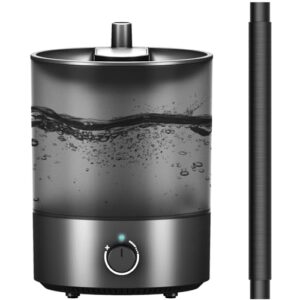
Consider the MRREPTILE Reptile Fogger if you want humidity without noise. Its ultrasonic transducer pushes out a fine, quiet mist from a 2.8L reservoir, and it pairs with outlet timers or humidistat controllers for hands-off control. Automatic dry-run shutdown protects the pump.
You’ll clean it regularly, though, since mineral buildup clogs the nozzle. Fair warning: some owners report tank leakage into the spout, and a few units fail within months.
- Quiet ultrasonic misting won’t disturb you or your pets
- Large 2.8L reservoir works with outlet timers and humidistat controllers for automatic operation
- Automatic dry-run shutdown protects the pump when water runs low
- Some units leak from the water tank into the outlet spout
- Reliability is mixed, with some units failing within 2-5 months
- Requires regular cleaning to prevent mineral buildup and float obstruction from causing fogging issues
2. Reptile Mister System with Timer
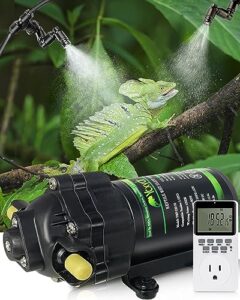
When you want control without spending much, this timer-based mister covers the basics. The mini silent pump uses a three-chamber diaphragm design, and the digital timer stores 20 programmable cycles with power-off memory, so your settings survive outages. Six 360° adjustable nozzles let you angle mist downward at 45–60 degrees for better fog dispersal.
You can expand from six to 10 nozzles total, though the unit measures just 5.2"L x 2"W x 2.4"H and weighs 1200 g.
The catch? Programming frustrates some owners, and durability reviews are mixed, including a motor failure around three months. The spray can also run strong for small enclosures, so you might remove nozzles.
- Mini silent pump with three-chamber diaphragm design keeps operation quiet
- Digital timer offers 20 programmable cycles with power-off memory to survive outages
- Expandable system supports up to 10 nozzles with 360° adjustable spray direction
- Timer programming is difficult for some users
- Durability is inconsistent, with reports of motor failure after three months
- Mist may be too strong for small enclosures, requiring nozzle removal or adjustment
Our Terrarium Misting Selection Process
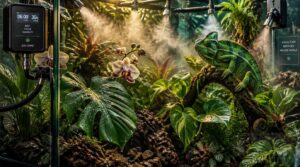
We didn’t cut corners here. Every unit in our comparison went through the same Terrarium Misting evaluation before it earned a spot.
First, we built a criteria matrix: reservoir capacity, nozzle coverage, timer precision, enclosure compatibility, and maintenance ease. We weighted those differently for arboreal tropical setups versus terrestrial desert habitats, since reptile and amphibian husbandry demands aren’t one-size-fits-all. Each system scored 0 to 5 per criterion, and the top three by total score made our shortlist.
Then came hands-on verification. We checked compatibility with existing habitat electronics, ran test cycles to confirm misting intervals, and pulled the plug to see how each unit handled power outages. You want fail-safe manual override and low-voltage protection, and we flagged anything that lacked them.
Our 4-to-6-week pilot in a mid-sized tropical terrarium tracked humidity at 6, 12, and 24 hours post-misting. We also documented MistKing parts availability, because spare nozzles and O-rings matter when downtime isn’t an option. If timer drift exceeded 15% over seven days, that system got benched.
Stocking up on MistKing nozzles and O-rings before you need them keeps your misting schedule on track without scrambling mid-cycle.
Foggers Versus Misters for Terrariums
Think of a fogger as steam from a kettle and a mister as a garden hose on fine spray. Both handle terrarium hydration, but they do it differently.
A fogger pushes out micro-fine particles, often 10 to 50 microns, so you get fast humidity spikes with almost no runoff. It’s ideal for amphibian care and tall, planted builds where you want vertical humidity layers. The catch? You’ll need solid airflow to avoid soggy hotspots, and hard water clogs the head quickly.
Foggers spike humidity fast with micro-fine mist, but poor airflow and hard water are their silent killers
An automatic reptile misting system sprays larger droplets through adjustable nozzles. You get targeted foliage moisture and even substrate coverage, which suits bigger enclosures. Pumps run louder and draw more current, though.
In any fogger vs mister comparison, your choice comes down to ambient humidity versus directed spray.
Reptile Misting System Buyer’s Guide
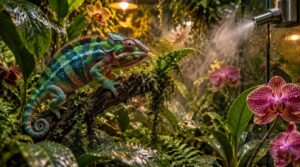
Before you spend money, you need to know what actually matters. We’ve broken the decision into six factors, from reservoir capacity to maintenance costs, so you can match a system to your setup. Here’s what to check before you buy.
Reservoir Capacity
decides how often you’ll refill, and it’s the spec most keepers underestimate. A 10L integrated tank runs a typical setup for 6–24 hours, though a single nozzle at low flow can stretch closer to 20. Larger enclosures drink more.
The 22L integrated tank buys you days between refills, ideal for big chameleon cages. Check whether a system’s expandable to 10 nozzles or expandable to 20 nozzles; more heads means faster drain. Transparent tanks let you check levels at a glance.
Timer Controls
A timer is basically your reptile’s circadian clock. Timer programming flexibility matters: a second-accurate programmable timer lets you dial in misting windows that mirror natural dew cycles. Look for adjustable misting frequency across multiple daily blocks, not just one cycle. WiFi app control adds convenience, and when the timer allows repeat misting schedules, you’re building consistency your animals benefit from.
Nozzle Coverage
Once your timer’s dialed in, nozzle coverage decides whether that mist actually reaches your animal. Look for adjustable nozzles with 90 to 180 degree horizontal spread, plus vertical tilt. 360 degree nozzles suit open enclosures; multidirectional spray nozzles handle tall, tiered setups. Check for expandable nozzle support if you’ll add enclosures, and verify even coverage with hygrometers at canopy and floor levels.
Noise Level
Coverage sorted, pump noise level becomes your next real concern. Most systems fall in the 20-50 dB range. MistKing runs quietly; the Monsoon Multi II produces an audible hum. An anti-vibration pad under your reservoir offers solid noise reduction at almost no cost.
For bedroom compatibility, slower misting cycle settings cut ticking noticeably. Quiet operation matters more than you’d think.
Dimensions and Materials
Noise handled, physical size is next. Compact units measure roughly 6×4 inches; multi-nozzle systems reach 12×6. Most units use durable plastic construction rated for sustained high humidity.
A few specs worth checking:
- Reservoir capacity runs 5–20 liters
- Silicone o-rings outlast nitrile seals in humid enclosures
- Adjustable spray patterns via directional nozzle heads
- Most are easy to install with push-fit connectors
Maintenance Costs
add up quickly. Nozzle clogging is the most frequent issue in hard-water setups, and it demands routine filter maintenance to prevent pressure loss. Combine water quality monitoring with tracking your reservoir capacity to set a reliable refill and cleaning schedule for your system.
| Cost Factor | Monthly Low | Monthly High |
|---|---|---|
| Electricity | $0.30 | $1.50 |
| Parts/Nozzles | ~$0.50 | ~$2.00 |
| Water/Minerals | Minimal | Moderate |
Automatic Setup, Maintenance, and DIY Options
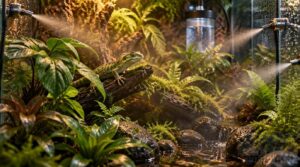
Set up your automatic reptile misting system by connecting power, filling the reservoir, and running a 5 to 10-minute purge cycle to clear air pockets before your first real mist.
Start with a single terrarium corner to verify uniform spray, then scale your terrarium misting systems and parts across multiple lines once output confirms consistent coverage. This keeps your expandable misting infrastructure manageable from day one.
Nozzle clog prevention comes down to weekly checks. Pull nozzles, clear debris, and replace any that’s running below 80% of target flow. It takes under five minutes.
For a DIY external reservoir or custom line routing, 90-degree elbow fittings guide tubes cleanly around décor. An inline pressure regulator keeps spray stable through power fluctuations.
Frequently Asked Questions (FAQs)
How can I make a DIY mister for my terrarium?
You can build a DIY terrarium humidifier using a small aquarium pump, an external reservoir, and airline tubing. Seal the joints, run a tubing leak test, then automate using spray duration settings and interval scheduling.
Is there an automatic mister system for terrariums?
Yes, there are automatic reptile misting systems built specifically for terrariums. They rely on a programmable timer to manage adjustable misting frequency and can often expand up to 10 nozzles as your enclosure collection grows.
Which is better for a terrarium, a fogger or a mister?
It depends entirely on your enclosure setup. Tall, densely planted terrariums favor foggers for uniform humidity coverage. If you’re prioritizing substrate moisture or targeted leaf areas, a mister gives you better and more precise control.
What is the best mister for a terrarium?
Rain doesn’t fall equally, and your terrarium’s mist shouldn’t either. The MistKing Starter Misting System V 50 leads the Best Reptile Misting Systems for Terrariums with precise reptile enclosure hydration and reliable fine mist generation.
What type of water should I use in misters?
That white crust on your nozzles? It’s avoidable. Use distilled water or reverse osmosis water to minimize buildup. If your water source connection is hard, a filter included system takes care of hard water descaling for you.
Can over-misting cause respiratory issues in reptiles?
It absolutely can. Running your automated misting system too long keeps humidity elevated, soaks substrate, and lets microbial growth thrive inside the enclosure. That sustained damp environment puts your reptile’s respiratory health at serious risk.
How do I accurately monitor enclosure humidity levels?
Place a calibrated hygrometer at mid-enclosure height, well away from direct spray. Don’t read it right after misting; wait 10-20 minutes. Logging daily RH highs and lows helps you fine-tune terrarium moisture regulation over time.
Conclusion
A keeper once lost a chameleon to a pump failure during a single weekend away. No backup, no alerts, no second chance. That’s exactly the reality reptile misting systems for terrariums are designed to prevent. The right unit runs quietly, holds enough water, and hits the humidity windows your animals actually need to thrive.
Pick the system that best fits your setup and your species, not just your price point. Your animals definitely won’t wait.