This site is supported by our readers. We may earn a commission, at no cost to you, if you purchase through links.
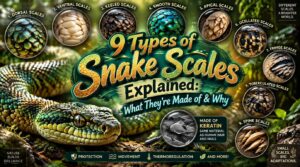
A snake’s body is covered in hundreds of scales, and no two regions look the same. Dorsal scales ridge along the back for grip and camouflage, ventral plates anchor each movement forward, and a transparent spectacle scale shields each eye without eyelids.
Understanding the types of snake scales tells you far more than anatomy. It reveals how a species hunts, where it lives, and even its sex. Field herpetologists use scale counts and arrangements to identify species that look nearly identical at a glance.
This breakdown covers nine distinct scale types, what each is made of, and the survival function it performs.
Table Of Contents
- Key Takeaways
- What Snake Scales Are Made Of
- 9 Main Types of Snake Scales
- How Scale Types Support Snake Survival
- Top 5 Picks for Scale Enthusiasts
- Frequently Asked Questions (FAQs)
- What are the different types of scales on a snake?
- What are the four different types of scales?
- What are the 7 levels of classification for a snake?
- Which snake has the toughest scales?
- Can damaged snake scales heal or regenerate over time?
- Do male and female snakes have different scale patterns?
- How many total scales does a snake typically have?
- Do snake scales change color or pattern as they age?
- Can a snakes species be identified by scales alone?
- Conclusion
Key Takeaways
- Snake scales are folded thickenings of the skin itself, made of tough reptile-specific beta-keratin, so they’re numb armor whose color comes from pigments like melanin embedded within.
- The nine scale types each have a distinct job: dorsal scales aid grip and camouflage, ventral plates drive locomotion, the transparent spectacle scale permanently shields each eye (which is why snakes can’t blink), and rattle segments form from molts that don’t reveal age.
- Scale counts and arrangements—like dorsal rows, ventral counts, and subcaudal numbers—are diagnostic tools herpetologists use to identify species, though scales alone can’t confirm a species without geography, color, and behavior.
- Damaged scales don’t regrow like bone; healing happens through ecdysis (shedding), which renews the entire epidermis, while scale patterns stay fixed for life even as color shifts with wear and age.
What Snake Scales Are Made Of
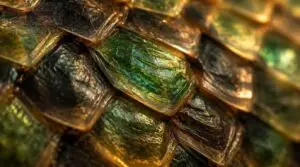
The scales covering a snake come from its epidermis, the outermost skin layer. They aren’t separate attachments. They’re folded thickenings of skin itself, and their main building block is keratin, the same protein in your fingernails.
Like your fingernails, those keratin scales are completely numb—actual sensation happens in the living tissue beneath them, as explained in this deeper look at how snakes actually feel through their scales.
Snake keratin differs from yours, though. It’s built from beta-keratin, a tougher form specialized for reptiles. This keratin composition gives scales their hardness and resistance to abrasion.
The structure works in layers. Beta-keratin filaments sit embedded in a protein matrix, creating rigidity without brittleness. During scale keratinization, these layers harden into the finished plate you see.
Color comes from pigments like melanin and carotenoids deposited within the keratin. Melanin also shields against UV damage and wear. Surface microtextures reduce friction, helping the snake slide through grass or sand.
Understanding snake scale anatomy starts here, because everything about scale types builds on this material foundation.
9 Main Types of Snake Scales
Now that you know what scales are made of, it’s time to meet the individual types. Each scale on a snake’s body has a distinct job, from gripping surfaces to protecting the eye. Here are the nine main scale types you’ll find, and what each one does.
Dorsal Scales
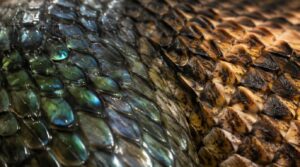
Most of a snake’s back is covered by dorsal scales, the rows you count when identifying a species. They’re made of keratin, the same protein in your fingernails, layered over the reptile skin structure.
You’ll notice two main textures. Smooth scales feel glossy and help aquatic species swim. Keeled scales have a raised ridge that breaks up light, hiding ambush hunters. A snake species field guide can help you quickly match these scale textures to specific species in the wild.
Scale row counts stay constant within a species, so herpetologists use them for identification.
Ventral Scales
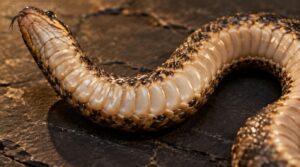
Flip a snake over and you’ll see its most distinctive feature. Ventral scales form a single row of wide plates running from chest to tail base. They’re keratin, like dorsals, but smoother and larger.
You’ll find these details useful:
- They grip smooth surfaces during locomotion.
- Each plate anchors to the epidermis and connective tissue.
- Keeled ventrals improve traction on rough ground.
- Aquatic species have rounded ventrals that reduce drag.
- Ventral counts aid species identification in snake anatomy guides.
Among snake scale types, these plates show growth clearly. Shed during ecdysis, they renew as your snake grows.
Subcaudal Scales

Continue past the ventral scales and you reach the tail. Subcaudal scales run from the last ventral to the tail tip, single or paired.
| Feature | Single Row | Paired Rows |
|---|---|---|
| Common groups | Many colubrids | Viperids |
| Count use | Species keys | Sexing clues |
| Function | Flexibility | Grip, traction |
Males often carry more subcaudals. These snake scale types round out reptile scale morphology.
Anal Plate
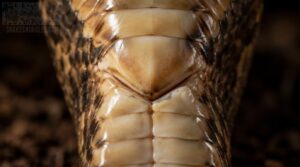
When you look at the cloacal region, you’ll find the anal plate, a single scale or paired scale covering the vent’s rear edge. It marks where ventral scutes end and subcaudal scales begin.
In reptile scale morphology, this feature matters: its shape, joining, and size vary by species, and scale counts around it help you identify snakes accurately.
Head Scales

Many snake scales on the head differ from those on the body. In herpetology, head scale morphology identifies species. You’ll examine these plates:
- Rostral scales on the snout tip
- Supraocular plates above each eye
- Interocular plates between the eyes
- Frontal and parietal scales on the crown
- Labial scales along the lip
These fused plates form a shield-like cap. Count them carefully; reptile anatomy here is diagnostic.
Spectacle Scale

Ever wondered why a snake never blinks? It can’t. Instead, a single transparent scale called the spectacle scale covers each eye like built-in safety glass. A humid hide for reptile eye care supports healthy sheds, keeping those spectacle scales clear and intact.
Snakes never blink because a transparent scale permanently shields each eye like built-in safety glass
You’ll find it fused over the eyeball, made of the same keratin composition as other snake scales. It’s smooth, clear, and sheds with the rest of the skin during molting.
This shield blocks dust, debris, and scratches. Before a shed, you’ll notice the spectacle turns milky blue. That’s normal. Don’t peel it; the snake controls it.
Granular Scales

Think of granular scales as the grip tape on a skateboard. These small, rounded pegs sit between larger scales, creating localized patches rather than full coverage.
Their scale texture adds micro-roughness, boosting traction on sandy or rocky ground.
You’ll see their scale arrangement vary with age and humidity.
Made from the same keratin composition as other snake scales, they renew with each molt.
Fringe Scales

Some snakes carry a secret weapon on their scale edges. Fringe scales are tiny keratinized projections along the margins of dorsal and lateral scales, giving the snake skin structure a hairlike, ragged look under magnification.
You’ll find them in certain colubrids and vipers, where they aid camouflage by scattering light and softening the scale texture. Species with otherwise identical scale counts often differ here, so check the fringe when identifying closely related snakes.
Rattle Segments

Your rattle isn’t one piece. It’s a stack of loosely linked segments.
Rattlesnakes grow a new rattle scale each time they molt, and scale development genes drive that sequential keratinized tissue formation at the tail base. Segments break off, so count doesn’t equal age.
Scale morphology matters more: shape, alignment, and dryness control how sharply each segment rasps.
A good herpetology anatomy reference illustrates exactly how each segment’s curved, interlocking shape shapes the rattle’s sound.
How Scale Types Support Snake Survival

Now that you know the nine scale types, let’s see how they keep snakes alive. Your snake’s protective integument is a single system, not separate parts.
Here’s how each type pays for itself:
- Dorsal scales smooth out the body, cutting drag during fast strikes.
- Ventral scales grip surfaces, powering efficient locomotion on ground and bark.
- The spectacle scale shields the eye from dust and drying air.
- Granular scales support biological camouflage by breaking up glare and outline.
- Rattle segments warn predators before contact happens.
These are evolutionary adaptations refined over millions of years. Hatchlings start with finer dorsal scales that harden with age, matching new habitats. Scale microstructure even guides shelter choices during thermoregulation. Every scale earns its place.
Top 5 Picks for Scale Enthusiasts
You’ve learned how scales work, so you may want to bring that interest into your home. The five picks below range from practical decor to learning resources for younger enthusiasts. Each one connects to the scale themes covered in this article.
1. Cotton Linen Animal Print Pillow Cover
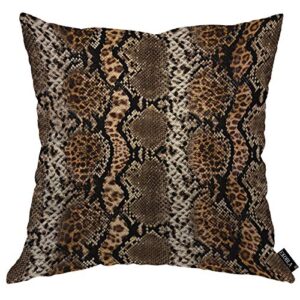
After a long day of studying scale morphology, you can bring that passion into your living space. This cotton linen pillow cover measures 18 by 18 inches and features an animal print on both sides. The invisible zipper lets you remove inserts quickly, and the fabric resists shrinking.
You’ll need to buy an insert separately. Wash it on a delicate cycle in cold water, then air dry. Some reviewers find the texture coarse, so keep that in mind.
| Best For | Animal lovers who want to bring their passion for wildlife into their living room, bedroom, or office decor with a stylish, double-sided printed pillow cover. |
|---|---|
| Material | Cotton and linen |
| Care Instructions | Machine wash delicate |
| Dimensions | 18 x 18 inches |
| Use Case | Home decor |
| Theme | Snake print |
| Limitations | Cover only |
| Additional Features |
|
- Features an animal print on both sides for versatile display
- Invisible zipper closure makes inserting and removing pillows easy
- Shrink-resistant cotton linen fabric is machine washable on a delicate cycle
- Pillow insert is not included and must be purchased separately
- Some reviewers find the fabric texture coarse or stiff
- Hand-cut and sewn construction allows for a 1–2 cm size deviation
2. REETOOK Black Flannel Reptile Throw Blanket
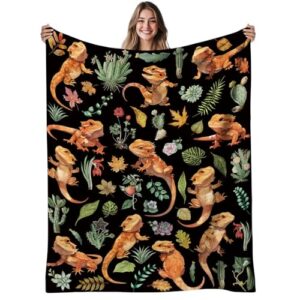
If a pillow cover isn’t enough, wrap yourself in the REETOOK Black Flannel Reptile Throw Blanket. It’s made of soft flannel with a reptile theme, perfect for bearded dragon fans. You can machine wash it in cold water without fading or shrinking.
Note the listed size, 4 by 3 inches at 0.46 kg, runs far smaller than a standard throw, and the reverse side is stark white. Some prints show text errors, so check reviews first.
| Best For | Reptile lovers and bearded dragon enthusiasts who want a themed, soft throw blanket for relaxing on sofas or beds. |
|---|---|
| Material | Flannel |
| Care Instructions | Machine wash cold |
| Dimensions | 4 x 3 inches |
| Use Case | Warm throw |
| Theme | Reptile |
| Limitations | Smaller than standard |
| Additional Features |
|
- Soft flannel material with a delicate, comfortable touch
- Machine washable in cold water without fading or shrinking
- Fun reptile theme, making it a great gift for reptile fans
- Listed dimensions (4"L x 3"W) are far smaller than a standard throw blanket
- Reverse side is stark white, which may look odd
- Some printed designs have text errors, according to customer reviews
3. Silver Simulation Leaves Artificial Plant Ornaments

If you want a display piece instead of something to wear, try the Silver Simulation Leaves from NUOBESTY. You get three pieces of silver-toned artificial plants, each set measuring 8.65 by 4.32 by 3.54 inches. They’re made of silk cloth with a lifelike look, so they pair well with reptile-themed rooms and snake-scale displays.
You can hang them on walls or place them in vases. They need no watering, but you should seal them in storage and keep them indoors, since humidity and sun can dull the finish.
| Best For | Anyone decorating a reptile-themed room, snake-scale display, or home table with realistic silver-toned artificial greenery that needs no watering. |
|---|---|
| Material | Silk cloth |
| Care Instructions | Seal when stored |
| Dimensions | 8.65 x 4.32 x 3.54 inches |
| Use Case | Decoration |
| Theme | Leaf |
| Limitations | Aquarium use listed |
| Additional Features |
|
- Made of premium silk cloth with a lifelike, realistic leaf appearance
- Comes as a set of three reusable pieces that require no watering
- Versatile for vases, flowerpots, walls, weddings, offices, and gardens
- Humidity and sunlight can dull the silver finish, so indoor use and sealed storage are required
- Color is listed ambiguously as both silver and assorted
- Not ideal for water-heavy settings despite being listed for aquarium decoration
4. Bigfoot Folklore Archival Giclee Art Print
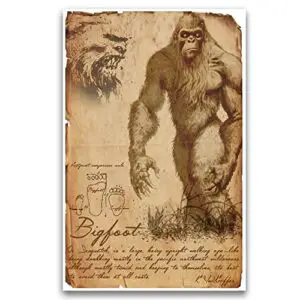
Collectors who like cryptid folklore may want the Big Folklore Archival Giclee Art Print. It’s part of a Myths and Monsters series, designed and printed in a home studio.
The print uses archival quality Giclee methods on ultra premium luster photo paper, so colors stay sharp for decades. Size options appear at checkout. You supply your own frame.
One buyer noted the paper texture feels different from standard photo paper. It suits cabins, home offices, and fans of American folklore.
| Best For | Cryptid enthusiasts and fans of American folklore who want archival-quality wall art for a cabin, home office, or gift-giving occasion. |
|---|---|
| Material | Luster photo paper |
| Care Instructions | N/A |
| Dimensions | Size at checkout |
| Use Case | Wall display |
| Theme | Folklore monster |
| Limitations | Frame not included |
| Additional Features |
|
- Part of a collectible Myths and Monsters folklore series, designed and printed in a home studio
- Archival quality Giclee print on ultra premium luster photo paper keeps colors sharp for decades
- Multiple size options available at checkout, appealing to both children and adults
- Frame is not included, so you’ll need to supply your own for display
- Print only, requiring separate framing before it can be shown
- One customer noted the paper texture feels different from standard photo paper
5. Snakes for Kids Junior Scientist Guide

Books give you the fastest path to mastery, and Snakes for Kids is a solid starting point. Published by Callisto Kids on June 21, 2022, this 78-page guide covers 45 species, including the King Cobra and Anaconda. You get color photographs of snakes in natural habitats, plus clear explanations of fangs, rattles, scales, and skin shedding.
It targets readers ages 6 to 9, so it suits young learners and homeschooling. Price is $14.40, though it varies by retailer.
| Best For | Kids ages 6 to 9 who are curious about snakes and want an introductory guide with real photos and easy-to-understand facts. |
|---|---|
| Material | Printed paper |
| Care Instructions | N/A |
| Dimensions | 8.25 x 8.25 inches |
| Use Case | Educational reading |
| Theme | Snakes |
| Limitations | Ages 6-9 only |
| Additional Features |
|
- Covers 45 snake species, including the King Cobra and Anaconda
- Features detailed color photographs of snakes in their natural habitats
- Explains snake biology clearly, from fangs and rattles to scales and skin shedding
- Not suitable for very young children, according to some customers
- Reading level is limited to ages 6 to 9
- Price of $14.40 may vary by retailer
Frequently Asked Questions (FAQs)
What are the different types of scales on a snake?
Most people think snake scales are all the same type. They’re not. You’ve got dorsal scales, ventral scales, subcaudal scales, the anal plate, head scales, granular scales, fringe scales, rattle segments, and the spectacle scale.
What are the four different types of scales?
You’ll find four main types of snake scales: dorsal scales along the top of the back, ventral scales on the belly, subcaudal scales on the underside of the tail, and head scales on the cranium.
What are the 7 levels of classification for a snake?
Take a corn snake. Its seven classification levels are Kingdom (Animalia), Phylum (Chordata), Class (Reptilia), Order (Squamata), Family (Colubridae), Genus (Pantherophis), and Species (guttatus). Mastering these seven levels makes your snake identification far more precise.
Which snake has the toughest scales?
Viperids are your best bet. Their heavily keeled dorsal scales show some of the densest keratin bonding under microscopic analysis, and that density makes them exceptionally resistant to abrasion and scale fragmentation in harsh habitats.
Can damaged snake scales heal or regenerate over time?
You might assume scales regrow like broken bones, but they don’t. Damaged snake scales heal through ecdysis, the shedding process. Each molt replaces the epidermis, restoring snake skin integrity. Severe injuries may leave scale abnormalities after successive molts.
Do male and female snakes have different scale patterns?
You’d think your snake’s sex would show in its scales. It doesn’t. Sexual dimorphism rarely affects scale patterns. Males and females share the same counts and arrangement. Differences reflect age, wear, or environment, not sex.
How many total scales does a snake typically have?
You’ll find no fixed number. A snake’s scale count tracks body length. Small species carry roughly 400 to 700 dorsal scales; large boas and pythons exceed 2, Add ventrals, subcaudals, and head scales, and totals reach thousands overall.
Do snake scales change color or pattern as they age?
Like a photograph fading in sunlight, snake scales keep their shape while color shifts. Your snake won’t change scale types.
Scale discoloration comes from wear, pigment maturation, and snake molting. Scale patterns stay fixed, though juvenile markings can blur.
True snake color polymorphism is genetic, not age-based.
Can a snakes species be identified by scales alone?
No. Scale patterns overlap between species and vary within them, so you can’t rely on scales alone. You’ll need geography, color, and behavior too. For certainty, DNA barcoding beats visual species differentiation.
Conclusion
Think of a snake’s scales as a full toolkit, each type shaped for one job. Dorsal scales grip, ventral plates drive movement, and the spectacle guards the eye. Once you know the types of snake scales, you can read a snake’s habitat, hunting style, and even sex from its skin. Study the patterns, count the rows, and you’ll identify species that others can’t tell apart. The body tells its story in scales.