This site is supported by our readers. We may earn a commission, at no cost to you, if you purchase through links.

A ball python that won’t eat, a chameleon with sunken eyes, a dart frog enclosure reading 35% RH when it needs 80% — most of these problems trace back to inconsistent humidity. Manual misting fixes it temporarily, but one missed session can set your animal back days.
Reptile misting systems for automated care remove that variable entirely. The right setup holds your target humidity range around the clock, whether you’re at work or asleep, without you touching a spray bottle.
This review breaks down the top six systems by real specs, coverage, and durability so you can buy with confidence.
Table Of Contents
- Key Takeaways
- Are Automatic Reptile Misters Worth It?
- Choosing The Right Reptile Misting System
- Top 6 Reptile Misting Systems Reviewed
- Setting Up Your Mister for Snake Enclosures
- How to Clean Your Reptile Mister
- Frequently Asked Questions (FAQs)
- Are automatic reptile misters worth it?
- What is the best automatic mister for reptiles?
- Is there an automatic mister system for terrariums?
- How much does a misting system cost?
- Can I use tap water in my mister?
- Should I use a fogger or a mister?
- How do misters affect live plants inside enclosures?
- What humidity level does my reptile actually need?
- Can misting systems work with humidity controllers?
- Conclusion
Key Takeaways
- Automated misting systems earn their value specifically for humidity-sensitive species like chameleons and tropical geckos, where even brief overnight humidity drops can cause dehydration and shedding problems — but they’re unnecessary for desert species with low moisture needs.
- Matching your system to enclosure size matters more than brand: plan one nozzle per 20–30 gallons, position nozzles 6–12 inches above substrate at a 20–45° downward angle, and add nozzles for dense plantings rather than compensating with longer spray cycles.
- Distilled or reverse osmosis water is non-negotiable for long-term reliability — tap water clogs micro-nozzles within months, and routine cleaning (nozzle soaks in 1:1 vinegar solution every 3–6 months plus pump descaling) is what keeps any system running past its warranty window.
- Across all six reviewed systems, durability is the recurring weak point — multiple units from different brands failed within two months — so factor in pump cycle ratings (20,000+ cycles minimum) and O-ring availability before choosing based on price alone.
Are Automatic Reptile Misters Worth It?

You can mist by hand reliably for a while, but maintaining stable humidity around the clock is genuinely difficult without an automatic misting system. For humidity-dependent species like chameleons, tree boas, or tropical geckos, even brief overnight drops can stress the animal and lead to dehydration or shedding problems over time.
Exploring reptile misting systems for tropical species can help you find an automated setup that keeps humidity steady through the night without any manual effort.
They’re not the right tool for every keeper, though. If your setup involves a xeric species with minimal moisture requirements, the added complexity isn’t worth it.
Where these systems earn their value is reptile humidity control during the hours you’re absent. A humidity sensor paired with timer flexibility holds your target RH bands without manual adjustments, and that level of consistency is what separates precise reptile care from guesswork.
A humidity sensor with timer flexibility replaces guesswork with consistency while you’re away
Choosing The Right Reptile Misting System
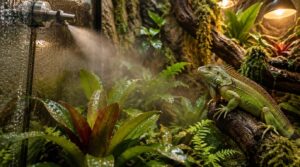
Not every misting system suits every setup, so picking the right one comes down to a few key factors. Before you commit to a unit, you’ll want to evaluate your enclosure size, your schedule, and how hands-on you’re willing to be with maintenance. The following criteria will help you match the right system to your specific needs.
Tank Size and Enclosure Coverage
The right reptile misting system starts with matching nozzle coverage to your specific enclosure size.
- Under 20 L: one nozzle, high-center
- 20–60 L: dual nozzles at opposite corners
- Tall tanks (>40 cm): multi-tier spray paths
- Glossy surfaces: raise nozzle 5–8 cm
- Dense plants: add nozzles or reduce droplet size
Consistent misting cycles depend on full coverage, not just top-down spray.
Reservoir Capacity and Refill Frequency
Coverage tells you how often your misting cycles need to run. Reservoir capacity determines how long you can go between refills. A 500 ml reservoir covers 3-5 days at 60-80 ml/day for most setups.
High temps or humidity above 60% push refill frequency up considerably. A low-level float sensor prevents dry-run damage. Use distilled water to extend time between cleanings.
Timer Flexibility and Spray Duration
Once you’ve dialed in refill frequency, timer flexibility is your next control point. Spray duration blocks from 0.5 to 60 minutes let you tune moisture output per cycle very precisely. Programmable timing windows with 1-minute increments keep misting frequency consistent without guesswork.
Randomized offsets of 5 to 15 minutes prevent enclosure hot spots by staggering each individual cycle’s start time.
Noise Level and Pump Quality
Although noise is easy to overlook, pump quality directly shapes long-term reliability in any Reptile Misting System you purchase.
- Target Quiet Operation below 55 dB at one meter.
- Choose brushless DC for a cooler SelfPriming Pump.
- Buy units rated 20,000-plus cycles, not cheaper alternatives.
- Do routine Pump Maintenance to reduce mineral buildup.
- Prefer diaphragm over piston for lower Noise Output.
Nozzle Count and Placement
Since nozzle count and placement directly determine misting consistency, plan one nozzle per 20-30 gallons of effective enclosure volume. Space them evenly around the perimeter.
Position adjustable nozzles 6-12 inches above substrate, angled 20-45° downward, to improve your spray pattern reach without pooling on the floor. Keep nozzles away from basking spots, and flush them weekly to prevent nozzle clogging.
Top 6 Reptile Misting Systems Reviewed
Each system below was evaluated on pump reliability, scheduling flexibility, and real-world coverage for the enclosures you’re most likely running.
The six options span budget-friendly basics to Wi-Fi-enabled setups, so you’ll find something that matches your setup regardless of complexity.
Here’s what each one actually delivers.
1. REPTITRIP Automatic Reptile Misting System
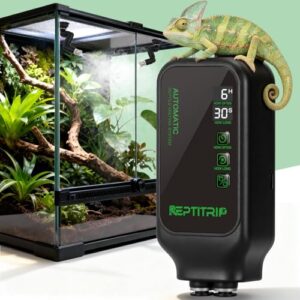
The REPTITRIP gives you serious scheduling flexibility, with spray durations from 1 to 180 seconds and intervals stretching up to 96 hours. Two 360-degree rotating nozzles let you direct mist exactly where your enclosure needs it. It connects via a 16-foot hose to any bucket or container you already own, so setup is fairly straightforward.
The tradeoff is real, though. There’s no built-in clock, so you can’t schedule specific start times, and a power outage will wipe your settings entirely.
| Best For | Reptile and amphibian keepers who want automated humidity control without the hassle of daily misting. |
|---|---|
| Spray Duration | 1–180 seconds |
| Mist Interval | 1–96 hours |
| Water Source | External bucket (no tank) |
| Nozzle Type | 2x 360° rotating |
| Primary Use | Reptiles, amphibians, terrariums |
| Control Type | Manual (no real-time clock) |
| Additional Features |
|
- Highly flexible scheduling with spray durations up to 180 seconds and intervals up to 96 hours
- Two 360-degree rotating nozzles let you target mist precisely where your enclosure needs it
- Works with any bucket or container you already own, keeping setup simple and cost-effective
- No built-in clock means you can’t set specific start times for misting cycles
- Power outages wipe your settings, requiring a full manual reprogramming
- No water tank included, so you’ll need to source your own container separately
2. Reptile Misting System with Timer
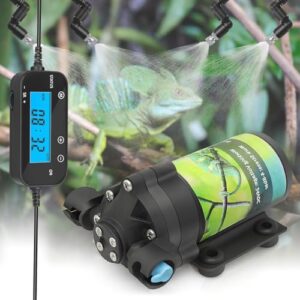
If you’re worried about timer complexity here, that concern is valid. Users report the programming interface isn’t straightforward, so budget time to configure it before relying on it.
That said, the flexibility is real: intervals range from 20 minutes to 30 days, with spray durations up to 9 minutes. The self-priming pump draws from any external container, and 16.4 ft of tubing with six adjustable nozzles covers most enclosures well.
One reported pump failure after two months warrants close monitoring.
| Best For | Reptile and terrarium owners who need automated, customizable misting while away from home. |
|---|---|
| Spray Duration | Up to 9 minutes |
| Mist Interval | 20 min–30 days |
| Water Source | External container (no tank) |
| Nozzle Type | 6x 360° adjustable |
| Primary Use | Terrariums, paludariums, biohabs |
| Control Type | Programmable timer |
| Additional Features |
|
- Six 360° adjustable nozzles with 16.4 ft of tubing offer flexible coverage for most enclosures
- Timer intervals ranging from 20 minutes to 30 days make it easy to match any humidity schedule
- Self-priming pump works with any external water container, so setup is simple and adaptable
- The timer programming is unintuitive and may require significant trial and error before it’s reliable
- At least one user reported pump failure after just two months of daily use
- The hose connection can leak without extra steps like heating the tubing and securing it with zip ties
3. RUNWUSHENG Automatic Reptile Misting System
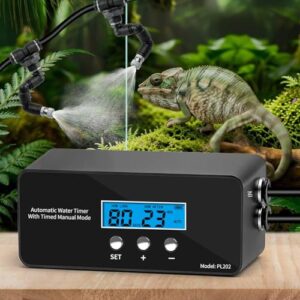
The RUNWUSHENG’s LCD controller lets you dial in spray duration and interval settings precisely. At $35.99, it ships with 16 ft of tubing and two nozzles, comfortably covering terrariums up to 36 inches without straining the diaphragm pump’s 1.5-2.0 L/h output.
Noise runs 40-55 dB, noticeable but not disruptive. The self-priming pump usually holds up for 12-18 months before flow drops noticeably. Clean your nozzles every 2-4 weeks with distilled water; mineral buildup chokes output before you realize it’s happening.
| Best For | Reptile and amphibian owners who want precise, automated humidity control for indoor terrariums without access to a plumbing connection. |
|---|---|
| Spray Duration | Adjustable via LCD |
| Mist Interval | Adjustable via LCD |
| Water Source | External container (no tank) |
| Nozzle Type | 2x fine mist nozzles |
| Primary Use | Reptiles, terrariums, plants |
| Control Type | LCD controller |
| Additional Features |
|
- LCD controller lets you program exact spray duration and intervals, taking the guesswork out of maintaining humidity levels
- Self-priming pump and 16 ft of tubing give you flexible placement options and can cover terrariums up to 36 inches
- At $35.99, it’s an affordable way to automate a daily task and reduce hands-on maintenance
- Pump lifespan of 12-18 months means you’ll likely need a replacement eventually
- Nozzles require cleaning every 2-4 weeks to prevent mineral buildup from choking output
- Operates at 40-55 dB, which may be noticeable in quiet rooms or during nighttime cycles
4. Moistenland WiFi Reptile Misting System
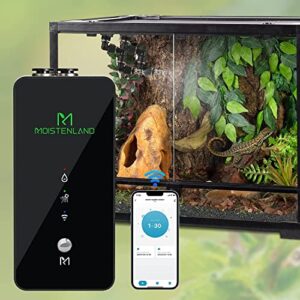
The Moistenland connects to your 2.4GHz network via the Smartlife app, letting you run daily or cyclical misting with durations down to one-second increments. Setup takes about five minutes.
The pump runs under 30 dB, and two to four nozzles cover enclosures up to 36 inches long. Adjustable nozzle height lets you direct mist precisely.
Durability is the weak point. Some units quit after two months, and leaks occur when tubing isn’t seated fully. Use distilled water and clean regularly.
| Best For | Reptile owners who want app-controlled, scheduled misting for snakes, lizards, chameleons, geckos, iguanas, or turtles. |
|---|---|
| Spray Duration | Adjustable |
| Mist Interval | One-time/daily/cyclical |
| Water Source | External (no tank) |
| Nozzle Type | High-density mist output |
| Primary Use | Snakes, lizards, chameleons |
| Control Type | WiFi app (Smartlife) |
| Additional Features |
|
- WiFi control via the Smartlife app lets you set precise daily or cyclical misting schedules from your phone
- Quiet pump (under 30 dB) with adjustable nozzles that can cover enclosures up to 36 inches long
- Quick setup in about 20 minutes with included DIY accessories
- Some units have stopped working after roughly two months, raising durability concerns
- Tubing must be fully seated at the ports or leaks will occur
- Mist output can be coarser than expected, which may not suit reptiles that need fine, even humidity
5. Ycxydr Smart Reptile Misting System
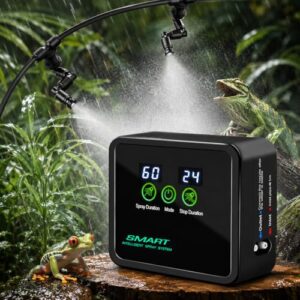
If Moistenland’s network features appeal but its reliability doesn’t, the Ycxydr offers a Bluetooth/Wi-Fi hybrid module with per-enclosure humidity targets and over-the-air firmware updates.
Its three-button LED timer sets spray duration from five to sixty seconds and stop intervals from one to twenty-four hours. The 2.5W pump drives two 360° rotating nozzles at 20-40 psi. Each nozzle covers about 0.5-0.75 meters of enclosure floor.
The PE hose is stiff and prone to disconnection. You’ll want spare O-rings and fittings on hand.
| Best For | Budget-conscious reptile and amphibian keepers who want automated humidity control without paying premium brand prices. |
|---|---|
| Spray Duration | 5–60 seconds |
| Mist Interval | 1–24 hours |
| Water Source | External reservoir (no tank) |
| Nozzle Type | 2x 360° rotating |
| Primary Use | Reptiles, amphibians, paludariums |
| Control Type | 3-button LED timer |
| Additional Features |
|
- The three-button LED timer lets you dial in spray duration (5–60 seconds) and rest intervals (1–24 hours), keeping enclosure humidity on a consistent schedule without any manual effort.
- Two 360° rotating spray heads distribute mist broadly, and the USB-powered self-priming pump means easy setup without complicated plumbing.
- Versatile enough for terrariums, paludariums, greenhouses, and garden misting, so it can pull double duty if needed.
- The included PE hose is stiff and rigid, making it awkward to route and prone to popping off connectors unexpectedly.
- The LED display stays lit at all times and reacts easily to accidental touches, which can throw off your saved timer settings.
- Reported durability problems — including pump failure, internal motor leaks, and inconsistent spray duration — raise real concerns about long-term reliability.
6. MECESOR Automatic Reptile Tank Mister
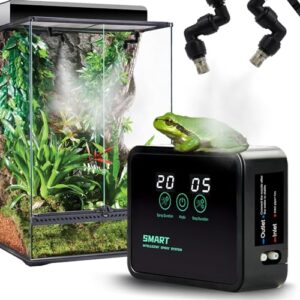
If the Ycxydr’s stiff hose frustrated you, MECESOR’s external reservoir design removes the built-in tank entirely, letting you swap in any bucket you already own.
Its three-button panel sets spray duration from five to sixty seconds and stop intervals from one to twenty-four hours. The two 360° rotating nozzles are angle-adjustable and disassemblable for cleaning.
The catch: customer reports flag front panels detaching, hose leaks, and units failing within two months. It also loses timer settings after a power outage.
| Best For | Reptile owners who want flexible humidity automation without being locked into a built-in water tank. |
|---|---|
| Spray Duration | 5–60 seconds |
| Mist Interval | 1–24 hours |
| Water Source | External reservoir (no tank) |
| Nozzle Type | 2x 360° angle-adjustable |
| Primary Use | Chameleons, snakes, frogs, lizards |
| Control Type | 3-button control panel |
| Additional Features |
|
- External reservoir design lets you use any bucket, so you’re not limited by a small built-in tank
- Two 360° rotating, angle-adjustable nozzles make it easy to direct mist exactly where your reptile needs it
- Flexible scheduling with spray durations from 5–60 seconds and stop intervals from 1–24 hours
- Reliability is a real concern, with reports of front panels detaching, hose leaks, and units dying within two months
- Timer settings reset after any power outage, meaning you’ll need to reprogram it each time
- Hoses are difficult to detach from nozzles, and the included instructions are widely considered inadequate
Setting Up Your Mister for Snake Enclosures
Once you’ve picked your system, placement will make or break humidity control. For snake enclosures, position nozzles 15-25 cm below the lid and arrange them diagonally across the enclosure’s full length. This keeps water off the substrate directly beneath and gives droplets enough room to disperse evenly.
For most temperate snakes, program your timer for 2-3 daily spray events, each lasting 5-20 seconds. Then check with a digital hygrometer and target 40-60% humidity between cycles.
Only use dechlorinated, filtered water in your misting system. Tap water causes mineral buildup that clogs micro-nozzles within weeks and kills spray consistency.
Install check valves on each line to stop dripping after the pump cuts off, particularly on automated systems running multiple daily cycles.
How to Clean Your Reptile Mister

Filtered water reduces mineral deposits, but it won’t eliminate them. Every 3-6 months, disassemble the nozzles and tubing, then soak small components in a 1:1 white vinegar solution for 15-30 minutes. Preventing nozzle clogs before they form saves you more time than clearing them after.
For pump descaling maintenance, run diluted vinegar through the system for 5-10 minutes, then rinse twice with clean water until no odor remains. A dedicated reptile misting pump descaler works faster than vinegar alone and leaves no lingering odor for sensitive reptiles.
Your misting system maintenance routine:
- Inspect seals, tighten fittings, and replace worn O-rings
- Wipe all external surfaces with mild, unscented soap
- Scrub the reservoir interior with a soft brush
- Dry every part completely before reassembling
This is your nozzle clogging prevention baseline. Test spray after each clean; uneven droplets mean residue remains.
Frequently Asked Questions (FAQs)
Are automatic reptile misters worth it?
Yes, if you’re keeping humidity-sensitive species. Automatic reptile misting systems cut your daily watering time by 60–90% and deliver consistent humidity cycles your animals need, especially during those critical shedding windows when moisture matters most.
What is the best automatic mister for reptiles?
For most setups, the Moistenland WiFi leads the pack. It offers remote control, smart home compatibility, and consistent spray cycles. If you’re managing a larger enclosure, the MECESOR’s multi-nozzle design gives you far better coverage.
Is there an automatic mister system for terrariums?
Automatic misting systems built specifically for terrariums handle terrarium humidity control on a set schedule. They combine a pump, reservoir, flexible tubing, and nozzles to fully automate your enclosure’s humidity without any manual misting needed.
How much does a misting system cost?
Reptile misting systems run the full price gamut. Entry-level automatic misting system options cost $20–$60, mid-tier timer models hit $60–$120, and smart units for automated care reach $150–$300. Your enclosure size shapes the final cost.
Can I use tap water in my mister?
Tap water works short-term, but mineral buildup from hard water clogs small misting nozzles within 3-6 months. For better water quality for reptiles, use distilled water or reverse osmosis water to extend your system’s life.
Should I use a fogger or a mister?
Fine mist, fine control, but only if your enclosure actually demands it. A reptile fogger excels in high-evaporation builds; reptile misting systems use larger droplets for moderate humidity control and reduce the surface wetting risk.
How do misters affect live plants inside enclosures?
Like rain in a jungle canopy, Foliar Hydration helps tropical plant care but risks mold without airflow. Monitor your Bioactive Substrate moisture closely. Consistent terrarium hydration with ventilation ensures Mold Prevention and healthy root zones.
What humidity level does my reptile actually need?
Most species thrive at 40–60% relative humidity. Desert dwellers tolerate 20–40%, while tropical lizards and iguanas need 60–80%. Amphibian setups push 70–90%. Always measure at head height and track shedding quality as your real indicator.
Can misting systems work with humidity controllers?
If your chameleon enclosure dries out by midday, a humidity controller can fix it. Most misters support humidity sensor connection, triggering spray only when RH drops below your target setpoint, enabling true closed-loop microclimate management.
Conclusion
Stable humidity shows up in every shed: clean, complete, no retained skin around the eyes or tail tip. That’s the clearest signal your enclosure is dialed in.
Reptile misting systems for automated care take the guesswork out of that equation. Match the system to your tank size, your schedule, and your species’ needs. Do that, and your animal gets consistent conditions every day, not just the days you remember to pick up the spray bottle.