This site is supported by our readers. We may earn a commission, at no cost to you, if you purchase through links.
Your corn snake’s basking spot reads 90°F on the dial. Your snake disagrees, refusing food and sitting half-shed for a week.
Cheap analog gauges drift by 5 degrees or more, and you won’t know until something goes wrong. That’s why digital thermometers hygrometers for corn snakes matter: they catch a dying heat mat at 3 a.m., track the full gradient from 95°F down to 75°F, and flag humidity drops before a stuck shed becomes a vet visit.
We tested five units for accuracy, probe placement, and real-world reliability. Here’s what earned a spot in the enclosure.
Table Of Contents
- Key Takeaways
- Corn Snake Temperature and Humidity Targets
- Top 5 Corn Snake Thermometer Hygrometers
- Digital Versus Analog Reptile Gauges
- Choosing The Best Monitoring Features
- Where to Place Enclosure Sensors
- Calibrating and Maintaining Accurate Readings
- Frequently Asked Questions (FAQs)
- What is the best hygrometer for snakes?
- What is the most accurate hygrometer for reptiles?
- What is the ideal humidity level for a corn snake tank?
- Where to put a hygrometer in a snake enclosure?
- How many sensors does a corn snake enclosure need?
- Can I use one device for both temperature and humidity?
- What temperature is too cold for a corn snake at night?
- How often should I replace the batteries in my device?
- Conclusion
Key Takeaways
- Corn snakes need a basking spot of 90–95°F, a cool side of 75–80°F, and 40–60% humidity (bumped to 60–70% during sheds), with nighttime temps never dropping below 70°F.
- Digital gauges beat analog because dials drift silently by 5°F or more, while digital units offer ±1–2°F accuracy, min-max memory to catch overnight heater failures, and remote logging that alerts you before your snake suffers.
- Probe placement is critical: put one sensor on the warm side and one on the cool side at least 15 cm apart, keep humidity probes mid-enclosure away from water bowls and heat lamps, and hold everything 2–3 inches off the glass.
- Even good sensors drift, so calibrate quarterly using fixed points like the ice-water method, verify readings against a trusted reference, replace batteries every 6–12 months, and swap out probes that keep drifting after recalibration.
Corn Snake Temperature and Humidity Targets
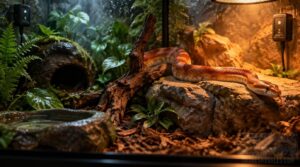
Get your temperature and humidity dialed in before anything else, because corn snakes are more sensitive to these variables than most beginners expect. The basking spot should sit between 90-95°F (32-35°C), giving your snake a warm zone to digest food and regulate its metabolism. The cool side of the enclosure needs to stay around 75-80°F (24-27°C). That thermal gradient matters. Corn snakes move between zones deliberately and they’ll need both extremes to self-regulate. A reliable digital thermometer on each side takes the guesswork out of hitting these numbers, and this corn snake temperature and humidity guide explains exactly where to place your probes.
For a full breakdown of humidity targets and year-round heating setups, this corn snake temperature and humidity guide covers everything in one place. If you’re setting up heating for the first time, this guide to maintaining consistent heat for corn snakes walks through thermostat choices and seasonal adjustments step by step.
For humidity, keep your baseline at 40-60% RH. Anything below 30% for extended periods risks retained sheds, which can cut off circulation if left unaddressed. When a shed cycle starts, bump humidity to 60-70% for 24-48 hours. Consistent humidity monitoring catches those shifts before they become problems.
A digital hygrometer placed at mid-enclosure height gives you the most accurate reading, and ReptiFiles’ corn snake care guide explains how to interpret those numbers across different seasons.
Top 5 Corn Snake Thermometer Hygrometers
Not every thermometer hygrometer on the market is worth your money or your corn snake’s safety. These five units cover a range of budgets and feature sets, from bare-bones basics to Bluetooth-enabled remote logging. Pick the one that fits your setup and move forward with confidence.
1. Flukers Digital Reptile Thermometer Hygrometer
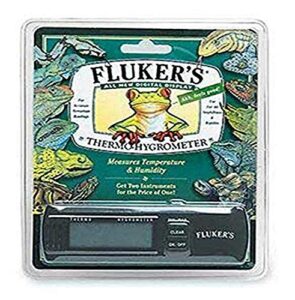
One device tracks both temperature and humidity, keeping your monitoring simple and your enclosure less cluttered. The Flukers Digital fits neatly into a 4-inch plastic unit with a digital display and adhesive backing, so mounting it inside the terrarium is straightforward.
The honest catch: temperature can drift around 3 degrees depending on placement, and humidity readings may swing 5-10% off. Some users report failure within a month. It’s a budget-friendly starting point, but calibrate it against a reliable reference early.
| Best For | Budget-conscious reptile, amphibian, and hermit crab owners who want a simple, all-in-one temperature and humidity monitor without spending a lot. |
|---|---|
| Display Type | Digital |
| Mounting Method | Adhesive backing |
| Power Source | N/A |
| Temp Accuracy | ~3°F variance |
| Humidity Accuracy | 5–10% off |
| Housing Material | Black plastic |
| Additional Features |
|
- Tracks both temperature and humidity in one compact unit, reducing clutter inside the enclosure
- Digital display and adhesive backing make it easy to install and read at a glance
- Cost-effective option for hobbyists who need basic condition monitoring across multiple enclosure zones
- Humidity readings can be off by 5–10%, and temperature may drift around 3 degrees depending on placement
- Some units stop working or lose accuracy within a month of use
- Less reliable than probe-based systems, so it may not suit owners who need precise readings
2. Zoo Med Analog Dual Gauge
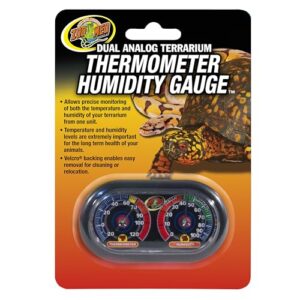
If digital drift frustrated you with the Flukers, the Zoo Med Analog goes a completely different direction. No screen, no batteries, just two dials reading temperature and humidity inside a single 6 by 4 inch black plastic enclosure.
The Velcro backing lets you reposition it without fuss, which matters when you’re still finding the right placement spot. Analog precision stops at the nearest degree or percent, so calibrate against a reliable reference. Plan to recalibrate every two to six months.
| Best For | Reptile, hermit crab, and egg incubator owners who want a simple, battery-free way to monitor temperature and humidity without relying on digital displays. |
|---|---|
| Display Type | Analog dial |
| Mounting Method | Velcro backing |
| Power Source | N/A |
| Temp Accuracy | ±1° precision |
| Humidity Accuracy | Manual calibration needed |
| Housing Material | Black plastic |
| Additional Features |
|
- Single enclosure tracks both temperature and humidity at a glance, no batteries required
- Velcro backing makes repositioning quick and easy during setup
- Compact size fits neatly inside most terrariums and vivariums
- Analog dials only read to the nearest degree or percent, limiting precision
- Humidity readings may drift and require manual calibration every two to six months
- Velcro adhesive can weaken over time, reducing holding strength
3. REPTI ZOO Digital Reptile Thermometer Hygrometer
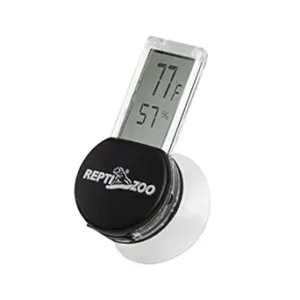
If dials feel too imprecise, the REPTI ZOO swings back to digital with a detachable 1.5 m probe you can thread into the enclosure while keeping the display on the outside. The suction cup mounts to glass or side panels, though it can slip on textured surfaces. Batteries run over a year.
That half-degree margin matters in classrooms too, so it’s worth comparing options in our guide to terrarium thermometers for classrooms before committing. Our guide to terrarium thermometers for small apartments breaks down which compact models hold their accuracy in tight spaces.
The backlit LCD and min-max memory cover your daily monitoring needs well. One real limitation: the display gets tough to read at steep angles, so placement still matters.
| Best For | Reptile keepers who want precise digital readings of both temperature and humidity in vivariums, hatchers, brooders, or propagators. |
|---|---|
| Display Type | Digital LCD |
| Mounting Method | Suction cup |
| Power Source | 2 batteries (1yr+) |
| Temp Accuracy | N/A |
| Humidity Accuracy | N/A |
| Housing Material | Glass and plastic |
| Additional Features |
|
- Measures both temperature and humidity on a single backlit LCD display with min-max memory
- Suction cup mount makes it easy to attach to glass enclosures, and the probe can be threaded inside while the display stays outside
- Batteries last over a year, and the package includes a spare
- The LCD can be hard to read at steep angles, so placement needs some thought
- The suction cup may slip or fail to stay attached on textured surfaces
- Not waterproof — submerging it will stop it from working
4. TempPro TempAir Digital Hygrometer
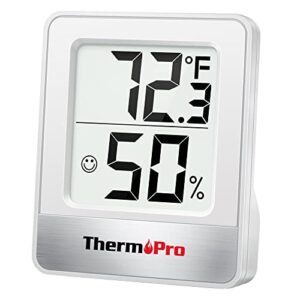
Several corn snake keepers overlook the remote probe advantage this unit delivers. The TempPro TempAir ships with a 1-meter sensor cord that lets you position the humidity probe exactly where your snake sleeps, not where the display happens to sit.
Accuracy is rated at ±1°F and ±3% RH, and the IPX5-rated housing shrugs off enclosure moisture without complaint. Min/max memory catches overnight temperature and humidity swings without any babysitting from you.
At just 35 grams, it won’t crowd your setup.
| Best For | Hobbyists and small-scale growers who need a lightweight, easy-to-read hygrometer for monitoring temperature and humidity across dynamic indoor environments like greenhouses, grow tents, or brooders. |
|---|---|
| Display Type | LCD |
| Mounting Method | Tabletop/magnetic/hang |
| Power Source | Coin AAA battery |
| Temp Accuracy | ±1°F/°C |
| Humidity Accuracy | ±2–3% RH |
| Housing Material | N/A |
| Additional Features |
|
- Large display digits and face icons make readings easy to interpret at a glance from across the room
- IPX5-rated housing handles moisture well, and the compact 35-gram body moves easily between rooms, vehicles, or enclosed spaces
- Versatile mounting options — tabletop, magnetic, or hanging — give you flexibility in any setup
- Some units arrive with a dead battery, so you may need a replacement right out of the box
- Accuracy tolerance of ±1°F and ±3% RH means readings can drift slightly, which matters in sensitive environments
- Not certified for outdoor use despite the IPX5 rating, limiting where it can reliably be deployed
5. Inkbird ITH-10 Digital Thermometer Hygrometer
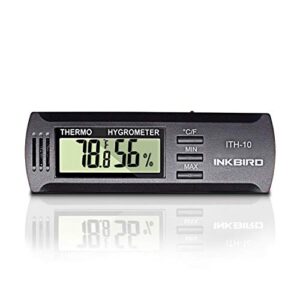
For tight budgets, the Inkbird ITH-10 punches above its weight. It records min-max temperature and humidity across two zones simultaneously, running on a single CR2032 battery. Temperature accuracy is ±1.8°F and humidity sits at ±3%, which is solid for the price point. The compact design fits neatly into any corn snake enclosure without crowding.
If you’re weighing it against pricier options, our guide to humidity gauges for desert reptiles breaks down how budget models like this compare on accuracy and battery life.
The catch? It can’t be manually calibrated. Drift happens, and you’ll need a reference device to verify readings over time. Worth the money, but verify first.
| Best For | Budget-conscious snake owners and hobbyists who need a compact, affordable thermometer and hygrometer for small enclosures like corn snake habitats. |
|---|---|
| Display Type | Digital |
| Mounting Method | Adhesive (bottom) |
| Power Source | CR2032 button cell |
| Temp Accuracy | ±1.8°F (±1°C) |
| Humidity Accuracy | ±3% RH |
| Housing Material | N/A |
| Additional Features |
|
- Records min-max temperature and humidity values, making it easy to track fluctuations over time
- Solid accuracy for the price (±1.8°F temperature, ±3% humidity)
- Compact design fits neatly into small enclosures without crowding
- Cannot be manually calibrated, so drift over time can’t be corrected
- You’ll need a separate reference device to verify readings
- Limited measurement ranges (23°F–140°F and 30%–90% RH) may not suit all environments
Digital Versus Analog Reptile Gauges
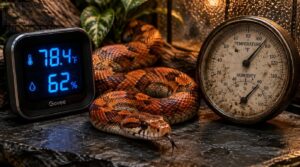
Think of it as a watch versus a sundial. One tells you exactly what’s happening; the other gives you a rough vibe.
Digital hygrometer-thermometer combos give you precise numbers, min-max memory, and often low-battery alarms. You know your warm side hit 88°F at 2 p.m., not "somewhere around there." That’s what you want for reptile enclosures, where a few degrees decide whether your snake eats or sulks.
Analog gauges have their place. No batteries, instant visual trend, dirt cheap. But dials drift, and they drift quietly. You won’t notice a five-degree error until your snake skips meals.
Expect temperature accuracy of ±1–2°F and humidity accuracy of ±3–5% from decent digital units. Analog? Guess. When in doubt, go digital.
Choosing The Best Monitoring Features
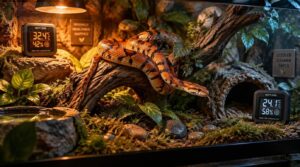
You’ve picked your gauge. Now make sure it actually earns its spot in your corn snake’s enclosure. The six features below separate the keepers from the clutter, so check your unit against each one.
Dual-Zone Monitoring
Your corn snake doesn’t live in one climate. It lives in two. Dual-zone monitoring means running two independent sensors, one in the basking hotspot, one in the cool hide, so you track the full temperature gradient simultaneously. Separate alarms catch heater failure or gradient collapse instantly.
Pair that with humidity monitoring and digital logging, and you’ll spot dangerous trends before your snake suffers.
High Sensor Accuracy
Here’s the uncomfortable truth: most budget reptile thermometers drift ±1°C or worse within weeks. That’s the difference between a healthy snake and a stressed one.
Prioritize ±0.5°C temperature accuracy and ±3% humidity accuracy. Capacitive sensors in a quality digital hygrometer hold their readings far longer than resistive types. Cheap gauges lie to you, and your corn snake pays the price.
Calibration Capability
Here’s the truth: most budget gauges ship with ±1°C or worse error. That’s enough to hide a heat gradient problem. Sensor calibration fixes it. Look for units with a user-adjustable offset, then verify with the icewater calibration method at 0°C. Set a calibration schedule, quarterly or after probe swaps, and log your offsets. Humidity sensor calibration matters too, since skewed temperature skews RH.
Min-Max Memory
Calibration gets your sensor honest. Min-max memory keeps it honest between checks. These chips record the coldest and warmest points over a rolling window, so a heater failure at 3 a.m. doesn’t vanish by morning.
What min-max memory gives you:
- Overnight low tracking for nocturnal drops
- Peak detection for basking overheats
- Timestamped extremes for incident reconstruction
- Alerts when readings beat stored extremes
- Nonvolatile storage that survives power loss
Check timestamps against lighting cycles, then clear the memory. Corn snakes forgive a lot, but not silent heat spikes.
Remote Data Logging
Min-max memory catches extremes. Remote data logging catches everything in between. Sample every 5–15 minutes, log both zones, and push readings over Wi-Fi or Bluetooth app control so a heater failure shows up on your phone, not in your snake.
| Event | What logging shows | Your response |
|---|---|---|
| Heater dies overnight | Low temp, timestamped | Replace thermostat |
| Heat spike at 2 p.m. | Basking overshoot | Adjust dimmer |
| Humidity creep | Gradual rise | Fix water bowl |
| Sensor dropout | Gap in data | Check power |
Corn snakes can’t call you. Digital thermometers hygrometers with remote monitoring can.
Your corn snake can’t call you when the heater fails—but remote digital monitoring can
Moisture-Resistant Probes
Logging is useless if the sensor dies first. Corn snake enclosures run humid, and cheap probes corrode fast.
Look for moisture-resistant probes with sealed housings, IP-rated enclosures, and stainless-steel or epoxy-coated tips. Waterproofed connectors survive misting and cleanup.
Check the spec sheet: drift under 0.5% RH per °C keeps humidity monitoring honest, and replaceable probe heads save you from buying a whole new unit.
Where to Place Enclosure Sensors
You’ve got the features down. Now put those sensors where they’ll actually tell you something. Probe placement makes or breaks your readings.
Mount your main probe on the warm side, mid-height, aimed at the basking zone. Your corn snake needs a proper temperature gradient, so set a second sensor on the cool side, 5 to 15 cm above the substrate. Keep them at least 15 cm apart, or one probe reads the other’s heat.
For humidity monitoring, position a probe in the middle third of the enclosure, away from the water bowl and misting zones. Add a second near the cool side to track the enclosure microclimate your snake uses during sheds.
Skip the hide? No. Sensor placement inside or beside a hide captures the true refuge temps. And keep every probe 2 to 3 inches off the glass, since walls wick moisture and skew readings.
Calibrating and Maintaining Accurate Readings
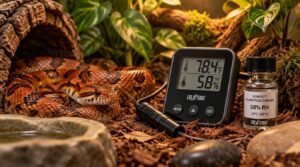
Because even the best sensor drifts, calibration isn’t optional. It’s maintenance. Start with the dry air offset check: power the unit on in dry conditions, and if readings shift more than ±2% RH in an hour, run a full calibration adjustment.
Use your device’s calibration mode and apply fixed points at 0%, 75%, and 100% RH if supported. Log the date and offset values every time. Recheck every 6 to 12 months, and always after relocating the enclosure or swapping substrate.
Verify temperature accuracy against a calibrated thermometer. Off by more than 0.5°C? Compensate in the device settings.
Monthly, inspect probes for corrosion and clean them with 70% isopropyl alcohol, only when dry. If drift persists after recalibration, replace the probe. Keep sensor placement consistent, and use min-max memory to catch anomalies between checks.
Frequently Asked Questions (FAQs)
What is the best hygrometer for snakes?
A hygrometer is your vivarium’s weather station, and snakes depend on it. The Inkbird ITH-10 wins for snakes: dual sensors, calibration, min-max memory, and ±3% RH sensor accuracy you can trust.
What is the most accurate hygrometer for reptiles?
Accuracy lives in calibration, not branding. The Inkbird ITH-10 leads Reptile Hygrometers, offering ±1–2% RH sensor accuracy and adjustable alarms. Calibrate it monthly with salt, and it stays trustworthy.
What is the ideal humidity level for a corn snake tank?
Wondering why your corn snake’s shed looks patchy? Humidity is often the culprit. Keep relative humidity between 40–60%, bump it to 60–70% during shedding, and check your hygrometer daily to avoid condensation risk.
Where to put a hygrometer in a snake enclosure?
Consider this: your corn snake’s humidity levels read 30 percent, yet the substrate feels soaked. Classic placement error.
Mount your hygrometer probe mid-enclosure, above the substrate line, roughly 2–3 inches clear of damp hides or the water dish. Skip corners, avoid burying anything, and keep it away from heat lamps so your reptile enclosure’s true microclimate shows up on screen.
How many sensors does a corn snake enclosure need?
A gradient is a map, and maps need landmarks. Your corn snake enclosure needs at least two sensors: one on the warm side, one on the cool. Add a third midline probe to track the temperature gradient precisely.
Can I use one device for both temperature and humidity?
Yes. A digital hygrometer thermometer combo with two separate probes covers both readings in one unit. Keep the temp probe mid-height, the humidity probe near substrate, and verify both sensors match a trusted reference.
What temperature is too cold for a corn snake at night?
Here’s the theory worth testing: many keepers assume corn snakes tolerate any nighttime dip. They don’t. Below 70°F (21°C) is too cold. Prolonged drops slow metabolism, disrupt digestion, and risk brumation. Keep nighttime temperature drops within 70–75°F for safe reptile health management.
How often should I replace the batteries in my device?
Last winter, a keeper’s dying battery read 5°F low, and her corn snake skipped two meals. Don’t wait for that. Replace batteries every 6 to 12 months, or sooner with heavy backlight use. Erratic readings? Swap them now.
Conclusion
A three-degree drift killed my friend’s heat mat reputation, and her snake’s appetite, before she noticed. That’s the cost of guessing.
Digital thermometers hygrometers for corn snakes remove the guesswork. Pick one with min-max memory, calibrate it quarterly, and place probes at both ends of the gradient.
Your snake can’t tell you it’s cold. Your readouts can. Trust the numbers, check them weekly, and you’ll never wonder again.