This site is supported by our readers. We may earn a commission, at no cost to you, if you purchase through links.

A ball python sitting in a 90°F basking zone sounds ideal until your sensor reads 90°F from six inches away and the actual substrate surface hits 105°F. That gap doesn’t just stress your animal; it can kill it. Accurate microclimate data separates responsible husbandry from guesswork, and most keepers don’t realize their setup has a problem until something goes wrong.
Digital thermometers hygrometers for terrariums now offer ±1°F accuracy and multi-point monitoring at roughly $5 per probe, making full gradient coverage genuinely affordable. This review breaks down the top options, placement strategy, and what to prioritize for your specific species.
Table Of Contents
- Key Takeaways
- Best Digital Thermometer Hygrometers for Terrariums
- Comparing Features, Accuracy, and Value
- Digital Versus Analog Terrarium Gauges
- Where to Place Terrarium Sensors
- Choosing The Right Monitor for Snakes
- Frequently Asked Questions (FAQs)
- What is the best hygrometer for a terrarium?
- Where to place a hygrometer in a terrarium?
- Which digital hygrometer is the most accurate?
- What is the most accurate hygrometer for reptiles?
- How do you calibrate a digital hygrometer?
- How long do digital terrarium sensors typically last?
- Can terrarium monitors integrate with smart home systems?
- What causes sudden inaccurate readings in digital hygrometers?
- Do digital thermometer hygrometers work for planted terrariums?
- Conclusion
Key Takeaways
- Accurate microclimate monitoring (±1°F and ±5% RH) is essential for reptile safety, since sensor placement errors can make a "safe" basking zone actually reach lethal substrate temperatures.
- The KJCOOSWI 4-Pack offers the best value at roughly $5 per probe for mapping thermal gradients across multiple enclosures, while the REPTI ZOO 2-Pack suits simpler two-zone setups despite weaker displays and suction cups.
- Sensor placement determines data quality: mount probes 1–2 inches above substrate, 1.5–2.5 inches from the ceiling for hot spots, and keep hygrometers 2–3 inches above substrate away from water bowls, mist, and wet moss to avoid false spikes.
- Digital units beat analog gauges on precision and trend logging, but only if you calibrate them regularly—use saturated salt solution (should stabilize near 75.3% RH) every three to six months and replace probes every 12–24 months.
Best Digital Thermometer Hygrometers for Terrariums
You need readings accurate to ±1°F and ±5% RH to catch meaningful shifts in your enclosure’s microclimates.
With readings updating every five seconds, you can track how quickly conditions shift — especially important when raising young snakes, as ball python hatchling behavior often signals stress before you’d otherwise notice a problem.
Should you want to verify conditions at the basking spot, hide entrance, and substrate surface, you’ll need more than one sensor.
The two options below cover that need at different pack sizes and price points.
1. KJCOOSWI 4-Pack Mini Thermometer Hygrometer
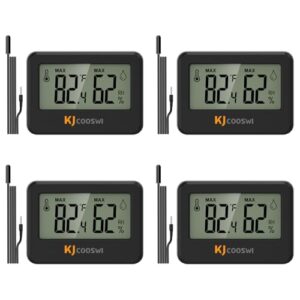
The KJCOOSWI 4-Pack gives you four compact digital units, each measuring 2.5×1.5×0.6 inches, so you can map thermal gradients across a single enclosure or monitor several tanks at once. Each module displays temperature and humidity simultaneously, updating every 10 seconds with ±1.8°F/±1°C and ±5% RH accuracy.
A preinstalled CR2032 battery delivers 12–18 months of runtime. Should you need wet-zone readings, the wired external probe measures temperature only; keep the main unit dry, since it isn’t waterproof. Magnetic backs and stands simplify mounting.
- Four compact units let you monitor several tanks or track gradients within one enclosure
- Wired external probe handles wet-zone temperature readings while the main unit stays dry
- Flexible mounting with magnetic backs and built-in stands, plus 12–18 months of battery life per unit
- Main unit is not waterproof and must be placed in a dry location
- External probe measures temperature only, not humidity
- Customer feedback shows mixed reliability regarding humidity accuracy
2. REPTI ZOO 2-Pack Digital Terrarium Thermometer
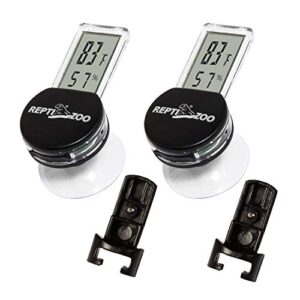
If four units exceed your needs, the REPTI ZOO 2-Pack covers two tanks or a single basking/cool zone split. Each unit measures 3.39 x 2.6 x 1.46 inches, weighs 2.08 ounces, and pairs a digital LED display with suction-cup mounting on front, side, or back glass. You get two units plus one spare battery.
It suits vivariums, brooders, and propagators, and it’s safer than adhesive strips for snakes. Should you need gradient tracking, monitor separate zones.
- Digital LED display tracks both temperature and humidity.
- Suction cup mounting works on front, side, or back glass.
- Includes two units plus a spare battery.
- Display contrast is low, making readings hard to see from a distance.
- Suction cups may lose adhesion quickly on glass.
- Batteries may need replacement anywhere from one month to one year.
Comparing Features, Accuracy, and Value
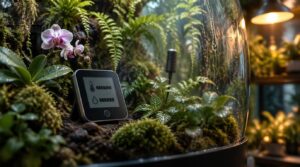
Before you buy, you’ll want to weigh essential features, measurement accuracy, sensor placement, durability, and overall value against each other. Should you need precision within ±1°F and ±5% RH, these criteria will determine which unit earns a spot in your setup. The breakdown below gives you exactly that comparison.
Substrate choice also plays a hidden role in humidity stability—understanding whether substrate liners risk causing impaction in snakes helps you balance moisture retention with your animal’s digestive safety.
Core Features
Roughly 70% of reptile keepers rely on digital gauges, and the gap between units comes down to features. You’ll want a display showing temperature and humidity together, with min/max memory spanning 24h or 7d.
Should you need trend data, Bluetooth app history beats scrolling an LCD. Check battery type (LR44 or CR2032), refresh rate (1–2 seconds), and whether probes are replaceable.
Digital vs analog gauges? Digital wins on precision.
Measurement Accuracy
Feature lists don’t guarantee precision. Digital sensor accuracy varies by unit, so verify it:
- Check stated humidity accuracy, ideally ±3% RH or better.
- Confirm temperature tolerance within ±1°F.
- Look for ISO and NIST certification on specs.
- Note whether it’s a combined temperature-humidity sensor.
Should you need tighter control, cross-sensitivity can skew RH readings 2–4%, and hysteresis delays readings by 1–2 minutes.
Pairing a well-calibrated sensor with humidity-resistant reptile tank accessories helps ensure your readings reflect actual enclosure conditions rather than material interference.
Sensor Placement
Before mounting anything, plan your sensor placement optimization. Position each External Temperature Probe horizontally, 1–2 inches below substrate at enclosure center, and situate hygrometers near plants, away from mist. Keep probes 2 cm from stones.
| Placement | Purpose |
|---|---|
| Basking zone | Baskingsurface spot checks |
| Cool zone | Tracks thermal gradient |
| Mid-level | Monitors enclosure microclimate |
Should you need dual-zone data, run two sensors vertically.
Durability And Reliability
Within humid enclosures, durability determines whether your readings stay trustworthy for years. Choose units with IP65-rated seals, resin-coated PCBs, and stainless steel probes, since misting and substrate contact corrode lesser sensors within months. For field-tested options, IP65 reptile thermometer hygrometers combine sealed housings with corrosion-resistant probes built specifically for humid enclosure conditions.
Should you need extended service life, verify CR2032 or 2xAAA power with auto-sleep after 10 minutes, plus low-battery alerts. Reinforced casings and vibration-damped mounting protect instrument reliability during routine reptile enclosure maintenance.
Overall Value
A 4-pack like the KJCOOSWI drops your cost to about $5 per probe, versus $10 or more for single units.
Should you need reptile husbandry monitoring across several enclosures, that price-per-probe math decides overall value. Factor in battery life, quarterly calibration, and replacement probe availability before you buy.
For terrarium climate control, multi-packs win on enclosure temperature regulation.
Digital Versus Analog Terrarium Gauges
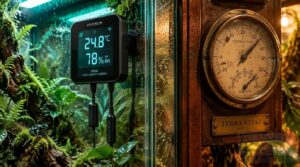
Digital units give you instant readouts and min/max logs; analog gauges just sit there, needing no battery and no firmware to fail. That tradeoff defines your choice.
Should you need hard numbers, weigh these four points:
- Digital sensors generally hold ±1.0°C and ±5–10% RH; analog units rarely publish specs.
- Analog drift is unpredictable, so schedule manual offset checks against a calibrated reference.
- Digital models support hygrometer drift correction and auto-calibration; analog offers no such feature.
- Analog gauges survive power interruptions and electronics failure better than digital ones.
Thermometer accuracy testing should be part of your purchase research, and Digital and Analog Reviews often expose real-world gaps manufacturers hide. If you monitor a snake enclosure long-term, digital wins on data; if you want simplicity, analog suffices.
Where to Place Terrarium Sensors
A sensor in the wrong spot lies to you. Placement determines whether your readings reflect your reptile’s reality or a statistical fiction.
A sensor in the wrong spot doesn’t monitor your reptile—it lies to you
Mount one probe 1.5–2.5 inches from the ceiling to catch hot-spot tendencies, and a second 6–8 inches above substrate for mid-level ambient enclosure monitoring. Keep every probe 1–2 inches above substrate; direct contact skews readings toward surface temperature, not air temperature.
Map your thermal gradient with dedicated sensors per zone: warm hide, cool hide, and open display. Should you need humidity data, position the hygrometer 1–3 inches above substrate, away from spray zones and wet moss, or you’ll chase phantom spikes.
Use silicone-mounted, water-resistant probes with IP-rated housings. Label each placement with its zone name and target range. Should you need to verify accuracy later, that label becomes your calibration reference.
Choosing The Right Monitor for Snakes
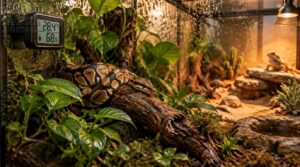
Snakes vary widely in their humidity needs, from ball pythons requiring moderate levels to bearded dragons preferring arid conditions.
Should you want reliable readings, your monitor must meet accuracy standards of ±1°F and ±5% RH.
Below you’ll find five selection criteria that narrow your options quickly.
Match Species Requirements
Your snake’s biology dictates your gauge settings. A ball python breeding female needs 50–70% humidity, while a king snake thrives at 40–50%.
Desert and tropical environments demand different targets, so program your monitoring accordingly. Humidity-dependent species care fails when you guess.
Match your thermometer hygrometer’s readings to species-specific thermal ranges, then verify every zone before introducing your animal.
Prioritize Sensor Accuracy
Once you’ve set species targets, your readings must be trustworthy. An accurate humidity reading prevents guesswork.
Verify sensor accuracy with a two-point check: distilled water at 20°C and 30°C anchors. Expect ±0.5°C and ±5% RH from budget units; higher-end probes hold ±0.25°C and ±2% RH.
Perform sensor calibration weekly, cross-check quarterly against a handheld meter, and replace probes every 12–24 months.
Monitor Enclosure Gradients
Accurate readings only matter when you’re tracking the full gradient, not one spot. A reptile thermal gradient setup needs probes at basking height and the cool end to capture the 4-6°C spread.
Position an External Temperature Probe at basking level for basking zone temperature verification, log via enclosure data logging every 5-10 minutes, and cross-check against reptile thermostat verification weekly.
Choose Durable Probes
Tracking gradients exposes probes to constant moisture, so probe material matters. Choose reptile hygrometers with IP67-rated stainless steel housings and waterproof, epoxy-sealed cable entry points to prevent ingress.
For reptile enclosure equipment that lasts, you’ll want Teflon-coated sensors to resist mineral buildup. Extend probe durability by replacing units showing corrosion or dull tips within 6-12 months in high-humidity tropical enclosures.
Compare Monitor Types
Once you’ve secured durable probes, monitor type determines how you access data. A basic Digital Hygrometer Indoor Thermometer covers single-point relative humidity measurement cheaply, but a thermohygrometer with MAXMIN record lets you catch overnight drops without constant checking.
For multiple enclosures, prioritize units with Bluetooth app history to log trends remotely and spot calibration drift before it harms your animals. Models like the Govee or Inkbird series make solid Bluetooth reptile hygrometers with app logging that alert you to humidity swings before your animals even notice them.
Frequently Asked Questions (FAQs)
What is the best hygrometer for a terrarium?
The KJCOOSWI 4-Pack tops the list of terrarium hygrometers. You get dual probes with ±2-3% humidity accuracy and suction-cup mounts, covering all your reptile habitat monitoring needs across multiple distinct enclosure microclimates without extra cost.
Where to place a hygrometer in a terrarium?
A hygrometer is your vivarium’s compass, and placement determines whether it points true. Mount it 2–3 inches above substrate, mid-wall, away from water bowls and basking spots, with clear airflow for reliable relative humidity readings.
Which digital hygrometer is the most accurate?
Placement skews readings by 15–25% RH, so your sensor matters more than you’d think. The Govee H5075 leads on precision: its Swiss capacitive sensor holds ±3% RH humidity accuracy, plus in-app calibration options. Should you need tighter control, choose it over ±5% REPTI ZOO units.
What is the most accurate hygrometer for reptiles?
Funny how the priciest gauge rarely wins. Calibration-grade hygrometers hit ±2–3% RH, but consumer units reach ±5%. For practical reptile health monitoring, pick a digital model with ±3% accuracy, temperature compensation, and periodic humidity sensor calibration.
How do you calibrate a digital hygrometer?
Should you need accurate readings for reptile health monitoring, calibrate your digital hygrometer using saturated salt solutions. Seal it over sodium chloride for six hours; it should stabilize near 3% RH. Adjust accordingly, repeating every three to six months.
How long do digital terrarium sensors typically last?
Consider a keeper running a KJCOOSWI mini sensor in a ball python tub: expect 6–12 months of battery life, shrinking to 6–9 with 5–10 minute logging. Should you need longer durability, choose replaceable batteries and recalibrate annually.
Can terrarium monitors integrate with smart home systems?
Want your terrarium readings on your phone? Yes, if you pick Wi‑Fi or Bluetooth models. Should you need smart home pet monitoring, verify Matter or Alexa support; otherwise use Bluetooth app history and IFTTT for remote monitoring.
What causes sudden inaccurate readings in digital hygrometers?
Why does your humidity gauge jump without warning? Sudden warm-up shifts calibration, battery voltage drops cause erratic output, condensation on the sensor head, rapid ambient swings, and in-app calibration offsets all trigger inaccurate digital hygrometers’ readings.
Do digital thermometer hygrometers work for planted terrariums?
Yes, digital hygrometer indoor thermometer units work well in planted terrariums. Should you need precise control, verify humidity accuracy within ±5% RH, mount probes near plants, and calibrate monthly for reliable vivarium readings.
Conclusion
A keeper once lost a $400 ball python to a heat spike that a single dial gauge never registered. That’s the real cost of guesswork.
Digital thermometers hygrometers for terrariums cost less than one vet visit, yet they catch problems dial gauges miss entirely. Should you invest in multi-probe coverage, verify readings against a known reference, and log your gradients weekly, your animals get what they can’t ask for: consistency. Measure first, then trust your setup.