This site is supported by our readers. We may earn a commission, at no cost to you, if you purchase through links.

Your snake just kept a pinky down. Next week, you hand it a hopper because the little guy looks hungry. Two days later, you’re scrubbing regurgitated mouse off the substrate.
One wrong guess about prey size turns a routine feeding into a stressed snake, a lost meal, and a 14-day wait before you can try again. Matching feeder size to snake girth removes the guesswork. The rule is simple: prey should be 1 to 1.5 times the width of your snake’s thickest point.
Grab a ruler and your snake’s current weight. Here’s how to measure, compare, and adjust before the next meal.
Table Of Contents
- Key Takeaways
- Measure Your Snake’s Widest Body Width
- Compare Feeder Width With Snake Girth
- Cross-Check Feeder Size Against Weight and Species
- Choose Between Pinkies, Fuzzies, Mice, and Rats
- Monitor Feeding and Digestion for Sizing Problems
- Know When to Increase Feeder Size
- Frequently Asked Questions (FAQs)
- How do I know what size food to feed my snake?
- What snake is worth $100,000?
- How old is a 25 inch corn snake?
- Do snakes remember who feeds them?
- How long should I wait before handling my snake after feeding?
- What should I do if my snake refuses food?
- Is it safe to feed live prey instead of frozen?
- How often should I feed my snake each week?
- Conclusion
Key Takeaways
- Measure your snake’s thickest point and keep prey width between 1 and 1.5 times that girth, because anything bigger risks regurgitation and a 14-day wait.
- Check that size against your snake’s weight and life stage, moving from pinkies to fuzzies, hoppers, then adult mice or rats as it grows.
- Watch every meal for warning signs like undigested prey, a lingering bulge, or weight loss, and don’t handle your snake for at least 48 hours after feeding.
- Step up just one feeder size at a time, and only when meals are swallowed easily, the bulge barely shows, and the girth-to-prey ratio has dropped below your target.
Measure Your Snake’s Widest Body Width
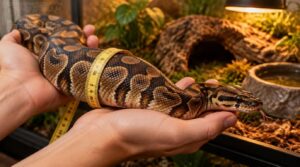
Your whole feeding plan starts with one number, so get it right. Two points below will show you how to measure correctly and keep your snake calm while you do it. Work through them in order, and you’ll pick prey with confidence.
Once you have that measurement, this corn snake food size guide shows which prey size matches your snake’s width at every growth stage.
Body Width Versus Circumference
Why does width matter more than circumference? Because midbody girth is what your feeder must pass through. Apply the girth-to-prey ratio, then verify:
- Measure midbody girth.
- Match feeder rodent sizing to it.
- Follow the prey width guideline: 1 to 1.25 times.
- Check the body weight percentage rule.
- Choose smaller when you’re unsure.
Don’t guess. Precision always keeps your snake safe. A properly sized meal should leave only a slight lump that fades within a day or two, and feeder mouse size categories range from pinkies at 1–3g up to XL adults at 30g+.
Measuring Without Stressing Your Snake
Precision shouldn’t stress your snake. Skip the tape and handling. Snap a top-down photo of the midbody girth with a ruler beside it, then measure the image. Shed skin works too. Lay it flat and measure its widest point. For flattened shed skin, a digital caliper ruler gives you a quick, accurate width reading without ever touching your snake.
Once you have a reliable girth measurement, use it to plan roomier, species-appropriate housing with this custom snake enclosure build guide.
Record every number in your feeding logs. Consistent growth monitoring shows when prey width needs adjusting, and it protects feeding safety.
Compare Feeder Width With Snake Girth
You’ve got your snake’s girth number. Now put it to work.
Hold the feeder up against that measurement. Apply the girth rule: prey width should match the widest part of your snake’s body, and it shouldn’t run past 1.5 times that girth. That’s your prey width guideline, and it protects feeding safety.
Check the prey-to-snake ratio every time. A ratio of 1 to 1.5 is your safe range. Go above it and you’re inviting regurgitation and digestion trouble.
Run the girth-to-prey ratio from the other side too. If your snake is 2 inches wide and the mouse measures 3.5, stop. Pick a smaller one. Measure the feeder at its thickest point, usually the midsection, not the head. Don’t just eyeball it, ever.
Cross-Check Feeder Size Against Weight and Species

Girth tells you the maximum size, but weight and species confirm it. You’re about to check your feeder against body weight and life stage, because hatchlings, juveniles, and adults each need a different target. Work through the two points below and you’ll lock in a size that’s safe, correct, and fully under your control.
If you’re unsure where your snake falls, this age-appropriate snake prey size guide shows how to match each meal to your snake’s life stage.
Hatchling and Juvenile Feeding Needs
A hatchling’s body is no wider than a pencil, so one oversized pinky can turn a first meal into a regurgitated mess.
Start with the girth rule: prey width should match your snake’s widest point. Offer pinkies to hatchling snakes, then move juvenile snakes to fuzzies or hoppers. Follow prey sizing guidelines, but let the lump decide. Visible and gone within a day? You’re right.
Adult Size and Body Condition
You can’t judge an adult by girth alone. Apply the girth rule first, then check body condition. A healthy snake shows firm muscle, no sharp spine ridge, no fat folds near the tail base.
Adult ball pythons at 1200g and up usually handle medium rats, 80 to 149g. Weigh your snake, adjust prey size, and keep your feeding schedule consistent.
Choose Between Pinkies, Fuzzies, Mice, and Rats

The right feeder category depends on your snake’s stage, so match it deliberately. Prey size selection starts with the animal in front of you, not the label on the bag.
Here’s your quick reference:
- Pinkies: hatchling snakes, roughly 1-3g.
- Fuzzies: young juvenile snakes, roughly 3-6g.
- Hoppers: growing juvenile snakes, roughly 6-12g.
- Adult mice and rats: mature snakes, 15-30g mice, then rats.
Corn snakes usually graduate to adult mice and stay there for life. Ball pythons can’t. Adult mice run too small for them long-term, so plan your move to rats early.
Once your snake controls XL adult mice comfortably, switch to a small rat. One rat feeds better than several mice. Keep your feeding schedule steady and use weight tracking.
Monitor Feeding and Digestion for Sizing Problems

Imagine this: you feed your ball python a rat that looked fine, then find it on the substrate two days later, barely changed. That’s regurgitation, and it’s your cue to recheck feeder size.
Watch every meal. Prey width beyond your snakes girth means discomfort, slow digestion, and higher regurgitation risks. Keep the warm end accurate with a probe thermometer, and don’t handle for 48 hours.
| Sign | Meaning | Action |
|---|---|---|
| Undigested prey, no odor | Too large | Wait 14 days |
| Prey stuck for hours | Impaction | Call a vet |
| Cool enclosure | Poor digestion | Verify temperatures |
| Weight dropping | Underfeeding | Track weekly |
Log weight tracking numbers weekly. After a regurgitation, offer probiotics and electrolytes, then feed a smaller item once 14 days pass. Always stay consistent.
Know When to Increase Feeder Size

Say your ball python, Juno, has been taking small adult mice for months. Last week she swallowed one in seconds, the bulge barely showed, and she’s striking at the tongs again within four days. That’s your signal.
Don’t guess. Run prey size monitoring every feeding. Track weight, measure girth, and watch the feeding response. Quick, keen, uneventful meals mean the meal is too small.
Check three things. Is her growth trajectory flat or climbing? Does the girth-to-prey ratio fall below your target? Is her feeding frequency holding steady without weight gain?
If two answers say yes, step up one size. Just one. Then watch digestion closely. Bigger isn’t better, control is. Regurgitation means you moved too fast. Drop back immediately.
Step up just one feeder size at a time, because bigger isn’t better, control is, and regurgitation means you moved too fast
Frequently Asked Questions (FAQs)
How do I know what size food to feed my snake?
Your snake swallows entire animals, yet prey measurement trips you up. Match feeder size to girth: prey width should equal, never exceed, 5 times your snake’s thickest point. Prey size selection follows the girthtoprey ratio.
What snake is worth $100,000?
A rare gem shines until everyone owns one.
Your $100,000 snake is a brand-new ball python morph, like the Ivory. Strong body condition and steady feeding response help breeders multiply it, then prices fall quickly.
How old is a 25 inch corn snake?
Your snake’s tape measure says 25 inches, so naturally it’s a mystery. It isn’t. That’s a juvenile corn snake, roughly 6 to 12 months old.
Check body weight, 60 to 90 grams, then log it.
Do snakes remember who feeds them?
Think your snake knows you by face? It doesn’t. It reads your scent, and scent recognition shapes its feeding response.
Keep feeding frequency steady, match prey width to body weight, and stick to husbandry practices.
How long should I wait before handling my snake after feeding?
Wait 48 to 72 hours before handling your snake. Check for a visible bulge first. If it’s still there, digestion’s active, and handling risks regurgitation. Large constrictors need 72 to 96 hours. Don’t rush it.
What should I do if my snake refuses food?
Your snake won’t starve overnight. Treat feeding refusal as a husbandry check first. Try a prey type comparison, warm the prey, and wait a week. Use growth monitoring, feeding response consistency, and feeding schedule adjustment.
Is it safe to feed live prey instead of frozen?
No, live prey isn’t safe. Rodents bite, scratch, and carry parasites, so frozen-thawed prey wins on feeding safety every time. If your snake shows feeding refusal, try pre-killed prey first, and never leave live prey unattended.
How often should I feed my snake each week?
Weekly feeding isn’t for every snake. Your feeding frequency depends on age: hatchlings eat every 5-7 days, adults every 2-4 weeks.
Follow meal frequency recommendations by weight, and make feeding interval adjustment when refusals persist.
Conclusion
Think a ruler is overkill for a snake that already eats well? One oversized meal says otherwise. Matching feeder size to snake girth takes two minutes and protects every meal that follows.
Measure the thickest point, aim for 1 to 1.5 times that width, and check the number against your snake’s weight. Watch for regurgitation, slow digestion, or leftover prey. Those signals tell you when to adjust. Measure first, feed second, and stay in control.