This site is supported by our readers. We may earn a commission, at no cost to you, if you purchase through links.

A boa constrictor can live 25 years or more, which means the enclosure you build today shapes the next quarter century of its life.
Get the heat gradient, humidity, and feeding routine right, and you’ll have a calm, thriving snake that eats on schedule and tolerates handling without a fuss. Get them wrong, and you’ll see mouth breathing, refused meals, and stuck sheds within months.
Knowing how to care for a boa constrictor comes down to a handful of repeatable habits, and this guide walks you through each one, from tank dimensions to your first handling session.
Table Of Contents
- Key Takeaways
- What Does Caring for a Boa Constrictor Involve?
- How Do You Set Up a Boa Constrictor Enclosure?
- How Do You Feed a Boa Constrictor Safely?
- How Do You Handle a Boa Constrictor and Build Trust?
- How Do You Manage Shedding and Keep Your Boa Healthy?
- Frequently Asked Questions (FAQs)
- Are boa constrictors hard to care for?
- Is a boa a beginner snake?
- What to do if a boa is constricting you?
- How big should a 3 year old boa be?
- How do you care for a boa constrictor?
- How do you tame a boa constrictor?
- Are boa constrictors healthy?
- Do boa constrictors need a bath?
- Do boa constrictors need water for drinking?
- What are boa constrictors?
- Conclusion
Key Takeaways
- Boa constrictors live 20–30 years, so your enclosure is a long-term commitment: adults need at least 48×24 inches of floor space with 18–24 inches of vertical room, hides at both ends, and safe, spot-cleanable substrate.
- Nail the climate—a basking spot of 88–92°F, a cool end of 78–82°F, nighttime drops to 70–75°F, and 40–60% humidity (raised to 75–85% during sheds)—and use a reliable digital hygrometer, since cheap stick-on gauges often read wrong.
- Feed frozen-thawed prey no wider than your boa’s thickest body point, warmed to about 100°F and offered with tongs during evening hours, then wait 48 hours after meals before handling and skip feeding during shed cycles.
- Build trust through short, consistent handling sessions—approach from the side, support the full body, and stop if you see thrashing—while watching for red flags like mouth breathing, wheezing, or stuck sheds that warrant a vet visit.
What Does Caring for a Boa Constrictor Involve?
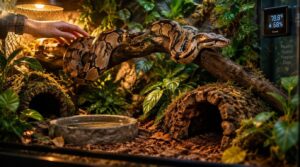
Caring for a boa constrictor means committing to a routine that spans decades, since these snakes can live 20 to 30 years in captivity. You’ll manage a stage-appropriate feeding schedule, offering whole prey sized to your boa’s girth, less often for adults than fast-growing juveniles.
Prey size ties directly to how large your snake will get, so it’s worth checking the average size of a boa constrictor before planning meals.
Caring for a boa constrictor means committing to a stage-appropriate feeding routine that spans decades
Your daily work centers on hydration and observation. Provide clean standing water for drinking and soaking, and change it regularly, because dirty water raises pathogen risk. Watch appetite, weight, activity, and stool consistency; these baseline checks catch problems early. Persistent mouth breathing, mucus, or wheezing signals respiratory trouble that needs a vet, not guesswork.
You’ll also reduce stress with hides and predictable handling, keep heat sources guarded, and avoid ingestible substrate. After meals, give your boa a rest period before touching it. Consistency is your best diagnostic tool.
How Do You Set Up a Boa Constrictor Enclosure?
Getting the enclosure right is the single most important thing you’ll do for your boa’s long-term health. A properly set up habitat covers two big areas: the tank itself and the climate inside it. Let’s break down exactly what you need, starting with size and furnishings, then heat, humidity, and lighting.
Enclosure Size and Furnishings
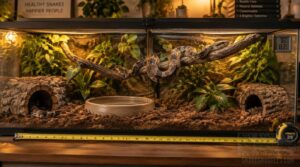
Two numbers matter most here: your adult boa needs a minimum floor space of 48×24 inches, plus 18–24 inches of vertical room for climbing and coiling. Juveniles do fine in something smaller, roughly 1.5–2× their body length. A 48×24 reptile enclosure hits those adult dimensions nicely while leaving room for secure locks and easy cleaning.
If you’re weighing similar setups for other species, this bull snake care sheet breaks down comparable space requirements in detail.
Substrate selection is next. Choose a reptile-safe material that allows digging yet lets you spot waste easily during daily checks. Aspen bedding is a popular pick here, since this reptile substrate aspen bedding burrows well and makes waste easy to spot.
Then furnish it: hide boxes at opposite ends, fixed non-slip branches, and a wide, shallow water dish you’ll refresh daily. Position hides so your snake can retreat from view, and keep doors secure, easy to clean, and free of sharp edges.
A sturdy reptile hide box gives your boa a secure retreat on both the warm and cool ends of the enclosure.
Heat, Humidity, and Lighting
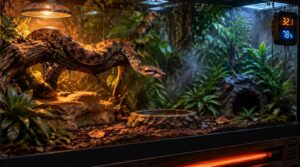
Now let’s dial in the climate. Your temperature gradient matters most:
- Basking hotspot: 88–92°F
- Cool end: 78–82°F
- Nighttime: 70–75°F
Use a basking lamp overhead, adding an undertank heater if the warm side struggles. Humidity control means 40–60%, monitored with a hygrometer and boosted lightly during sheds. UVB lighting is optional; shade hides you’ve already placed so eyes stay comfortable.
For more inspiration on laying out hides, heat zones, and decor, browse these corn snake habitat ideas.
How Do You Feed a Boa Constrictor Safely?

Once your enclosure’s climate is dialed in, feeding becomes the next skill to master, and it’s easier than you’d think with a solid feeding protocol.
Follow these five steps:
- Choose the right prey size, roughly matching your boa’s girth, never wider than the thickest part of its body.
- Offer frozen-thawed prey, warmed to about 100°F so it smells and feels like a live meal.
- Present it with feeding tongs, keeping your hands well clear of the strike zone.
- Feed in the enclosure (a separate feeding tank is optional) during evening hours when your boa’s naturally active.
- Leave it alone until swallowing is complete.
Skip meals during a shed cycle, and if regurgitation happens, wait at least a week before trying again. Log every feeding; patterns tell you everything.
How Do You Handle a Boa Constrictor and Build Trust?
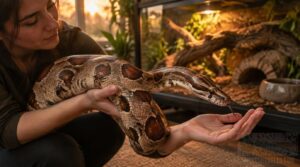
When should you start handling your boa? Give it a week or two to settle in, then begin with short, calm sessions so contact feels predictable rather than surprising.
Trust building works best with a routine: same time of day, same approach, same slow movements. Let your boa tongue-flick your hands and explore before you lift it. Consistent handling a few times weekly beats marathon sessions once a month.
Follow this sequence every time:
- Approach from the side, never from above (that reads as predator).
- Support the body along its length, not just the neck.
- Keep the first sessions under ten minutes.
- Return it calmly if you see thrashing or tight coiling.
Watch behavioral cues: relaxed tongue flicks and slow movement mean you’re doing it right. Skip handling after meals (wait 48 hours) and always separate feeding from handling so your hands don’t smell like prey.
How Do You Manage Shedding and Keep Your Boa Healthy?
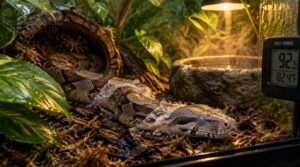
How does your boa’s shedding process actually unfold? Watch for dull skin and cloudy eyes first, then bump your humidity levels to 75-85%. Patchy shed means the air’s too dry, so act early. For accurate readings, rely on a digital hygrometer instead of cheap stick-on gauges, which often display incorrect values.
- Add a humid hide packed with damp sphagnum moss (change it often so mold doesn’t take hold).
- Mix water into your coconut husk or cypress mulch until it’s damp, not muddy.
- Offer a large water bowl under the heat source so your boa can soak at will.
- If shed sticks, give a lukewarm 20-30 minute soak.
Retained eye caps or tail tips can cause infection or constriction, so never peel them yourself. Pair daily hygrometer checks with routine enclosure sanitation, gentle handling tips, and regular health checkups, and you’ll keep your boa thriving.
Frequently Asked Questions (FAQs)
Are boa constrictors hard to care for?
Honestly, no. Boas are beginner-friendly because they’re hardy captives. The real challenge is consistency: maintaining your temperature gradient, humidity levels, and a proper feeding schedule. Steady daily routines beat perfect execution every time.
Is a boa a beginner snake?
You might assume any snake sold in pet stores suits novices, but that’s misleading. Boas aren’t beginner snakes; they’re large, long-lived, and powerful. Most herpetologists recommend starting with smaller species or supervised care first.
What to do if a boa is constricting you?
A boa’s grip works like a coiled spring, so don’t wrestle it. Unwrap from the tail, working forward, keeping your airway clear. Call for help if you can’t separate safely. Stay calm.
How big should a 3 year old boa be?
At 3 years, expect 4–6 feet overall, with males usually smaller than females. Weight usually lands between 600–1,200 grams. Track growth monitoring and body condition scoring, since individual variation can shift these ranges by a foot or 200 grams.
How do you care for a boa constrictor?
Caring for a boa constrictor means a secure, spacious enclosure with a proper temperature gradient, humidity levels near 70%, appropriately sized prey on a consistent feeding schedule, gentle handling, and regular health monitoring.
How do you tame a boa constrictor?
Wondering how a snake learns to trust you? Through habituation: short, calm sessions where you support the body fully, move slowly, and keep a consistent routine. Behavioral observation tells you when to lengthen sessions.
Are boa constrictors healthy?
You may worry snakes are fragile, but boa constrictors are hardy. Keep their enclosure clean, feed appropriately, and watch health indicators like shedding and breathing. Respiratory infections and scale rot respond well to early treatment, so schedule a regular veterinary checkup.
Do boa constrictors need a bath?
No, your boa doesn’t need routine bathing. Water exposure is only for shedding assistance or heavy soiling. Instead, keep humidity levels right, offer a shallow water dish, and stay on top of enclosure cleaning.
Do boa constrictors need water for drinking?
You might think snakes never drink, but they do. Keep a sturdy, tip-proof water dish filled with fresh water always. Your boa also gets hydration from prey and soaks when humidity levels dip, especially during shedding.
What are boa constrictors?
You’ll find the boa constrictor among the largest snakes in the Boidae family, native to Central and South America. These nonvenomous constrictors reach 6–13 feet, are largely nocturnal ambush predators, and, unlike most snakes, are viviparous, giving birth to live young.
Conclusion
Picture a boa draped calmly over your arm, tongue flicking, muscles loose. That’s what good husbandry buys you.
Mastering how to care for a boa constrictor isn’t about memorizing dozens of rules; it’s about nailing a few repeatable ones: the right heat gradient, steady humidity, appropriately sized meals, and patient handling. Check your gauges weekly, keep feeding records, and watch your snake’s body language. Do that, and you’ll share two decades of trust with a genuinely rewarding animal.